


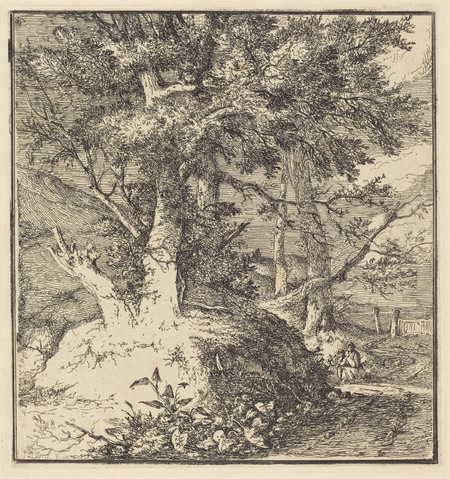

Tree on a Mound, John Chrome, etching, 13 x 12 in. ( 34 x 32 cm), in the collection fo the National Gallery of Art, DC.
English landscape painter John Chrome, who was active in the late 18th and early 19th centuries, evokes a wooded scene with a wonderful selection of straight and wavy lines and textural scribbles, highlighted with areas left blank.
A splash of light emerges from behind the mound on the right, beside which are two figures that appear to me to be a woman and child (images above, bottom).
I particularly enjoy the way Chrome has varied the directrion of hatching on the hillside to the left, adding to the impression of a rolling, uneven surface.
Rabbit Hole Dept: The museum’s website lists the work as “etching on chine applique”. I wasn’t familiar with the term and did a litte digging (trying, as always, to skip the “AI overview” and go to actual source websites).
Chine applique is a printing method for intaglio prints in which the print is made on a thin sheet of paper, originally “China paper”, that is backed by another, thicker sheet. The thin paper takes the impression better, but is delicate unless backed by a stronger sheet.
China paper, I subsequently found out, refers to what was the original version of the modern papermaking process, developed in China in the first or second century AD (Eastern Han period), and is attributed to a court official named Cai Lun (alternately Ts’ai Lun). It consisted of a pulp slurry of mulberry bark, hemp and rags with water, pressed out in a frame and dried.
300 years later, paper making came to the Eastern Medditerranean cultures, gradually replacing papyrus, and didn’t appear in Europe until the 11th century.

