


Categories
- 3d CGI
- Amusements
- Animation
- Anime & Manga
- Art Materials
- Art Videos
- Blogroll
- Cartoons
- Color
- Comics
- Concept & Visual Dev.
- Creativity
- Digital Art
- Digital Painting
- Displaying Art on the Web
- Drawing
- Eye Candy for Today
- Gallery and Museum Art
- High-res Art Images
- Illustration
- Motion Graphics & Flash
- Museums
- Online Museums
- Outsider Art
- Painting
- Painting a Day
- Paleo Art
- Pastel, Conté & Chalk
- Pen & Ink
- Prints and Printmaking
- Reviews
- Sc-fi and Fantasy
- Sculpture & Dimensional
- Site Comments
- Sketching
- Storyboards
- Tools and Techniques
- Uncategorized
- Vector Art
- Videos & Podcasts
- Vision and Optics
- Watercolor and Gouache
- Webcomics
Archives
- September 2026
- August 2026
- July 2026
- June 2026
- May 2026
- April 2026
- March 2026
- February 2026
- January 2026
- December 2025
- November 2025
- October 2025
- September 2025
- August 2025
- July 2025
- June 2025
- May 2025
- January 2025
- December 2024
- November 2024
- October 2024
- September 2024
- August 2024
- June 2024
- April 2024
- March 2024
- February 2024
- January 2024
- December 2023
- November 2023
- October 2023
- September 2023
- August 2023
- July 2023
- May 2023
- April 2023
- March 2023
- February 2023
- January 2023
- December 2022
- November 2022
- September 2022
- August 2022
- July 2022
- June 2022
- May 2022
- April 2022
- March 2022
- February 2022
- January 2022
- December 2021
- November 2021
- October 2021
- September 2021
- August 2021
- July 2021
- June 2021
- May 2021
- April 2021
- March 2021
- February 2021
- January 2021
- December 2020
- November 2020
- October 2020
- September 2020
- August 2020
- July 2020
- June 2020
- May 2020
- April 2020
- March 2020
- February 2020
- January 2020
- December 2019
- November 2019
- October 2019
- September 2019
- August 2019
- July 2019
- June 2019
- May 2019
- April 2019
- March 2019
- February 2019
- January 2019
- December 2018
- November 2018
- October 2018
- September 2018
- August 2018
- July 2018
- June 2018
- May 2018
- April 2018
- March 2018
- February 2018
- January 2018
- December 2017
- November 2017
- October 2017
- September 2017
- August 2017
- July 2017
- June 2017
- May 2017
- April 2017
- March 2017
- February 2017
- January 2017
- December 2016
- November 2016
- October 2016
- September 2016
- August 2016
- July 2016
- June 2016
- May 2016
- April 2016
- March 2016
- February 2016
- January 2016
- December 2015
- November 2015
- October 2015
- September 2015
- August 2015
- July 2015
- June 2015
- May 2015
- April 2015
- March 2015
- February 2015
- January 2015
- December 2014
- November 2014
- October 2014
- September 2014
- August 2014
- July 2014
- June 2014
- May 2014
- April 2014
- March 2014
- February 2014
- January 2014
- December 2013
- November 2013
- October 2013
- September 2013
- August 2013
- July 2013
- June 2013
- May 2013
- April 2013
- March 2013
- February 2013
- January 2013
- December 2012
- November 2012
- October 2012
- September 2012
- August 2012
- July 2012
- June 2012
- May 2012
- April 2012
- March 2012
- February 2012
- January 2012
- December 2011
- November 2011
- October 2011
- September 2011
- August 2011
- July 2011
- June 2011
- May 2011
- April 2011
- March 2011
- February 2011
- January 2011
- December 2010
- November 2010
- October 2010
- September 2010
- August 2010
- July 2010
- June 2010
- May 2010
- April 2010
- March 2010
- February 2010
- January 2010
- December 2009
- November 2009
- October 2009
- September 2009
- August 2009
- July 2009
- June 2009
- May 2009
- April 2009
- March 2009
- February 2009
- January 2009
- December 2008
- November 2008
- October 2008
- September 2008
- August 2008
- July 2008
- June 2008
- May 2008
- April 2008
- March 2008
- February 2008
- January 2008
- December 2007
- November 2007
- October 2007
- September 2007
- August 2007
- July 2007
- June 2007
- May 2007
- April 2007
- March 2007
- February 2007
- January 2007
- December 2006
- November 2006
- October 2006
- September 2006
- August 2006
- July 2006
- June 2006
- May 2006
- April 2006
- March 2006
- February 2006
- January 2006
- December 2005
- November 2005
- October 2005
- September 2005
- August 2005
Relevant Blogs
Art, Painting & Sketch
- Gurney Journey
- Underpaintings
- Art and Influence
- Painting Perceptions
- Oil Painters of America
- Vasari Paint POV
- Flying Fox
- Urban Sketchers
- Bento (Smithsonian)
- Art Inconnu
- The Hidden Place
- Still Life
- Making a Mark
- The Art of the Landscape
- Exploring Color & Creativity
- Art Contrarian
- Artist A Day
- beinArt Surreal Art Collective
- Eye Level
- David Dunlop
- p.i.g.m.e.n.t.i.u.m
- CultureGrrl
- Joaquín Sorolla blog
- Artists in Pastel
“Painting a Day”
- A Painting a Day (Keiser)
- On Painting (Keiser)
- Julian Merrow-Smith
- Karen Jurick
- Jeffrey Hayes
- Carol Marine
- Abbey Ryan
- Daily Paintworks
Other Painting Blogs
- Virtual Gouache Land
- Neil Hollingsworth
- Marc Hanson
- Kevin Menck
- Marc Dalessio
- Larry Seiler
- Stapleton Kearns
- Colin Page
- Roos Schuring
- Hans Versfelt
- Titus Meeuws
- Régis Pettinari
- René Plein Air
- Belinda Del Pesco
- Robin Weiss
- Nathan Fowkes (Land Sketch)
- William Wray
- Frank Serrano
- Stephen Magsig
- Michael Chesley Johnson
- Twice a Week
- Sarah Wimperis
- Rob Adams
- Michael Cole Manley
- The Dirty Palette Club
- Mike Manley’s Draw!
Gallery Art & Illustration mix
Illustration
- Howard Pyle
- 100 Years of Illustration
- BibliOdyssey
- Illustration Art
- Today’s Inspiration
- Illustration Mundo
- Little Chimp Society
- Danny Gregory
- R D (John Martz
- Illustration Friday blog
- Monster Brains
- Illustrators & Illustrations (RU)
- Elwood H. Smith
- DaniDraws.com
- Designers Who Blog
- iSpot Blog
Sci-Fi & Fantasy
Illustration & Comics
Comics & Cartoons
- Comics Beat
- Robot 6
- Newsarama Blog
- Comic Vine
- Comics Alliance
- Forbidden Planet Int.
- Paolo Rivera
- Bolt City
- Flight
- Scott McCloud
- The Comics Journal
- Comixpedia
- Funnybook Babylon
- James Baker
- Middleton’s Sketchbook
- Boneville
- The Hotel Fred
- Paul Rivoche
- Daily Cartoonist
- Mad About Cartoons (William Wray)
- Digital Strips
Illustration & Concept
Animation & Concept
- Cartoon Brew
- Animation Blog
- Cold Hard Flash
- Concept Art World
- The CAB
- FY Concept Art
- Concept Ships
- Concept Robots
- John Nevarez
- Armand Serrano
- Marcos Mateu-Mestre
- all kinds of stuff (Kricfalusi)
- Yacin the faun (Man Arenas)
- Kelsey Mann
- Cre8tivemarks Blog
- Ice-Cream Monster Toon Cafe
- AAU Character & Creature Design
- AAU Animation Notes
- Articles and Texticles
Paleo & Scientific
Tools & Techniques
Other
Lists of Art Blogs
Art Image Resource Links
Historic Art Images
- Wikimedia Commons: Paintings
- Wikimedia Commons: Drawings
- The Athenaeum
- WikiArt (WikiPaintings)
- Google Art Project: Artists
- Google Art Project: Collections (Museums)
- ArtCyclopedia
- Web Gallery of Art
- Art Renewal Center
- Web Gallery of Impressionism
Auction Consolidation sites
Auction sites
- Sotheby’s
- Bonham’s
- Christies
- Heritage Auctions: Fine Art
- Heritage Auctions: Illustration
- Freeman’s Auctions
- Bukowskis
- Shannon’s
Image Search
Reverse Image Search (search by image)
- Tin Eye
- RevImg
- Google Image Search (camera icon)
- Bing Image Search (camera icon)
Promoting some friends and some clients of my website design business
- Twin Willows T’ai Chi studio in Wilmington DE. Taiji classes with Bryan Davis.
- Ray Hayward, Inspired Teacher of T’ai Chi ( Taiji ) in Minneapolis, Founder of Mindful Motion Tai Chi Academy
- OldHead Tattoo studio and Art Gallery in Wilmington DE. Tattoos and paintings by Bruce Gulick
- Sharon Domenico Art, pet portrait oil paintings
- Platinum Paperhanging, wallpaper hanging, Main Line and Philadelphia, PA
- Lisa Stone Design, interior designer, Main Line and Philadelphia, PA
- Studio12KPT, original art, prints, calendars and other custom printed items by Van Sickle & Rolleri
-
Happy Leyendecker Baby New Year!
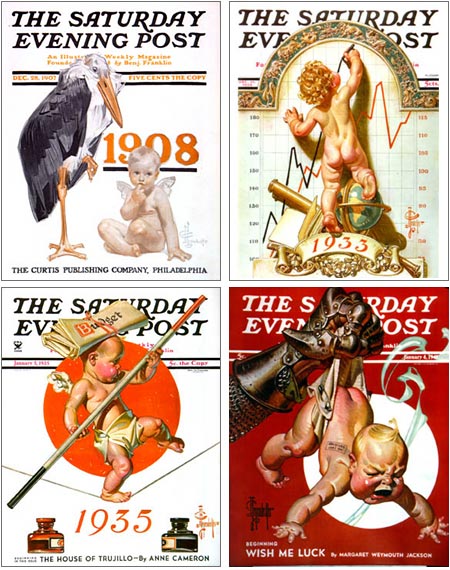
There are traditions that seem as though they’ve always been in place. Some of them have origins that are obscured by time, but others can be assigned to a particular time and person. The tradition of representing the new year with the image of a baby is one of the latter.In addition to helping codify the modern image of Santa Claus (see my recent post on Illustrators’ Visions of Santa Claus), the great Golden Age illustrator J.C. Leyendecker originated the idea of using a baby to symbolize the birth of the new year.
Starting with a Saturday Evening Post cover in 1906 for which he painted a winged cherub that was close to the idea, he began using an actual baby in the December, 1907 issue to welcome in 1908; and continued to represent the coming year that way on New Year’s covers of the Post into the 1940’s.
Leyendecker was the Post’s major artist in the first half of the 20th Century, and was routinely given the assignments for the important major holiday issues. It was only years later that Norman Rockwell, who considered Leyendecker his artistic ideal, began to take on those duties. (See my previous post on J. C. Leyendecker.)
Curtis Publishing, publishers of The Saturday Evening Post, provide a nice archive of their covers, often arranged by artist or subject, including a two page gallery of Leyendecker New Year’s Baby covers. (The images are linked to larger versions. It’s easy to miss the link to the second page at the bottom of the first.)
It’s a treat to look through them, not only as great illustration, but as a fascinating chronicle of 20th Century history. Leyendecker would play with the idea of the New Year’s Baby to conceptualize the political, social and economic concerns of the day, be it stock market worries, balanced budgets or the looming shadow of war.
Categories:
-
Annibale Carracci’s Book of Portraiture (?)

I have to admit I’m not quite sure what this is. I came across it from a link somewhere (and have unfortunately forgotten the connection), and bookmarked it under “cool drawing resource”.Carracci was a 16th Century Italian master renowned for his beautiful frescos and paintings, and credited with inventing caricature in the modern sense. It is his drawings I have always noticed, though; they stand out even among other great masters of the time.
The pieces on this site are from a book that looks like it may be a drawing manual based on Carracci’s drawings, featuring both light outline drawings and finished renderings, presumably by a later French artist, of faces, facial features, hands, feet and other items related to drawing people.
Though not as beautiful as Carracci’s delicate and subtle drawings in red chalk, these engravings are particularly interesting for the contrast between the lightly rendered and fully rendered versions, and the instructive array of eyes, ears, mouths and other features. It should be as useful to artists today as it was 400 years ago.
Categories:
-
Andy’s Early Comics Archive
 OK, I’m going to divide you into two groups for this tour.
Those of you who think you don’t like comics (possibly because you associate them with bland newspaper strips and endless arrays of costumed superheroes), please get on the bus labeled “Quick Tour”. You should at least take a peak at this, even if just out of curiosity. You may find that your image of comics is unnecessarily limited and discover some wonderful visual art you’ve been missing out on.
I will suggest those of you who love comics, but limit your appreciation for them to modern superhero comics, join the first group on the “Quick Tour” bus.
In the other group are those of you who love comics and revel in the wide spectrum of accomplishment in this amazing and unbounded art form, along with those who are simply adventurous in terms of your appreciation for visual art.
I will ask those of you in this group to pack a lunch, sign a waiver releasing me from responsibility for exposing you to a major time sink, and get on the bus labeled “Magical Mystery Tour”.
Both groups may find their eyes opened about what “comics” are, have been or can be, and may allow themselves to be dazzled with some of the oldest, weirdest, and finest examples of this wonderful medium.
Andy Konky Kru (Andy Bleck) has compiled an amazing archive of “early comics”, hosted on the site of Bugpowder, a collaborative weblog devoted to the UK independent comics community.
If, like me, you think of “early comics” as being the wonderful work from the late 19th and early 20th Centuries, you will be amazed and delighted to find that Andy’s collection begins in 300 A.D., and includes examples of “comics” (which has been defined as images in sequence, often combined with words, that tell a story) from the dusty centuries of the dark ages, the flowering of the Renaissance, through the 18th and early 19th centuries and up to the early 20th. He leaves off at around 1929.
For those of you on the Quick Tour, don’t miss the transcendently amazing work of Winsor McCay (see my previous post), George Herriman (and here), and Cliff Sterrett .
You might also want to check out modernist artist Lyonel Feininger and wonderful oddities like Gustav Verbeek and Hubert Crowley.
Those of you on the “Magical Mystery Tour” will find prime examples of favorites as describe above, the expected landmarks like Wihelm Busch, Rudolph Dirks, Frederick Opper, Richard Outcault, Frank King and others, but you may also encounter surprise treasures like Harry Grant Dart.
Aficionados of the great illustrators will find unexpected examples of “graphic stories” by such luminaries as Howard Pyle, Gustav Dore, Augustus Egg, Heath Robinson (and here), A. B. Frost, John Held Jr., Ernest Shepard and John Tenniel.
Wow.
There is a handy chronological index at the top of the pages. The index page has a more descriptive listing of the periods.
My only complaint is that, in what I assume is an effort to make them easier to read on web pages, Andy has taken the liberty of rearranging the panel layout of many of these comics and placing them in vertical stacks, sometimes missing their titles. I would much rather scroll around if necessary to see them in their original layout, but this is a minor quibble and pales in the light of what a tremendous service he is providing with this archive. Here’s an opportunity to see these gems on the web, large enough to be close to their original size in early newspapers and book printings, and you can search them out in their original form elsewhere once you find yourself fascinated.
While the archive isn’t complete, and is weak in some areas (E.C. Segar for example), I assume this is a work in progress; and on the whole, Andy has picked superb examples of these artist’s works. It’s an amazing resource and an absolute delight.
(Images above, top to bottom: Winsor McCay, George Herriman, Cliff Sterrett, Harry Grant Dart, Heath Robinson.)
Andy has also provided articles on speech balloons in cartoons and comics and an index of comics without words in his archive. He also provides listings of books with reprints of early comics and over 500 links to comics resources.
If that weren’t enough, Andy’s own paintings, drawings and travel sketches (and here) are quite nice and worthy of a visit on their own.
Whew! I’m glad I had you sign those time sink waivers.
Categories:
-
Simon Rodgers
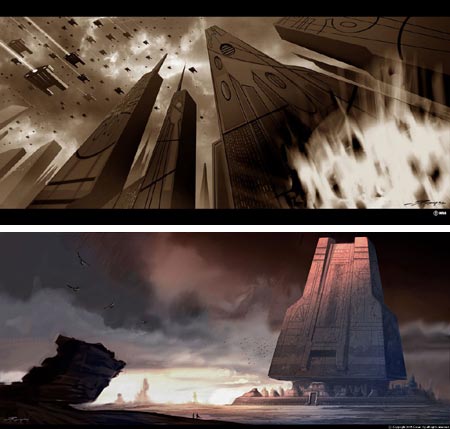
Simon Rodgers is a concept artist for the film industry. Aside from that I know very little about him.I know from a mention on John Nevarez’ blog that he worked with Nevarez on Disney’s Tarzan project. (See my post from last year on John Nevarez.)
Rodgers’ blog features mostly quick (but wonderfully realized) studies and concept sketches for personal projects, speed paintings and other work done primarily for fun or exercise. There are occasional concept illustrations, though, for an unspecified “Conan project” (image above, bottom) that looks fascinating from the scale and imagination conveyed in his images.
There are also hints of several personal projects of his, including a children’s book, that I hope see completion, just because the concept illos look so cool.
Maybe Rodgers will eventually add a little bio to his blog, so we know more about who he is and what’s he’s worked on, but in the meanwhile he’s giving us some tasty eye candy.
Link via ArtDojo
Categories:
-
Frederick Catherwood
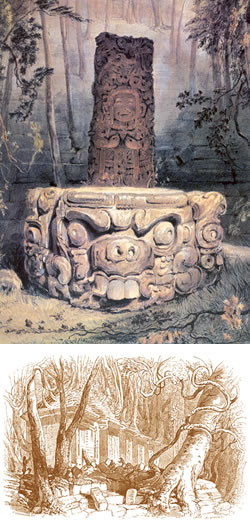 If Indiana Jones had been equipped with a sketchbook and watercolor kit instead of his famous whip, he might have been Frederick Catherwood.
Catherwood was an English architect and artist who traveled to Central America in the mid-1800’s with a writer named John Lloyd Stephens to create a book on the ancient Mayan ruins, which had been previously documented, but not in detail.
They were astonished by the ruins of of the Mayan’s monumental structures, and did their best to convey that astonishment in their book.
Catherwood produced numerous drawings and watercolors on the spot, often with the aid of a camera lucidia. (A camera lucidia is an optical device, predating photography, which projects a scene against a piece of glass, making it easier for an artist to compose a scene and see it visually “flattened”. Many artists have found them useful, probably including the great Dutch master Vermeer.) [Oops! Wrong! See my erratum below.]
If the camera lucidia makes some aspects of seeing a scene easier, all other conditions for making these works were far from ideal. These were treks into remote regions in thick jungles in oppressive heat and humidity amid malarial insects, dangerous swamps, torrential rains and local civil war.
The book published by Stephens and Catherwood on their return, Incidents of Travel in Central America, Chiapas, and Yucatan, featured lithographs made from Catherwood’s drawings and was an immediate success. Catherwood was trying for both scientific accuracy and for the drama of the magnificent ruins, and accomplished both.
The pair returned to the Yucatan and released another book, Incidents of Travel in Yucatan 2 years later, which Catherwood followed a year later with Views of Ancient Monuments in Central America, a collection of 25 color lithographs made from watercolors he painted at the various sites.
Catherwood had made previous trips to the Eastern Mediterranean to draw the monuments of Egyptian, Carthaginian, Phonecian and Greek civilizations, and was the first ‘”infidel” to enter the Mosque of Al-Aqsa and made the first architectural drawings of its interior.
A large number of his original drawing and paintings were lost to fire while on display in New York, but many remain and are often more detailed than the engravings created for publication.
There are some books about him, including The Lost Cities of the Mayas: The Life, Art, and Discoveries of Frederick Catherwood by Fabio Bourbon, and there are modern editions (though still out of print) of Views of ancient monuments in Cental America, Chiapas and Yucatan, Incidents of Travel in Central America, Chiapas And Yucatan and Incidents of Travel in Yucatan.
Link and suggestion courtesy of John Uibel, a modern concept artist who credits Catherwood as his favorite artist and largest influence (see my post on John Uibel)
Erratum: As Daniel van Benthuysen was kind enough to point out, I was off in my description of the camera lucida, I read “camera lucida” in a bio of Catherwood and in the bleary early morning hours, saw “camera obscura” in my head. Catherwood used a camera lucida, Vermeer a camera obscura. See the comments page for this post to read Daniel’s excellent description of the two devices. (If you’ve ever seen those ads for those spindly little devices that promise to let you “Draw anything!” in silver age American comics, that’s essentially a camera lucida.) Just goes to show that I’m more obscure then lucid in the mornings.
Categories:
-
Drawn! (update)
 A tip of the hat to Johnny at Drawn! for their recent mention of my post on Illustrators’ Visions of Santa Claus..
This seems a convenient time to mention Drawn! again. For those of you who aren’t already regular readers, the promise of a little time off over the holidays may be opportune for getting lost in their regular posts, and enormous archive of previous posts, about terrific illustrators, cartoonists, comic artists, animators and all manner of other artists.
See my previous post on Drawn! and my thoughts on why most readers of lines and colors should find it a tremendous resource and great fun.
Categories:




Charley’s Picks
Bookshop.org
(Bookshop.org affilliate links; sales benefit independent bookshop owners; I get a small percentage to help support my work on Lines and Colors)
Carlson’s Guide to Landscape Painting
Drawing and Sketching in Pencil
Bridgman’s Complete Guide to Drawing from Life
Charley’s Picks
Amazon
(Amazon.com affiliate links; sales go to a larger yacht for Jeff Bezos; but I get a small percentage to help support my work on Lines and Colors)
Carlson’s Guide to Landscape Painting
Drawing and Sketching in Pencil
Bridgman’s Complete Guide to Drawing from Life