


Categories
- 3d CGI
- Amusements
- Animation
- Anime & Manga
- Art Materials
- Art Videos
- Blogroll
- Cartoons
- Color
- Comics
- Concept & Visual Dev.
- Creativity
- Digital Art
- Digital Painting
- Displaying Art on the Web
- Drawing
- Eye Candy for Today
- Gallery and Museum Art
- High-res Art Images
- Illustration
- Motion Graphics & Flash
- Museums
- Online Museums
- Outsider Art
- Painting
- Painting a Day
- Paleo Art
- Pastel, Conté & Chalk
- Pen & Ink
- Prints and Printmaking
- Reviews
- Sc-fi and Fantasy
- Sculpture & Dimensional
- Site Comments
- Sketching
- Storyboards
- Tools and Techniques
- Uncategorized
- Vector Art
- Videos & Podcasts
- Vision and Optics
- Watercolor and Gouache
- Webcomics
Archives
- June 2026
- May 2026
- April 2026
- March 2026
- February 2026
- January 2026
- December 2025
- November 2025
- October 2025
- September 2025
- August 2025
- July 2025
- June 2025
- May 2025
- January 2025
- December 2024
- November 2024
- October 2024
- September 2024
- August 2024
- June 2024
- April 2024
- March 2024
- February 2024
- January 2024
- December 2023
- November 2023
- October 2023
- September 2023
- August 2023
- July 2023
- May 2023
- April 2023
- March 2023
- February 2023
- January 2023
- December 2022
- November 2022
- September 2022
- August 2022
- July 2022
- June 2022
- May 2022
- April 2022
- March 2022
- February 2022
- January 2022
- December 2021
- November 2021
- October 2021
- September 2021
- August 2021
- July 2021
- June 2021
- May 2021
- April 2021
- March 2021
- February 2021
- January 2021
- December 2020
- November 2020
- October 2020
- September 2020
- August 2020
- July 2020
- June 2020
- May 2020
- April 2020
- March 2020
- February 2020
- January 2020
- December 2019
- November 2019
- October 2019
- September 2019
- August 2019
- July 2019
- June 2019
- May 2019
- April 2019
- March 2019
- February 2019
- January 2019
- December 2018
- November 2018
- October 2018
- September 2018
- August 2018
- July 2018
- June 2018
- May 2018
- April 2018
- March 2018
- February 2018
- January 2018
- December 2017
- November 2017
- October 2017
- September 2017
- August 2017
- July 2017
- June 2017
- May 2017
- April 2017
- March 2017
- February 2017
- January 2017
- December 2016
- November 2016
- October 2016
- September 2016
- August 2016
- July 2016
- June 2016
- May 2016
- April 2016
- March 2016
- February 2016
- January 2016
- December 2015
- November 2015
- October 2015
- September 2015
- August 2015
- July 2015
- June 2015
- May 2015
- April 2015
- March 2015
- February 2015
- January 2015
- December 2014
- November 2014
- October 2014
- September 2014
- August 2014
- July 2014
- June 2014
- May 2014
- April 2014
- March 2014
- February 2014
- January 2014
- December 2013
- November 2013
- October 2013
- September 2013
- August 2013
- July 2013
- June 2013
- May 2013
- April 2013
- March 2013
- February 2013
- January 2013
- December 2012
- November 2012
- October 2012
- September 2012
- August 2012
- July 2012
- June 2012
- May 2012
- April 2012
- March 2012
- February 2012
- January 2012
- December 2011
- November 2011
- October 2011
- September 2011
- August 2011
- July 2011
- June 2011
- May 2011
- April 2011
- March 2011
- February 2011
- January 2011
- December 2010
- November 2010
- October 2010
- September 2010
- August 2010
- July 2010
- June 2010
- May 2010
- April 2010
- March 2010
- February 2010
- January 2010
- December 2009
- November 2009
- October 2009
- September 2009
- August 2009
- July 2009
- June 2009
- May 2009
- April 2009
- March 2009
- February 2009
- January 2009
- December 2008
- November 2008
- October 2008
- September 2008
- August 2008
- July 2008
- June 2008
- May 2008
- April 2008
- March 2008
- February 2008
- January 2008
- December 2007
- November 2007
- October 2007
- September 2007
- August 2007
- July 2007
- June 2007
- May 2007
- April 2007
- March 2007
- February 2007
- January 2007
- December 2006
- November 2006
- October 2006
- September 2006
- August 2006
- July 2006
- June 2006
- May 2006
- April 2006
- March 2006
- February 2006
- January 2006
- December 2005
- November 2005
- October 2005
- September 2005
- August 2005
Relevant Blogs
Art, Painting & Sketch
- Gurney Journey
- Underpaintings
- Art and Influence
- Painting Perceptions
- Oil Painters of America
- Vasari Paint POV
- Flying Fox
- Urban Sketchers
- Bento (Smithsonian)
- Art Inconnu
- The Hidden Place
- Still Life
- Making a Mark
- The Art of the Landscape
- Exploring Color & Creativity
- Art Contrarian
- Artist A Day
- beinArt Surreal Art Collective
- Eye Level
- David Dunlop
- p.i.g.m.e.n.t.i.u.m
- CultureGrrl
- Joaquín Sorolla blog
- Artists in Pastel
“Painting a Day”
- A Painting a Day (Keiser)
- On Painting (Keiser)
- Julian Merrow-Smith
- Karen Jurick
- Jeffrey Hayes
- Carol Marine
- Abbey Ryan
- Daily Paintworks
Other Painting Blogs
- Virtual Gouache Land
- Neil Hollingsworth
- Marc Hanson
- Kevin Menck
- Marc Dalessio
- Larry Seiler
- Stapleton Kearns
- Colin Page
- Roos Schuring
- Hans Versfelt
- Titus Meeuws
- Régis Pettinari
- René Plein Air
- Belinda Del Pesco
- Robin Weiss
- Nathan Fowkes (Land Sketch)
- William Wray
- Frank Serrano
- Stephen Magsig
- Michael Chesley Johnson
- Twice a Week
- Sarah Wimperis
- Rob Adams
- Michael Cole Manley
- The Dirty Palette Club
- Mike Manley’s Draw!
Gallery Art & Illustration mix
Illustration
- Howard Pyle
- 100 Years of Illustration
- BibliOdyssey
- Illustration Art
- Today’s Inspiration
- Illustration Mundo
- Little Chimp Society
- Danny Gregory
- R D (John Martz
- Illustration Friday blog
- Monster Brains
- Illustrators & Illustrations (RU)
- Elwood H. Smith
- DaniDraws.com
- Designers Who Blog
- iSpot Blog
Sci-Fi & Fantasy
Illustration & Comics
Comics & Cartoons
- Comics Beat
- Robot 6
- Newsarama Blog
- Comic Vine
- Comics Alliance
- Forbidden Planet Int.
- Paolo Rivera
- Bolt City
- Flight
- Scott McCloud
- The Comics Journal
- Comixpedia
- Funnybook Babylon
- James Baker
- Middleton’s Sketchbook
- Boneville
- The Hotel Fred
- Paul Rivoche
- Daily Cartoonist
- Mad About Cartoons (William Wray)
- Digital Strips
Illustration & Concept
Animation & Concept
- Cartoon Brew
- Animation Blog
- Cold Hard Flash
- Concept Art World
- The CAB
- FY Concept Art
- Concept Ships
- Concept Robots
- John Nevarez
- Armand Serrano
- Marcos Mateu-Mestre
- all kinds of stuff (Kricfalusi)
- Yacin the faun (Man Arenas)
- Kelsey Mann
- Cre8tivemarks Blog
- Ice-Cream Monster Toon Cafe
- AAU Character & Creature Design
- AAU Animation Notes
- Articles and Texticles
Paleo & Scientific
Tools & Techniques
Other
Lists of Art Blogs
Art Image Resource Links
Historic Art Images
- Wikimedia Commons: Paintings
- Wikimedia Commons: Drawings
- The Athenaeum
- WikiArt (WikiPaintings)
- Google Art Project: Artists
- Google Art Project: Collections (Museums)
- ArtCyclopedia
- Web Gallery of Art
- Art Renewal Center
- Web Gallery of Impressionism
Auction Consolidation sites
Auction sites
- Sotheby’s
- Bonham’s
- Christies
- Heritage Auctions: Fine Art
- Heritage Auctions: Illustration
- Freeman’s Auctions
- Bukowskis
- Shannon’s
Image Search
Reverse Image Search (search by image)
- Tin Eye
- RevImg
- Google Image Search (camera icon)
- Bing Image Search (camera icon)
Promoting some friends and some clients of my website design business
- Twin Willows T’ai Chi studio in Wilmington DE. Taiji classes with Bryan Davis.
- Ray Hayward, Inspired Teacher of T’ai Chi ( Taiji ) in Minneapolis, Founder of Mindful Motion Tai Chi Academy
- OldHead Tattoo studio and Art Gallery in Wilmington DE. Tattoos and paintings by Bruce Gulick
- Sharon Domenico Art, pet portrait oil paintings
- Platinum Paperhanging, wallpaper hanging, Main Line and Philadelphia, PA
- Lisa Stone Design, interior designer, Main Line and Philadelphia, PA
- Studio12KPT, original art, prints, calendars and other custom printed items by Van Sickle & Rolleri
-
Jean-François Millet

Today is “Labor Day” here in the U.S., a holiday set aside to honor the economic and social contributions of working people to the society. Ironically, the holiday has come to represent leisure — a three day weekend signifying the unofficial end of Summer.Perhaps, in the midst of a current political climate in which legislators backed by big money corporate contributors are making a systematic attempt to strip public labor unions of their right to collective bargaining, it’s time to refocus attention on the original significance of the holiday (even though its creation was a matter of political expediency), and not just the barbecues and mini-vacations.
The representation of peasant labor as a reality of life, and not simply as incidental “color” and window dressing for other subjects more palatable to the art-buying upper classes, can be traced to 19th Century French painter Jean-François Millet.
Unlike his contemporary Gustav Courbet, who also broke with tradition by portraying the working poor in the light of realism, Millet was actually from a peasant family.
Though his paintings of toil in the fields evoked charges of advocating the incipient Socialist movement, as well as lambasts of ugliness from his detractors (of whom there were many), Millet’s intentions were not to foment unrest and change the status of peasant workers. He saw their lot from his own childhood experience as inevitable and unchanging; his goal as an artist was to paint what he saw and what he knew with empathy and understanding.
His depiction of peasants and their work as possibly “noble”, and therefore elevated beyond their place, aroused the ire of the upper classes, who were, of course, the potential art buyers. After his initial struggles against critical detractors, during which he sold paintings for much less than the asking price and repeatedly had to borrow money, he eventually achieved success and establishment acceptance, and in 1870 was even elected to the Salon jury.
Millet had significant impact on other artists, both his contemporaries, many of whom formed the core of the Barbizon School, and those who came after. Vincent van Gogh in particular came back to Millet again and again as a source of inspiration, as you can see in his copy (images above, bottom right) of Millet’s Sower (bottom left)
Two of Millet’s works in particular have become iconic, The Gleaners (image above, top), showing peasants continuing to work after the work is done, exercising their right to glean the field of stray grains of wheat after the harvest was finished, and The Angelus (second down).
The Angelus became one of the most reproduced paintings in history, probably because of religious connotations, though Millet’s intention was simply to show a brief respite from toil, permitted for workers to stop and pray at the tolling of the church bell.
Both paintings have been the subject of homages by other artists. Salvador Dalí was obsessed with The Angelus, painting his own versions of it into several paintings.
Working peasants were not Millet’s only subjects, he also painted commissioned portraits, landscapes and genre paintings, and was an accomplished draftsman and pastel artist (above, seventh down), but the workers were where his heart was.
Whatever the conditions of their toil, Millet often bathed his peasants and their fields in golden light. He also placed them in an atmospheric evocation of the seasons, the inescapable cycles of life and death and work.
Categories:
-
Ernst Fuchs

Ernst Fuchs is an Austrian painter, printmaker, draftsman, sculptor and architect who was one of the founders of the Vienna School of Fantastic Realism, and remains its most prominently known member.Like the other members of that school, Fuchs took much of his inspiration from the painting techniques and detailed realism of the early Flemish masters, in particular Jan van Eyck and Jean Fouquet, and Mannerists like Jaques Callot, whose influence you can see in Fuchs’ intense graphics.
He also studied masters like Albrecht Altdorfer, Albrecht Durer and Matthias Grünewald, adopting and reviving their practice of “mischtechnik” (mixed technique), in which the foundation image is painted in egg tempera, over which are laid glazes of oil paint mixed with resin. The effect is one of jewel-like transparency and intense color.
Fuchs applies these techniques to his fantastic interpretations of religious subjects and visionary scenes, filled with lush textures, intricate detail and imaginative sculptural forms (in which I also see the legacy of the Surrealists, in particular Max Ernst).
Fuchs’ work has had a dramatic impact on a subsequent generation of fantastic realists and visionary painters like H.R. Giger, Robert Venosa, Martina Hoffmann, Mati Klarwein, Alex Grey, A. Andrew Gonzalez, Kris Kuksi and others.
In 1972 Fuchs acquired a derelict villa in Hütteldorf which he renovated and transformed into an unique architectural space, and which now serves as the Ernst Fuchs Museum. He also decorated the interiors of other spaces, including the WInter Church of the Parish Church of St. Egyd, Klagenfurt (images above, bottom)
The official Ernst Fuchs site contains a gallery of his paintings, divided into time periods (note that use of the arrows at bottom gives you access to at least one additional page of thumbnails), as well as etchings, sculpture and more.
Categories:
-
Caravaggio and His Followers in Rome

Michelangelo Merisi da Caravaggio, AKA Caravaggio, notorious bad boy of art, rebellious realist and master of chiaroscuro, spent much of his life, with all of its dramatic ups and downs, in Rome.His wild behavior and the scandalous brushes with heresy brought on by his insistence on using unrepentantly grungy commonfolk for his models in religious works was matched only by the astonishing and undeniable force of his abilities as a painter. His influence on other painters was immediate and long lasting.
Organized by the National Gallery of Canada, in cooperation with the Kimbell Art Museum in Fort Worth, Texas, Caravaggio and His Followers in Rome is an exhibit examining his time in Rome and the impact of his innovations on other artists as diverse as Georges de La Tour, Jusepe de Ribera, Simon Vouet, Artemisia Gentileschi, Gerrit van Honthorst and Peter Paul Rubens.
The exhibition is focused around 10 major paintings by the master, surrounded by thematically related works by followers and others influenced by him.
Unfortunately, neither museum’s site does a good job of telling you about the exhibit. I’ve added some links to reviews below. There is also a video on YouTube that, though accompanied by an inexplicable choice of music, gives a quick walk through of the major pieces.
For the best reproductions of Caravaggio’s work online, I recommend the Web Gallery of Art. For more see my previous posts on Caravaggio, also listed below, that contain links to other resources. (The other “Caravaggio in Rome” post refers to a different exhibit that took place in Rome.)
Caravaggio and His Followers in Rome is at the National Gallery of Canada in Ottawa until September 11, 2011. It will then be on display at the Kimbell Art Museum in Fort Worth, Texas from October 16, 2011 to January 8, 2012.
Categories:
-
More Paul Felix

As I mentioned last year, John Nevarez continues to maintain and add to this unofficial blog for the work of the superb visual development artist Paul Felix.The latest additions are a wonderful series of visual notes on perspective, shading, composition and more that are like a classroom in themselves.
Great stuff.
[Via Scott Altmann (my post here) and Bill Robinson]
Categories:
-
Wacom Inkling

Wacom is the venerable maker of pressure sensitive tablets and styli that have been the standard for digital artists for many years. My understanding is that the name is a combination of “wa”, from a Japanese word meaning harmony, and “com” from computer, meaning a device that puts one in harmony with a computer.They make several lines of products — their industry standard Intuos line of professional tablets, of which I have been a dedicated user in one form or another for over 15 years, their newer consumer oriented line of Bamboo tablets and touchpads and their high end Cintiq models. The latter incorporate computer displays in the tablet to allow for drawing directly on the screen.
To these lines (and their smaller items like the Bamboo stylus for iPad) they are adding a new product called Inkling, a “digital sketch pen”.
This is a ballpoint pen that incorporates some electronics and is accompanied by a small receiver box that clips onto the top of a sketchbook or drawing pad, allowing the user to draw with the familiar tool of ink on paper and simultaneously have that drawing stored electronically as a digital image for later download to a computer.
There have been other “digital pens” that perform a similar function, but this is the first to offer pressure sensitivity, that quality in traditional digital drawing tablets that allows artists to vary the line weight (and often other characteristics of a stroke) with the amount of pressure applied to the pen. It also provides the ability for artists to add “layers” to the digital file, so that different parts of the drawing can be easily separated out on the computer.
The digital image can be downloaded to a computer via USB and into the Wacom software provided. The included Sketch Manager software can transform the lines into vector paths or leave them as a bitmap. The files can then be exported into Adobe Photoshop, Illustrator and other common applications used by digital artists.
This is obviously meant to accommodate quick sketches and rough drawings as opposed to the more finished work one would do directly on the computer with a tablet and graphics software, but it should be a welcome addition to the digital artist arsenal, and perhaps spread the appeal of digital drawing to those more comfortable with traditional drawing tools.
One of the barriers traditional artists face when starting to use a pressure sensitive tablet is getting used to drawing while looking at the screen instead of one’s hand, which takes a little getting used to. This is certainly a less expensive way around that than the deluxe Cintiq models.
The Inkling digital sketchpen retails for $199.00 U.S.D., and should be available in mid September.
In addition to the Wacom product page, there is an introductory video on YouTube.
(The product page link given is for the Americas; see the general Wacom site for links to other world regions.)
Categories:
-
Jason Scheier
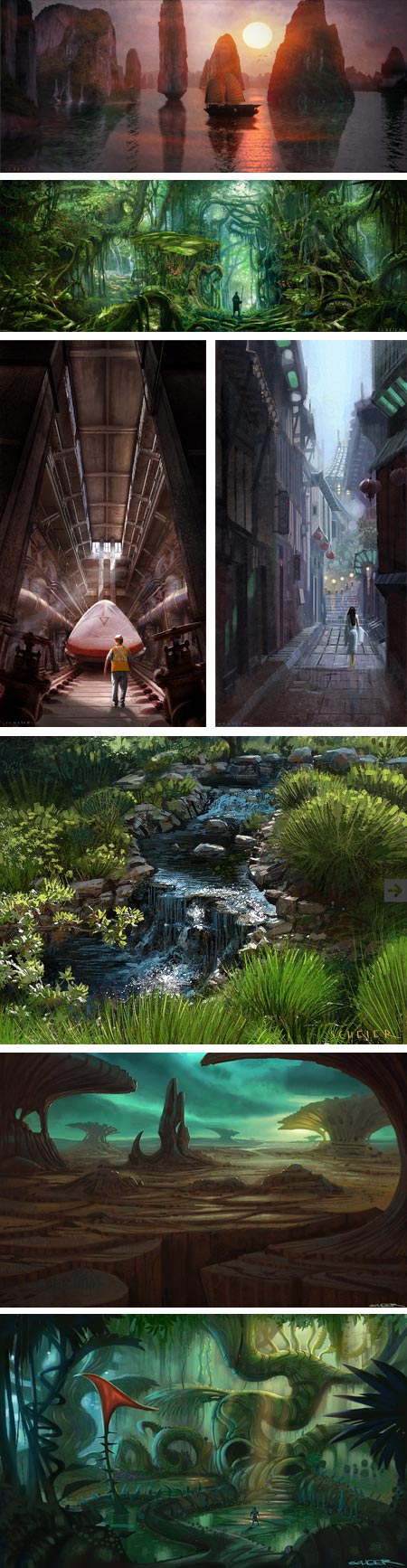
Jason Scheier is a visual development artist and concept designer based in Pasadena, California. His clients include DreamWorks Animation SKG, NBC Universal, Anonymous Content, Honda Automotive, General Electric and DreamWorks Feature Films.The images on his website gallery have names, though they don’t include references to the projects for which they were designed. Scheier’s focus is on environments and landscapes, sometimes realistic, often wildly imaginative.
His digital renderings feature carefully controlled color palettes and richly textured surfaces. His gallery even includes examples of digital plein air painting (images above, third from bottom) which have a nicely painterly look.
Scheier is also in instructor at the Los Angeles Academy of Figurative Art where he is teaching an Imaginative Process Seminar on September 13.
Categories:




Charley’s Picks
Bookshop.org
(Bookshop.org affilliate links; sales benefit independent bookshop owners; I get a small percentage to help support my work on Lines and Colors)

John Singer Sargent: Watercolors


Urban Sketching: Understanding Perspective


Charley’s Picks
Amazon
(Amazon.com affiliate links; sales go to a larger yacht for Jeff Bezos; but I get a small percentage to help support my work on Lines and Colors)
John Singer Sargent: Watercolors
Urban Sketching: Understanding Perspective