


Categories
- 3d CGI
- Amusements
- Animation
- Anime & Manga
- Art Materials
- Art Videos
- Blogroll
- Cartoons
- Color
- Comics
- Concept & Visual Dev.
- Creativity
- Digital Art
- Digital Painting
- Displaying Art on the Web
- Drawing
- Eye Candy for Today
- Gallery and Museum Art
- High-res Art Images
- Illustration
- Motion Graphics & Flash
- Museums
- Online Museums
- Outsider Art
- Painting
- Painting a Day
- Paleo Art
- Pastel, Conté & Chalk
- Pen & Ink
- Prints and Printmaking
- Reviews
- Sc-fi and Fantasy
- Sculpture & Dimensional
- Site Comments
- Sketching
- Storyboards
- Tools and Techniques
- Uncategorized
- Vector Art
- Videos & Podcasts
- Vision and Optics
- Watercolor and Gouache
- Webcomics
Archives
- April 2026
- March 2026
- February 2026
- January 2026
- December 2025
- November 2025
- October 2025
- September 2025
- August 2025
- July 2025
- June 2025
- May 2025
- January 2025
- December 2024
- November 2024
- October 2024
- September 2024
- August 2024
- June 2024
- April 2024
- March 2024
- February 2024
- January 2024
- December 2023
- November 2023
- October 2023
- September 2023
- August 2023
- July 2023
- May 2023
- April 2023
- March 2023
- February 2023
- January 2023
- December 2022
- November 2022
- September 2022
- August 2022
- July 2022
- June 2022
- May 2022
- April 2022
- March 2022
- February 2022
- January 2022
- December 2021
- November 2021
- October 2021
- September 2021
- August 2021
- July 2021
- June 2021
- May 2021
- April 2021
- March 2021
- February 2021
- January 2021
- December 2020
- November 2020
- October 2020
- September 2020
- August 2020
- July 2020
- June 2020
- May 2020
- April 2020
- March 2020
- February 2020
- January 2020
- December 2019
- November 2019
- October 2019
- September 2019
- August 2019
- July 2019
- June 2019
- May 2019
- April 2019
- March 2019
- February 2019
- January 2019
- December 2018
- November 2018
- October 2018
- September 2018
- August 2018
- July 2018
- June 2018
- May 2018
- April 2018
- March 2018
- February 2018
- January 2018
- December 2017
- November 2017
- October 2017
- September 2017
- August 2017
- July 2017
- June 2017
- May 2017
- April 2017
- March 2017
- February 2017
- January 2017
- December 2016
- November 2016
- October 2016
- September 2016
- August 2016
- July 2016
- June 2016
- May 2016
- April 2016
- March 2016
- February 2016
- January 2016
- December 2015
- November 2015
- October 2015
- September 2015
- August 2015
- July 2015
- June 2015
- May 2015
- April 2015
- March 2015
- February 2015
- January 2015
- December 2014
- November 2014
- October 2014
- September 2014
- August 2014
- July 2014
- June 2014
- May 2014
- April 2014
- March 2014
- February 2014
- January 2014
- December 2013
- November 2013
- October 2013
- September 2013
- August 2013
- July 2013
- June 2013
- May 2013
- April 2013
- March 2013
- February 2013
- January 2013
- December 2012
- November 2012
- October 2012
- September 2012
- August 2012
- July 2012
- June 2012
- May 2012
- April 2012
- March 2012
- February 2012
- January 2012
- December 2011
- November 2011
- October 2011
- September 2011
- August 2011
- July 2011
- June 2011
- May 2011
- April 2011
- March 2011
- February 2011
- January 2011
- December 2010
- November 2010
- October 2010
- September 2010
- August 2010
- July 2010
- June 2010
- May 2010
- April 2010
- March 2010
- February 2010
- January 2010
- December 2009
- November 2009
- October 2009
- September 2009
- August 2009
- July 2009
- June 2009
- May 2009
- April 2009
- March 2009
- February 2009
- January 2009
- December 2008
- November 2008
- October 2008
- September 2008
- August 2008
- July 2008
- June 2008
- May 2008
- April 2008
- March 2008
- February 2008
- January 2008
- December 2007
- November 2007
- October 2007
- September 2007
- August 2007
- July 2007
- June 2007
- May 2007
- April 2007
- March 2007
- February 2007
- January 2007
- December 2006
- November 2006
- October 2006
- September 2006
- August 2006
- July 2006
- June 2006
- May 2006
- April 2006
- March 2006
- February 2006
- January 2006
- December 2005
- November 2005
- October 2005
- September 2005
- August 2005
Relevant Blogs
Art, Painting & Sketch
- Gurney Journey
- Underpaintings
- Art and Influence
- Painting Perceptions
- Oil Painters of America
- Vasari Paint POV
- Flying Fox
- Urban Sketchers
- Bento (Smithsonian)
- Art Inconnu
- The Hidden Place
- Still Life
- Making a Mark
- The Art of the Landscape
- Exploring Color & Creativity
- Art Contrarian
- Artist A Day
- beinArt Surreal Art Collective
- Eye Level
- David Dunlop
- p.i.g.m.e.n.t.i.u.m
- CultureGrrl
- Joaquín Sorolla blog
- Artists in Pastel
“Painting a Day”
- A Painting a Day (Keiser)
- On Painting (Keiser)
- Julian Merrow-Smith
- Karen Jurick
- Jeffrey Hayes
- Carol Marine
- Abbey Ryan
- Daily Paintworks
Other Painting Blogs
- Virtual Gouache Land
- Neil Hollingsworth
- Marc Hanson
- Kevin Menck
- Marc Dalessio
- Larry Seiler
- Stapleton Kearns
- Colin Page
- Roos Schuring
- Hans Versfelt
- Titus Meeuws
- Régis Pettinari
- René Plein Air
- Belinda Del Pesco
- Robin Weiss
- Nathan Fowkes (Land Sketch)
- William Wray
- Frank Serrano
- Stephen Magsig
- Michael Chesley Johnson
- Twice a Week
- Sarah Wimperis
- Rob Adams
- Michael Cole Manley
- The Dirty Palette Club
- Mike Manley’s Draw!
Gallery Art & Illustration mix
Illustration
- Howard Pyle
- 100 Years of Illustration
- BibliOdyssey
- Illustration Art
- Today’s Inspiration
- Illustration Mundo
- Little Chimp Society
- Danny Gregory
- R D (John Martz
- Illustration Friday blog
- Monster Brains
- Illustrators & Illustrations (RU)
- Elwood H. Smith
- DaniDraws.com
- Designers Who Blog
- iSpot Blog
Sci-Fi & Fantasy
Illustration & Comics
Comics & Cartoons
- Comics Beat
- Robot 6
- Newsarama Blog
- Comic Vine
- Comics Alliance
- Forbidden Planet Int.
- Paolo Rivera
- Bolt City
- Flight
- Scott McCloud
- The Comics Journal
- Comixpedia
- Funnybook Babylon
- James Baker
- Middleton’s Sketchbook
- Boneville
- The Hotel Fred
- Paul Rivoche
- Daily Cartoonist
- Mad About Cartoons (William Wray)
- Digital Strips
Illustration & Concept
Animation & Concept
- Cartoon Brew
- Animation Blog
- Cold Hard Flash
- Concept Art World
- The CAB
- FY Concept Art
- Concept Ships
- Concept Robots
- John Nevarez
- Armand Serrano
- Marcos Mateu-Mestre
- all kinds of stuff (Kricfalusi)
- Yacin the faun (Man Arenas)
- Kelsey Mann
- Cre8tivemarks Blog
- Ice-Cream Monster Toon Cafe
- AAU Character & Creature Design
- AAU Animation Notes
- Articles and Texticles
Paleo & Scientific
Tools & Techniques
Other
Lists of Art Blogs
Art Image Resource Links
Historic Art Images
- Wikimedia Commons: Paintings
- Wikimedia Commons: Drawings
- The Athenaeum
- WikiArt (WikiPaintings)
- Google Art Project: Artists
- Google Art Project: Collections (Museums)
- ArtCyclopedia
- Web Gallery of Art
- Art Renewal Center
- Web Gallery of Impressionism
Auction Consolidation sites
Auction sites
- Sotheby’s
- Bonham’s
- Christies
- Heritage Auctions: Fine Art
- Heritage Auctions: Illustration
- Freeman’s Auctions
- Bukowskis
- Shannon’s
Image Search
Reverse Image Search (search by image)
- Tin Eye
- RevImg
- Google Image Search (camera icon)
- Bing Image Search (camera icon)
Promoting some friends and some clients of my website design business
- Twin Willows T’ai Chi studio in Wilmington DE. Taiji classes with Bryan Davis.
- Ray Hayward, Inspired Teacher of T’ai Chi ( Taiji ) in Minneapolis, Founder of Mindful Motion Tai Chi Academy
- OldHead Tattoo studio and Art Gallery in Wilmington DE. Tattoos and paintings by Bruce Gulick
- Sharon Domenico Art, pet portrait oil paintings
- Platinum Paperhanging, wallpaper hanging, Main Line and Philadelphia, PA
- Lisa Stone Design, interior designer, Main Line and Philadelphia, PA
- Studio12KPT, original art, prints, calendars and other custom printed items by Van Sickle & Rolleri
-
Women Painting Women, RJD Gallery 2017

“Women Painting Women: A Voice with a Vision” is a group show at the RJD Gallery in Bridgehampton, NY (Long Island) that opens this Saturday, October 7, and runs to October 30, 2017.The title of the show pretty well describes the theme. There is a nice variety of approaches — within the traditions of representational realism.
This is the 5th annual version of the exhibition; I previously covered the 2015 show.
As of this writing, the page for the exhibition on the gallery’s website is out of date, and is still focused on artist submissions rather than promoting the final show to gallery goers.
However, there is an online gallery of nicely zoomable images of work from the show on the gallery’s Artsy page.
(Images above: Bryony Bensly, Erin Anderson, Jantina Peperkamp, Rachel Moseley, Sarah Stieber, Dana Hawk, Daggi Wallace, Odile Richer, Margo Selski, Andrea Kowch)
[Via Karin Jurick]
Categories:
-
Eye Candy for Today: Constable’s Salisbury Cathedral

Salisbury Cathedral from the Bishop’s Garden, John ConstableLink is to zoomable version on Google Art Project; downloadable version on Wikimedia Commons; original is in the Frick Collection, NY.
Constable painted the Salisbury Cathedral a number of times, from several different points of view. This view is the most familiar, and is deservedly one of Constable’s best known paintings.
What isn’t as well known is that there are two finished versions of this composition, as well as a full-size preparatory study.
The original version, now in the Victoria and Albert Museum, had a darker sky and a vantage point slightly closer to the cathedral. The painting was commissioned by Dr. John Fisher, Bishop of Salisbury, who was a close friend of Constable’s.
Constable described it as one of his most difficult landscapes, citing the structure of the cathedral and the light to dark relationships in particular.
Fisher, however wasn’t fond of that version’s darker, more overcast sky, and Constable painted this second version with a lighter sky and a viewpoint slightly further back, opening up the composition somewhat. The full-size study for this version is now in the Metropolitan Museum of Art.
I haven’t seen the V&A version, but in reproduction, it looks as though Constable has made other adjustments to the balance of light and dark in the second painting. In the Frick version, the cathedral seems lighter and the foreground darker, as if to compensate for the lack of the darker sky to highlight the cathedral.
Both paintings also include cows grazing on the Bishop’s grounds, and the Bishop and his wife in the left foreground, pointing to the spire. Farther back along the path is a young woman with an umbrella, presumably one of the Bishop’s daughters.
I had the opportunity to see the original in the Frick Collection over the weekend, and I was again impressed with how modern the painting looks — in its immediacy, the almost impressionistic brush marks in the foliage, and the wonderfully painterly approach to rendering the trunks of the trees. Constable’s white highlights are physically thick and textural; his approach to the trees in many ways anticipates the work of the French Impressionists later in the century, as well as contemporary landscape painting in general.
Categories:
-
The Frick Collection, NYC

I was in New York over the weekend and I took the opportunity to visit the Frick Collection, which I haven’t been to for a few years (it’s often hard for me to get past the Met and the Morgan Library to other museums when I’m in NYC).
The Frick is based on the collection of Pittsburgh industrialist Henry Clay Frick, and is housed in his mansion on Manhattan’s Upper East Side, at 5th Avenue & 70th, not far from the Met.
Though it’s a pretty large urban mansion, it’s a small museum compared to behemoths like the Met or the Brooklyn Museum, but given its size, I think it has some of the highest “masterpiece density” of world-class works per square foot of major museums (perhaps only beaten out by the Uffzzi).
There are stunning, famous and often reproduced works by Vermeer, Rembrandt, Titian, Velazquez, Belinni, Holbein, Constable, Turner, Ingres, Monet, Degas, Whistler and… well, more than I can list here.
If you’re in NYC and want a good dose of masterpieces without dealing with the mind-boggling scale of the Met, the Frick has your number.
Though based on Henry Clay Frick’s collection, the museum is not static, there are changing exhibits, and the museum continues to acquire works for the collection.
The Frick has “pay-what-you-wish” admission on Wednesdays from 2-6 p.m.
Online collection
Though I’m glad the museum has put their collection online in an easily searchable manner with reasonably large images, they have not been as generous as some museums in terms of making high-resolution images of their collection readily available, and photography is not permitted in the museum (you can take your selfies in the central court, but not in the collections).
For those who can’t visit in person, the online gallery can be searched directly or sorted by collection (i.e. paintings, works on paper, sculpture and other decorative objects), and browsed or searched from there.
There is also a collection app, suitable for tablets, though the resolution is not quite as high as the website.
Even for those in NY who can readily visit the museum, it’s worth browsing through the works on paper in particular, as there are numerous objects that can’t be displayed often, and it’s a really nice collection to browse online.
What isn’t obvious when viewing the collection online (and really should be) is the option to use a Mirador IIF pop-up viewer to view an enlarged version of the image in a full-screen window.
Though the resolution of the image isn’t higher than the built into the page enlargement, the latter has to be viewed within the constraints of a window in the page.
The full page viewer is accessed by clicking the enigmatic Miridor IIF icon at the bottom of the right-hand information column for each image. The icon looks like three lower case i’s and an f. Why they can’t also label this link with “full screen viewer” or some other explanatory text is beyond me.
That being said, there are also a few high-resolution images of some of the objects in the Frick Collection from other online sources. You can find some of them in zoomable form on the Google Art Project, and others by using a size-filtered search on Bing Images or Google Images. (Hopefully, these links will work for you, I’ve set them to “Frick Collection paintings” and filtered for 1600 pixels wide or larger).
There is also a selection of images from the Frick Collection on Wikimedia Commons, though only a few of them are higher in resolution than the ones on the Frick Collection website.
(Images above: Johannes Vermeer, Giovanni Bellini, Hans Holbein, John Constable, James Whistler, Rembrandt van Rijn, Joseph Turner, François Boucher, Jean-Auguste-Dominique Ingres, Titian, Jean-Baptiste Simeon Chardin, Giovanni Battista Tiepolo, Johannes Vermeer)
Categories:
-
Eye Candy for Today: Heinrich Böhmer Landscape with Deer

Landscape with Deer, Heinrich BöhmerLink is to The Greatest of Art blog; there is another copy of the image on The Golden Kite Forum. I don’t know the location of the original.
Turn of the century German landscape painter Heinrich Böhmer had a wonderful touch with atmospheric perspective in his woodland interiors. I love the sense of filtered light dappled across the rocks, stream and forest floor.
Categories:
-
Michael Rothman

Michael Rothman is a natural science illustrator who appears to specialize in complex scenes of plants and animals in their natural environment. His subjects include both extant and extinct species.Rothman has a superb ability to render highly detailed compositions — with multiple focal points of individual plants and animals — in a way that is both clear and naturalistic.
Some of his paintings are so naturalistic that they have the feeling of nicely painted landscapes that just happen to be intimate in scale. I particularly admire his representation of textures; many of his images feel highly tactile.
Rothman’s online profile mentions that he works both in traditional and digital media, but the individual images in the galleries on his website don’t have an indication of medium.
There is also a selection of his images on Science-Art.com.
Rothman’s clients include publications like The New York Times, Scientific American and The New Yorker, publishers like Random House, Wiliam Morrow and Harper/Collins, and a number of museums, zoos and other institutions.
Some of his book credits as illustrator include: Here Is the Tropical Rain Forest (Web of Life), At Home with the Gopher Tortoise: The Story of a Keystone Species, The Forest in the Clouds and Jaguar in the Rain Forest (Amazon links).
Categories:
-
Short Trip, Alexander Perrin
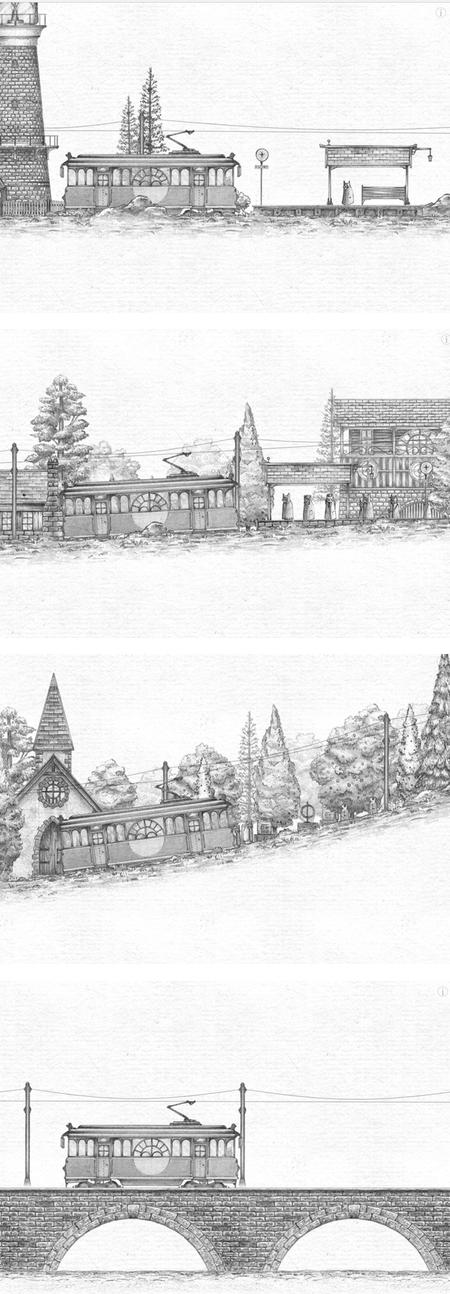
Short Trip is a hand-drawn interactive animation by Alexander Perrin.The author calls it an “interactive illustration”, and the drawings are done in pencil.
If you would like to be simply and delightfully amused for 5 or 10 minutes, turn your sound on, open your browser to full screen and play with it using the left and right arrow keys.
There is information about Perrin and the project here.
[Via Jason Kottke]
Categories:




Charley’s Picks
Bookshop.org
(Bookshop.org affilliate links; sales benefit independent bookshop owners; I get a small percentage to help support my work on Lines and Colors)

John Singer Sargent: Watercolors


Urban Sketching: Understanding Perspective


Charley’s Picks
Amazon
(Amazon.com affiliate links; sales go to a larger yacht for Jeff Bezos; but I get a small percentage to help support my work on Lines and Colors)
John Singer Sargent: Watercolors
Urban Sketching: Understanding Perspective