


Categories
- 3d CGI
- Amusements
- Animation
- Anime & Manga
- Art Materials
- Art Videos
- Blogroll
- Cartoons
- Color
- Comics
- Concept & Visual Dev.
- Creativity
- Digital Art
- Digital Painting
- Displaying Art on the Web
- Drawing
- Eye Candy for Today
- Gallery and Museum Art
- High-res Art Images
- Illustration
- Motion Graphics & Flash
- Museums
- Online Museums
- Outsider Art
- Painting
- Painting a Day
- Paleo Art
- Pastel, Conté & Chalk
- Pen & Ink
- Prints and Printmaking
- Reviews
- Sc-fi and Fantasy
- Sculpture & Dimensional
- Site Comments
- Sketching
- Storyboards
- Tools and Techniques
- Uncategorized
- Vector Art
- Videos & Podcasts
- Vision and Optics
- Watercolor and Gouache
- Webcomics
Archives
- April 2026
- March 2026
- February 2026
- January 2026
- December 2025
- November 2025
- October 2025
- September 2025
- August 2025
- July 2025
- June 2025
- May 2025
- January 2025
- December 2024
- November 2024
- October 2024
- September 2024
- August 2024
- June 2024
- April 2024
- March 2024
- February 2024
- January 2024
- December 2023
- November 2023
- October 2023
- September 2023
- August 2023
- July 2023
- May 2023
- April 2023
- March 2023
- February 2023
- January 2023
- December 2022
- November 2022
- September 2022
- August 2022
- July 2022
- June 2022
- May 2022
- April 2022
- March 2022
- February 2022
- January 2022
- December 2021
- November 2021
- October 2021
- September 2021
- August 2021
- July 2021
- June 2021
- May 2021
- April 2021
- March 2021
- February 2021
- January 2021
- December 2020
- November 2020
- October 2020
- September 2020
- August 2020
- July 2020
- June 2020
- May 2020
- April 2020
- March 2020
- February 2020
- January 2020
- December 2019
- November 2019
- October 2019
- September 2019
- August 2019
- July 2019
- June 2019
- May 2019
- April 2019
- March 2019
- February 2019
- January 2019
- December 2018
- November 2018
- October 2018
- September 2018
- August 2018
- July 2018
- June 2018
- May 2018
- April 2018
- March 2018
- February 2018
- January 2018
- December 2017
- November 2017
- October 2017
- September 2017
- August 2017
- July 2017
- June 2017
- May 2017
- April 2017
- March 2017
- February 2017
- January 2017
- December 2016
- November 2016
- October 2016
- September 2016
- August 2016
- July 2016
- June 2016
- May 2016
- April 2016
- March 2016
- February 2016
- January 2016
- December 2015
- November 2015
- October 2015
- September 2015
- August 2015
- July 2015
- June 2015
- May 2015
- April 2015
- March 2015
- February 2015
- January 2015
- December 2014
- November 2014
- October 2014
- September 2014
- August 2014
- July 2014
- June 2014
- May 2014
- April 2014
- March 2014
- February 2014
- January 2014
- December 2013
- November 2013
- October 2013
- September 2013
- August 2013
- July 2013
- June 2013
- May 2013
- April 2013
- March 2013
- February 2013
- January 2013
- December 2012
- November 2012
- October 2012
- September 2012
- August 2012
- July 2012
- June 2012
- May 2012
- April 2012
- March 2012
- February 2012
- January 2012
- December 2011
- November 2011
- October 2011
- September 2011
- August 2011
- July 2011
- June 2011
- May 2011
- April 2011
- March 2011
- February 2011
- January 2011
- December 2010
- November 2010
- October 2010
- September 2010
- August 2010
- July 2010
- June 2010
- May 2010
- April 2010
- March 2010
- February 2010
- January 2010
- December 2009
- November 2009
- October 2009
- September 2009
- August 2009
- July 2009
- June 2009
- May 2009
- April 2009
- March 2009
- February 2009
- January 2009
- December 2008
- November 2008
- October 2008
- September 2008
- August 2008
- July 2008
- June 2008
- May 2008
- April 2008
- March 2008
- February 2008
- January 2008
- December 2007
- November 2007
- October 2007
- September 2007
- August 2007
- July 2007
- June 2007
- May 2007
- April 2007
- March 2007
- February 2007
- January 2007
- December 2006
- November 2006
- October 2006
- September 2006
- August 2006
- July 2006
- June 2006
- May 2006
- April 2006
- March 2006
- February 2006
- January 2006
- December 2005
- November 2005
- October 2005
- September 2005
- August 2005
Relevant Blogs
Art, Painting & Sketch
- Gurney Journey
- Underpaintings
- Art and Influence
- Painting Perceptions
- Oil Painters of America
- Vasari Paint POV
- Flying Fox
- Urban Sketchers
- Bento (Smithsonian)
- Art Inconnu
- The Hidden Place
- Still Life
- Making a Mark
- The Art of the Landscape
- Exploring Color & Creativity
- Art Contrarian
- Artist A Day
- beinArt Surreal Art Collective
- Eye Level
- David Dunlop
- p.i.g.m.e.n.t.i.u.m
- CultureGrrl
- Joaquín Sorolla blog
- Artists in Pastel
“Painting a Day”
- A Painting a Day (Keiser)
- On Painting (Keiser)
- Julian Merrow-Smith
- Karen Jurick
- Jeffrey Hayes
- Carol Marine
- Abbey Ryan
- Daily Paintworks
Other Painting Blogs
- Virtual Gouache Land
- Neil Hollingsworth
- Marc Hanson
- Kevin Menck
- Marc Dalessio
- Larry Seiler
- Stapleton Kearns
- Colin Page
- Roos Schuring
- Hans Versfelt
- Titus Meeuws
- Régis Pettinari
- René Plein Air
- Belinda Del Pesco
- Robin Weiss
- Nathan Fowkes (Land Sketch)
- William Wray
- Frank Serrano
- Stephen Magsig
- Michael Chesley Johnson
- Twice a Week
- Sarah Wimperis
- Rob Adams
- Michael Cole Manley
- The Dirty Palette Club
- Mike Manley’s Draw!
Gallery Art & Illustration mix
Illustration
- Howard Pyle
- 100 Years of Illustration
- BibliOdyssey
- Illustration Art
- Today’s Inspiration
- Illustration Mundo
- Little Chimp Society
- Danny Gregory
- R D (John Martz
- Illustration Friday blog
- Monster Brains
- Illustrators & Illustrations (RU)
- Elwood H. Smith
- DaniDraws.com
- Designers Who Blog
- iSpot Blog
Sci-Fi & Fantasy
Illustration & Comics
Comics & Cartoons
- Comics Beat
- Robot 6
- Newsarama Blog
- Comic Vine
- Comics Alliance
- Forbidden Planet Int.
- Paolo Rivera
- Bolt City
- Flight
- Scott McCloud
- The Comics Journal
- Comixpedia
- Funnybook Babylon
- James Baker
- Middleton’s Sketchbook
- Boneville
- The Hotel Fred
- Paul Rivoche
- Daily Cartoonist
- Mad About Cartoons (William Wray)
- Digital Strips
Illustration & Concept
Animation & Concept
- Cartoon Brew
- Animation Blog
- Cold Hard Flash
- Concept Art World
- The CAB
- FY Concept Art
- Concept Ships
- Concept Robots
- John Nevarez
- Armand Serrano
- Marcos Mateu-Mestre
- all kinds of stuff (Kricfalusi)
- Yacin the faun (Man Arenas)
- Kelsey Mann
- Cre8tivemarks Blog
- Ice-Cream Monster Toon Cafe
- AAU Character & Creature Design
- AAU Animation Notes
- Articles and Texticles
Paleo & Scientific
Tools & Techniques
Other
Lists of Art Blogs
Art Image Resource Links
Historic Art Images
- Wikimedia Commons: Paintings
- Wikimedia Commons: Drawings
- The Athenaeum
- WikiArt (WikiPaintings)
- Google Art Project: Artists
- Google Art Project: Collections (Museums)
- ArtCyclopedia
- Web Gallery of Art
- Art Renewal Center
- Web Gallery of Impressionism
Auction Consolidation sites
Auction sites
- Sotheby’s
- Bonham’s
- Christies
- Heritage Auctions: Fine Art
- Heritage Auctions: Illustration
- Freeman’s Auctions
- Bukowskis
- Shannon’s
Image Search
Reverse Image Search (search by image)
- Tin Eye
- RevImg
- Google Image Search (camera icon)
- Bing Image Search (camera icon)
Promoting some friends and some clients of my website design business
- Twin Willows T’ai Chi studio in Wilmington DE. Taiji classes with Bryan Davis.
- Ray Hayward, Inspired Teacher of T’ai Chi ( Taiji ) in Minneapolis, Founder of Mindful Motion Tai Chi Academy
- OldHead Tattoo studio and Art Gallery in Wilmington DE. Tattoos and paintings by Bruce Gulick
- Sharon Domenico Art, pet portrait oil paintings
- Platinum Paperhanging, wallpaper hanging, Main Line and Philadelphia, PA
- Lisa Stone Design, interior designer, Main Line and Philadelphia, PA
- Studio12KPT, original art, prints, calendars and other custom printed items by Van Sickle & Rolleri
-
Yoshitaka Amano


Yoshitaka Amano is a Japanese illustrator, concept artist, and designer of scenes, characters and costumes for film and gaming.
In addition, Amano is known for his work for both Japanese and American comics, as well as his gallery art.
His style blends influences from Japanese woodblock prints, American and European comics and pop culture as well as Art Nouveau and Golden Age European illustration.
Amano appears to work primarily in watercolor and ink. There is a brief video on YouTube that includes scenes of him working. There is also an interview on Polygon.
Categories:
-
Mastery by George Leonard (and its relevance to learning drawing and painting)

I came across a recent post on James Gurney’s art blog, Gurney Journey in which a reader had asked “How do you force yourself to improve?“, and it prompted me to think about some of what I’ve learned on the subject of studying, practicing and improving, and a book that was instructive in informing my own practice.
I’ve found it extremely helpful to understand that learning a skill like drawing or painting does not progress in the way we often expect.
We tend to think dedicated practice and study will result in a simple upward curve of progress, even if it’s a shallow curve. However the development of a skill like drawing or painting (or a sport, martial art, musical instrument or any other skill that requires long term study and practice) proceeds more like a series of plateaus.
You can work and study and practice for a long time and think you are making no progress, until at some point you notice that you have done a drawing or painting that is better than you could have done before.
Frustratingly, it may be followed by a series of others that indicate an apparent drop back to your previous level, but eventually you find yourself working at that higher level consistently. You have arrived at another plateau — on which you will be until your constant study and practice pays off with another bump up.
Understanding this, adjusting your expectations and learning not to block your own progress, can be instrumental in your pursuit of mastery in any skill.
Mastery is the title of a book by George Leonard that mentions art not at all (as best I recall) but is of spot-on relevance because it is all about the process of mastering a skill.
I came across it in the early 90’s because I had read some of Leonard’s writing for Esquire. I found it interesting in that he based some of Mastery on his own experience in learning and teaching Aikido, a Japanese “soft-style” martial art that is practiced as much for self development as for self defense.
In my own life, I have three areas in which I’ve devoted time, energy and effort to learning a skill — out of enthusiasm rather than necessity — drawing and painting (considered as one skill set), playing guitar, and Ta’i Chi Chuan, a Chinese “soft-style” martial art, practiced as much for self development as for self defense.
I’ve found striking similarities in the relationship of study, practice and progress in the process of learning all three skill sets.
Leonard’s Mastery is specifically about this relationship, and I found it to be a lightbulb over the head kind of read, one that has stuck with me and helped form my approach to learning.
Leonard explains the plateau phenomenon much better than I can here. He describes several kinds of individuals who get in their own way in their attempts at mastery and lays out a simple and clear approach to clearing your own path of the most common self-imposed obstructions.
The book has a subtitle of “The keys to success and long term fulfillment”, that I suspect the author may not have been happy with; but book publicists who attempt to promote books to the widest audience possible often do a disservice to potential readers who might find the titles most of interest.
You’ll find Mastery listed under “self-help” books, and though that may not be completely inaccurate, it certainly misses the point. Every book in that category has to promise to “change you life”. While I doubt Mastery will do that, it might change the way you approach learning a skill.
Mastery is a short, succinct read, and I found it worthy of a place on the bookshelf next to my art instruction books.
Categories:
-
Marla Greenfield


Though she also paints landscapes, interiors and architectural subjects, Massachusetts based watercolor painter Marla Greenfield has a particular focus on still life and florals.
Her still life subjects are often presented in compositions that bring them close and have a dynamic that sets parts of objects on the painting’s edge, partially out of view. If not done carefully, this could lead a viewer’s attention out of the image, but Greenfield handles it with apparent ease, unerringly bringing your eye back into the composition.
All of her subjects are presented with crisp clarity, bright but naturalistic color and strong value relationships.
In addition to the gallery of images on her website, you can also find a portfolio of her work on Artwork Archive, where they are presented with information on availability and price.
Categories:
-
Auguste Toulmouche
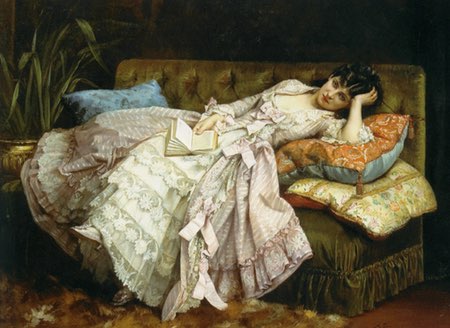

Auguste Toulmouche was a French academic painter noted for his idealized portraits of high society women, arrayed in finery and posed, usually full length, amid sumptuous surroundings.
For most of his career, Toulmouche was highly regarded and popular. He studied with Charles Gleyre, to whose atelier he would later recommend the young Claude Monet.
Ironically, it was the revolution in artistic sensibilities brought about by Monet (to whom Toulmouche was a cousin by marriage) and the Impressionist painters (the first three of whom initially met in Gleyre’s studio) that would cause the work of Toulmouche and others in similar genres to fall from critical favor.
Categories:
-
Eye Candy for Today: Theodore Rousseau landscape


The Edge of the Woods at Monts-Girard, Fontainebleau Forest, Théodor Rousseau, oil on wood, roughly 32 x 48 inches, (80 x 122 cm), in the collection of the Metropolitan Museum of Art, which has zoomable and downloadable versions of the high-res image.
Rousseau was one of the primere painters of the Barbizon School, painting in the nearby Forest of Fontainebleau.
This is a prime example of his paintings of the area, a wonderful contrast of light and dark and a beautifully balanced composition. I love in particular the studied variation of cloud types in the sky.
Categories:
-
Portraits of the artist’s father


Some portraits of artist’s fathers.
(Images above, [links are to relevant Lines and Colors posts]: Albrecht Durer, Pablo Picasso, William Macgregor Paxton, M.C. Escher, Maarten van Heemskerck, Laura Knight, Nikolai Fechin, Rembrandt van Rijn, Jules Bastien Lepage)
Categories:




Charley’s Picks
Bookshop.org
(Bookshop.org affilliate links; sales benefit independent bookshop owners; I get a small percentage to help support my work on Lines and Colors)

John Singer Sargent: Watercolors


Urban Sketching: Understanding Perspective


Charley’s Picks
Amazon
(Amazon.com affiliate links; sales go to a larger yacht for Jeff Bezos; but I get a small percentage to help support my work on Lines and Colors)
John Singer Sargent: Watercolors
Urban Sketching: Understanding Perspective