


Categories
- 3d CGI
- Amusements
- Animation
- Anime & Manga
- Art Materials
- Art Videos
- Blogroll
- Cartoons
- Color
- Comics
- Concept & Visual Dev.
- Creativity
- Digital Art
- Digital Painting
- Displaying Art on the Web
- Drawing
- Eye Candy for Today
- Gallery and Museum Art
- High-res Art Images
- Illustration
- Motion Graphics & Flash
- Museums
- Online Museums
- Outsider Art
- Painting
- Painting a Day
- Paleo Art
- Pastel, Conté & Chalk
- Pen & Ink
- Prints and Printmaking
- Reviews
- Sc-fi and Fantasy
- Sculpture & Dimensional
- Site Comments
- Sketching
- Storyboards
- Tools and Techniques
- Uncategorized
- Vector Art
- Videos & Podcasts
- Vision and Optics
- Watercolor and Gouache
- Webcomics
Archives
- April 2026
- March 2026
- February 2026
- January 2026
- December 2025
- November 2025
- October 2025
- September 2025
- August 2025
- July 2025
- June 2025
- May 2025
- January 2025
- December 2024
- November 2024
- October 2024
- September 2024
- August 2024
- June 2024
- April 2024
- March 2024
- February 2024
- January 2024
- December 2023
- November 2023
- October 2023
- September 2023
- August 2023
- July 2023
- May 2023
- April 2023
- March 2023
- February 2023
- January 2023
- December 2022
- November 2022
- September 2022
- August 2022
- July 2022
- June 2022
- May 2022
- April 2022
- March 2022
- February 2022
- January 2022
- December 2021
- November 2021
- October 2021
- September 2021
- August 2021
- July 2021
- June 2021
- May 2021
- April 2021
- March 2021
- February 2021
- January 2021
- December 2020
- November 2020
- October 2020
- September 2020
- August 2020
- July 2020
- June 2020
- May 2020
- April 2020
- March 2020
- February 2020
- January 2020
- December 2019
- November 2019
- October 2019
- September 2019
- August 2019
- July 2019
- June 2019
- May 2019
- April 2019
- March 2019
- February 2019
- January 2019
- December 2018
- November 2018
- October 2018
- September 2018
- August 2018
- July 2018
- June 2018
- May 2018
- April 2018
- March 2018
- February 2018
- January 2018
- December 2017
- November 2017
- October 2017
- September 2017
- August 2017
- July 2017
- June 2017
- May 2017
- April 2017
- March 2017
- February 2017
- January 2017
- December 2016
- November 2016
- October 2016
- September 2016
- August 2016
- July 2016
- June 2016
- May 2016
- April 2016
- March 2016
- February 2016
- January 2016
- December 2015
- November 2015
- October 2015
- September 2015
- August 2015
- July 2015
- June 2015
- May 2015
- April 2015
- March 2015
- February 2015
- January 2015
- December 2014
- November 2014
- October 2014
- September 2014
- August 2014
- July 2014
- June 2014
- May 2014
- April 2014
- March 2014
- February 2014
- January 2014
- December 2013
- November 2013
- October 2013
- September 2013
- August 2013
- July 2013
- June 2013
- May 2013
- April 2013
- March 2013
- February 2013
- January 2013
- December 2012
- November 2012
- October 2012
- September 2012
- August 2012
- July 2012
- June 2012
- May 2012
- April 2012
- March 2012
- February 2012
- January 2012
- December 2011
- November 2011
- October 2011
- September 2011
- August 2011
- July 2011
- June 2011
- May 2011
- April 2011
- March 2011
- February 2011
- January 2011
- December 2010
- November 2010
- October 2010
- September 2010
- August 2010
- July 2010
- June 2010
- May 2010
- April 2010
- March 2010
- February 2010
- January 2010
- December 2009
- November 2009
- October 2009
- September 2009
- August 2009
- July 2009
- June 2009
- May 2009
- April 2009
- March 2009
- February 2009
- January 2009
- December 2008
- November 2008
- October 2008
- September 2008
- August 2008
- July 2008
- June 2008
- May 2008
- April 2008
- March 2008
- February 2008
- January 2008
- December 2007
- November 2007
- October 2007
- September 2007
- August 2007
- July 2007
- June 2007
- May 2007
- April 2007
- March 2007
- February 2007
- January 2007
- December 2006
- November 2006
- October 2006
- September 2006
- August 2006
- July 2006
- June 2006
- May 2006
- April 2006
- March 2006
- February 2006
- January 2006
- December 2005
- November 2005
- October 2005
- September 2005
- August 2005
Relevant Blogs
Art, Painting & Sketch
- Gurney Journey
- Underpaintings
- Art and Influence
- Painting Perceptions
- Oil Painters of America
- Vasari Paint POV
- Flying Fox
- Urban Sketchers
- Bento (Smithsonian)
- Art Inconnu
- The Hidden Place
- Still Life
- Making a Mark
- The Art of the Landscape
- Exploring Color & Creativity
- Art Contrarian
- Artist A Day
- beinArt Surreal Art Collective
- Eye Level
- David Dunlop
- p.i.g.m.e.n.t.i.u.m
- CultureGrrl
- Joaquín Sorolla blog
- Artists in Pastel
“Painting a Day”
- A Painting a Day (Keiser)
- On Painting (Keiser)
- Julian Merrow-Smith
- Karen Jurick
- Jeffrey Hayes
- Carol Marine
- Abbey Ryan
- Daily Paintworks
Other Painting Blogs
- Virtual Gouache Land
- Neil Hollingsworth
- Marc Hanson
- Kevin Menck
- Marc Dalessio
- Larry Seiler
- Stapleton Kearns
- Colin Page
- Roos Schuring
- Hans Versfelt
- Titus Meeuws
- Régis Pettinari
- René Plein Air
- Belinda Del Pesco
- Robin Weiss
- Nathan Fowkes (Land Sketch)
- William Wray
- Frank Serrano
- Stephen Magsig
- Michael Chesley Johnson
- Twice a Week
- Sarah Wimperis
- Rob Adams
- Michael Cole Manley
- The Dirty Palette Club
- Mike Manley’s Draw!
Gallery Art & Illustration mix
Illustration
- Howard Pyle
- 100 Years of Illustration
- BibliOdyssey
- Illustration Art
- Today’s Inspiration
- Illustration Mundo
- Little Chimp Society
- Danny Gregory
- R D (John Martz
- Illustration Friday blog
- Monster Brains
- Illustrators & Illustrations (RU)
- Elwood H. Smith
- DaniDraws.com
- Designers Who Blog
- iSpot Blog
Sci-Fi & Fantasy
Illustration & Comics
Comics & Cartoons
- Comics Beat
- Robot 6
- Newsarama Blog
- Comic Vine
- Comics Alliance
- Forbidden Planet Int.
- Paolo Rivera
- Bolt City
- Flight
- Scott McCloud
- The Comics Journal
- Comixpedia
- Funnybook Babylon
- James Baker
- Middleton’s Sketchbook
- Boneville
- The Hotel Fred
- Paul Rivoche
- Daily Cartoonist
- Mad About Cartoons (William Wray)
- Digital Strips
Illustration & Concept
Animation & Concept
- Cartoon Brew
- Animation Blog
- Cold Hard Flash
- Concept Art World
- The CAB
- FY Concept Art
- Concept Ships
- Concept Robots
- John Nevarez
- Armand Serrano
- Marcos Mateu-Mestre
- all kinds of stuff (Kricfalusi)
- Yacin the faun (Man Arenas)
- Kelsey Mann
- Cre8tivemarks Blog
- Ice-Cream Monster Toon Cafe
- AAU Character & Creature Design
- AAU Animation Notes
- Articles and Texticles
Paleo & Scientific
Tools & Techniques
Other
Lists of Art Blogs
Art Image Resource Links
Historic Art Images
- Wikimedia Commons: Paintings
- Wikimedia Commons: Drawings
- The Athenaeum
- WikiArt (WikiPaintings)
- Google Art Project: Artists
- Google Art Project: Collections (Museums)
- ArtCyclopedia
- Web Gallery of Art
- Art Renewal Center
- Web Gallery of Impressionism
Auction Consolidation sites
Auction sites
- Sotheby’s
- Bonham’s
- Christies
- Heritage Auctions: Fine Art
- Heritage Auctions: Illustration
- Freeman’s Auctions
- Bukowskis
- Shannon’s
Image Search
Reverse Image Search (search by image)
- Tin Eye
- RevImg
- Google Image Search (camera icon)
- Bing Image Search (camera icon)
Promoting some friends and some clients of my website design business
- Twin Willows T’ai Chi studio in Wilmington DE. Taiji classes with Bryan Davis.
- Ray Hayward, Inspired Teacher of T’ai Chi ( Taiji ) in Minneapolis, Founder of Mindful Motion Tai Chi Academy
- OldHead Tattoo studio and Art Gallery in Wilmington DE. Tattoos and paintings by Bruce Gulick
- Sharon Domenico Art, pet portrait oil paintings
- Platinum Paperhanging, wallpaper hanging, Main Line and Philadelphia, PA
- Lisa Stone Design, interior designer, Main Line and Philadelphia, PA
- Studio12KPT, original art, prints, calendars and other custom printed items by Van Sickle & Rolleri
-
MUVA
 MUVA (Museo Virtual de Artes – El Pais) is a virtual art museum for contemporary art from Uruguay. It’s been on the web for a number of years. I’m not sure exactly when it debuted, but it predates the virtual spaces in virtual worlds like Second Life by a good bit.
The museum is an online gallery, with rotating shows of various artists, that is arranged in a 3-D virtual space that you can “walk though” using links in the interface. Hovering your mouse over parts of the interface, or on control buttons, allows you to navigate through the gallery spaces in which previews of the works are arranged like paintings hanging on the virtual walls of the museum. Clicking directly on a work allows you to view a larger image of the work in much the same way you would in a standard online gallery. A small map in the interface shows you your position and orientation within the museum’s floors and galleries.
There is a relatively new Flash version now to compliment the original HTML version (shown here). Try a little of both to see which you prefer, depending on the speed of your connection. Both versions are offered in either Spanish or English. When in doubt, there is a help feature at the bottom of the interface and if you become impatient, use the Site Map.
This arrangement is obviously not as efficient as regular thumbnail-and-enlargement online galleries, but sometimes, particularly when viewing art, efficiency is not the point. The 3-D environment is convincing and consistent enough to give you a feeling of taking some time to wander through a real museum, with it’s attendant “Let’s see what’s in this gallery.” sense of exploration.
Overall the effect is clever and entertaining in it own right, leading you to perhaps spend some time with some artists that you might not be familiar with or seek out under other circumstances.
Categories:
-
J. C. Leyendecker
 If you were to ask most people to name the most successful American illustrator of the first half of the 20th Century, who was a classically trained artist and master craftsman, who was in large part responsible for the popular image we have of Santa Claus, who created the notion of using a baby to represent the New Year in illustrations, whose productive career spanned 50 years, who basically invented the look of 20th Century magazine cover design, and who painted more Saturday Evening Post covers than any other artist — the answer would invariably be “Norman Rockwell”, an answer that would just as invariably be wrong.
In fact, this is a description of Joseph Christian Leyendecker, whose position of relative modern obscurity compared to Rockwell just boggles my mind. Leyendecker was a fantastic illustrator whose paintings are marvels of design, draughtsmanship and the beautifully controlled application of color.
At a time when illustrators of his stature were treated like current day rock stars, Leyendecker led a very private life, perhaps to keep his relationship with Charles Beach, his model, manager, assistant and companion, out of the public eye. His creations became stars in their own right, though.
Leyendecker’s most famous illustrations were the series he created for Arrow Shirts featuring the “Arrow Collar Man”, an elegantly dapper guy who received thousands of fan letters and marriage proposals from swooning women, and who set standards for what was considered a masculine ideal at the time (sort of a male version of the Gibson Girl). The campaign was notable as being one of the first to deliberately sell a “lifestyle” instead of just a product.
Leyendecker also set new standards for illustration art. He and his brother Frank X. Leyendecker, also a terrific and under-appreciated illustrator, studied in Paris at the famed Académie Julian when William Bouguereau, the Academician’s Academician and a superb painter, was its director. They attracted much attention even then as talented art students among the best in Europe, in sharp contrast to their current lack of attention. Frank receives even less attention than Joseph, apparently in his brother’s shadow in posterity as well as in life.
Norman Rockwell was a great admirer of Leyedecker, who he considered the ideal for which he aimed when he began doing Post covers. He eventually became friends with the Leyendecker brothers and a chapter in his autobiography is one of the few personal accounts that exist from those who knew them.
Leyendecker had a tremendous impact on other illustrators. His work is dazzling in its technical proficiency, beautifully composed and designed, and drawn with the kind of flair and refined skill that only comes to the best of the best. He would make the application of paint (supposedly with a secret proprietary oil painting medium) appear as part of the design, with strokes of color defining the form in his paintings the way hatching is used in drawings, and often allowing parts of the underpainting show through.
He was also a genius for finding “the straight within the curved”, and his figures have a sharp, crisp geometry that makes them really snap. Seemingly simple things like folds in cloth became wonders of painted design, zig-zagging valleys of carefully controlled color, highlighted with those amazing strokes of color hatching.
Leyendecker reportedly worked in stages, creating many small-scale studies from which he would then construct the whole using the traditional technique of “squaring up” to transfer to the larger canvas. The American Art Archives site has a great page of his studies that is not to be missed by anyone interested in the techniques of one of the great illustrators.
I mentioned Leyendecker in my post on Thanksgiving two days ago and Shane White left a comment about a current Leyendecker show I wasn’t aware of. For those fortunate enough to live within reach, there is a Leyendecker exhibit titled J. C. Leyendecker: America’s “Other” Illustrator, at The Haggin Museum in Stockton, California that continues through the end of December.
J.C Schau’s monograph J. C. Leyendecker (cover shown at left, bottom) is long out of print, as is The J. C. Leyendecker Collection: American Illustrators Poster Book by Frederic B. Taraba, though you may be able to find them with used book searches through Amazon and elsewhere. There is a good chapter on Leyendecker in Susan E. Meyer’s America’s Great Illustrators, a terrific book that can be found used for under $15. If nothing else, look for them in libraries so you can get a feeling for how great his work looks in print.
I’ve assembled what resources I can find for you below. American Art Archives is the best, but I would love to know of others I may have missed. Maybe if enough interest is generated from the show, and a little buzz gets going on the web, we might be able to convince a publisher to cough up a new book on this fantastic and amazingly underappreciated artist.
Categories:
-
Evgeny and Lydia Baranov
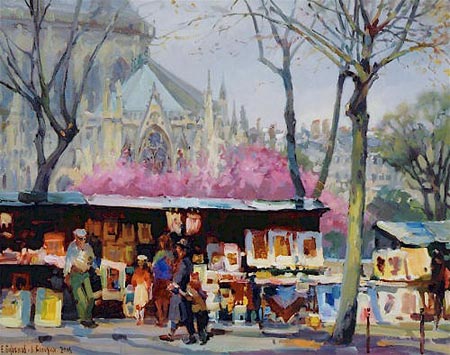
Many art forms can be collaborative, film production, musical performances, mainstream comics, animation and others can be the culmination the efforts of several artists working together in varying degrees.Collaboration in painting is usually more one-sided, as in a master being aided by an assistant, a master touching up the work of a pupil or a figure painter employing a specialist to paint animals into a composition (as Rubens did); all are examples of one dominant painter and one helping. True collaborative painting, in which the same painting is worked on by two artists working in tandem with equal input, is rare.
Husband and wife Evgeny and Lydia Baranov, who are originally from Russia but now live in California, seem to have achieved a balance that allows them to do just that. They work side by side on the same canvas, which might be started by either, sharing the application of paint and the advancement of the composition in an interplay they liken to improvisational jazz.
They seem to work and think alike enough that the intention and execution of the paintings feels of a whole, like the work of a single artist. They apparently travel extensively and their work includes landscapes and cityscapes from Paris (image above), Russia, Venice and other parts of the world, in addition to their adopted home of California.
Their online galleries also include intimate interiors and still lifes, occasionally combined with exteriors in the same composition as in their “Moscow Windows” series. Their work also includes portraits and figures in the context of interiors or landscapes. Their approach is painterly, with broad strokes of intense color laid down directly, space and form defined with areas of color and little evidence of line.
I don’t know if someone more familiar with their work than I could pick out the influences of one artist over the other. Their site sometimes arranges their work by date, and I see more variation in style over time than I do in a given year, indicating to me a pretty seamless synthesis of the vision of the two artists into a shared whole.
It’s interesting to compare this approach to that of two other artists I have featured who are husband and wife, Neil and Karen Hollingsworth, who obviously share influences, but retain separate artistic points of view. I think it’s rare enough to find couples who work in the same medium and general style; the Baraov’s joined expression is very unusual.
Categories:
-
Thanks
 While I realize the American holiday of Thanksgiving is about giving thanks for weightier and more immediate concerns, like being here at all, having enough to eat, clothes, shelter and basic freedom, at least for those of us fortunate enough to enjoy these things; lines and colors is specifically about art, and the day gives me a chance to reflect on the amazing cornucopia of visual art that we enjoy, from the past and in the present.
In the course of writing this blog for the past year and few odd months, I’ve had the pleasure of sharing some of the art treasures I’m aware of, rediscovering some I had forgotten or neglected and discovering new ones. In all, I’m just flat-out amazed at the bounty of great drawings, paintings, illustrations, concept art, cartoons, comics, webcomics, woodblock prints, digital paintings, animations and images of all kinds that we have access to, whether through reproductions on the web, books, libraries, and periodicals, or in person in the halls of museums large and small, galleries local and national and, perhaps best of all, from our own hands.
When I was in the first few weeks of writing lines and colors I found myself wondering if there were enough topics to sustain the kind of daily posts I was doing once I got past the favorite artists I had in my head at the time. Now that I’ve been doing it for a while, I simply don’t know how I can ever find time to write bout all of the great stuff that I have remembered or discovered in the process, particularly in light of all of the exciting things I see happening in the various art communities.
I’ve been thrilled to watch the painting-a-day phenomenon bloom and spread, individual artists and galleries reach for new ways to make contact with those who would appreciate and support their art, and students, young and old, forging their way through the process of artistic discovery and sharing that experience with other artists and the world at large through the ever-growing list of sketching and painting blogs. I’ve seen online comics explode from a handful to hundreds, sketching clubs, illustration challenges, and artist groups spring up like crazy and art resources of all kinds appear on the web.
Wow.
So my hat’s off to all of those participating in the explosion of art appreciation that I think is happening, partly on the net and partly in the rethinking of art on a local scale, with galleries banding together to promote gallery walks, schools looking for unorthodox teaching methods, independent ateliers springing up, and individuals taking the first steps into artistic creation since leaving it behind in adolescence when wrongfully told that only “professional artists” should pursue it past that point. Attitudes are changing, the role of art in society is expanding, not contracting as pundits were afraid would happen under the pressure of popular entertainment. It’s an exciting time to be interested in art.
And thanks to all of you readers of lines and colors, for your interest, comments, suggestions and support, and for making this project more than worthwhile and tremendous fun.
Oh yes, the illustration at left, top is by J. C Leyendeker, one of the most amazing of the great illustrators from the early 20th Century (and sure to be the topic of a full future post). It’s the cover of The Saturday Evening Post from November, 1928. You can find more of his fantastic illustrations, and those of many other artists in the SEP cover archive on the Curtis Publishing site.
And yes, that archive also includes the image you were probably expecting to see here today, at left, bottom: Rockwell’s “Freedom from Want“, not specifically a Thanksgiving image, but part of a series of “Four Freedoms“, posters created by Rockwell as a response to a speech by President Roosevelt to Congress in 1941 on those really basic freedoms: Freedom From Fear, Freedom of Speech, Freedom From Want, and Freedom of Worship.
Categories:
-
Greg Broadmore
 For somebody who isn’t specifically a paleo artist, New Zealand artist Greg Broadmore paints very cool and realistic dinosaurs. He has apparently loved drawing dinos from an early age (as happens to many of us), and now gets to paint them in the service of movie concept art, specifically for the lavishly dinosaur-populated remake of King Kong from Peter Jackson.
Broadmore works as a concept artist for Jackson’s WETA Workshop and has also done concept design and illustration for The Lion the Witch and the Wardrobe, and the upcoming Halo and live action Evangelion films.
He works digitally in Photoshop and Painter, and his illustrations have a feeling of physical paint and a muscular approach to light and shade that gives his work an appealing immediacy and power.
Broadmore’s work is featured prominently in The World of Kong: A Natural History of Skull Island, a book set up as a mock “natural history” of Kong’s Skull Island, beautifully illustrated by the WETA concept artists who worked on the film.
Broadmore also created a comic called Killer Robots Will Smash the World that is published in New Zealand and may bit hard to find here in the States (I’m looking).
Did I mention that he also paints great robots?
The links below are to his galleries on the WETA Workshop site, that showcase his concept art for the films, and a site called The Battery, a project he shares with fellow WETA artist Warren Mahy, which features some of his sketches and quick studies, as well as more finished personal work.
Categories:
-
Mark Rogalski
 One of the most basic forms for children’s books is the ABC book, a tried and true formula with a long history, that usually presents a challenge for illustrators: to come up with a way to make images associated with the alphabet that are amusing enough to keep a child’s attention through repeated readings. The best illustrators who take on this venerable form not only accomplish that, but look for a new and different way to approach the idea and make it fresh.
In his new book Tickets to Ride: An Alphabetic Amusement illustrator Mark Rogalski has created a veritable amusement park of alphabet illustrations in the form of delightfully styled and wittily titled alliterative animal rides.
The images of the Zebra Zeppelin and Octopus Orbiter Blast at left are just a taste. Unfortunately, the images on Rogalski’s web site are too small to get a real feeling for these delightful digital paintings, which are at once boldly simple and richly detailed. You can see them somewhat larger in the recent Communication Arts Illustration Annual 47, and, of course, at their intended size in the book.
The illustrations make for an ideal kind of children’s book: fun and simple enough to appeal to kids, and visually sophisticated enough to also keep Mom or Dad entertained through repeated readings.
Rogalski’s site is also a bit shy on information about the artist or his techniques. I get the impression from his speaking schedule, and the fact that the book is published by Running Press, that he is based here in the Philadelphia area. The Contact page of his site promises more info to come — “Archives”, “History” and the tantalizing “Oddities”, but we’ll apparently have to wait for a bit. In the meanwhile, the book should provide enough “tickets to ride” to keep us nicely amused, regardless of our age.
Categories:




Charley’s Picks
Bookshop.org
(Bookshop.org affilliate links; sales benefit independent bookshop owners; I get a small percentage to help support my work on Lines and Colors)

John Singer Sargent: Watercolors


Urban Sketching: Understanding Perspective


Charley’s Picks
Amazon
(Amazon.com affiliate links; sales go to a larger yacht for Jeff Bezos; but I get a small percentage to help support my work on Lines and Colors)
John Singer Sargent: Watercolors
Urban Sketching: Understanding Perspective