


Categories
- 3d CGI
- Amusements
- Animation
- Anime & Manga
- Art Materials
- Art Videos
- Blogroll
- Cartoons
- Color
- Comics
- Concept & Visual Dev.
- Creativity
- Digital Art
- Digital Painting
- Displaying Art on the Web
- Drawing
- Eye Candy for Today
- Gallery and Museum Art
- High-res Art Images
- Illustration
- Motion Graphics & Flash
- Museums
- Online Museums
- Outsider Art
- Painting
- Painting a Day
- Paleo Art
- Pastel, Conté & Chalk
- Pen & Ink
- Prints and Printmaking
- Reviews
- Sc-fi and Fantasy
- Sculpture & Dimensional
- Site Comments
- Sketching
- Storyboards
- Tools and Techniques
- Uncategorized
- Vector Art
- Videos & Podcasts
- Vision and Optics
- Watercolor and Gouache
- Webcomics
Archives
- July 2026
- June 2026
- May 2026
- April 2026
- March 2026
- February 2026
- January 2026
- December 2025
- November 2025
- October 2025
- September 2025
- August 2025
- July 2025
- June 2025
- May 2025
- January 2025
- December 2024
- November 2024
- October 2024
- September 2024
- August 2024
- June 2024
- April 2024
- March 2024
- February 2024
- January 2024
- December 2023
- November 2023
- October 2023
- September 2023
- August 2023
- July 2023
- May 2023
- April 2023
- March 2023
- February 2023
- January 2023
- December 2022
- November 2022
- September 2022
- August 2022
- July 2022
- June 2022
- May 2022
- April 2022
- March 2022
- February 2022
- January 2022
- December 2021
- November 2021
- October 2021
- September 2021
- August 2021
- July 2021
- June 2021
- May 2021
- April 2021
- March 2021
- February 2021
- January 2021
- December 2020
- November 2020
- October 2020
- September 2020
- August 2020
- July 2020
- June 2020
- May 2020
- April 2020
- March 2020
- February 2020
- January 2020
- December 2019
- November 2019
- October 2019
- September 2019
- August 2019
- July 2019
- June 2019
- May 2019
- April 2019
- March 2019
- February 2019
- January 2019
- December 2018
- November 2018
- October 2018
- September 2018
- August 2018
- July 2018
- June 2018
- May 2018
- April 2018
- March 2018
- February 2018
- January 2018
- December 2017
- November 2017
- October 2017
- September 2017
- August 2017
- July 2017
- June 2017
- May 2017
- April 2017
- March 2017
- February 2017
- January 2017
- December 2016
- November 2016
- October 2016
- September 2016
- August 2016
- July 2016
- June 2016
- May 2016
- April 2016
- March 2016
- February 2016
- January 2016
- December 2015
- November 2015
- October 2015
- September 2015
- August 2015
- July 2015
- June 2015
- May 2015
- April 2015
- March 2015
- February 2015
- January 2015
- December 2014
- November 2014
- October 2014
- September 2014
- August 2014
- July 2014
- June 2014
- May 2014
- April 2014
- March 2014
- February 2014
- January 2014
- December 2013
- November 2013
- October 2013
- September 2013
- August 2013
- July 2013
- June 2013
- May 2013
- April 2013
- March 2013
- February 2013
- January 2013
- December 2012
- November 2012
- October 2012
- September 2012
- August 2012
- July 2012
- June 2012
- May 2012
- April 2012
- March 2012
- February 2012
- January 2012
- December 2011
- November 2011
- October 2011
- September 2011
- August 2011
- July 2011
- June 2011
- May 2011
- April 2011
- March 2011
- February 2011
- January 2011
- December 2010
- November 2010
- October 2010
- September 2010
- August 2010
- July 2010
- June 2010
- May 2010
- April 2010
- March 2010
- February 2010
- January 2010
- December 2009
- November 2009
- October 2009
- September 2009
- August 2009
- July 2009
- June 2009
- May 2009
- April 2009
- March 2009
- February 2009
- January 2009
- December 2008
- November 2008
- October 2008
- September 2008
- August 2008
- July 2008
- June 2008
- May 2008
- April 2008
- March 2008
- February 2008
- January 2008
- December 2007
- November 2007
- October 2007
- September 2007
- August 2007
- July 2007
- June 2007
- May 2007
- April 2007
- March 2007
- February 2007
- January 2007
- December 2006
- November 2006
- October 2006
- September 2006
- August 2006
- July 2006
- June 2006
- May 2006
- April 2006
- March 2006
- February 2006
- January 2006
- December 2005
- November 2005
- October 2005
- September 2005
- August 2005
Relevant Blogs
Art, Painting & Sketch
- Gurney Journey
- Underpaintings
- Art and Influence
- Painting Perceptions
- Oil Painters of America
- Vasari Paint POV
- Flying Fox
- Urban Sketchers
- Bento (Smithsonian)
- Art Inconnu
- The Hidden Place
- Still Life
- Making a Mark
- The Art of the Landscape
- Exploring Color & Creativity
- Art Contrarian
- Artist A Day
- beinArt Surreal Art Collective
- Eye Level
- David Dunlop
- p.i.g.m.e.n.t.i.u.m
- CultureGrrl
- Joaquín Sorolla blog
- Artists in Pastel
“Painting a Day”
- A Painting a Day (Keiser)
- On Painting (Keiser)
- Julian Merrow-Smith
- Karen Jurick
- Jeffrey Hayes
- Carol Marine
- Abbey Ryan
- Daily Paintworks
Other Painting Blogs
- Virtual Gouache Land
- Neil Hollingsworth
- Marc Hanson
- Kevin Menck
- Marc Dalessio
- Larry Seiler
- Stapleton Kearns
- Colin Page
- Roos Schuring
- Hans Versfelt
- Titus Meeuws
- Régis Pettinari
- René Plein Air
- Belinda Del Pesco
- Robin Weiss
- Nathan Fowkes (Land Sketch)
- William Wray
- Frank Serrano
- Stephen Magsig
- Michael Chesley Johnson
- Twice a Week
- Sarah Wimperis
- Rob Adams
- Michael Cole Manley
- The Dirty Palette Club
- Mike Manley’s Draw!
Gallery Art & Illustration mix
Illustration
- Howard Pyle
- 100 Years of Illustration
- BibliOdyssey
- Illustration Art
- Today’s Inspiration
- Illustration Mundo
- Little Chimp Society
- Danny Gregory
- R D (John Martz
- Illustration Friday blog
- Monster Brains
- Illustrators & Illustrations (RU)
- Elwood H. Smith
- DaniDraws.com
- Designers Who Blog
- iSpot Blog
Sci-Fi & Fantasy
Illustration & Comics
Comics & Cartoons
- Comics Beat
- Robot 6
- Newsarama Blog
- Comic Vine
- Comics Alliance
- Forbidden Planet Int.
- Paolo Rivera
- Bolt City
- Flight
- Scott McCloud
- The Comics Journal
- Comixpedia
- Funnybook Babylon
- James Baker
- Middleton’s Sketchbook
- Boneville
- The Hotel Fred
- Paul Rivoche
- Daily Cartoonist
- Mad About Cartoons (William Wray)
- Digital Strips
Illustration & Concept
Animation & Concept
- Cartoon Brew
- Animation Blog
- Cold Hard Flash
- Concept Art World
- The CAB
- FY Concept Art
- Concept Ships
- Concept Robots
- John Nevarez
- Armand Serrano
- Marcos Mateu-Mestre
- all kinds of stuff (Kricfalusi)
- Yacin the faun (Man Arenas)
- Kelsey Mann
- Cre8tivemarks Blog
- Ice-Cream Monster Toon Cafe
- AAU Character & Creature Design
- AAU Animation Notes
- Articles and Texticles
Paleo & Scientific
Tools & Techniques
Other
Lists of Art Blogs
Art Image Resource Links
Historic Art Images
- Wikimedia Commons: Paintings
- Wikimedia Commons: Drawings
- The Athenaeum
- WikiArt (WikiPaintings)
- Google Art Project: Artists
- Google Art Project: Collections (Museums)
- ArtCyclopedia
- Web Gallery of Art
- Art Renewal Center
- Web Gallery of Impressionism
Auction Consolidation sites
Auction sites
- Sotheby’s
- Bonham’s
- Christies
- Heritage Auctions: Fine Art
- Heritage Auctions: Illustration
- Freeman’s Auctions
- Bukowskis
- Shannon’s
Image Search
Reverse Image Search (search by image)
- Tin Eye
- RevImg
- Google Image Search (camera icon)
- Bing Image Search (camera icon)
Promoting some friends and some clients of my website design business
- Twin Willows T’ai Chi studio in Wilmington DE. Taiji classes with Bryan Davis.
- Ray Hayward, Inspired Teacher of T’ai Chi ( Taiji ) in Minneapolis, Founder of Mindful Motion Tai Chi Academy
- OldHead Tattoo studio and Art Gallery in Wilmington DE. Tattoos and paintings by Bruce Gulick
- Sharon Domenico Art, pet portrait oil paintings
- Platinum Paperhanging, wallpaper hanging, Main Line and Philadelphia, PA
- Lisa Stone Design, interior designer, Main Line and Philadelphia, PA
- Studio12KPT, original art, prints, calendars and other custom printed items by Van Sickle & Rolleri
-
Monet at the Grand Palais

It may surprise lovers of Impressionism in the U.S. and Britain that Claude Monet, the artist whose name most hold synonymous with Impressionism, doesn’t evoke the same level of reverence in his native France. Not that he isn’t popular; the French just seem a bit more blasé about their cornucopia of Impressionist works and the nominal star of the group.A new exhibition at the Grand Palais in Paris seeks to change that, if by no other means than overwhelming visitors with the sheer number of Monet’s stunning works collected in a single place.
Over 200 of his paintings have been collected from museums in France and around the world, in an exhibition that spans Monet’s career from the early realism of the 1860’s to the fiery Impressionist canvasses of the 1920’s.
The Grand Palais’s own website has always been essentially useless in seeking information about exhibitions there, which are usually mounted by other institutions. The Musée d’Orsay, co-sponsor of the exhibition, also has little to offer.
On digging further, I found that the Réunion des Musées Nationaux, the other co-sponsor, has the in depth information about the exhibit.
Jackpot.
If you’re a regular reader of Lines and Colors, you may have heard me gripe about the relative lack of high-resolution art images on the web, frustrated with the small teaser images most sites seem to find sufficient.
The website for Exhibition Monet 2010 (English version here) is a bounty of zoomable high-resolution images of works from the exhibition.
You have to be willing to wait through a somewhat slow-loading Flash interface, but in the Gallery you will find beautiful images of Monet’s work, in most cases two or three times common screen resolution.
The gallery is arranged chronologically. Click on an individual image, or click on “All the Paintings” at left to start at the earliest, and you can move through them in order.
Be sure to click on the images themselves to zoom to the larger version (linked for most though not quite all of the paintings). Do yourself the favor of clicking the plus sign to bring the view all the way up to 100% to see the images in proper focus (they are slightly blurry in lower resolutions), and you will be rewarded with images of Monet’s work in which you can see the texture of the individual brushstrokes.
If you are interested enough in Monet to view all of the paintings, be prepared for a major time sink. I don’t know if all 200 or so paintings from the exhibition are included in the online gallery, but they may well be.
It’s wonderful to tour through Monet’s 60 year career, watch his approach evolve and change, and in particular, to see several of the famous series, the haystacks, Rouen Cathedral, Houses of Parliment, and of course the water lilies, in which he repeatedly painted the same subject at different times in different light.
For those who live near Paris, or can travel there (sigh), the exhibition runs until 24 January, 2011.
You may want to book your tickets early, by all accounts the exhibition is fulfilling its role in generating the kind of enthusiasm for Monet in France that he has enjoyed in the the U.S. and Britain for the last 100 years.
Even if you think you know Monet, this exhibition, and its online version, may reveal him anew; perhaps allowing you to begin to see through the Impressionist master’s remarkable eyes.
Cezanne reportedly said of him: “Monet is just an eye — but God, what an eye!”
Categories:
-
Peanuts turns 60
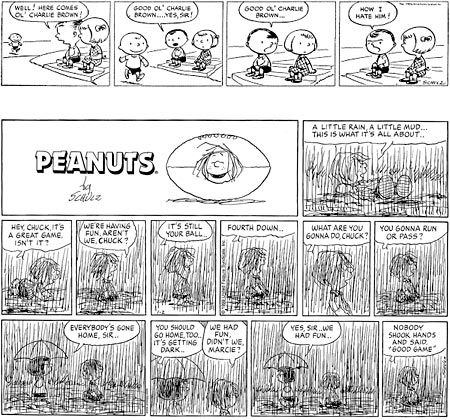
Peanuts, the iconic comic strip with a title its author hated, began 60 years ago today on October 2nd, 1950.The name was tacked on by the syndicate, arguing that the name Charles Schultz wanted, “L’il Folks”, was too close to the names of other current strips, and downplaying the viability of his subsequent suggestion, “Good Ol’ Charlie Brown”.
The strip was amazingly successful, particularly given that its protagonist was the epitome of lack of success (making him, of course, the character so many could identify with).
The first strip, shown above, top and reprinted here, set the tone.
Peanuts ran until February 13, 2000, and was one of the most popular and influential comic strips of all time.
Comics.com maintains an archive here.
Schultz insisted that the strip die with him, and not be carried on by assistants (which he didn’t use) or surrogates, as was common practice for comic strips in the 20th Century when their creators died or retired.
A few months after his death, on May 27, 2000, more than a hundred of his fellow cartoonists honored Schultz and his creation with special tribute versions of their own comics.
The Peanuts strip was a farewell and thanks, but the next to the last strip, a Sunday shown above and linked here, was if anything, darker. Drawn by a seriously ill Schulz, it shows our protagonist still unable to kick the football after nearly 50 years of that running gag.
[Addendum: Akkkk! OK, it’s Peppermint Patti, not CB with the football in the rain, but you get the idea.]
Good grief!
Categories:
-
Nicolas Ferrand
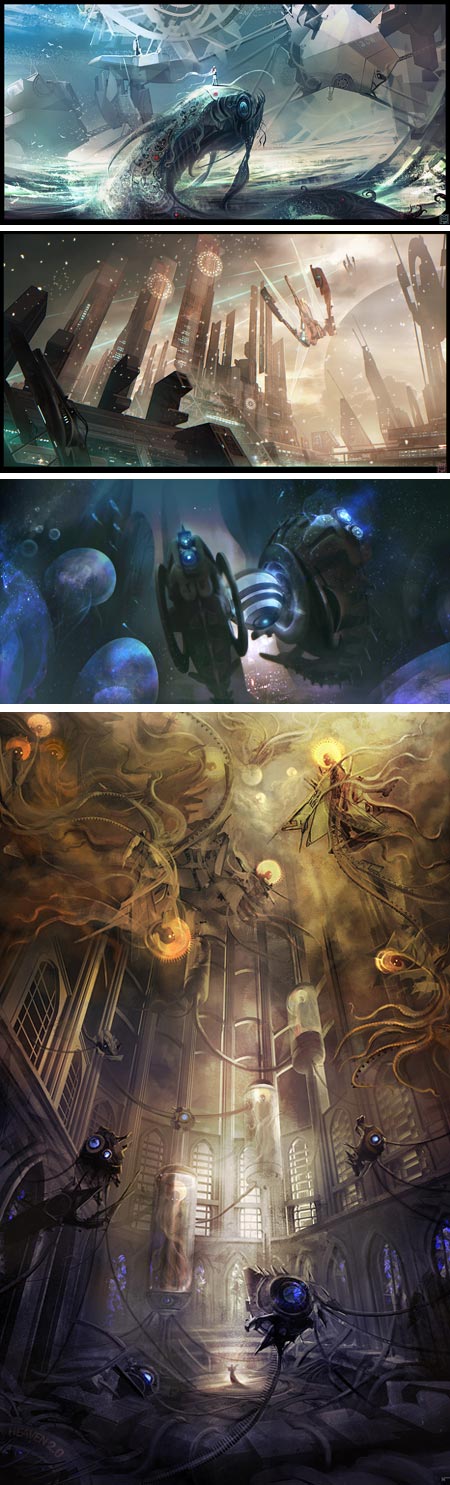
Concept artist Nicolas Ferrand works in the gaming industry, and has worked on titles like Assasin’s Creed, Prince of Persia 3, Splinter Cell 2, 3 & 4, Ghost Recon 2, Far Cry 2 and Avatar.Born in France, he now lives in Montreal, Canada where he is working on Thief 4 for Eidos/Square Enix.
Ferrand works in both 3-D modeling and digital painting, apparently combining the two. He uses large almost monochromatic passages to set mood, offsetting them with areas of brighter colors in a contrasting range. He also is able to utilize areas of detail as additional contrasts to areas of simpler shapes and surfaces, combining the techniques to provide visual focus and power.
Ferrand maintains both a website and a blog, both of which have examples of his work. There is an interview with him on 3DM3.com.
His work is featured, along with five other concept artists, in the book Exodyssey.
Categories:
-
Paintbox Leaves

Paintbox Leaves: Autumnal Inspiration from Cole to Wyeth is an exhibition at the Hudson River Museum in Yonkers, NY that features some prime examples of American landscape painting from the 19th and early 20th centuries.The exhibit explores the fascination artists have had with the glories of the American landscape in Autumn, described by Thomas Cole as quoted on the site:
There is one season when the American forest surpasses all the world in gorgeousness, that is the autumnal; — then every hill and dale is riant in the luxury of color — every hue is there, from the liveliest green to deepest purple from the most — golden yellow to the intensest crimson.
The online exhibit page lists several of the works, each one in the list linked to an image and descriptive text.
Paintbox Leaves: Autumnal Inspiration from Cole to Wyeth is on display until January 16, 2011.
(Images above: N.C. Wyeth, Robert Reid, Albert Bierstadt, Thomas Worthington Whittredge)
Categories:
-
The Legend of Steel Bashaw, Petar Meseldžija
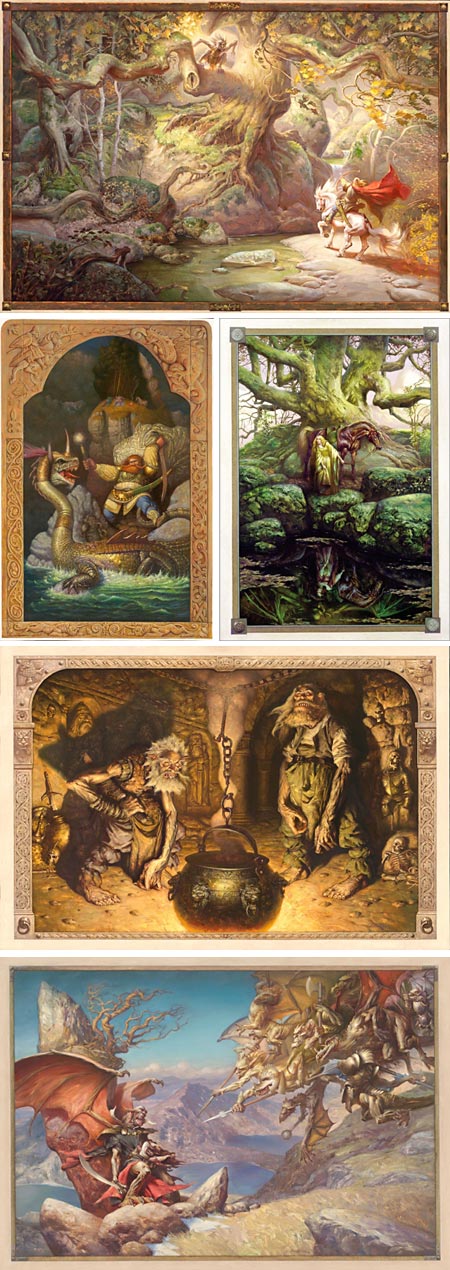
Serbian artist Petar Meseldžija, who I wrote about in 2008, has a career that has included outstanding work in comics, illustration, posters and gallery art.He has taken elements from all aspects of his skill range and applied them to the classic form of the illustrated storybook in The Legend of Steel Bashaw, an adaptation of a Serbian folktale known as Baš Čelik.
To bring the book to U.S. readers, Meseldžija worked with Flesk Publications, whose consistent high standards in reproduction and printing for art books make them an ideal choice to bring Meseldžija to the attention of a wider audience.
Flesk sent me a review copy and they’ve hit it out of the park again.
Meseldžija brings his rich, painterly style to classic fantasy settings, quite cottages on sunny hillsides, paths through darkened green woods, mountain streams and ancient castles; and in particular, gnarled trees, wet with moss and tinged with fall colors, that are like characters themselves.
Into these settings he brings grotesque giants, fearsome demons and cunning dragons, along with our hero and heroine, who play out a story cast in the mold of great man vs. monster legends like Beowulf and Homer’s Odyssey.
With an eye for subtle color contrasts and vibrant textures, Meseldžija brings the story to life in the first two thirds of the book. In the latter third, Flesk has worked with Meseldžija to bring the making of the story and its images to light, with initial sketches, concept drawings, and highly refined preliminary tone drawings, as well as color sketches and some of the artist’s relevant landscape paintings.
The result is two books in one, the illustrated story and the “making of” chapter that reveals Meseldžija’s working methods.
You can see some images from the book on the Flesk Publications site, as well as in the Illustration section of Meseldžija’s site.
The book can be ordered through Flesk’s new online store, or via snail mail.
Petar Meseldžija’s website has been revised and expanded since I last wrote about him, and includes examples of his work in multiple areas.
[Update 11/23/10: Petar Meseldžija now has a blog at http://petarmeseldzija.blogspot.com/. Though it was only recently started, he has already added fascinating information about his working methods.]
Categories:
-
Edgar Degas
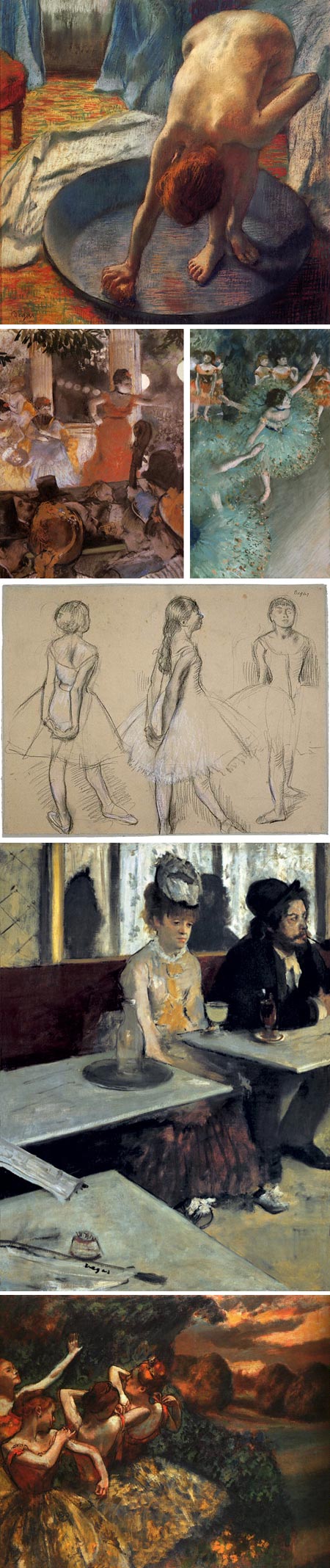
Though considered a member of the original core group of French Impressionists, Edgar Degas (Hilaire Germain Edgar Degas), always stood apart, both in his approach to painting, in which he considered himself a realist rather than an Impressionist, and in his emphasis on drawing.Amid a group that downplayed the role of drawing in art in deference to the immediacy of painting the fleeting effects of light (Monet went so far as to hide the role drawing played in his art), Degas was arguably one of the finest draftsmen of the 19th Century.
Degas was part of the Impressionist group socially, and hung out at the Café Guerbois with artists in and around their circle, including Manet, Cézanne, Renoir, Monet, Sisley, Bazille and Pissarro, though he often argued with them.
He helped organize the Impressionists’ out-of-the-mainstream independent exhibits, and exhibited in all but one of them. More financially stable then the others, he also collected works by painters in and around their circle, like Pissarro, Gauguin, Cézanne and Manet.
In his painting style, however, he never adopted the broken dots of color, painting of light effects or fondness for landscape championed by Monet and the other Impressionists, and was derisive of their practice of plein air painting.
He instead continued in the vein of the realists like Courbet and Corot (who, we forget today, were radical in their own time). Degas, too was radical in his own way, particularly in his dramatic compositions, which broke the laws of academic painting as surely as his contemporaries did with their deliberate rejection of academic traditions.
Like the Impressionists, Degas was very influenced by the work of Édouard Manet, who he met while both were copying the same painting in the Louvre (a practice common to serious art students at the time), but Degas also carried with him his admiration for artists like Ingres and Delacroix.
Degas, particularly in his later work, did share with the Impressionists the use of bold, painterly brushwork and vivid colors; and this, as well as his compositional innovations, carried over into his intensely expressive pastel drawings, which may be the most recognizable of his works today.
With their familiar subjects of ballet rehearsals, horse racing and women at the bath, Degas’ pastels are beautifully drawn, innovatively realized and striking in their graphic power.
Degas also drew beautifully in other media, and was accomplished at etching, lithography and sculpture.
There is currently an exhibition at the Morgan Library and Museum in New York of Degas Drawings and Sketchbooks that is on display until January 23, 2011. The Online Exhibition on the website lets you flip through a selection of drawings and a sketchbook from the exhibit. Use the “See thumbnails” choice at left and when using the Zoomable views, be sure to choose the “Full Screen” option below the image to the right of the zooming controls.
Degas has become one of the most popular and revered artists in the world, and there are more resources in print and on the web than I can begin to list here; so I will instead point you to a general search on Amazon for Degas, and the extensive lists of web resources for Degas on ArtCyclopedia, including museum listings and image archives (see the tabs at the top of the list for other categories).
Categories:




Charley’s Picks
Bookshop.org
(Bookshop.org affilliate links; sales benefit independent bookshop owners; I get a small percentage to help support my work on Lines and Colors)

John Singer Sargent: Watercolors


Urban Sketching: Understanding Perspective


Charley’s Picks
Amazon
(Amazon.com affiliate links; sales go to a larger yacht for Jeff Bezos; but I get a small percentage to help support my work on Lines and Colors)
John Singer Sargent: Watercolors
Urban Sketching: Understanding Perspective