


Categories
- 3d CGI
- Amusements
- Animation
- Anime & Manga
- Art Materials
- Art Videos
- Blogroll
- Cartoons
- Color
- Comics
- Concept & Visual Dev.
- Creativity
- Digital Art
- Digital Painting
- Displaying Art on the Web
- Drawing
- Eye Candy for Today
- Gallery and Museum Art
- High-res Art Images
- Illustration
- Motion Graphics & Flash
- Museums
- Online Museums
- Outsider Art
- Painting
- Painting a Day
- Paleo Art
- Pastel, Conté & Chalk
- Pen & Ink
- Prints and Printmaking
- Reviews
- Sc-fi and Fantasy
- Sculpture & Dimensional
- Site Comments
- Sketching
- Storyboards
- Tools and Techniques
- Uncategorized
- Vector Art
- Videos & Podcasts
- Vision and Optics
- Watercolor and Gouache
- Webcomics
Archives
- August 2026
- July 2026
- June 2026
- May 2026
- April 2026
- March 2026
- February 2026
- January 2026
- December 2025
- November 2025
- October 2025
- September 2025
- August 2025
- July 2025
- June 2025
- May 2025
- January 2025
- December 2024
- November 2024
- October 2024
- September 2024
- August 2024
- June 2024
- April 2024
- March 2024
- February 2024
- January 2024
- December 2023
- November 2023
- October 2023
- September 2023
- August 2023
- July 2023
- May 2023
- April 2023
- March 2023
- February 2023
- January 2023
- December 2022
- November 2022
- September 2022
- August 2022
- July 2022
- June 2022
- May 2022
- April 2022
- March 2022
- February 2022
- January 2022
- December 2021
- November 2021
- October 2021
- September 2021
- August 2021
- July 2021
- June 2021
- May 2021
- April 2021
- March 2021
- February 2021
- January 2021
- December 2020
- November 2020
- October 2020
- September 2020
- August 2020
- July 2020
- June 2020
- May 2020
- April 2020
- March 2020
- February 2020
- January 2020
- December 2019
- November 2019
- October 2019
- September 2019
- August 2019
- July 2019
- June 2019
- May 2019
- April 2019
- March 2019
- February 2019
- January 2019
- December 2018
- November 2018
- October 2018
- September 2018
- August 2018
- July 2018
- June 2018
- May 2018
- April 2018
- March 2018
- February 2018
- January 2018
- December 2017
- November 2017
- October 2017
- September 2017
- August 2017
- July 2017
- June 2017
- May 2017
- April 2017
- March 2017
- February 2017
- January 2017
- December 2016
- November 2016
- October 2016
- September 2016
- August 2016
- July 2016
- June 2016
- May 2016
- April 2016
- March 2016
- February 2016
- January 2016
- December 2015
- November 2015
- October 2015
- September 2015
- August 2015
- July 2015
- June 2015
- May 2015
- April 2015
- March 2015
- February 2015
- January 2015
- December 2014
- November 2014
- October 2014
- September 2014
- August 2014
- July 2014
- June 2014
- May 2014
- April 2014
- March 2014
- February 2014
- January 2014
- December 2013
- November 2013
- October 2013
- September 2013
- August 2013
- July 2013
- June 2013
- May 2013
- April 2013
- March 2013
- February 2013
- January 2013
- December 2012
- November 2012
- October 2012
- September 2012
- August 2012
- July 2012
- June 2012
- May 2012
- April 2012
- March 2012
- February 2012
- January 2012
- December 2011
- November 2011
- October 2011
- September 2011
- August 2011
- July 2011
- June 2011
- May 2011
- April 2011
- March 2011
- February 2011
- January 2011
- December 2010
- November 2010
- October 2010
- September 2010
- August 2010
- July 2010
- June 2010
- May 2010
- April 2010
- March 2010
- February 2010
- January 2010
- December 2009
- November 2009
- October 2009
- September 2009
- August 2009
- July 2009
- June 2009
- May 2009
- April 2009
- March 2009
- February 2009
- January 2009
- December 2008
- November 2008
- October 2008
- September 2008
- August 2008
- July 2008
- June 2008
- May 2008
- April 2008
- March 2008
- February 2008
- January 2008
- December 2007
- November 2007
- October 2007
- September 2007
- August 2007
- July 2007
- June 2007
- May 2007
- April 2007
- March 2007
- February 2007
- January 2007
- December 2006
- November 2006
- October 2006
- September 2006
- August 2006
- July 2006
- June 2006
- May 2006
- April 2006
- March 2006
- February 2006
- January 2006
- December 2005
- November 2005
- October 2005
- September 2005
- August 2005
Relevant Blogs
Art, Painting & Sketch
- Gurney Journey
- Underpaintings
- Art and Influence
- Painting Perceptions
- Oil Painters of America
- Vasari Paint POV
- Flying Fox
- Urban Sketchers
- Bento (Smithsonian)
- Art Inconnu
- The Hidden Place
- Still Life
- Making a Mark
- The Art of the Landscape
- Exploring Color & Creativity
- Art Contrarian
- Artist A Day
- beinArt Surreal Art Collective
- Eye Level
- David Dunlop
- p.i.g.m.e.n.t.i.u.m
- CultureGrrl
- Joaquín Sorolla blog
- Artists in Pastel
“Painting a Day”
- A Painting a Day (Keiser)
- On Painting (Keiser)
- Julian Merrow-Smith
- Karen Jurick
- Jeffrey Hayes
- Carol Marine
- Abbey Ryan
- Daily Paintworks
Other Painting Blogs
- Virtual Gouache Land
- Neil Hollingsworth
- Marc Hanson
- Kevin Menck
- Marc Dalessio
- Larry Seiler
- Stapleton Kearns
- Colin Page
- Roos Schuring
- Hans Versfelt
- Titus Meeuws
- Régis Pettinari
- René Plein Air
- Belinda Del Pesco
- Robin Weiss
- Nathan Fowkes (Land Sketch)
- William Wray
- Frank Serrano
- Stephen Magsig
- Michael Chesley Johnson
- Twice a Week
- Sarah Wimperis
- Rob Adams
- Michael Cole Manley
- The Dirty Palette Club
- Mike Manley’s Draw!
Gallery Art & Illustration mix
Illustration
- Howard Pyle
- 100 Years of Illustration
- BibliOdyssey
- Illustration Art
- Today’s Inspiration
- Illustration Mundo
- Little Chimp Society
- Danny Gregory
- R D (John Martz
- Illustration Friday blog
- Monster Brains
- Illustrators & Illustrations (RU)
- Elwood H. Smith
- DaniDraws.com
- Designers Who Blog
- iSpot Blog
Sci-Fi & Fantasy
Illustration & Comics
Comics & Cartoons
- Comics Beat
- Robot 6
- Newsarama Blog
- Comic Vine
- Comics Alliance
- Forbidden Planet Int.
- Paolo Rivera
- Bolt City
- Flight
- Scott McCloud
- The Comics Journal
- Comixpedia
- Funnybook Babylon
- James Baker
- Middleton’s Sketchbook
- Boneville
- The Hotel Fred
- Paul Rivoche
- Daily Cartoonist
- Mad About Cartoons (William Wray)
- Digital Strips
Illustration & Concept
Animation & Concept
- Cartoon Brew
- Animation Blog
- Cold Hard Flash
- Concept Art World
- The CAB
- FY Concept Art
- Concept Ships
- Concept Robots
- John Nevarez
- Armand Serrano
- Marcos Mateu-Mestre
- all kinds of stuff (Kricfalusi)
- Yacin the faun (Man Arenas)
- Kelsey Mann
- Cre8tivemarks Blog
- Ice-Cream Monster Toon Cafe
- AAU Character & Creature Design
- AAU Animation Notes
- Articles and Texticles
Paleo & Scientific
Tools & Techniques
Other
Lists of Art Blogs
Art Image Resource Links
Historic Art Images
- Wikimedia Commons: Paintings
- Wikimedia Commons: Drawings
- The Athenaeum
- WikiArt (WikiPaintings)
- Google Art Project: Artists
- Google Art Project: Collections (Museums)
- ArtCyclopedia
- Web Gallery of Art
- Art Renewal Center
- Web Gallery of Impressionism
Auction Consolidation sites
Auction sites
- Sotheby’s
- Bonham’s
- Christies
- Heritage Auctions: Fine Art
- Heritage Auctions: Illustration
- Freeman’s Auctions
- Bukowskis
- Shannon’s
Image Search
Reverse Image Search (search by image)
- Tin Eye
- RevImg
- Google Image Search (camera icon)
- Bing Image Search (camera icon)
Promoting some friends and some clients of my website design business
- Twin Willows T’ai Chi studio in Wilmington DE. Taiji classes with Bryan Davis.
- Ray Hayward, Inspired Teacher of T’ai Chi ( Taiji ) in Minneapolis, Founder of Mindful Motion Tai Chi Academy
- OldHead Tattoo studio and Art Gallery in Wilmington DE. Tattoos and paintings by Bruce Gulick
- Sharon Domenico Art, pet portrait oil paintings
- Platinum Paperhanging, wallpaper hanging, Main Line and Philadelphia, PA
- Lisa Stone Design, interior designer, Main Line and Philadelphia, PA
- Studio12KPT, original art, prints, calendars and other custom printed items by Van Sickle & Rolleri
-
Kurt Huggins and Zelda Devon
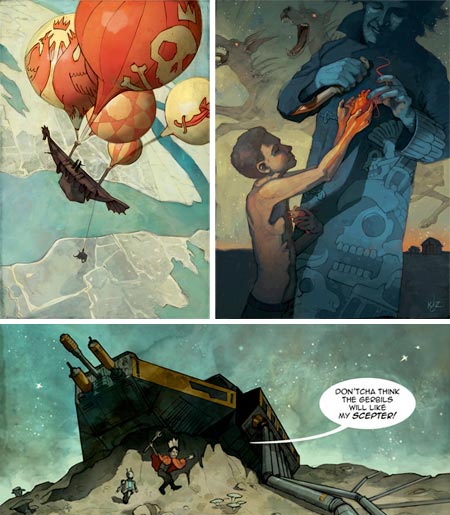
Kurt Huggins and Zelda Devon, collectively known as Teetering Bulb, are a an illustrator team living in Brooklyn. Their clients include Realms of Fantasy, Dover Publishing, Wizards of the Coast, Honest Tea and Tor.com.They are also creators of webcomics; and Tor.com, home of Tor publishing (se my post on Tor.com) is hosting their short story webcomic, The Dreaded Question, as well as a new fantasy story King of an Endless Sky (image above, bottom), which has just started.
The latter, presumably because it only has two episodes, is still lacking page to page navigation. [Addendum: this has been addressed (see this post’s comments), and the complete story is available from this page. As of this writing there are three pages, with new updates every Thursday.]
Their comics approach has a nice painted feeling, while still working within the traditional comics framework of color filled line drawings. Their illustration is more painterly, but still has a graphic, linear quality that gives it a particular visual charm.
Their blog features many of their works in various stages of creation, in addition to sketches, studies, anatomy drawings, and finished illustrations.
Their portfolio is basically a subset of blog posts, as are listings in the right hand column for sketchbooks and prints.
[Via LCSV4]
Categories:
-
A.D. – New Orleans After the Deluge
Though it’s been commonly accepted in Europe and Japan for may years, it’s finally creeping into common knowledge here in the U.S. that the medium of comics, or “graphic stories”, is not limited to — a: an audience of kids, and b: stories about steroid disasters in leotards grimacing and punching each other.
Comics is simply a medium, one that can be used to convey or talk about essentially anything, including reportage.
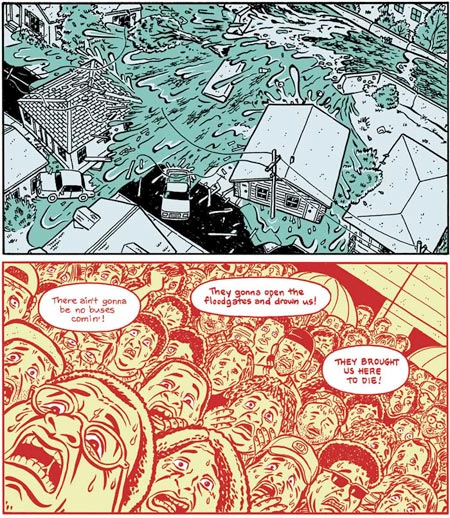
A.D. New Orleans After the Deluge is a graphic story about the disaster (both natural and political) of Hurricane Katrina and its aftermath.
The story is published by Smith Magazine and written and drawn by Josh Neufeld, a member of the ACT-I-VATE comics collective and author of The Vagabonds, with consulting and editing from Jeff Newlet and Miles VanMeter.
A.D. was initially published as a webcomic, which you can still read online at Smith Magazine, and has now been released in book format.
There is a video interview on the making of the story on YouTube.
[Via Salon]
Categories:
-
Vermeer’s Milkmaid in New York

It’s not that often that I get excited about the the occasion of a single painting crossing the Atlantic Ocean, except for those occasions when it happens to be one of the finest paintings by one of history’s finest painters, and particularly if that painter is Johannes Vermeer.Celebrating the 400th anniversary of the historic voyage of Henry Hudson (as in name of the river) from Amsterdam to New York (as in New Amsterdam), Vermeer’s The Milkmaid (De melkmeid, high resolution image here) will be on loan from Rijksmuseum in Amsterdam to the Metropolitan Museum of Art in New York from September 10 to November 29, 2009.
Historically, Vermeer’s works have not travelled often, though that seems to be happening more frequently these days, and The Milkmaid has not been on this side of the Atlantic since it was exhibited at the 1939 World’s Fair.
The painting, one of only 35 (give or take an attribution) by the enigmatic Dutch artist, is widely acknowledged to be one of his finest, and will be displayed in the company of the Met’s own astonishing collection of 5 Vermeers, including another pinnacle of his work (and my personal favorite), Young Woman with a Water Pitcher..
In both of these works, the humble subject of a woman pouring, or about to pour, liquid from one vessel to another is imbued with Vermeer’s almost magical command of light, pouring in through the vessel of a leaded glass window and drenching his physical objects in its liquid warmth.
The Girl With a Pearl Earring gets the glory because it has become a cultural icon, but it is in Vermeer’s more complete works like these that we see the master’s extraordinary abilities to best advantage.
The Met is also surrounding the Vermeers with works by Pieter de Hooch, Nicolaes Maes and other Vermeer contemporaries (see my post on Pieter de Hooch).
In addition, if you can make it to the exhibition, you are only a short distance from three more of Vermeer’s extraordinary paintings at the Frick Collection. Wow.
For more on Vermeer we can turn, as always, to Jonathan Janson’s amazing web resource, Essential Vermeer (and his related blog, Flying Fox).
Janson has just put the finishing touches on a terrific addition to this already dazzling resource with the Complete Catalog of the Paintings of Johannes Vermeer. This includes a notice for tracking all Vermeer paintings currently traveling, and has in-depth articles and interactive features on all of Vermeer’s known works. (I say known works because Vermeer fans are always hoping another will turn up in a dusty attic in Paris somewhere.)
Janson’s article/interactive on The Milkmaid has a rollover feature that goes into detail about various aspects of the painting and its contents, and there are numerous articles on related topics in other portions of the site. (See my previous posts on Jonathan Janson and The Essential Vermeer.)
So if you are in New York this Fall, and are inclined to experience the magic of light from the 17th Century, captured, distilled and bottled by Vermeer’s genius and released in your presence like a mist of poetry scented photons, here is your chance.
Categories:
-
Georgia O’Keeffe
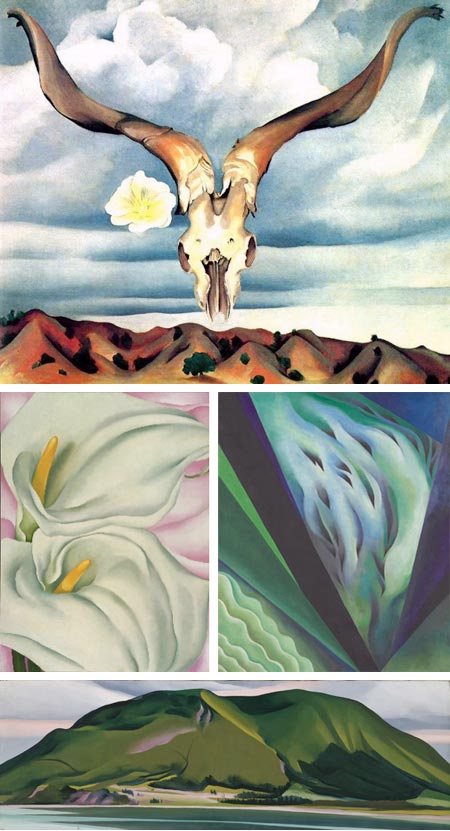
Though she had been given art lessons at home as a child, and followed a desire to be an artist into studies at the Art Institute of Chicago and The Art Student’s League in New York, where she studied with William Merritt Chase (see my post on William Merritt Chase), Georgia O’Keeffe stopped making art soon afterwards, frustrated with her work and direction in pursuing realistic painting.Four years later she encountered the artistic philosophy of Arthur Wesley Dow while taking a summer course for teachers at the University of Virginia, whose novel ideas insisted that the artist should create based on elements of color and line and the artist’s own inclinations rather than emulating nature. Freed from the constraints she felt in her academic training, she began to reinvestigate the possibilities of art.
A couple of years after that she produced a series of charcoal drawings that a friend of hers brought to the attention of renowned photographer and gallery owner Alfred Steiglitz, and the drawings were exhibited in Steiglitz’s New York gallery without O’Keeffe’s knowledge.
Steiglitz proceeded to convince O’Keeffe to move to New York and pursue painting full time. Steiglitz and O’Keeffe married several years later and were one of the most celebrated artistic collaborations of the 20th Century. Steiglitz produced a remarkable body of portraits of O’Keeffe over the course of their life together and was an indefatigable supporter and promoter of her work.
In New York, O’Keeffe painted large scale canvasses of flowers (for which there was much speculation of sexual suggestion in the imagery), saying later, “I decided that if I could paint that flower in a huge scale, you could not ignore its beauty.”
O’Keef begain spending her summers in New Mexico, producing works inspired by the desert landscape and the light and color of the southwest, along with still lifes and other subjects that reached across the boundaries of representational and nonrepresentational art.
O’Keeffe received both popular and critical acclaim in her lifetime and remains one of the major figures of 20th Century American art.
If you get a chance to see her work in person, you will see how her approach and her use of scale can do one of the things art does best, encourage you to stop and look at things with fresh eyes.
There is an extensive list of museums with her work in their collections on Artcyclopedia.
[Thanks to Bram from Raised by Squirels for correcting my major “O’Keefe” (one “f”) typo, title and everything.]
Categories:
-
Kunstbar

One of animated films that I discovered through Irene Gallo’s Saturday Morning Cartoons listing (see my previous post) delighted me in particular, Kunstbar, by Steve Whitehouse and a group of associates that call themselves The Petrie Lounge. The group includes Denis Gonzalez, John Halfpenny, Chris Labonte and Paul Teglas.“Kunst” is the word for “art” in German, Dutch, Norwegian, Danish and Estonain. The Kunstbar we encounter is apparently on a side street off one of Giorgio DeChirico’s perspective defying plazas, and is frequented by artistes whose taste in drinks is, um… interesting.
The menu consists of drinks named after artists, a common enough practice, but here the Petrie Lounge crew has taken that idea literally and the drinks are in the spirit of the artist in more than name. Our intrepid protagonist, apparently a dedicated art lover, tries several, much to his detriment and our amusement.
This stylish animated short is a delight for lovers of art and animation alike, so stop by the Kunstbar for a short one.
Oh, and don’t order the Bosch.
Categories:
-
Saturday Morning Cartoon Index
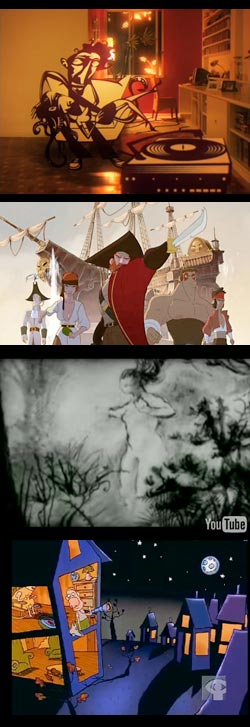 In addition to her own terrific blog, The Art Department (required reading for anyone interested in science fiction and fantasy illustration), her contributions to the Tor.com blog, and of course her ongoing work in bringing the best and brightest lights in the field to print in her role as art director at Tor Books, Irene Gallo (see my posts about Irene Gallo and Tor Books) brings her sharp eye to bear in another way we benefit from.
Each Saturday she makes another astute selection of two short animated films worthy of our attention and posts them to her Saturday Morning Cartoon Index on the Tor site.
These shorts are from a variety of creators and sources (though many are sponsored by the national Film Board of Canada), and traverse the spectrum of subject matter, style, emotional tone, animation technique and cinematic direction.
They share one characteristic, they are all terrific examples of short form animation, and a treat to watch.
Gallo keeps the stew well stirred, mixing style and approaches from week to week and selection to selection. Sometimes the two choices for a given week share some common theme or characteristic, as in her matchup of Pyrats and The Tale of How (see my posts on The Tale of How).
There are many weeks of selections already posted, enough to keep you animated and amused for a number of weekdays, as well as looking forward to future Saturday mornings.
(Images at left, Tyger, Pyrats, Syrinx and Strange Invaders, see the Tor page for credits and details)
Categories:



Charley’s Picks
Bookshop.org
(Bookshop.org affilliate links; sales benefit independent bookshop owners; I get a small percentage to help support my work on Lines and Colors)
Carlson’s Guide to Landscape Painting
Drawing and Sketching in Pencil

Bridgman’s Complete Guide to Drawing from Life
Charley’s Picks
Amazon
(Amazon.com affiliate links; sales go to a larger yacht for Jeff Bezos; but I get a small percentage to help support my work on Lines and Colors)
Carlson’s Guide to Landscape Painting
Drawing and Sketching in Pencil
Bridgman’s Complete Guide to Drawing from Life