


Categories
- 3d CGI
- Amusements
- Animation
- Anime & Manga
- Art Materials
- Art Videos
- Blogroll
- Cartoons
- Color
- Comics
- Concept & Visual Dev.
- Creativity
- Digital Art
- Digital Painting
- Displaying Art on the Web
- Drawing
- Eye Candy for Today
- Gallery and Museum Art
- High-res Art Images
- Illustration
- Motion Graphics & Flash
- Museums
- Online Museums
- Outsider Art
- Painting
- Painting a Day
- Paleo Art
- Pastel, Conté & Chalk
- Pen & Ink
- Prints and Printmaking
- Reviews
- Sc-fi and Fantasy
- Sculpture & Dimensional
- Site Comments
- Sketching
- Storyboards
- Tools and Techniques
- Uncategorized
- Vector Art
- Videos & Podcasts
- Vision and Optics
- Watercolor and Gouache
- Webcomics
Archives
- May 2026
- April 2026
- March 2026
- February 2026
- January 2026
- December 2025
- November 2025
- October 2025
- September 2025
- August 2025
- July 2025
- June 2025
- May 2025
- January 2025
- December 2024
- November 2024
- October 2024
- September 2024
- August 2024
- June 2024
- April 2024
- March 2024
- February 2024
- January 2024
- December 2023
- November 2023
- October 2023
- September 2023
- August 2023
- July 2023
- May 2023
- April 2023
- March 2023
- February 2023
- January 2023
- December 2022
- November 2022
- September 2022
- August 2022
- July 2022
- June 2022
- May 2022
- April 2022
- March 2022
- February 2022
- January 2022
- December 2021
- November 2021
- October 2021
- September 2021
- August 2021
- July 2021
- June 2021
- May 2021
- April 2021
- March 2021
- February 2021
- January 2021
- December 2020
- November 2020
- October 2020
- September 2020
- August 2020
- July 2020
- June 2020
- May 2020
- April 2020
- March 2020
- February 2020
- January 2020
- December 2019
- November 2019
- October 2019
- September 2019
- August 2019
- July 2019
- June 2019
- May 2019
- April 2019
- March 2019
- February 2019
- January 2019
- December 2018
- November 2018
- October 2018
- September 2018
- August 2018
- July 2018
- June 2018
- May 2018
- April 2018
- March 2018
- February 2018
- January 2018
- December 2017
- November 2017
- October 2017
- September 2017
- August 2017
- July 2017
- June 2017
- May 2017
- April 2017
- March 2017
- February 2017
- January 2017
- December 2016
- November 2016
- October 2016
- September 2016
- August 2016
- July 2016
- June 2016
- May 2016
- April 2016
- March 2016
- February 2016
- January 2016
- December 2015
- November 2015
- October 2015
- September 2015
- August 2015
- July 2015
- June 2015
- May 2015
- April 2015
- March 2015
- February 2015
- January 2015
- December 2014
- November 2014
- October 2014
- September 2014
- August 2014
- July 2014
- June 2014
- May 2014
- April 2014
- March 2014
- February 2014
- January 2014
- December 2013
- November 2013
- October 2013
- September 2013
- August 2013
- July 2013
- June 2013
- May 2013
- April 2013
- March 2013
- February 2013
- January 2013
- December 2012
- November 2012
- October 2012
- September 2012
- August 2012
- July 2012
- June 2012
- May 2012
- April 2012
- March 2012
- February 2012
- January 2012
- December 2011
- November 2011
- October 2011
- September 2011
- August 2011
- July 2011
- June 2011
- May 2011
- April 2011
- March 2011
- February 2011
- January 2011
- December 2010
- November 2010
- October 2010
- September 2010
- August 2010
- July 2010
- June 2010
- May 2010
- April 2010
- March 2010
- February 2010
- January 2010
- December 2009
- November 2009
- October 2009
- September 2009
- August 2009
- July 2009
- June 2009
- May 2009
- April 2009
- March 2009
- February 2009
- January 2009
- December 2008
- November 2008
- October 2008
- September 2008
- August 2008
- July 2008
- June 2008
- May 2008
- April 2008
- March 2008
- February 2008
- January 2008
- December 2007
- November 2007
- October 2007
- September 2007
- August 2007
- July 2007
- June 2007
- May 2007
- April 2007
- March 2007
- February 2007
- January 2007
- December 2006
- November 2006
- October 2006
- September 2006
- August 2006
- July 2006
- June 2006
- May 2006
- April 2006
- March 2006
- February 2006
- January 2006
- December 2005
- November 2005
- October 2005
- September 2005
- August 2005
Relevant Blogs
Art, Painting & Sketch
- Gurney Journey
- Underpaintings
- Art and Influence
- Painting Perceptions
- Oil Painters of America
- Vasari Paint POV
- Flying Fox
- Urban Sketchers
- Bento (Smithsonian)
- Art Inconnu
- The Hidden Place
- Still Life
- Making a Mark
- The Art of the Landscape
- Exploring Color & Creativity
- Art Contrarian
- Artist A Day
- beinArt Surreal Art Collective
- Eye Level
- David Dunlop
- p.i.g.m.e.n.t.i.u.m
- CultureGrrl
- Joaquín Sorolla blog
- Artists in Pastel
“Painting a Day”
- A Painting a Day (Keiser)
- On Painting (Keiser)
- Julian Merrow-Smith
- Karen Jurick
- Jeffrey Hayes
- Carol Marine
- Abbey Ryan
- Daily Paintworks
Other Painting Blogs
- Virtual Gouache Land
- Neil Hollingsworth
- Marc Hanson
- Kevin Menck
- Marc Dalessio
- Larry Seiler
- Stapleton Kearns
- Colin Page
- Roos Schuring
- Hans Versfelt
- Titus Meeuws
- Régis Pettinari
- René Plein Air
- Belinda Del Pesco
- Robin Weiss
- Nathan Fowkes (Land Sketch)
- William Wray
- Frank Serrano
- Stephen Magsig
- Michael Chesley Johnson
- Twice a Week
- Sarah Wimperis
- Rob Adams
- Michael Cole Manley
- The Dirty Palette Club
- Mike Manley’s Draw!
Gallery Art & Illustration mix
Illustration
- Howard Pyle
- 100 Years of Illustration
- BibliOdyssey
- Illustration Art
- Today’s Inspiration
- Illustration Mundo
- Little Chimp Society
- Danny Gregory
- R D (John Martz
- Illustration Friday blog
- Monster Brains
- Illustrators & Illustrations (RU)
- Elwood H. Smith
- DaniDraws.com
- Designers Who Blog
- iSpot Blog
Sci-Fi & Fantasy
Illustration & Comics
Comics & Cartoons
- Comics Beat
- Robot 6
- Newsarama Blog
- Comic Vine
- Comics Alliance
- Forbidden Planet Int.
- Paolo Rivera
- Bolt City
- Flight
- Scott McCloud
- The Comics Journal
- Comixpedia
- Funnybook Babylon
- James Baker
- Middleton’s Sketchbook
- Boneville
- The Hotel Fred
- Paul Rivoche
- Daily Cartoonist
- Mad About Cartoons (William Wray)
- Digital Strips
Illustration & Concept
Animation & Concept
- Cartoon Brew
- Animation Blog
- Cold Hard Flash
- Concept Art World
- The CAB
- FY Concept Art
- Concept Ships
- Concept Robots
- John Nevarez
- Armand Serrano
- Marcos Mateu-Mestre
- all kinds of stuff (Kricfalusi)
- Yacin the faun (Man Arenas)
- Kelsey Mann
- Cre8tivemarks Blog
- Ice-Cream Monster Toon Cafe
- AAU Character & Creature Design
- AAU Animation Notes
- Articles and Texticles
Paleo & Scientific
Tools & Techniques
Other
Lists of Art Blogs
Art Image Resource Links
Historic Art Images
- Wikimedia Commons: Paintings
- Wikimedia Commons: Drawings
- The Athenaeum
- WikiArt (WikiPaintings)
- Google Art Project: Artists
- Google Art Project: Collections (Museums)
- ArtCyclopedia
- Web Gallery of Art
- Art Renewal Center
- Web Gallery of Impressionism
Auction Consolidation sites
Auction sites
- Sotheby’s
- Bonham’s
- Christies
- Heritage Auctions: Fine Art
- Heritage Auctions: Illustration
- Freeman’s Auctions
- Bukowskis
- Shannon’s
Image Search
Reverse Image Search (search by image)
- Tin Eye
- RevImg
- Google Image Search (camera icon)
- Bing Image Search (camera icon)
Promoting some friends and some clients of my website design business
- Twin Willows T’ai Chi studio in Wilmington DE. Taiji classes with Bryan Davis.
- Ray Hayward, Inspired Teacher of T’ai Chi ( Taiji ) in Minneapolis, Founder of Mindful Motion Tai Chi Academy
- OldHead Tattoo studio and Art Gallery in Wilmington DE. Tattoos and paintings by Bruce Gulick
- Sharon Domenico Art, pet portrait oil paintings
- Platinum Paperhanging, wallpaper hanging, Main Line and Philadelphia, PA
- Lisa Stone Design, interior designer, Main Line and Philadelphia, PA
- Studio12KPT, original art, prints, calendars and other custom printed items by Van Sickle & Rolleri
-
J. Alden Weir
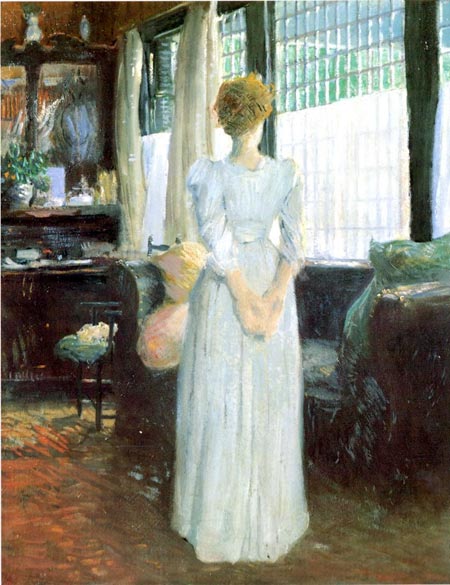
Julian Alden Weir, more commonly called J. Alden Weir, was one of the wonderfully diverse group of artists that get lumped together under the catch-all heading of “American Impressionists”.Weir was a member of The Ten American Painters, a loosely tied group of painters in New York and Boston who broke away from the Society of American Artists, which was itself a splinter group from the National Academy of Design. His compatriots in the Ten included Childe Hassam, Robert Reid, Willard Metcalf, Frank Benson, Edmund Tarbell, Thomas Wilmer Dewing, and eventually, William Merrit Chase.
Most important among them for Weir was John Henry Twatchman, with whom Weir formed a long lasting friendship. The two artists painted together, often exhibited together, and were both teachers at the Art Students League in New York. Weir also taught at, and was a member of, the Cos Cob Art Colony, an artists community that sprang up around Twatchman’s home in Greenwich, CT, along with Hassam, Theodore Robinson and Robert Reid.
Members of the Cos Cob Colony were involved with the staging of the 1913 Armory Show, famous now for introducing European modernist art to America; over which Weir resigned from his presidency of the Association of Painters and Sculptors.
As a student, Weir trained at the National Academy of Design, and then in Paris at the École des Beaux-Arts, where he studied with Jean-Léon Gérôme and was friends with Jules Bastien-Lepage, who became something of a mentor.
When he returned form Europe Weir intended to make his living painting portraits, but was unsuccessful in obtaining portrait commissions for some time, so many of his portrait works from the time are of family and friends.
Weir’s style and approach changed dramatically over the course of his career, from traditional landscapes that have a feeling of Corot and Courbet and portraits influenced by Manet, to later works in which he came to adopt some of the stylistic characteristics of French Impressionism (which he at first despised), and a continuing influence from his fondness for Japanese prints.
He was also influenced by Twatchman’s tonalist aproach, possibly also the result of meeting Whistler in London before returning to the U.S. after his time in France. There was also the tonalist influence of his friendship with Albert Pinkham Ryder. Weir’s older brother, John Ferguson Weir, who I can find little info on, was also a painter, working somewhat in the tradition of the Barbizon School.
J. Alden Weir’s intimate interior scenes often put me in mind of those of Edmund Tarbell and Childe Hassam, with their muted light and tactile feeling for wood and cloth.
In his later career, Weir didn’t share his friends’ enthusiasm for traveling to paint in various locations, preferring to remain on his Connecticut farm, which is now a National Historic Site.
In his Impressionist influenced works, Weir sometimes breaks up his canvas into the short strokes of brilliant color associated with the style of Monet, Sisley and Pissarro, but just as often uses rough scumbling to achieve his broken color, giving his canvasses a fascinating textural quality.
Like a number of the other painters labeled American Impressionists, Weir didn’t feel the need to follow the lead of his French counterparts in throwing out the academic traditions of drawing and solidity of form; and his style is often a delightful blend of the two seemingly contrary artistic factions, which is one of the reasons I find Weir and the other American painters of his circle so appealing.
Categories:
-
Vincenzo Camuccini

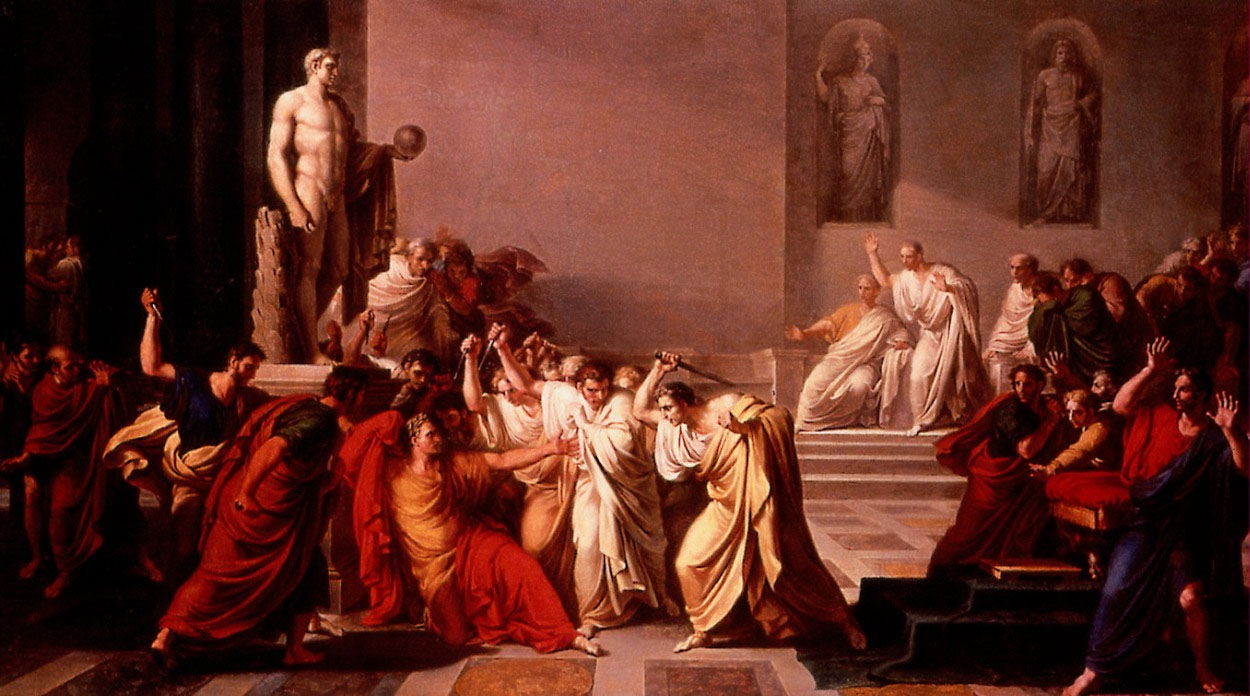
Today is the “Ides of March” or March 15th, the anniversary of the date in 44BC when a group of Roman senators assassinated Julius Caesar; whose lust for power had prompted him to declare himself absolute ruler for life (i.e. dictator), and thus threatened the senators’ power (more important, of course, than the welfare of the Roman citizenry, but it threatened that as well).Personally, I think the Ides of March should be a worldwide holiday, in which power hungry leaders everywhere should be reminded to watch their step, perhaps with the circulation of images like Vincenzo Camuccini’s Death of Julius Caesar.
Camuccini was an Italian painter active in the late 18th and early 19th Centuries, and was considered the foremost Italian academic painter of his time. He was a neoclassicist, like his French contemporary David, painting histories, such as the aforementioned demise of ol’ Julius, and portraits of eminent members of society.
Camuccini spent the early part of his career copying the masters, particularly Raphael. His own style, while considered more refined than original, eventually gained him popularity and made him rich enough to allow him to collect a large number of works by other artists, including Raphael’s Madonna of the Pinks.
Camuccini’s Death of Julius Caesar is staged as a tableau rather than an intimate drama, but his portrayal of Caesar is reliably accurate, as it is based on an existing bust of Caesar from Caesar’s time, one of the first examples we have of direct realistic portrait sculpture of a known individual.
The death scene and Camuccini’s self-portrait are about the only paintings of his you’ll see widely reproduced, but his death scene is often used to illustrate the event, and/or mention of it in Shakespeare’s play.
Where most portraits of leaders are monuments to power, the Death of Julius Caesar is a monument to the limits and end of overreaching power, a far nobler subject in my estimation. So to all of the world’s leaders (and so-called leaders), I wish you a careful, thoughtful and warily observant Ides of March!
Categories:
-
J.P. Targete

How about some nice monsters and warriors for a Friday diversion?J.P. Targete paints wonderfully textured imaginary worlds populated with snarling monsters, glowering demons, deranged warriors, power-mad wizards, seething dragons, jealous witches and all manner of fun beasties and grotesqueries.
Targete is an illustrator, concept artist and art director for the publishing and gaming industries. While attending the School of Visual Art in New York on a full scholarship, Targete began illustrating book covers for Avon Books. Since then he has expanded his publishing client list to include Ace/Berkeley, Bantam, Warner Books, Eos and Tor. He won the A.S.F.A. Chesley award (named for pioneering space artist Chesley Bonestell) in 2000 for best paperback book cover.
His work has appeared in the Spectrum collections of contemporary fantastic art and a collection of his work, Illumina: the Art of JP Targete, was published by Paper Tiger in 2003.
In recent years Targete has been focusing on concept art for gaming companies and worked for NCSoft for a time, contributing to upcoming games like Tabula Rasa and Aion.
Targete is currently freelancing and, in addition to his other projects, is working on a graphic novel. He is also the instructor for a three part DVD from the Gnomon Workshop, Imaginative Illustration with J.P. Targete.
Targete works in a variety of media, oil, watercolor, acrylic and digital. His online gallery is divided into traditional paintings, digital paintings, two sections or concept art and a section of sketches.
Categories:
-
Walt Reed and Illustration House
 Illustration House is a venerable gallery, repository and auction house in New York that specializes in great illustration. It is the province of Walt Reed, who is probably the foremost expert on illustration that we have.
Reed is also the author of numerous definitive books on the subject, including The Illustrator in America, 1860-2000, Visions of Adventure: N. C. Wyeth and the Brandywine Artists and John Clymer: An artist’s rendezvous with the frontier West; as well as several excellent art instruction books from his association with the Famous Artist Schools, like The Figure: The Classic Approach to Drawing and Construction (this goes on the shelf next to your Andrew Loomis and George Bridgeman books), and a number of titles co-authored with others.
Some of his titles are sadly out of print, like Great American Illustrators and The Magic Pen of Joseph Clement Coll, but you can sometimes find them used.
In his role as curator and chief illustration expert and enthusiast at Illustration House, Reed created a focus for the interest in collecting great illustration that has become remarkably strong in the past few decades.
Though the gallery’s web site is kind of drab and left-over from he 90’s, it does feature succinct bios of some of the great Golden Age illustrators.
The really interesting part of the Illustration House site, though, is the previews of the seasonal auctions, for which images are posted of some of the finest illustration works that are currently available on the open market.
Usually linked from the bottom of the home page, you can choose links to View Lots, and get a list with thumbnails. The thumbnails aren’t linked, click on the lot numbers at the left for larger images of the works.
Here you will find an amazing treasure trove of great illustration, that just happens to be changing hands at the time. You’ll recognize many of the great names in illustration, including many that I’ve featured here on lines and colors.
The most recent auction, for example, includes pieces by Harry Anderson, John Berkey, Joseph Clement Coll, James Montgomery Flagg, Al Hirschfeld, Jeff Jones, Heinrich Kley, J.C. Leyendecker, Andrew Loomis, Al Parker, Howard Pyle, Maxfield Parrish, Norman Rockwell, Saul Steinberg, Haddon Sundblom and Gustaf Tenggren, along with many others. (The links are to my articles, I’m not linking directly to the auction posts because they change over time and will be replaced with newly offered pieces.)
Don’t miss the links at page top to subsequent pages, you can also choose at page bottom to view a linked text list by artist name.
Irene Gallo wrote a couple of nice posts (here and here) about the most recent auctions on her blog The Art Department.
If you have a few thousand extra dollars burning a hole in your pocket, and a blank wall begging for some of history’s greatest illustration art, Walt Reed’s Illustration House the place to go.
(Shown here, top to bottom: Gustaf Tenggren, Howard Pyle, J.C. Leyendecker, Harry Anderson, Heinrich Kley.)
Categories:
-
Nelson Shanks

It’s always seemed to me that portraiture is a particularly demanding type of painting, at least the kind of portraiture in which the artist is commissioned to create the portrait, as opposed to an artist who paints someone simply because they find them an interesting subject.Not only do you have the exacting demands of producing a likeness, which requires very careful observation and, depending on style, faithful reproduction of that likeness with careful draftsmanship and rendering; a commissioned portrait requires that the client, whether the individual themselves or someone related, be pleased with the result, which is an issue faced more often by illustrators than gallery artists.
If someone doesn’t like your landscape, they pass by in the gallery and you can sell it to someone else. A commissioned portrait has a very limited market.
Some artists thrive on the practice, though, and history’s great painters have included numerous portrait painters.
The modern practice doesn’t get as much attention as some other types of painting, but there are portraits artists who are at the top of the game and get a great deal of respect from other artists as well as their from their patrons.
Nelson Shanks is one of the latter. With a background in academic art training that he “pieced together” from various teachers and sources, both here and in Europe, Shanks has established himself not only as one one of the country’s premiere portrait painters, but also as one of the major proponents of classical realism.
Shanks, along with his wife Leona Shanks, is the founder of Studio Incamminati, an atelier style teaching program here in Philadelphia, which focuses on the principles of classical realism.
Shanks’ commissioned portraits include such notable figures as former presidents Bill Clinton and Ronald Regan, Pope John Paul II, Margaret Thatcher, Princess Diana, King Gustav and Queen Silvia of Sweden, Queen Julianna of the Netherlands, Luciano Pavarotti and numerous CEOs and chairmen of boards, including those of the Museum of Modern Art, the Metropolitan Museum of Art and the New York Times.
His web site has a few of these portraits, as well as figure paintings and a few other subjects, but the images are frustratingly small. There is a selection of larger images on the Art Renewal Center, which also has a separate article on him as a “modern master”, Nelson Shanks, Humanist Realist.
Personally, I’m more interested in his figure painting, which is superb, and his portraits of non-famous individuals, in which you can more clearly see the painter as a painter, rather than as a painter in that particular role of portrait painter of notable figures. It is here, I think, and in those rare excursion into landscape, and particularly interior scenes, where Shanks shines.
Categories:
-
Niko Henrichon

Niko Henrichon is a Canadian comic book artist who has recently moved to France. He has done work for American publishers Marvel Comics, Dark Horse and DC/Vertigo, including Barnum!: In Secret Service to the USA with writers Howard Chaykin and David Tischman, and The Sandman Presents: Taller Tales with Bill Willingham and Spider-Man Fairy Tales.He is best known for his collaboration with writer Brian K. Vaughan on the graphic story Pride of Baghdad, art from which is currently on display in the LitGraphic: The World of the Graphic Novel exhibit at the Norman Rockwell Museum.
Henrichon is a contributor to the second 24Seven comics anthology and worked with 24Seven creator Ivan Brandon for a five-issue arc of Machine Man that will run in Marvel Comics Presents starting with #8 this April. He is also a guest artist for Fables #70 from DC/Vertigo, and recently worked on a European project called Unleash.
Henrichon also created Fantastico, a personal comics project, from which the images above were taken.
His blog also serves as his web site, with three pages marked out for Illustrations, Comics and Sketchbook. You’ll also find many more pieces linked from smaller images in the blog posts themselves.
Henrichon has a refreshingly open style that is somewhere between mainstream American comics and European comics, perhaps leaning to the European side; with fewer spotted blacks and less hatching than most mainstream American comics artists and an emphasis on defining form with color, but without heavy modeling.
I find it hard to pin down, but there is something about the unassuming qualities of Henrichon’s work that I find particularly appealing, a sort of innocent charm in the way he delineates his figures. You get the feeling that his drawing style has evolved naturally out of drawing what he likes, and hasn’t been forced into a particular genre. Somehow, he impresses by not trying too hard to impress.
Categories:




Charley’s Picks
Bookshop.org
(Bookshop.org affilliate links; sales benefit independent bookshop owners; I get a small percentage to help support my work on Lines and Colors)

John Singer Sargent: Watercolors


Urban Sketching: Understanding Perspective



_l.jpg)


Charley’s Picks
Amazon
(Amazon.com affiliate links; sales go to a larger yacht for Jeff Bezos; but I get a small percentage to help support my work on Lines and Colors)
John Singer Sargent: Watercolors
Urban Sketching: Understanding Perspective