


Categories
- 3d CGI
- Amusements
- Animation
- Anime & Manga
- Art Materials
- Art Videos
- Blogroll
- Cartoons
- Color
- Comics
- Concept & Visual Dev.
- Creativity
- Digital Art
- Digital Painting
- Displaying Art on the Web
- Drawing
- Eye Candy for Today
- Gallery and Museum Art
- High-res Art Images
- Illustration
- Motion Graphics & Flash
- Museums
- Online Museums
- Outsider Art
- Painting
- Painting a Day
- Paleo Art
- Pastel, Conté & Chalk
- Pen & Ink
- Prints and Printmaking
- Reviews
- Sc-fi and Fantasy
- Sculpture & Dimensional
- Site Comments
- Sketching
- Storyboards
- Tools and Techniques
- Uncategorized
- Vector Art
- Videos & Podcasts
- Vision and Optics
- Watercolor and Gouache
- Webcomics
Archives
- July 2026
- June 2026
- May 2026
- April 2026
- March 2026
- February 2026
- January 2026
- December 2025
- November 2025
- October 2025
- September 2025
- August 2025
- July 2025
- June 2025
- May 2025
- January 2025
- December 2024
- November 2024
- October 2024
- September 2024
- August 2024
- June 2024
- April 2024
- March 2024
- February 2024
- January 2024
- December 2023
- November 2023
- October 2023
- September 2023
- August 2023
- July 2023
- May 2023
- April 2023
- March 2023
- February 2023
- January 2023
- December 2022
- November 2022
- September 2022
- August 2022
- July 2022
- June 2022
- May 2022
- April 2022
- March 2022
- February 2022
- January 2022
- December 2021
- November 2021
- October 2021
- September 2021
- August 2021
- July 2021
- June 2021
- May 2021
- April 2021
- March 2021
- February 2021
- January 2021
- December 2020
- November 2020
- October 2020
- September 2020
- August 2020
- July 2020
- June 2020
- May 2020
- April 2020
- March 2020
- February 2020
- January 2020
- December 2019
- November 2019
- October 2019
- September 2019
- August 2019
- July 2019
- June 2019
- May 2019
- April 2019
- March 2019
- February 2019
- January 2019
- December 2018
- November 2018
- October 2018
- September 2018
- August 2018
- July 2018
- June 2018
- May 2018
- April 2018
- March 2018
- February 2018
- January 2018
- December 2017
- November 2017
- October 2017
- September 2017
- August 2017
- July 2017
- June 2017
- May 2017
- April 2017
- March 2017
- February 2017
- January 2017
- December 2016
- November 2016
- October 2016
- September 2016
- August 2016
- July 2016
- June 2016
- May 2016
- April 2016
- March 2016
- February 2016
- January 2016
- December 2015
- November 2015
- October 2015
- September 2015
- August 2015
- July 2015
- June 2015
- May 2015
- April 2015
- March 2015
- February 2015
- January 2015
- December 2014
- November 2014
- October 2014
- September 2014
- August 2014
- July 2014
- June 2014
- May 2014
- April 2014
- March 2014
- February 2014
- January 2014
- December 2013
- November 2013
- October 2013
- September 2013
- August 2013
- July 2013
- June 2013
- May 2013
- April 2013
- March 2013
- February 2013
- January 2013
- December 2012
- November 2012
- October 2012
- September 2012
- August 2012
- July 2012
- June 2012
- May 2012
- April 2012
- March 2012
- February 2012
- January 2012
- December 2011
- November 2011
- October 2011
- September 2011
- August 2011
- July 2011
- June 2011
- May 2011
- April 2011
- March 2011
- February 2011
- January 2011
- December 2010
- November 2010
- October 2010
- September 2010
- August 2010
- July 2010
- June 2010
- May 2010
- April 2010
- March 2010
- February 2010
- January 2010
- December 2009
- November 2009
- October 2009
- September 2009
- August 2009
- July 2009
- June 2009
- May 2009
- April 2009
- March 2009
- February 2009
- January 2009
- December 2008
- November 2008
- October 2008
- September 2008
- August 2008
- July 2008
- June 2008
- May 2008
- April 2008
- March 2008
- February 2008
- January 2008
- December 2007
- November 2007
- October 2007
- September 2007
- August 2007
- July 2007
- June 2007
- May 2007
- April 2007
- March 2007
- February 2007
- January 2007
- December 2006
- November 2006
- October 2006
- September 2006
- August 2006
- July 2006
- June 2006
- May 2006
- April 2006
- March 2006
- February 2006
- January 2006
- December 2005
- November 2005
- October 2005
- September 2005
- August 2005
Relevant Blogs
Art, Painting & Sketch
- Gurney Journey
- Underpaintings
- Art and Influence
- Painting Perceptions
- Oil Painters of America
- Vasari Paint POV
- Flying Fox
- Urban Sketchers
- Bento (Smithsonian)
- Art Inconnu
- The Hidden Place
- Still Life
- Making a Mark
- The Art of the Landscape
- Exploring Color & Creativity
- Art Contrarian
- Artist A Day
- beinArt Surreal Art Collective
- Eye Level
- David Dunlop
- p.i.g.m.e.n.t.i.u.m
- CultureGrrl
- Joaquín Sorolla blog
- Artists in Pastel
“Painting a Day”
- A Painting a Day (Keiser)
- On Painting (Keiser)
- Julian Merrow-Smith
- Karen Jurick
- Jeffrey Hayes
- Carol Marine
- Abbey Ryan
- Daily Paintworks
Other Painting Blogs
- Virtual Gouache Land
- Neil Hollingsworth
- Marc Hanson
- Kevin Menck
- Marc Dalessio
- Larry Seiler
- Stapleton Kearns
- Colin Page
- Roos Schuring
- Hans Versfelt
- Titus Meeuws
- Régis Pettinari
- René Plein Air
- Belinda Del Pesco
- Robin Weiss
- Nathan Fowkes (Land Sketch)
- William Wray
- Frank Serrano
- Stephen Magsig
- Michael Chesley Johnson
- Twice a Week
- Sarah Wimperis
- Rob Adams
- Michael Cole Manley
- The Dirty Palette Club
- Mike Manley’s Draw!
Gallery Art & Illustration mix
Illustration
- Howard Pyle
- 100 Years of Illustration
- BibliOdyssey
- Illustration Art
- Today’s Inspiration
- Illustration Mundo
- Little Chimp Society
- Danny Gregory
- R D (John Martz
- Illustration Friday blog
- Monster Brains
- Illustrators & Illustrations (RU)
- Elwood H. Smith
- DaniDraws.com
- Designers Who Blog
- iSpot Blog
Sci-Fi & Fantasy
Illustration & Comics
Comics & Cartoons
- Comics Beat
- Robot 6
- Newsarama Blog
- Comic Vine
- Comics Alliance
- Forbidden Planet Int.
- Paolo Rivera
- Bolt City
- Flight
- Scott McCloud
- The Comics Journal
- Comixpedia
- Funnybook Babylon
- James Baker
- Middleton’s Sketchbook
- Boneville
- The Hotel Fred
- Paul Rivoche
- Daily Cartoonist
- Mad About Cartoons (William Wray)
- Digital Strips
Illustration & Concept
Animation & Concept
- Cartoon Brew
- Animation Blog
- Cold Hard Flash
- Concept Art World
- The CAB
- FY Concept Art
- Concept Ships
- Concept Robots
- John Nevarez
- Armand Serrano
- Marcos Mateu-Mestre
- all kinds of stuff (Kricfalusi)
- Yacin the faun (Man Arenas)
- Kelsey Mann
- Cre8tivemarks Blog
- Ice-Cream Monster Toon Cafe
- AAU Character & Creature Design
- AAU Animation Notes
- Articles and Texticles
Paleo & Scientific
Tools & Techniques
Other
Lists of Art Blogs
Art Image Resource Links
Historic Art Images
- Wikimedia Commons: Paintings
- Wikimedia Commons: Drawings
- The Athenaeum
- WikiArt (WikiPaintings)
- Google Art Project: Artists
- Google Art Project: Collections (Museums)
- ArtCyclopedia
- Web Gallery of Art
- Art Renewal Center
- Web Gallery of Impressionism
Auction Consolidation sites
Auction sites
- Sotheby’s
- Bonham’s
- Christies
- Heritage Auctions: Fine Art
- Heritage Auctions: Illustration
- Freeman’s Auctions
- Bukowskis
- Shannon’s
Image Search
Reverse Image Search (search by image)
- Tin Eye
- RevImg
- Google Image Search (camera icon)
- Bing Image Search (camera icon)
Promoting some friends and some clients of my website design business
- Twin Willows T’ai Chi studio in Wilmington DE. Taiji classes with Bryan Davis.
- Ray Hayward, Inspired Teacher of T’ai Chi ( Taiji ) in Minneapolis, Founder of Mindful Motion Tai Chi Academy
- OldHead Tattoo studio and Art Gallery in Wilmington DE. Tattoos and paintings by Bruce Gulick
- Sharon Domenico Art, pet portrait oil paintings
- Platinum Paperhanging, wallpaper hanging, Main Line and Philadelphia, PA
- Lisa Stone Design, interior designer, Main Line and Philadelphia, PA
- Studio12KPT, original art, prints, calendars and other custom printed items by Van Sickle & Rolleri
-
Cartoon Color Wheel
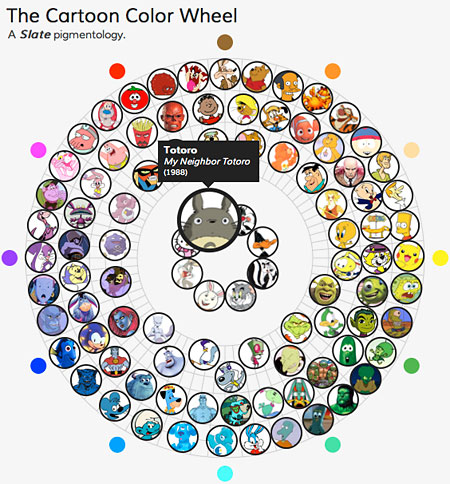
Here’s a fun notion; the Slate Magazine blog, Culturebox, has put together an interactive color wheel of cartoon characters arranged by their hue (and, correctly enough, by intensity, as indicated by our grayish friends at the center of the wheel).In the original, you can mouse over the characters for identification.
[Via Cartoon Brew]
Categories:
-
Femke Hiemstra

Dutch artist Femke Hiemstra paints her richly detailed and wonderfully textural paintings of animals (anthropomorphic and otherwise), odd characters and fantastical landscapes on found objects. Her odd shaped “canvases” are the covers of old books, wooden holy water fonts and antique wooden panels.Her mixed media pieces also include typography, sometimes completing the illusion that the antique book on the surface of which she is painting, for example, is a real but very different book.
Hiemstra studied illustration at the School of Arts in Utrecht and “Illustration and Visualizing” at the School of Graphic Arts in Amsterdam, where she currently lives and works.
Her mixed media technique includes thin layers of acrylic and water, colored pencils and sometimes chalk and oil crayons.
Heimstra is part of a three person show at Merry Karnowsky Gallery that is on view until August 27, 2011.
[Via beinArt Collective]
Categories:
-
Augustin Lesage

Augustin Lesage was a French painter associated with “outsider art” (L’Art Brut), art created outside of normal cultural definitions.A coal miner from the age of 14, Lesage supposedly heard a voice deep in the mine say “One day you’ll be a painter!”, followed by a succession of other voices, some of which he took to be the voice of his sister Mary, who died at the age of three.
He began with “automatic drawing”, a practice the Surrealists employed to produce art directly form the subconscious, but one also associated with communicating with the departed by spiritualists. He moved from there into painting, guided by the voices, and began to produce large scale canvasses in which he explored kalidoscopic images, repetitions of surface patterns and themes of spiritualism and symbolism.
Most of the images in this post, and those in many of the resources I list below, came from shawna-bo-bonna’s Flickr stream.
The two images above, bottom, which are both titled A symbolic Composition of the Spiritual World but were done two years apart, became the inspiration for animations created in 2010 by Max Hattler (see my previous post 1923 aka Heaven and 1925 aka Hell by Max Hattler).
Categories:
-
1923 aka Heaven and 1925 aka Hell by Max Hattler

1923 aka Heaven (images above, top five) and 1925 aka Hell (above, bottom 5) are two animated film by Max Hattler that were inspired by two paintings by French outsider artist Augustin Lesage.The two paintings are both named A symbolic Composition of the Spiritual World, one painted in 1923 (above, middle left) and one in 1925 (middle right).
Hattler’s animation loops are just that, motion and sound, no story, and they repeat phrases and sequences with variations in color and other characteristics. They are exercises in rythym, pattern repetition and recursion. They were created over a five day period with students at the Animation Workshop in Viborg , Denmark.
You can see more of Hattler’s animations on his website; I’ll try to post more about Augustin Lesage in an upcoming post.
[Via DATAISNATURE and MetaFilter]
Categories:
-
1896 Paintings on Wikimedia Commons

Lets set the Wayback Machine and take a walk through the year 1896 by way of the Wikimedia Commons page for that category.
Yes, the image quality is uneven, but there are gems to be found, and this is just a selection from the introductory page for this category. You can drill down into subcategories, and of course into listings for individual artists.
For more on browsing image resources on Wikimedia Commons, see my post from 2010.
(Images above: Daniel Ridgeway Knight, Albert Anker, Ivan Shishkin, Alfons Mucha, Ilya Repin, Carl Schuster, James Jabusa Shannon, John William Waterhouse, Anders Zorn, Kryzhitsky Ozero, Viktor Vasnetsov)
Categories:
-
Charles E. Williams II
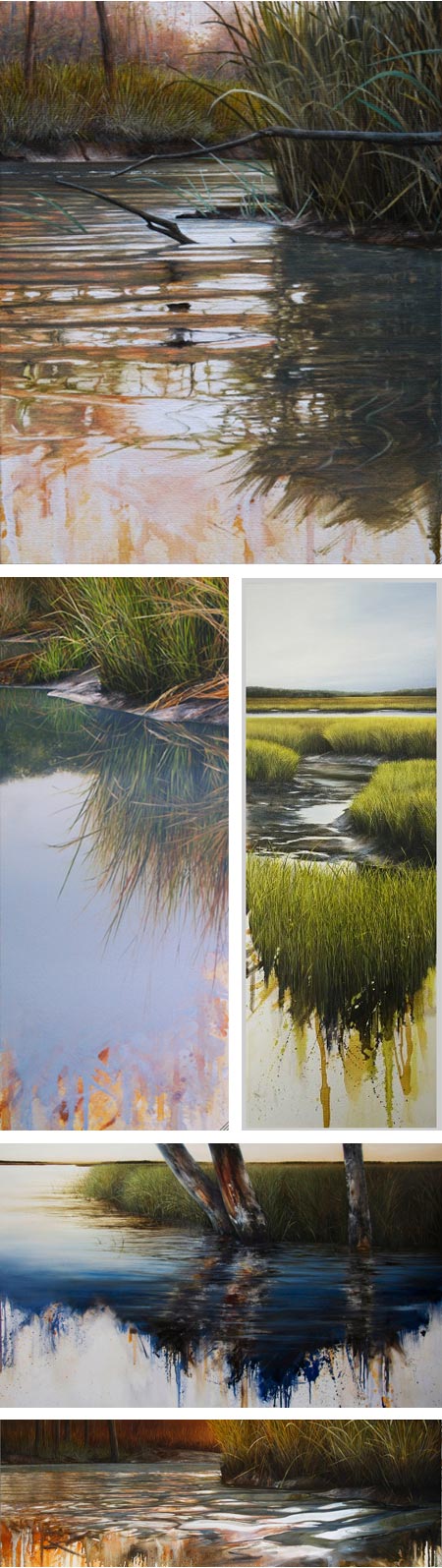
I’ve always been fascinated with works of realism in which the representational image, which presents an illusion of reality, transitions to obvious marks on paper or paint strokes on canvas at the edges, allowing us to see both the drawn or painted illusion and the reality of marks on a surface in the same image.In many of the paintings of Charles E. Williams II, this effect is pronounced and takes the form of dripped paint marks at the bottom edges of his compositions, which are often of scenes involving creeks, streams or other bodies of water.
The effect is striking, highlighting both our perceptions of three dimensional scenes on a two dimensional surface, and Williams’ skills as a realist painter, without which the effect would be negligible.
Williams was born and is based in South Carolina; he studied fine art at the Savannah College of At and Design in Georgia.
In addition to his website, Williams posts his work to a blog, and you can also find galleries of his work on Bluecanvas and Robert Lange Studios.
[Via Escape Into Life]
Categories:




Charley’s Picks
Bookshop.org
(Bookshop.org affilliate links; sales benefit independent bookshop owners; I get a small percentage to help support my work on Lines and Colors)

John Singer Sargent: Watercolors


Urban Sketching: Understanding Perspective


Charley’s Picks
Amazon
(Amazon.com affiliate links; sales go to a larger yacht for Jeff Bezos; but I get a small percentage to help support my work on Lines and Colors)
John Singer Sargent: Watercolors
Urban Sketching: Understanding Perspective