


Categories
- 3d CGI
- Amusements
- Animation
- Anime & Manga
- Art Materials
- Art Videos
- Blogroll
- Cartoons
- Color
- Comics
- Concept & Visual Dev.
- Creativity
- Digital Art
- Digital Painting
- Displaying Art on the Web
- Drawing
- Eye Candy for Today
- Gallery and Museum Art
- High-res Art Images
- Illustration
- Motion Graphics & Flash
- Museums
- Online Museums
- Outsider Art
- Painting
- Painting a Day
- Paleo Art
- Pastel, Conté & Chalk
- Pen & Ink
- Prints and Printmaking
- Reviews
- Sc-fi and Fantasy
- Sculpture & Dimensional
- Site Comments
- Sketching
- Storyboards
- Tools and Techniques
- Uncategorized
- Vector Art
- Videos & Podcasts
- Vision and Optics
- Watercolor and Gouache
- Webcomics
Archives
- August 2026
- July 2026
- June 2026
- May 2026
- April 2026
- March 2026
- February 2026
- January 2026
- December 2025
- November 2025
- October 2025
- September 2025
- August 2025
- July 2025
- June 2025
- May 2025
- January 2025
- December 2024
- November 2024
- October 2024
- September 2024
- August 2024
- June 2024
- April 2024
- March 2024
- February 2024
- January 2024
- December 2023
- November 2023
- October 2023
- September 2023
- August 2023
- July 2023
- May 2023
- April 2023
- March 2023
- February 2023
- January 2023
- December 2022
- November 2022
- September 2022
- August 2022
- July 2022
- June 2022
- May 2022
- April 2022
- March 2022
- February 2022
- January 2022
- December 2021
- November 2021
- October 2021
- September 2021
- August 2021
- July 2021
- June 2021
- May 2021
- April 2021
- March 2021
- February 2021
- January 2021
- December 2020
- November 2020
- October 2020
- September 2020
- August 2020
- July 2020
- June 2020
- May 2020
- April 2020
- March 2020
- February 2020
- January 2020
- December 2019
- November 2019
- October 2019
- September 2019
- August 2019
- July 2019
- June 2019
- May 2019
- April 2019
- March 2019
- February 2019
- January 2019
- December 2018
- November 2018
- October 2018
- September 2018
- August 2018
- July 2018
- June 2018
- May 2018
- April 2018
- March 2018
- February 2018
- January 2018
- December 2017
- November 2017
- October 2017
- September 2017
- August 2017
- July 2017
- June 2017
- May 2017
- April 2017
- March 2017
- February 2017
- January 2017
- December 2016
- November 2016
- October 2016
- September 2016
- August 2016
- July 2016
- June 2016
- May 2016
- April 2016
- March 2016
- February 2016
- January 2016
- December 2015
- November 2015
- October 2015
- September 2015
- August 2015
- July 2015
- June 2015
- May 2015
- April 2015
- March 2015
- February 2015
- January 2015
- December 2014
- November 2014
- October 2014
- September 2014
- August 2014
- July 2014
- June 2014
- May 2014
- April 2014
- March 2014
- February 2014
- January 2014
- December 2013
- November 2013
- October 2013
- September 2013
- August 2013
- July 2013
- June 2013
- May 2013
- April 2013
- March 2013
- February 2013
- January 2013
- December 2012
- November 2012
- October 2012
- September 2012
- August 2012
- July 2012
- June 2012
- May 2012
- April 2012
- March 2012
- February 2012
- January 2012
- December 2011
- November 2011
- October 2011
- September 2011
- August 2011
- July 2011
- June 2011
- May 2011
- April 2011
- March 2011
- February 2011
- January 2011
- December 2010
- November 2010
- October 2010
- September 2010
- August 2010
- July 2010
- June 2010
- May 2010
- April 2010
- March 2010
- February 2010
- January 2010
- December 2009
- November 2009
- October 2009
- September 2009
- August 2009
- July 2009
- June 2009
- May 2009
- April 2009
- March 2009
- February 2009
- January 2009
- December 2008
- November 2008
- October 2008
- September 2008
- August 2008
- July 2008
- June 2008
- May 2008
- April 2008
- March 2008
- February 2008
- January 2008
- December 2007
- November 2007
- October 2007
- September 2007
- August 2007
- July 2007
- June 2007
- May 2007
- April 2007
- March 2007
- February 2007
- January 2007
- December 2006
- November 2006
- October 2006
- September 2006
- August 2006
- July 2006
- June 2006
- May 2006
- April 2006
- March 2006
- February 2006
- January 2006
- December 2005
- November 2005
- October 2005
- September 2005
- August 2005
Relevant Blogs
Art, Painting & Sketch
- Gurney Journey
- Underpaintings
- Art and Influence
- Painting Perceptions
- Oil Painters of America
- Vasari Paint POV
- Flying Fox
- Urban Sketchers
- Bento (Smithsonian)
- Art Inconnu
- The Hidden Place
- Still Life
- Making a Mark
- The Art of the Landscape
- Exploring Color & Creativity
- Art Contrarian
- Artist A Day
- beinArt Surreal Art Collective
- Eye Level
- David Dunlop
- p.i.g.m.e.n.t.i.u.m
- CultureGrrl
- Joaquín Sorolla blog
- Artists in Pastel
“Painting a Day”
- A Painting a Day (Keiser)
- On Painting (Keiser)
- Julian Merrow-Smith
- Karen Jurick
- Jeffrey Hayes
- Carol Marine
- Abbey Ryan
- Daily Paintworks
Other Painting Blogs
- Virtual Gouache Land
- Neil Hollingsworth
- Marc Hanson
- Kevin Menck
- Marc Dalessio
- Larry Seiler
- Stapleton Kearns
- Colin Page
- Roos Schuring
- Hans Versfelt
- Titus Meeuws
- Régis Pettinari
- René Plein Air
- Belinda Del Pesco
- Robin Weiss
- Nathan Fowkes (Land Sketch)
- William Wray
- Frank Serrano
- Stephen Magsig
- Michael Chesley Johnson
- Twice a Week
- Sarah Wimperis
- Rob Adams
- Michael Cole Manley
- The Dirty Palette Club
- Mike Manley’s Draw!
Gallery Art & Illustration mix
Illustration
- Howard Pyle
- 100 Years of Illustration
- BibliOdyssey
- Illustration Art
- Today’s Inspiration
- Illustration Mundo
- Little Chimp Society
- Danny Gregory
- R D (John Martz
- Illustration Friday blog
- Monster Brains
- Illustrators & Illustrations (RU)
- Elwood H. Smith
- DaniDraws.com
- Designers Who Blog
- iSpot Blog
Sci-Fi & Fantasy
Illustration & Comics
Comics & Cartoons
- Comics Beat
- Robot 6
- Newsarama Blog
- Comic Vine
- Comics Alliance
- Forbidden Planet Int.
- Paolo Rivera
- Bolt City
- Flight
- Scott McCloud
- The Comics Journal
- Comixpedia
- Funnybook Babylon
- James Baker
- Middleton’s Sketchbook
- Boneville
- The Hotel Fred
- Paul Rivoche
- Daily Cartoonist
- Mad About Cartoons (William Wray)
- Digital Strips
Illustration & Concept
Animation & Concept
- Cartoon Brew
- Animation Blog
- Cold Hard Flash
- Concept Art World
- The CAB
- FY Concept Art
- Concept Ships
- Concept Robots
- John Nevarez
- Armand Serrano
- Marcos Mateu-Mestre
- all kinds of stuff (Kricfalusi)
- Yacin the faun (Man Arenas)
- Kelsey Mann
- Cre8tivemarks Blog
- Ice-Cream Monster Toon Cafe
- AAU Character & Creature Design
- AAU Animation Notes
- Articles and Texticles
Paleo & Scientific
Tools & Techniques
Other
Lists of Art Blogs
Art Image Resource Links
Historic Art Images
- Wikimedia Commons: Paintings
- Wikimedia Commons: Drawings
- The Athenaeum
- WikiArt (WikiPaintings)
- Google Art Project: Artists
- Google Art Project: Collections (Museums)
- ArtCyclopedia
- Web Gallery of Art
- Art Renewal Center
- Web Gallery of Impressionism
Auction Consolidation sites
Auction sites
- Sotheby’s
- Bonham’s
- Christies
- Heritage Auctions: Fine Art
- Heritage Auctions: Illustration
- Freeman’s Auctions
- Bukowskis
- Shannon’s
Image Search
Reverse Image Search (search by image)
- Tin Eye
- RevImg
- Google Image Search (camera icon)
- Bing Image Search (camera icon)
Promoting some friends and some clients of my website design business
- Twin Willows T’ai Chi studio in Wilmington DE. Taiji classes with Bryan Davis.
- Ray Hayward, Inspired Teacher of T’ai Chi ( Taiji ) in Minneapolis, Founder of Mindful Motion Tai Chi Academy
- OldHead Tattoo studio and Art Gallery in Wilmington DE. Tattoos and paintings by Bruce Gulick
- Sharon Domenico Art, pet portrait oil paintings
- Platinum Paperhanging, wallpaper hanging, Main Line and Philadelphia, PA
- Lisa Stone Design, interior designer, Main Line and Philadelphia, PA
- Studio12KPT, original art, prints, calendars and other custom printed items by Van Sickle & Rolleri
-
Barry Windsor-Smith
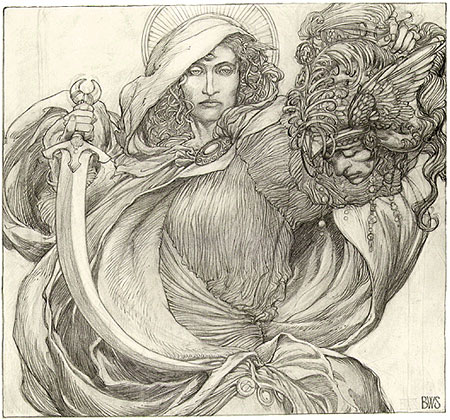
Barry Windsor-Smith is a British comic book artist and illustrator who initially made a name for himself in American comics with his art for the Marvel Comics’ adaptations of Robert E. Howard’s Conan stories in the 1970’s.Windsor-Smith (often simply referred to in print as “BWS”) was heavily influenced by the art of the Pre-Raphaelites and Art Nouveau and he was the first bring those sensibilities to American comic book art in a significant way. His fluid penwork and hatching style also shows the influence of pen and ink illustrators of Authurian legends like Howard Pyle.
In the years since his Conan debut, BWS has illustrated a number of notable comics stories for Marvel, as well as well as some lost gems. (A personal favorite of mine is a 4-issue run on a series called Machine Man, that had terrific coloring as well as ink work by Windsor-Smith.) He has also done work for other comics companies like Valiant, Malibu and Dark Horse, where he created an oversize format series called Barry Windsor-Smith: Storyteller. He has published prints and drawings under his own imprint, Gorblimey Press. He was also a member of the legendary Studio in New York that included Jeff Jones, Berni Wrightson and Michael Kaluta.
Fantagraphics Books is publishing a beautifully-produced multi-volume set called Opus, that showcases some of Windsor-Smith’s best work over the course of his career.
Another of his lost comic book gems was a one-shot story in Marvel Fanfare #15, featuring The Thing from The Fantastic Four, that is probably one of the best stories ever done with that character. BWS has created a new Thing graphic album due from Marvel some time this year. There is a brief preview of it on Comic Book Galaxy.
There is a fan-created Barry Windor-Smith Unofficial Blog (in Spanish, Google English translation here) that follows BWS activities.
You can also find some nice drawings by Windsor-Smith on the Artistic Interpretations of Literary Figures site, which I profiled in October of last year.
Categories:
-
Alphonse Mucha
 Alfons Mucha, whose name is usually Anglicised as Alphonse Mucha, was a Czech painter and graphic artist. While living in Paris in he late 1800’s he adopted a style that was to to become what most of us think of as Art Nouveau (orginally referred to as “Le style Mucha”). Mucha disliked the term “Art Nouveau”, saying that art was eternal and never just “nouveau”, and tried unsuccessfully to distance himself from the label for the rest of his career.
After years of difficulty living as a proverbial “starving artist”, Mucha achieved acceptance and fame as the result of his posters for Sarah Bernhardt and other theatrical figures of the day.
His work has been very influential on other artists. When illustrators or comic book artists today do their version of “Art Nouveau”, they’re basically doing their take on Mucha. Illustrators notwithstanding, I think his influence on the course of art, design and our culture in general is dramatically misunderstood and undervalued.
In an age when the industrial revolution was making mass-produced goods available, it also seemed to be increasingly making them ugly and diminishing the role of the artist/craftsman in society. Art Nouveau was a revolt against this uglyness and there is a strong social component to the work that we no longer see.
Printing technology had just changed and the artists associated with the Art Nouveau style believed in bringing art to every aspect of life, removing the dividing line between art and commerce, between beauty and utility, between “high art” and “low art”, and most importantly, between the elite and the public, making art available to everyone, not just the rich.
Mucha designed labels for champagne, liquors, biscuits, perfume, even cigarette paper (much to the delight of counterculture types in the 1960’s, when Mucha’s work experienced a revival).
Mucha was a brilliant designer as well as an artist and his style also broke down the barrier between art and design. His drawings blended inextricably with the design elements of the work. His elegant curveuliear forms and Byzantine surface decoration extended into, and became part of the drawing.
Most of us have grown up taking Art Nouveau for granted as “pretty” or “decorative”. It’s difficult for us to realize what a revolution in design Mucha’s style was at the time. It’s also difficult to get a feeling for the turnabout in the place of art in society that Art Nouveau represented.
The art Nouveau artists were contemporary with the Impressionists. (Surprised? I was.) Mucha shared a studio with Gauguin for a while. Our fascination with Impressionism, combined with our modernist-induced snobbery and “Art for Art’s sake” elitism, prevent us from seeing the contribution of Mucha and the Art Nouveau movement to our culture.
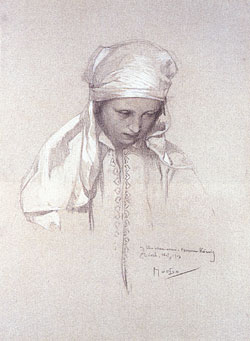 Mucha spent the last years of his life creating the twenty monumental canvases of the Slav Epic, a history of the Slavs that he considered his masterpiece. If you think you know Mucha from his posters and labels, but haven’t seen his painting and drawings, you’re missing out.
The official Mucha website is maintained by the Mucha Foundation and has a good sampling of his work. The Art Renewal Center has excellent reproductions of Mucha drawings and paintings as well as posters and labels. There are also good images in the imageNETion gallery, and a good biography of Mucha here.
Mucha published two books to make his style more available to graphic artists and others, Documents Decoratifs and Figures Decoratifs (Amazon links to Dover editions), the latter is full of drawings of figures and draperies in pencil, pen, charcoal and chalk. Dover also publishes inexpensive editions of other Mucha drawings as well as a nice Mucha Postcard book. For better editions, though, look for “Alphonse Mucha” by Sarah Mucha, or (even better but more expensive), “Alphonse Mucha : The Spirit of Art Nouveau” (Victor Arwas, Jana Brabcova-Orlikova, Anna Dvorak).
[Update March 2011: See my more recent posts Mucha update from 2009, with more links and resources, Mucha on Gallica Digital Library and Mucha’s Slav Epic from 2011.]
Categories:
-
Enki Bilal
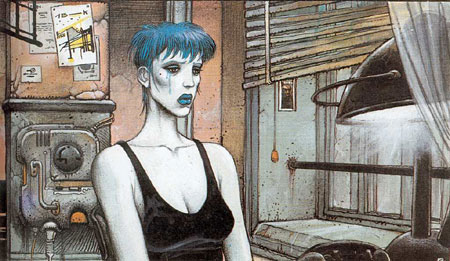
Enki Bilal is one of the major figures in European comic art. Bilal was born in Yugoslavia (now Serbia), but has spent most of his life in France. His comics albums (what we misname here as “graphic novels”), are among the most popular and most respected in Europe.He sometimes writes his own stories and often works with writer Pierre Christin. I haven’t read anything specific about his technique, but it has always looked to me like a mixed media approach – watercolor combined with colored pencils or chalks.
The remarkable thing about Bilal’s art is his incredible use of texture. The stories he illustrates tend to be dystopian (to say the least) and he seems to revel in the textures of decaying buildings, chipped paint, tortured wood, cracked ceramics, rough stone, broken concrete, grimy, soot covered surfaces and wrinkled skin. He indulges in this love of texture to such a degree that the ugly often becomes beautiful (perhaps unintentionally).
Bilal is also a film director. (There is a lot of intermingling and crossover in the European film and comics communities.)
There is no official Bilal site that I’m aware of, but there is a major Enki Bilal fan site (in French). Here is the Google translated version (rough but navigable).
The Albums section contains extracts from many of his comics albums, often many whole pages. There are also some large images in the section marked Les creations [ Divers et variées ]
Here is another site that has a great list of Bilal links, most of the sections have translations in various languages (links on the left).
A number of the comic albums he has worked on are available in English translations. If you want a taste, try “Bilal Library: Memories : Memories of Outer Space and Memories of Other Times” (images here and here), “The Town That Didn’t Exist” (images here), or “The Hunting Party” (images here). If you want to jump in the deep end, go for “The Nikopol Trilogy” (images here, here, here, here and shown above).
Note: The sites linked here contain nudity, sexually suggestive images and violence. Avoid them if you’re likely to be offended.
Categories:
-
Nosepilot (Alexandru Sacul)

Nosepilot is a diversion: a Flash animation in which charmingly simple vector drawings morph and change and blend one into the other in a loose, not-quite-a-story sequence set to music.I think Nosepilot has been on the web in one form or another for at least 8 or 9 years, and has been immensely popular at times. There’s a whole story that goes with that. Rather than rehash it here, I’l let Scott Thigpen tell you about it on his Artsy Fartsy Weblog (which may or may not be up for much longer, if not go here).
From the scrolling text in the glasses in the Nosepilot opening screen, choose your language (mostly for text and credits, there’s no dialog) and the animation will begin.
After ten or twelve minutes, the animation drops you off at a group of still images. Click around and they switch to different versions and enlargements of themselves. Find the right one and they link to another group of images that respond the same way. You can click through these images into other sets (by finding the right one to click on) for at least 8 or 10 sets. I’ve never taken it farther than that, so I don’t know if it goes to any particular conclusion (I suspect not).
Nosepilot is just a diversion, there’s no “point” to it. If you don’t like it after the first few minutes, you won’t miss anything significant by clicking over to the latest celebrity gossip on Yahoo News.
I admire the simple, effective use of vector illustrations which allowed Sacul to make the piece resolution independent (the movie scales up or down with changes to the size of your browser window).
Here is a link to Sacul’s animated illustration portfolio.
Addendum: I may be wrong in my assessment of the “still images”, having missed an underlying graphic narrative. See this post’s comments for more.
Categories:
-
sparth construct (Nicolas Bouvier)

Nicolas Bouvier, known as Sparth, is a concept designer for high-end games, and also illustrates book covers. Born in France and now residing in Texas, Sparth has done concept art for games like Cold Fear and Prince of Persia – Warrior Within and illustrated book covers for authors like Robert Heinlein, Frank Herbert and Neil Gaiman. His concept art has been featured in collections like Concept Design 2 and Exposé 3.His site’s Gallery pages include extensive sections of Illustration and Concept Art. There is also a large section of “Archived Materials” which actually contains more images than the other galleries. The images are reproduced nice and large so you can really get a good look at them.
 His concept art style is loose and painterly, with a great economy of strokes, suggesting rather than trying to capture every detail. His use of color and atmosphere is also very effective.
The “Artistic Process” section contains several extended tutorials, including a 19 page tutorial for the image shown above. The “Press” section contains links to illustrated interviews on Making of, CG Talk and CG Channel that discuss his work and techniques in some depth.
Although he works primarily digitally, the “Traditional” gallery contains sketches in pencil, watercolor and gouache.
If you guessed that the image at left is from the “Traditional” gallery, you guessed wrong. It’s actually from a fascinating section called “live digital pictures“, meaning digital sketches done from life with a laptop and Wacom tablet. (This is something I enjoy doing myself. It’s like having a huge paintbox with no mess. It lets you paint in places where you ordinarily couldn’t bring paints and allows you to paint at night.)
In addition to his web site called sparth construct, Sparth has a terrific blog, also called sparth construct, which features lots of art with comments. (Link via Designers who blog.)
Categories:
-
M.C. Escher
 M.C. Escher’s visions of strange worlds, impossible objects, and incredible tesselations form an extraordinary bridge between art and mathematics.
Critics often revile Escher and try to dismiss him as a creator of “decorative patterns” and “visual tricks”; and of course, he can’t possibly be a great artist because he’s (ugh!) popular with the (gasp!) masses! His images have been reproduced on countless posters, mugs, T-shirts, et cetera, which you’ve undoubtedly seen in a college dorm somewhere. Many of his images have become cultural icons to the point of being clichés, which is unfortunate because that makes it difficult to see them with the fresh eyes they deserve.
If the purpose of art is to communicate, Escher does that admirably, and he has definite things to say. If the purpose of art is to affect our emotions, Escher does that as well. He forces us to confront the possibility that our comfortable confidence in the reality of our senses may not be well founded. He demonstrates that what we think is visual truth may be illusion, and things we think unrelated may in fact be unexpectedly connected.
His thought-provoking juxtapositions of visual elements, disorienting perspective, startling geometry, unexpected spatial relationships and obsessively recursive surface patterns can halt someone in their tracks when they first encounter his work. People can become captivated by Escher’s images to an extraordinary degree. (You can see my own fascination with him in this early page from my webcomic.)
Escher mastered several printmaking techniques: woodcuts, wood engravings, even the arcane and difficult art of mezzotint, but the majority of his works are created with stone lithography, also a very demanding process.
The Official M.C. Escher Website is actually well done and has a fairly extensive gallery of his work, arranged by periods of the artist’s life. It also includes a biography, links to other sites of interest and short video interviews with Escher.
The official site’s gallery images are a bit small; there are larger ones on unofficial sites like: The Oldest Escher Collection on the Web and World of Escher (which has a lot of commercial stuff for sale, but the prints in the gallery have good-sized enlargements).
Some additional sites of interest: an Illustrated essay; The Mathematical Art of M.C. Escher on the Mathacademy site, fan site Neal’s Escher Page (with a nice list of links), Escher for Real (attempts to make actual objects that duplicate, at least from one angle, some of Escher’s “impossible” objects) and Tesselations.org, a site that explains tesselations, highlights Escher’s tesselations and shows you how to create some yourself.
None of the web images of his prints can compare with the reproductions in good books. M.C. Escher : 29 Master prints is wonderfully large and the reproductions are excellent. The Magic of M. C. Escher (J. L. Locker) is much more extensive and wonderfully done (out of print, but still available), and M. C. Escher is a nice, inexpensive volume.
Categories:



Charley’s Picks
Bookshop.org
(Bookshop.org affilliate links; sales benefit independent bookshop owners; I get a small percentage to help support my work on Lines and Colors)
Carlson’s Guide to Landscape Painting
Drawing and Sketching in Pencil
Bridgman’s Complete Guide to Drawing from Life
Charley’s Picks
Amazon
(Amazon.com affiliate links; sales go to a larger yacht for Jeff Bezos; but I get a small percentage to help support my work on Lines and Colors)
Carlson’s Guide to Landscape Painting
Drawing and Sketching in Pencil
Bridgman’s Complete Guide to Drawing from Life