


Categories
- 3d CGI
- Amusements
- Animation
- Anime & Manga
- Art Materials
- Art Videos
- Blogroll
- Cartoons
- Color
- Comics
- Concept & Visual Dev.
- Creativity
- Digital Art
- Digital Painting
- Displaying Art on the Web
- Drawing
- Eye Candy for Today
- Gallery and Museum Art
- High-res Art Images
- Illustration
- Motion Graphics & Flash
- Museums
- Online Museums
- Outsider Art
- Painting
- Painting a Day
- Paleo Art
- Pastel, Conté & Chalk
- Pen & Ink
- Prints and Printmaking
- Reviews
- Sc-fi and Fantasy
- Sculpture & Dimensional
- Site Comments
- Sketching
- Storyboards
- Tools and Techniques
- Uncategorized
- Vector Art
- Videos & Podcasts
- Vision and Optics
- Watercolor and Gouache
- Webcomics
Archives
- May 2026
- April 2026
- March 2026
- February 2026
- January 2026
- December 2025
- November 2025
- October 2025
- September 2025
- August 2025
- July 2025
- June 2025
- May 2025
- January 2025
- December 2024
- November 2024
- October 2024
- September 2024
- August 2024
- June 2024
- April 2024
- March 2024
- February 2024
- January 2024
- December 2023
- November 2023
- October 2023
- September 2023
- August 2023
- July 2023
- May 2023
- April 2023
- March 2023
- February 2023
- January 2023
- December 2022
- November 2022
- September 2022
- August 2022
- July 2022
- June 2022
- May 2022
- April 2022
- March 2022
- February 2022
- January 2022
- December 2021
- November 2021
- October 2021
- September 2021
- August 2021
- July 2021
- June 2021
- May 2021
- April 2021
- March 2021
- February 2021
- January 2021
- December 2020
- November 2020
- October 2020
- September 2020
- August 2020
- July 2020
- June 2020
- May 2020
- April 2020
- March 2020
- February 2020
- January 2020
- December 2019
- November 2019
- October 2019
- September 2019
- August 2019
- July 2019
- June 2019
- May 2019
- April 2019
- March 2019
- February 2019
- January 2019
- December 2018
- November 2018
- October 2018
- September 2018
- August 2018
- July 2018
- June 2018
- May 2018
- April 2018
- March 2018
- February 2018
- January 2018
- December 2017
- November 2017
- October 2017
- September 2017
- August 2017
- July 2017
- June 2017
- May 2017
- April 2017
- March 2017
- February 2017
- January 2017
- December 2016
- November 2016
- October 2016
- September 2016
- August 2016
- July 2016
- June 2016
- May 2016
- April 2016
- March 2016
- February 2016
- January 2016
- December 2015
- November 2015
- October 2015
- September 2015
- August 2015
- July 2015
- June 2015
- May 2015
- April 2015
- March 2015
- February 2015
- January 2015
- December 2014
- November 2014
- October 2014
- September 2014
- August 2014
- July 2014
- June 2014
- May 2014
- April 2014
- March 2014
- February 2014
- January 2014
- December 2013
- November 2013
- October 2013
- September 2013
- August 2013
- July 2013
- June 2013
- May 2013
- April 2013
- March 2013
- February 2013
- January 2013
- December 2012
- November 2012
- October 2012
- September 2012
- August 2012
- July 2012
- June 2012
- May 2012
- April 2012
- March 2012
- February 2012
- January 2012
- December 2011
- November 2011
- October 2011
- September 2011
- August 2011
- July 2011
- June 2011
- May 2011
- April 2011
- March 2011
- February 2011
- January 2011
- December 2010
- November 2010
- October 2010
- September 2010
- August 2010
- July 2010
- June 2010
- May 2010
- April 2010
- March 2010
- February 2010
- January 2010
- December 2009
- November 2009
- October 2009
- September 2009
- August 2009
- July 2009
- June 2009
- May 2009
- April 2009
- March 2009
- February 2009
- January 2009
- December 2008
- November 2008
- October 2008
- September 2008
- August 2008
- July 2008
- June 2008
- May 2008
- April 2008
- March 2008
- February 2008
- January 2008
- December 2007
- November 2007
- October 2007
- September 2007
- August 2007
- July 2007
- June 2007
- May 2007
- April 2007
- March 2007
- February 2007
- January 2007
- December 2006
- November 2006
- October 2006
- September 2006
- August 2006
- July 2006
- June 2006
- May 2006
- April 2006
- March 2006
- February 2006
- January 2006
- December 2005
- November 2005
- October 2005
- September 2005
- August 2005
Relevant Blogs
Art, Painting & Sketch
- Gurney Journey
- Underpaintings
- Art and Influence
- Painting Perceptions
- Oil Painters of America
- Vasari Paint POV
- Flying Fox
- Urban Sketchers
- Bento (Smithsonian)
- Art Inconnu
- The Hidden Place
- Still Life
- Making a Mark
- The Art of the Landscape
- Exploring Color & Creativity
- Art Contrarian
- Artist A Day
- beinArt Surreal Art Collective
- Eye Level
- David Dunlop
- p.i.g.m.e.n.t.i.u.m
- CultureGrrl
- Joaquín Sorolla blog
- Artists in Pastel
“Painting a Day”
- A Painting a Day (Keiser)
- On Painting (Keiser)
- Julian Merrow-Smith
- Karen Jurick
- Jeffrey Hayes
- Carol Marine
- Abbey Ryan
- Daily Paintworks
Other Painting Blogs
- Virtual Gouache Land
- Neil Hollingsworth
- Marc Hanson
- Kevin Menck
- Marc Dalessio
- Larry Seiler
- Stapleton Kearns
- Colin Page
- Roos Schuring
- Hans Versfelt
- Titus Meeuws
- Régis Pettinari
- René Plein Air
- Belinda Del Pesco
- Robin Weiss
- Nathan Fowkes (Land Sketch)
- William Wray
- Frank Serrano
- Stephen Magsig
- Michael Chesley Johnson
- Twice a Week
- Sarah Wimperis
- Rob Adams
- Michael Cole Manley
- The Dirty Palette Club
- Mike Manley’s Draw!
Gallery Art & Illustration mix
Illustration
- Howard Pyle
- 100 Years of Illustration
- BibliOdyssey
- Illustration Art
- Today’s Inspiration
- Illustration Mundo
- Little Chimp Society
- Danny Gregory
- R D (John Martz
- Illustration Friday blog
- Monster Brains
- Illustrators & Illustrations (RU)
- Elwood H. Smith
- DaniDraws.com
- Designers Who Blog
- iSpot Blog
Sci-Fi & Fantasy
Illustration & Comics
Comics & Cartoons
- Comics Beat
- Robot 6
- Newsarama Blog
- Comic Vine
- Comics Alliance
- Forbidden Planet Int.
- Paolo Rivera
- Bolt City
- Flight
- Scott McCloud
- The Comics Journal
- Comixpedia
- Funnybook Babylon
- James Baker
- Middleton’s Sketchbook
- Boneville
- The Hotel Fred
- Paul Rivoche
- Daily Cartoonist
- Mad About Cartoons (William Wray)
- Digital Strips
Illustration & Concept
Animation & Concept
- Cartoon Brew
- Animation Blog
- Cold Hard Flash
- Concept Art World
- The CAB
- FY Concept Art
- Concept Ships
- Concept Robots
- John Nevarez
- Armand Serrano
- Marcos Mateu-Mestre
- all kinds of stuff (Kricfalusi)
- Yacin the faun (Man Arenas)
- Kelsey Mann
- Cre8tivemarks Blog
- Ice-Cream Monster Toon Cafe
- AAU Character & Creature Design
- AAU Animation Notes
- Articles and Texticles
Paleo & Scientific
Tools & Techniques
Other
Lists of Art Blogs
Art Image Resource Links
Historic Art Images
- Wikimedia Commons: Paintings
- Wikimedia Commons: Drawings
- The Athenaeum
- WikiArt (WikiPaintings)
- Google Art Project: Artists
- Google Art Project: Collections (Museums)
- ArtCyclopedia
- Web Gallery of Art
- Art Renewal Center
- Web Gallery of Impressionism
Auction Consolidation sites
Auction sites
- Sotheby’s
- Bonham’s
- Christies
- Heritage Auctions: Fine Art
- Heritage Auctions: Illustration
- Freeman’s Auctions
- Bukowskis
- Shannon’s
Image Search
Reverse Image Search (search by image)
- Tin Eye
- RevImg
- Google Image Search (camera icon)
- Bing Image Search (camera icon)
Promoting some friends and some clients of my website design business
- Twin Willows T’ai Chi studio in Wilmington DE. Taiji classes with Bryan Davis.
- Ray Hayward, Inspired Teacher of T’ai Chi ( Taiji ) in Minneapolis, Founder of Mindful Motion Tai Chi Academy
- OldHead Tattoo studio and Art Gallery in Wilmington DE. Tattoos and paintings by Bruce Gulick
- Sharon Domenico Art, pet portrait oil paintings
- Platinum Paperhanging, wallpaper hanging, Main Line and Philadelphia, PA
- Lisa Stone Design, interior designer, Main Line and Philadelphia, PA
- Studio12KPT, original art, prints, calendars and other custom printed items by Van Sickle & Rolleri
-
Thought of You (Ryan Woodward)

Thought of You (also on Vimeo) is a short animation by professional animator, storyboard and concept artist Ryan Woodward.It is a simple but beautifully done dance sequence, with suggestions of a story, but open ended enough for viewers to make their own interpretations. Elegantly animated, the sequence is set to World Spins Madly On by The Weepies.
What I find particularly enjoyable is the way the characters are drawn as gestural figures, as though from quick life studies, or the kind of construction line drawings used by those who must invent the figure from imagination, like storyboard artists, illustrators and comics artists.
I also admire the way he has used variations in finish or solidity of the figures to evoke degrees of presence.
In addition to his own site, which includes examples of his illustrations, storyboards and animatics, as well as other short films, Woodward has created a site for Thought of You and similar experiments called Conté Animated, referring in part to his years of teaching gesture drawing, a history that informs every frame of Thought of You.
[Via MetaFilter]
Categories:
-
Robert Kogge

I think the role of texture, whether physical or rendered, plays a more important part in the visceral presence and visual impact of artworks than is often mentioned. It is frequently overshadowed by the more overt characteristics of a painting or drawing. There are artists, however, for whom texture a major component in their artistic voice, to the point where its presence and power can’t be ignored.Robert V. Kogge deliberately works with muted color palettes and narrow ranges of value to let the textural elements of his work come to the fore. At one point in his career, Kogge says he found his preparatory drawings for paintings taking on a life of their own, becoming finished works, and he started drawing directly on unprimed canvas with graphite.
He currently works with colored pencil, a medium that lends itself well to expressions of texture, on canvas with washes of colored ink.
Though you will find cityscapes in his oeuvre, it is his still life images that captured my attention. They invite you to enter slowly, revealing their individual elements gradually, each emerging in turn from the composition to take its place in your attention.
Within the subdued color and value range, Kogge finds a wealth of subtle variation, combined with beautiful textural surfaces, both rendered in his images, and expressed through the canvas surface on which they rest.
There is a gallery of his work on American Artist’s Artist Daily, a bio on Contemporary Still Life and a portfolio on Local Artists.
Categories:
-
More J.C. Leyendecker on Illustration Art

Long time readers of Lines and Colors will know that J.C. Leyendecker is one of my favorite illustrators, and I’m always happy to share Leyendecker resources on the web when I come across them.Illustrator Chris Sheban, who I wrote about here, was kind enough to let me know about an older post on David Apatoff’s wonderful Illustration Art blog featuring a beautiful sheet of Leyendecker studies here, and another set here.
Be sure to click through to the high resolution images that Apatoff has been kind enough to make available for us. Apatoff also adds his own brief but insightful observations about Leyendecker’s technique, particularly the elements of style and design with which he enlivens even the most ordinary objects and surfaces.
Leyendecker can make folds in clothing as beautiful as other artists make pastoral valleys.
Apatoff has another post titled The Anvil of Art about the young Norman Rockwell trying to figure out how Leyendecker, his artistic hero, accomplished his astonishing level of virtuosity.
[Via Chris Sheban]
Categories:
-
Alexis Rockman
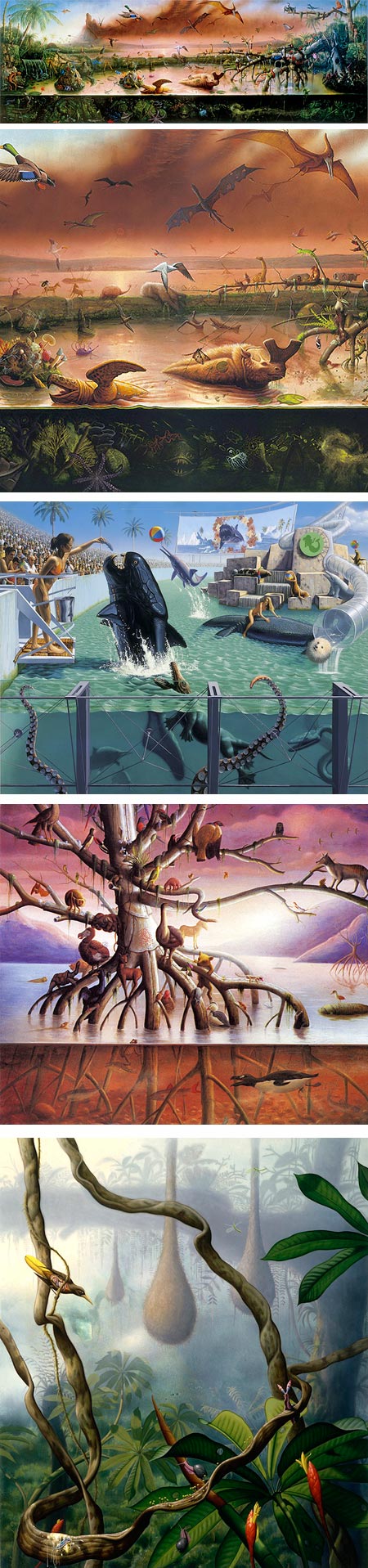
Alexis Rockman might be called an unnatural history artist.Drawing on the visual language of natural history artists, botanical illustrators and and paleontological reconstruction artists, along with a fascination for diorama-style cut-aways and mural-like panoramas, Rockman puts the the time machine in the other gear and moves us into the future, depicting familiar landmarks in the aftermath of ecological or bioengineering disasters.
He also applies his skills to more direct portrayals of the natural world, but it is his fantastic visions, sometimes surreal in their dreamlike juxtapositions of animal and plant life with the artifacts of human construction, that resonate most strongly.
The Smithsonian American Art Museum is displaying a major exhibition of Rockman’s work, covering the span of his career with almost 50 paintings.
Alexis Rockman: A Fable for Tomorrow takes its name from the first chapter of Rachel Carson’s A Silent Spring, the first book to bring the fragility of the ecosystem into the awareness of the general public. There is a gallery on the museum’s site.
Alexis Rockman: A Fable for Tomorrow is also the title of a book created to accompany the exhibition.
Rockman’s own site has galleries of his work from several series and different periods of his career.
There is also a gallery on Wired Science that allows a quick overview of his work.
Alexis Rockman: A Fable for Tomorrow is on view at the Smithsonian American Art Museum until may 8, 2011.
Categories:
-
Sargent and Impressionism

John Singer Sargent was American by birth, but spent most of his career and adult life in England and Europe.In 1884 he exhibited his painting called Madame X at the Salon in Paris. Though famous now, the painting became the subject of scandal at the time, a kind of attention that Sargent didn’t relish, and the unwanted drama left him exhausted.
Sargent retreated to the English countryside, and for several years painted largely to please himself, rather than his usual concentration on society portraits.
Though Sargent could really be called a “painterly realist”, it was during this period that he painted many of the works that have earned him placement among the painters considered to be “American Impressionists”.
In Sargent’s case the experimentation with the broken color, effects of light and plein air painting of the the French Impressionists came directly from his association and friendship with Claude Monet. Sargent visited Monet several times at Giverny, Monet visited Sargent in England, and the two corresponded. Sargent expressed great admiration for Monet and his work.
The Adelson Galleries in New York, which has mounted several impressive Sargent exhibitions in the past, is presenting a show of Sargent’s work from that period, 1883 to 1889, drawing on works from the gallery’s collection and borrowing major pieces from museums in the U.S. and England.
The press release for the exhibition gives some background.
Though he adopted some of the superficial characteristics of Monet’s approach, Sargent never fully painted in the Impressionist style. His experiments, however, are among some of his most recognizable works, like his painting of artist Paul Helleu Sketching with His Wife (image above, top)
Missing here is his wonderful Carnation, Lily, Lily Rose (a personal favorite of mine), though studies (image above, third down, left) and related works point to its importance in this period of Sargent’s career.
Sargent and Impressionism is on view until December 18, 2010. There is a painting on the gallery’s Current Exhibition page, and a gallery of 31 images, with thumbnails here. (This may change when the exhibition closes.)
There is also a good review of the show from the New York Times, with an accompanying slideshow of images.
Categories:
-
William Stout: Inspirations

I am unabashed in my enthusiasm for the work of William Stout, and I’ve written about him previously several times here on Lines and Colors (links below). In particular, I take great delight in his beautiful drawings in pen and ink with watercolor.I’ve been looking forward to the release of William Stout: Inspirations from Flesk publications since it’s companion volume, William Stout: Halllucinations, was released back in July (my review here).
Stout has been prolific in his career, and there are a number of illustrations and other drawings that are difficult to find in print. Much to the delight of Stout fans like myself, the two books have collected a number of these from various sources and presented them in the kind of beautifully produced and printed art volumes that are Flesk’s specialty.
The two collections are arranged thematically, the first focusing on monsters, trolls, dragons and creatures, the new one on women from fantasy and fairy tales.
In both volumes we see Stout having fun, gleefully drawing on his inspirations from traditional stories and pop culture as well as paying tribute to some of his artistic roots.
In Inspirations, we find Stout working with subjects from Edgar Rice Burroughs, Shakespeare, The Wizard of Oz (Baum’s not MGM’s), Wagner’s Ring Cycle, Rima the Jungle Girl, The Bride of Frankenstein and even a humorous take on his own dinosaur illustrations; in the process creating playful homages to late 20th Century artists like Frank Frazetta and Dave Stevens, and Golden Age masters like Arthur Rackham, Edmund Dulac and the great but under-appreciated Gustav Tenngren and John Bauer (links to my posts).
In fact, in his Foreward, Stout outlines what he calls his “Rackham/Dulac Technique” in a step-by step walkthough of the process that many illustrators will find enlightening.
Stout has been influenced by a number of great Golden Age pen and ink illustrators, with a variety of approaches, and in his own style he has managed to distill a balance of linework, rendering and application of color that I find particularly appealing. Combined with his accomplished draftsmanship and fervent imagination, he serves up a smorgasbord of visual treats in these collections.
There is a small gallery of preview images on the Flesk site (click on the image to pop up the gallery), along with more detail about Inspirations and the companion volume Hallucinations, as well as the other Stout titles from Flesk: Dinosaur Discoveries and New Dinosaur Discoveries A-Z.
The titles can all be ordered directly from the Flesk online store (or the old way via mail).
The limited edition signed hardback version of William Stout: Inspirations is already sold out from the Flesk site, though you may still be able to order copies of the hardback directly from William Stout’s site.
You can also find more of Stout’s work, in a variety of media, subjects and approaches, in the galleries on his site.
Categories:




Charley’s Picks
Bookshop.org
(Bookshop.org affilliate links; sales benefit independent bookshop owners; I get a small percentage to help support my work on Lines and Colors)

John Singer Sargent: Watercolors


Urban Sketching: Understanding Perspective


Charley’s Picks
Amazon
(Amazon.com affiliate links; sales go to a larger yacht for Jeff Bezos; but I get a small percentage to help support my work on Lines and Colors)
John Singer Sargent: Watercolors
Urban Sketching: Understanding Perspective