


Categories
- 3d CGI
- Amusements
- Animation
- Anime & Manga
- Art Materials
- Art Videos
- Blogroll
- Cartoons
- Color
- Comics
- Concept & Visual Dev.
- Creativity
- Digital Art
- Digital Painting
- Displaying Art on the Web
- Drawing
- Eye Candy for Today
- Gallery and Museum Art
- High-res Art Images
- Illustration
- Motion Graphics & Flash
- Museums
- Online Museums
- Outsider Art
- Painting
- Painting a Day
- Paleo Art
- Pastel, Conté & Chalk
- Pen & Ink
- Prints and Printmaking
- Reviews
- Sc-fi and Fantasy
- Sculpture & Dimensional
- Site Comments
- Sketching
- Storyboards
- Tools and Techniques
- Uncategorized
- Vector Art
- Videos & Podcasts
- Vision and Optics
- Watercolor and Gouache
- Webcomics
Archives
- April 2026
- March 2026
- February 2026
- January 2026
- December 2025
- November 2025
- October 2025
- September 2025
- August 2025
- July 2025
- June 2025
- May 2025
- January 2025
- December 2024
- November 2024
- October 2024
- September 2024
- August 2024
- June 2024
- April 2024
- March 2024
- February 2024
- January 2024
- December 2023
- November 2023
- October 2023
- September 2023
- August 2023
- July 2023
- May 2023
- April 2023
- March 2023
- February 2023
- January 2023
- December 2022
- November 2022
- September 2022
- August 2022
- July 2022
- June 2022
- May 2022
- April 2022
- March 2022
- February 2022
- January 2022
- December 2021
- November 2021
- October 2021
- September 2021
- August 2021
- July 2021
- June 2021
- May 2021
- April 2021
- March 2021
- February 2021
- January 2021
- December 2020
- November 2020
- October 2020
- September 2020
- August 2020
- July 2020
- June 2020
- May 2020
- April 2020
- March 2020
- February 2020
- January 2020
- December 2019
- November 2019
- October 2019
- September 2019
- August 2019
- July 2019
- June 2019
- May 2019
- April 2019
- March 2019
- February 2019
- January 2019
- December 2018
- November 2018
- October 2018
- September 2018
- August 2018
- July 2018
- June 2018
- May 2018
- April 2018
- March 2018
- February 2018
- January 2018
- December 2017
- November 2017
- October 2017
- September 2017
- August 2017
- July 2017
- June 2017
- May 2017
- April 2017
- March 2017
- February 2017
- January 2017
- December 2016
- November 2016
- October 2016
- September 2016
- August 2016
- July 2016
- June 2016
- May 2016
- April 2016
- March 2016
- February 2016
- January 2016
- December 2015
- November 2015
- October 2015
- September 2015
- August 2015
- July 2015
- June 2015
- May 2015
- April 2015
- March 2015
- February 2015
- January 2015
- December 2014
- November 2014
- October 2014
- September 2014
- August 2014
- July 2014
- June 2014
- May 2014
- April 2014
- March 2014
- February 2014
- January 2014
- December 2013
- November 2013
- October 2013
- September 2013
- August 2013
- July 2013
- June 2013
- May 2013
- April 2013
- March 2013
- February 2013
- January 2013
- December 2012
- November 2012
- October 2012
- September 2012
- August 2012
- July 2012
- June 2012
- May 2012
- April 2012
- March 2012
- February 2012
- January 2012
- December 2011
- November 2011
- October 2011
- September 2011
- August 2011
- July 2011
- June 2011
- May 2011
- April 2011
- March 2011
- February 2011
- January 2011
- December 2010
- November 2010
- October 2010
- September 2010
- August 2010
- July 2010
- June 2010
- May 2010
- April 2010
- March 2010
- February 2010
- January 2010
- December 2009
- November 2009
- October 2009
- September 2009
- August 2009
- July 2009
- June 2009
- May 2009
- April 2009
- March 2009
- February 2009
- January 2009
- December 2008
- November 2008
- October 2008
- September 2008
- August 2008
- July 2008
- June 2008
- May 2008
- April 2008
- March 2008
- February 2008
- January 2008
- December 2007
- November 2007
- October 2007
- September 2007
- August 2007
- July 2007
- June 2007
- May 2007
- April 2007
- March 2007
- February 2007
- January 2007
- December 2006
- November 2006
- October 2006
- September 2006
- August 2006
- July 2006
- June 2006
- May 2006
- April 2006
- March 2006
- February 2006
- January 2006
- December 2005
- November 2005
- October 2005
- September 2005
- August 2005
Relevant Blogs
Art, Painting & Sketch
- Gurney Journey
- Underpaintings
- Art and Influence
- Painting Perceptions
- Oil Painters of America
- Vasari Paint POV
- Flying Fox
- Urban Sketchers
- Bento (Smithsonian)
- Art Inconnu
- The Hidden Place
- Still Life
- Making a Mark
- The Art of the Landscape
- Exploring Color & Creativity
- Art Contrarian
- Artist A Day
- beinArt Surreal Art Collective
- Eye Level
- David Dunlop
- p.i.g.m.e.n.t.i.u.m
- CultureGrrl
- Joaquín Sorolla blog
- Artists in Pastel
“Painting a Day”
- A Painting a Day (Keiser)
- On Painting (Keiser)
- Julian Merrow-Smith
- Karen Jurick
- Jeffrey Hayes
- Carol Marine
- Abbey Ryan
- Daily Paintworks
Other Painting Blogs
- Virtual Gouache Land
- Neil Hollingsworth
- Marc Hanson
- Kevin Menck
- Marc Dalessio
- Larry Seiler
- Stapleton Kearns
- Colin Page
- Roos Schuring
- Hans Versfelt
- Titus Meeuws
- Régis Pettinari
- René Plein Air
- Belinda Del Pesco
- Robin Weiss
- Nathan Fowkes (Land Sketch)
- William Wray
- Frank Serrano
- Stephen Magsig
- Michael Chesley Johnson
- Twice a Week
- Sarah Wimperis
- Rob Adams
- Michael Cole Manley
- The Dirty Palette Club
- Mike Manley’s Draw!
Gallery Art & Illustration mix
Illustration
- Howard Pyle
- 100 Years of Illustration
- BibliOdyssey
- Illustration Art
- Today’s Inspiration
- Illustration Mundo
- Little Chimp Society
- Danny Gregory
- R D (John Martz
- Illustration Friday blog
- Monster Brains
- Illustrators & Illustrations (RU)
- Elwood H. Smith
- DaniDraws.com
- Designers Who Blog
- iSpot Blog
Sci-Fi & Fantasy
Illustration & Comics
Comics & Cartoons
- Comics Beat
- Robot 6
- Newsarama Blog
- Comic Vine
- Comics Alliance
- Forbidden Planet Int.
- Paolo Rivera
- Bolt City
- Flight
- Scott McCloud
- The Comics Journal
- Comixpedia
- Funnybook Babylon
- James Baker
- Middleton’s Sketchbook
- Boneville
- The Hotel Fred
- Paul Rivoche
- Daily Cartoonist
- Mad About Cartoons (William Wray)
- Digital Strips
Illustration & Concept
Animation & Concept
- Cartoon Brew
- Animation Blog
- Cold Hard Flash
- Concept Art World
- The CAB
- FY Concept Art
- Concept Ships
- Concept Robots
- John Nevarez
- Armand Serrano
- Marcos Mateu-Mestre
- all kinds of stuff (Kricfalusi)
- Yacin the faun (Man Arenas)
- Kelsey Mann
- Cre8tivemarks Blog
- Ice-Cream Monster Toon Cafe
- AAU Character & Creature Design
- AAU Animation Notes
- Articles and Texticles
Paleo & Scientific
Tools & Techniques
Other
Lists of Art Blogs
Art Image Resource Links
Historic Art Images
- Wikimedia Commons: Paintings
- Wikimedia Commons: Drawings
- The Athenaeum
- WikiArt (WikiPaintings)
- Google Art Project: Artists
- Google Art Project: Collections (Museums)
- ArtCyclopedia
- Web Gallery of Art
- Art Renewal Center
- Web Gallery of Impressionism
Auction Consolidation sites
Auction sites
- Sotheby’s
- Bonham’s
- Christies
- Heritage Auctions: Fine Art
- Heritage Auctions: Illustration
- Freeman’s Auctions
- Bukowskis
- Shannon’s
Image Search
Reverse Image Search (search by image)
- Tin Eye
- RevImg
- Google Image Search (camera icon)
- Bing Image Search (camera icon)
Promoting some friends and some clients of my website design business
- Twin Willows T’ai Chi studio in Wilmington DE. Taiji classes with Bryan Davis.
- Ray Hayward, Inspired Teacher of T’ai Chi ( Taiji ) in Minneapolis, Founder of Mindful Motion Tai Chi Academy
- OldHead Tattoo studio and Art Gallery in Wilmington DE. Tattoos and paintings by Bruce Gulick
- Sharon Domenico Art, pet portrait oil paintings
- Platinum Paperhanging, wallpaper hanging, Main Line and Philadelphia, PA
- Lisa Stone Design, interior designer, Main Line and Philadelphia, PA
- Studio12KPT, original art, prints, calendars and other custom printed items by Van Sickle & Rolleri
-
Brian Boulton

There is a style of drawing, that you may see with some frequency on the web, that involves photorealistic rendering in pencil of images from photographs. It is often practiced by people with little or no professional training and, while I find that admirable, there is sometimes an accompanying lack of focus, finesse and artistic judgement.The graphite drawings of Brian Boulton, on the other hand, are an exception. His current series of drawings is rendered in detail and is the result of close observation, but Boulton’s command of texture, value and compositional emphasis puts the rendering in the service of his artistic vision, well beyond the realm of mere photorealist representation.
His figures are most often turned away from the viewer, inviting us to grasp the figure as a human form, but without the obvious point of focus of a face with which to interact. The result is a different point of view, that of an unseen observer.
We are invited to see textures of cloth and leather, hair and areas of skin as surfaces, materials as well as forms. The details of folds in the clothing, essentially in the lineage of drapery in classical compositions, are presented with the kind of importance usually given to surfaces in still life drawings.
Boulton is based in Vancouver. He studied architectural rendering at the College of New Caledonia, in British Columbia and Film and Art History at Langara College in Vancouver.
The original concept for this series of drawings began in a previous series, “10 Drawings“, completed in 1999. Boulton returned to the subject, and expanded on it, in 2008 and 2009, and in apparently continuing to explore the approach.
Categories:
-
Marcus Stone
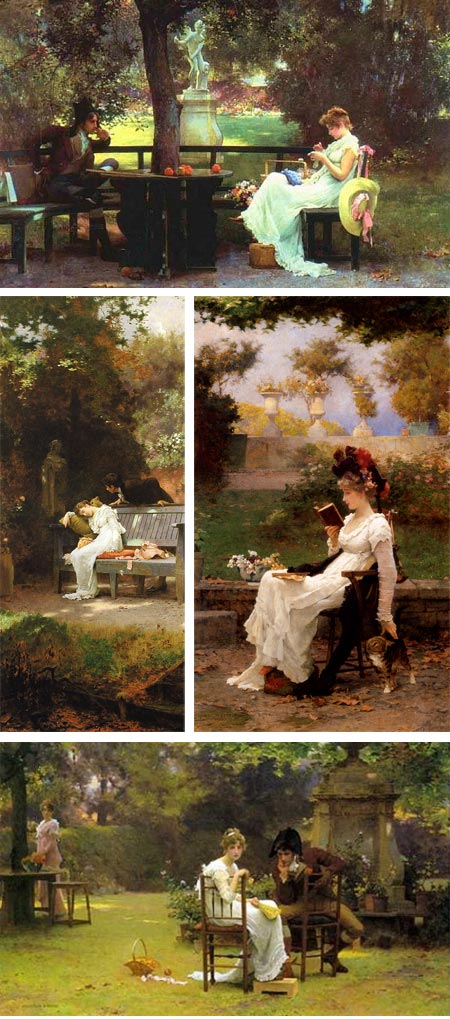
Marcus Stone was an illustrator and painter who was active in the latter part of the 19th Century.Stone was trained by his father, Frank Stone, who had been a noted illustrator was a friend and companion of Charles Dickens (and antagonist of the Pre-Raphaelite painters).
Marcus Stone was exhibiting at the Royal Academy at the age of eighteen, and was illustrating books by Dickens and other noted authors a few years later.
After finding himself frustrated with the restraints of illustration and reproduction techniques of the time, he transitioned into gallery paintings. He was elected to the Royal Academy as an associate and later as an academician, and was the recipient of awards and praise from the artistic establishment.
He focused at first on history painting and later specialized in scenes of romantic drama, often set in lush formal gardens.
His later work shows a brighter and more painterly approach, as the influence of the new styles of painting spread through Europe and the UK.
Categories:
-
Malcolm Sutherland
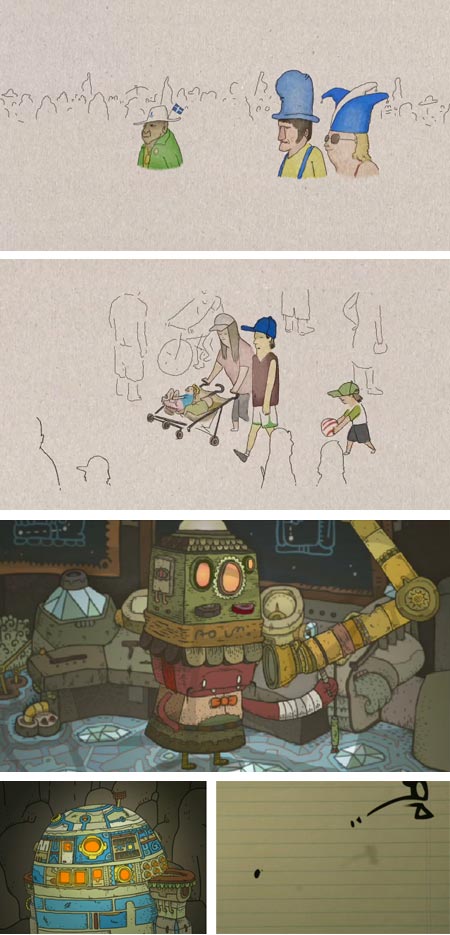
I love the immediacy and visual charm of location sketching, in which quickly realized sketches can often carry more feeling of place and time than elaborate drawings.Canadian illustrator and animator Malcolm Sutherland has managed to capture, and animate, some that feeling of informal charm and casual rendering, along with a strong sense of “being there” in his short animation La Fete (top two images, above).
This is an observation of passers by at an event called La Fête Nationale (essentially, the “National Holiday”) in Montreal, Quebec.
If, like me, you love to watch people pass by, particularly at events and gatherings where they are often deliberately putting themselves on display, you will immediately recognize that sense of observed life in his simply realized outline and color fill drawings. He uses clever fades and transitions to isolate members of the crowd, just as your attention might pick out individuals or small groups an focus on them.
You will find a numerous of other short animations on Sutherland’s Vimeo page. They feature a variety of subjects and approaches, from the simplicity of his “Untitled Drawings” in which he creates stream-of-consciousness drawings as if in stop-motion, to more elaborate pieces like The Astronomer’s Dream, a ten minute tour de force of surreal imaginings (above, third down).
Among his other shorts on Vimeo are his nicely bizarre reimagining of Star Wars scenes, his contributions to the Star Wars Uncut project.
There are a number of additional short animations, along with a gallery of illustration, on his web site. On the Theatre page, I was particularly taken with the animation Birdcalls and its fascinating use of pictographic representation of sounds.
Sound plays an important role in Sutherland’s work, for which he turns to the assistance of several collaborators.
He experiments with several forms of animation, such as the combination of stop-motion, hand drawn shapes, abstract rotoscoping, animation projected against 3-D objects, and jazz-like improvised collaboration with contributing musicians of Forming Game, for which there is an accompanying “Making Of” short documentary.
Categories:
-
Kent Barton

Illustrator Kent Barton works in scratchboard, linocut and woodcut, media that draw their lineage from graphic arts traditions that reach back into the early history of image making.He uses that feeling to advantage in his images, both in subjects for which it seems particularly appropriate to use classical graphic approach, and in modern subjects that, when cast in that style, become somehow iconic and set out of time.
All three are media that require thoughtful preparation and involve a painstaking process.
Barton does “environmental” works, intended to be reproduced in large scale and incorporated as part of an architectural space. These are often collage-like panoramas of historical images. You can see some of them, and some images of the spaces in which they’re installed, both before and after, on the Art on a Grand Scale site of artist’s representative Richard Solomon.
For his more involved compositions, Barton works up his sketches with multiple layers of tracing paper, allowing him to reposition elements until the composition works properly (I’ve also seen comic book artists and other illustrators work this way).
For the final he renders in scratchboard, laying color over it in the final stages, frequently working back and forth between scratching out, inking in, and altering the surface with materials like steel wool.
Categories:
-
Concept Art World

Concept Art World is a blog (or blog-themed magazine) devoted to film and gaming concept and production art and related disciplines.It features artists from around the world, and offers articles on concept art from particular projects and a listing of artists and studios, as well as resources like books and some how-to features.
You can browse featured articles and recent artists, or go to News and work your way back through the posts. The individual artist features show a sampling of each artist’s work and a brief bio statement, and links to the artist’s web site and/or blog.
(Images above: Frank Hong, Herve Groussin, Dehong He, Daryl Mandryk, Alex Broeckel)
Categories:
-
The Arts Map

The Arts Map is a new site, still in BETA, that uses a version of Google Maps to list artists, arts organizations, galleries, and other arts related people, places and things in a geographical context.Other than those who operate their own gallery or offer instruction in their studios, I’m not sure how useful it would be for artists to list themselves (I didn’t see any reason to list myself at this point); but if this catches on and fills out significantly with galleries, art schools, art supply stores, museums and related subjects, it could become a very useful resource for artists to consult.
The site is still young, and the listings sparse particularly compared to what I know exists in areas I’m familiar with, like Center City Philadelphia. This becomes obvious to almost anyone when viewing the map of lower Manhattan. Though art museums and art schools, for example, exist on the map as location highlights, as they would in any Google Map of an area, they are not yet pins, or clickable entries, on the Arts Map.
It’s apparently up to each institution to enter their information, just as an individual artist might, and participation is at an early stage.
According to the founders, “The Arts Map is about inclusion, not exclusion. Our goal is to provide a resource which will benefit the entire arts community.”
Listings are free, and you can be non-specific about address if you want to (street address is optional), providing other locations or ways to see and access your art, including galleries, websites or blogs. So in that respect, it may be worth listing for artists who don’t have a reason for someone to come to their location, just know where they are in a general sense.
[Via Jeanette Jobson’s Illustrated Life]
Categories:




Charley’s Picks
Bookshop.org
(Bookshop.org affilliate links; sales benefit independent bookshop owners; I get a small percentage to help support my work on Lines and Colors)

John Singer Sargent: Watercolors


Urban Sketching: Understanding Perspective


Charley’s Picks
Amazon
(Amazon.com affiliate links; sales go to a larger yacht for Jeff Bezos; but I get a small percentage to help support my work on Lines and Colors)
John Singer Sargent: Watercolors
Urban Sketching: Understanding Perspective