


Categories
- 3d CGI
- Amusements
- Animation
- Anime & Manga
- Art Materials
- Art Videos
- Blogroll
- Cartoons
- Color
- Comics
- Concept & Visual Dev.
- Creativity
- Digital Art
- Digital Painting
- Displaying Art on the Web
- Drawing
- Eye Candy for Today
- Gallery and Museum Art
- High-res Art Images
- Illustration
- Motion Graphics & Flash
- Museums
- Online Museums
- Outsider Art
- Painting
- Painting a Day
- Paleo Art
- Pastel, Conté & Chalk
- Pen & Ink
- Prints and Printmaking
- Reviews
- Sc-fi and Fantasy
- Sculpture & Dimensional
- Site Comments
- Sketching
- Storyboards
- Tools and Techniques
- Uncategorized
- Vector Art
- Videos & Podcasts
- Vision and Optics
- Watercolor and Gouache
- Webcomics
Archives
- April 2026
- March 2026
- February 2026
- January 2026
- December 2025
- November 2025
- October 2025
- September 2025
- August 2025
- July 2025
- June 2025
- May 2025
- January 2025
- December 2024
- November 2024
- October 2024
- September 2024
- August 2024
- June 2024
- April 2024
- March 2024
- February 2024
- January 2024
- December 2023
- November 2023
- October 2023
- September 2023
- August 2023
- July 2023
- May 2023
- April 2023
- March 2023
- February 2023
- January 2023
- December 2022
- November 2022
- September 2022
- August 2022
- July 2022
- June 2022
- May 2022
- April 2022
- March 2022
- February 2022
- January 2022
- December 2021
- November 2021
- October 2021
- September 2021
- August 2021
- July 2021
- June 2021
- May 2021
- April 2021
- March 2021
- February 2021
- January 2021
- December 2020
- November 2020
- October 2020
- September 2020
- August 2020
- July 2020
- June 2020
- May 2020
- April 2020
- March 2020
- February 2020
- January 2020
- December 2019
- November 2019
- October 2019
- September 2019
- August 2019
- July 2019
- June 2019
- May 2019
- April 2019
- March 2019
- February 2019
- January 2019
- December 2018
- November 2018
- October 2018
- September 2018
- August 2018
- July 2018
- June 2018
- May 2018
- April 2018
- March 2018
- February 2018
- January 2018
- December 2017
- November 2017
- October 2017
- September 2017
- August 2017
- July 2017
- June 2017
- May 2017
- April 2017
- March 2017
- February 2017
- January 2017
- December 2016
- November 2016
- October 2016
- September 2016
- August 2016
- July 2016
- June 2016
- May 2016
- April 2016
- March 2016
- February 2016
- January 2016
- December 2015
- November 2015
- October 2015
- September 2015
- August 2015
- July 2015
- June 2015
- May 2015
- April 2015
- March 2015
- February 2015
- January 2015
- December 2014
- November 2014
- October 2014
- September 2014
- August 2014
- July 2014
- June 2014
- May 2014
- April 2014
- March 2014
- February 2014
- January 2014
- December 2013
- November 2013
- October 2013
- September 2013
- August 2013
- July 2013
- June 2013
- May 2013
- April 2013
- March 2013
- February 2013
- January 2013
- December 2012
- November 2012
- October 2012
- September 2012
- August 2012
- July 2012
- June 2012
- May 2012
- April 2012
- March 2012
- February 2012
- January 2012
- December 2011
- November 2011
- October 2011
- September 2011
- August 2011
- July 2011
- June 2011
- May 2011
- April 2011
- March 2011
- February 2011
- January 2011
- December 2010
- November 2010
- October 2010
- September 2010
- August 2010
- July 2010
- June 2010
- May 2010
- April 2010
- March 2010
- February 2010
- January 2010
- December 2009
- November 2009
- October 2009
- September 2009
- August 2009
- July 2009
- June 2009
- May 2009
- April 2009
- March 2009
- February 2009
- January 2009
- December 2008
- November 2008
- October 2008
- September 2008
- August 2008
- July 2008
- June 2008
- May 2008
- April 2008
- March 2008
- February 2008
- January 2008
- December 2007
- November 2007
- October 2007
- September 2007
- August 2007
- July 2007
- June 2007
- May 2007
- April 2007
- March 2007
- February 2007
- January 2007
- December 2006
- November 2006
- October 2006
- September 2006
- August 2006
- July 2006
- June 2006
- May 2006
- April 2006
- March 2006
- February 2006
- January 2006
- December 2005
- November 2005
- October 2005
- September 2005
- August 2005
Relevant Blogs
Art, Painting & Sketch
- Gurney Journey
- Underpaintings
- Art and Influence
- Painting Perceptions
- Oil Painters of America
- Vasari Paint POV
- Flying Fox
- Urban Sketchers
- Bento (Smithsonian)
- Art Inconnu
- The Hidden Place
- Still Life
- Making a Mark
- The Art of the Landscape
- Exploring Color & Creativity
- Art Contrarian
- Artist A Day
- beinArt Surreal Art Collective
- Eye Level
- David Dunlop
- p.i.g.m.e.n.t.i.u.m
- CultureGrrl
- Joaquín Sorolla blog
- Artists in Pastel
“Painting a Day”
- A Painting a Day (Keiser)
- On Painting (Keiser)
- Julian Merrow-Smith
- Karen Jurick
- Jeffrey Hayes
- Carol Marine
- Abbey Ryan
- Daily Paintworks
Other Painting Blogs
- Virtual Gouache Land
- Neil Hollingsworth
- Marc Hanson
- Kevin Menck
- Marc Dalessio
- Larry Seiler
- Stapleton Kearns
- Colin Page
- Roos Schuring
- Hans Versfelt
- Titus Meeuws
- Régis Pettinari
- René Plein Air
- Belinda Del Pesco
- Robin Weiss
- Nathan Fowkes (Land Sketch)
- William Wray
- Frank Serrano
- Stephen Magsig
- Michael Chesley Johnson
- Twice a Week
- Sarah Wimperis
- Rob Adams
- Michael Cole Manley
- The Dirty Palette Club
- Mike Manley’s Draw!
Gallery Art & Illustration mix
Illustration
- Howard Pyle
- 100 Years of Illustration
- BibliOdyssey
- Illustration Art
- Today’s Inspiration
- Illustration Mundo
- Little Chimp Society
- Danny Gregory
- R D (John Martz
- Illustration Friday blog
- Monster Brains
- Illustrators & Illustrations (RU)
- Elwood H. Smith
- DaniDraws.com
- Designers Who Blog
- iSpot Blog
Sci-Fi & Fantasy
Illustration & Comics
Comics & Cartoons
- Comics Beat
- Robot 6
- Newsarama Blog
- Comic Vine
- Comics Alliance
- Forbidden Planet Int.
- Paolo Rivera
- Bolt City
- Flight
- Scott McCloud
- The Comics Journal
- Comixpedia
- Funnybook Babylon
- James Baker
- Middleton’s Sketchbook
- Boneville
- The Hotel Fred
- Paul Rivoche
- Daily Cartoonist
- Mad About Cartoons (William Wray)
- Digital Strips
Illustration & Concept
Animation & Concept
- Cartoon Brew
- Animation Blog
- Cold Hard Flash
- Concept Art World
- The CAB
- FY Concept Art
- Concept Ships
- Concept Robots
- John Nevarez
- Armand Serrano
- Marcos Mateu-Mestre
- all kinds of stuff (Kricfalusi)
- Yacin the faun (Man Arenas)
- Kelsey Mann
- Cre8tivemarks Blog
- Ice-Cream Monster Toon Cafe
- AAU Character & Creature Design
- AAU Animation Notes
- Articles and Texticles
Paleo & Scientific
Tools & Techniques
Other
Lists of Art Blogs
Art Image Resource Links
Historic Art Images
- Wikimedia Commons: Paintings
- Wikimedia Commons: Drawings
- The Athenaeum
- WikiArt (WikiPaintings)
- Google Art Project: Artists
- Google Art Project: Collections (Museums)
- ArtCyclopedia
- Web Gallery of Art
- Art Renewal Center
- Web Gallery of Impressionism
Auction Consolidation sites
Auction sites
- Sotheby’s
- Bonham’s
- Christies
- Heritage Auctions: Fine Art
- Heritage Auctions: Illustration
- Freeman’s Auctions
- Bukowskis
- Shannon’s
Image Search
Reverse Image Search (search by image)
- Tin Eye
- RevImg
- Google Image Search (camera icon)
- Bing Image Search (camera icon)
Promoting some friends and some clients of my website design business
- Twin Willows T’ai Chi studio in Wilmington DE. Taiji classes with Bryan Davis.
- Ray Hayward, Inspired Teacher of T’ai Chi ( Taiji ) in Minneapolis, Founder of Mindful Motion Tai Chi Academy
- OldHead Tattoo studio and Art Gallery in Wilmington DE. Tattoos and paintings by Bruce Gulick
- Sharon Domenico Art, pet portrait oil paintings
- Platinum Paperhanging, wallpaper hanging, Main Line and Philadelphia, PA
- Lisa Stone Design, interior designer, Main Line and Philadelphia, PA
- Studio12KPT, original art, prints, calendars and other custom printed items by Van Sickle & Rolleri
-
Ivan Bilibin (update)
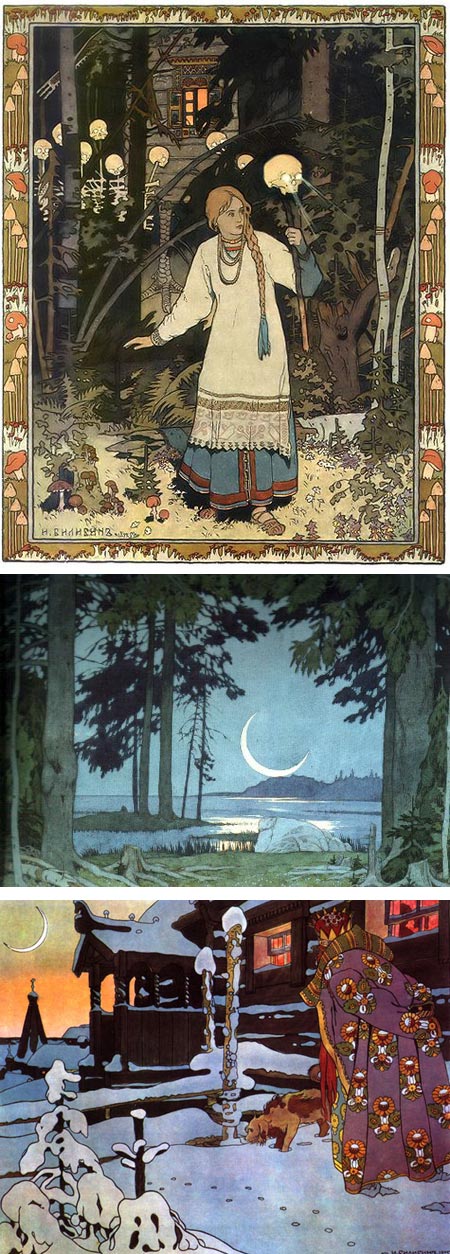
From time to time, I like to check back on artists I’ve written about a few years ago and see what new resources for their work have appeared on the constantly expanding internet since I last wrote about them.I took a look this morning at sources for Ivan Bilibin, a terrific Russian illustrator that I discovered by accident while walking through the Metropolitan Museum of art in 2006.
Ivan Yakovlevich Bilibin was active during a period generally known as the Golden Age of Illustration, roughly contemporary with great English and European illustrators like Arthur Rackham, Edmund Dulac, Kay Neilsen, Gustav Tenggren, John Bauer and Walter Crane.
With the possible exception of Crane and Russian Illustrator Gennady Spirin, Bilibin’s influences seem to have come more from Russian folk art than from other illustrators; along with elements from Art Nouveau and Renaissance art.
I was delighted to find that there are indeed new resources for Bilibin’s art since I last wrote about him, including multi-image galleries on Wikimedia Commons, Wikipedia and Cascadia Graphics.
They include not only more images of his colorful illustrations, but, as in the image above, middle, examples of some of his designs for stage sets (also here and here).
There is at least one collection of stories with Bilibin’s illustrations in print and readily available, Russian Fairy Tales (Everyman’s Library Children’s Classics). You may be able to find others used.
Categories:
-
Henri Le Sidaner

French painter and pastel artist Henri Le Sidaner (Eugéne Augustin) began academic training at the l’École des Beaux-Arts in Paris, briefly studying under Alexandre Cabanel, but soon rejected that pursuit in favor a fascination with the paths into broken color and light being blazed by the Impressionists.Le Sidaner is best known as an Intimist painter. Intimism is one of the less familiar of the “isms”, whose primary proponents were Pierre Bonnard and édouard Vulliard. Other practitioners include Edmond Aman-Jean.
It was essentially a form of genre painting that in some ways bridged Post-Impressionism and Symbolism, borrowing the broken color and flurry of almost Pointillist brushstrokes from the former, and the emotional content from the latter.
The name refers to the frequent subjects of quiet room interiors, intimate garden scenes and small views of landscape. Le Sidaner often portrayed table settings in gardens, soft nocturnes, and almost tonalist scenes of canals and waterways.
Unlike the Impressionists, who sought to portray light with fidelity to nature, La Sidaner and the other Intimists put their intense strokes of color in service of the emotion or mood with which they wished to infuse the scene.
Categories:
-
Ruth Sanderson
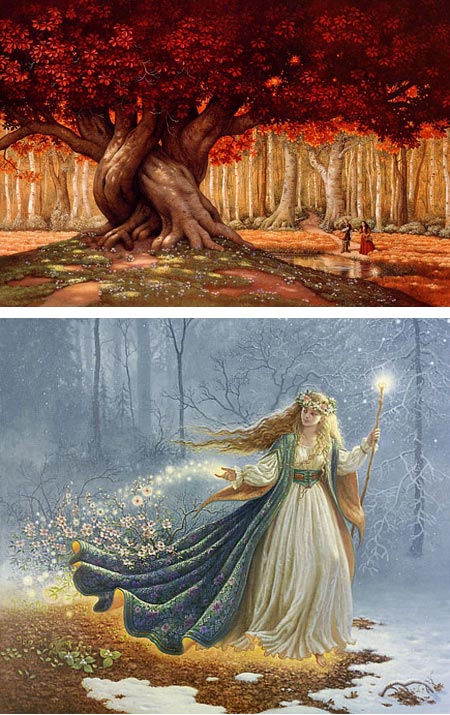
Ruth Sanderson is an illustrator with a long career of creating illustrations for children’s books, fairy tales and fantasy. Her book illustrations have garnered multiple awards, including her own original fairy tale, The Enchanted Wood.She cites as her influences American illustrators like Howard Pyle, N.C. Wyeth and Norman Rockwell, along with the English Pre-Raphaelite painters and the landscape artists of the Hudson River School.
Landscape plays an important role in her storybook themed paintings, with lavishly forested settings filled with detailed flora as a backdrop for fairies, knights, princesses and Mother Goose characters.
In addition to galleries of illustrations in various categories, her web site has a cover gallery of books she has illustrated, arranged by years, and a page of step-by-step process for several of her paintings.
Categories:
-
Zahra’s Paradise

Working under assumed names for obvious reasons, writer “Amir” and artist “Khalil” chronicle events in Iran in the wake of the disputed elections of 2009 in an ongoing story called Zahra’s Paradise.Zahra’s Paradise is a graphic story that is being published as a webcomic in installments every Monday, Wednesday and Friday. It just started on February 19, and will continue to include current events as they happen in the context of a fictional story. It follows a young Iranian blogger’s search for his brother, who has disappeared following his participation in the post-election protests.
The author is an Iranian-American human rights activist and the artist is a sculptor, ceramics artist and cartoonist who is taking on his first graphic novel.
The webcomic is being published simultaneously in English, Farsi, Arabic, French, Spanish, Italian and Dutch. First Second Books will publish the story in book form in 2011.
The site conveniently opens on the first page of the story (unlike the majority of webcomics, who open their site with the most recent page on the mistaken assumption that convenience for current readers is more important than orienting new ones.)
The art is clear and straightforward, with enough touches of style to add visual charm without distracting from the storytelling. Simple tones and hatching, along with well spotted blacks, provide depth and visual balance.
The characters are immediately accessible, even to Westerners who might assume they have little connection to people and events in Iran. As we follow along with the search for Mehdi, we may find out more about how similar, and different, our lives are.
[Via BoingBoing]
Categories:
-
Edward Sorel
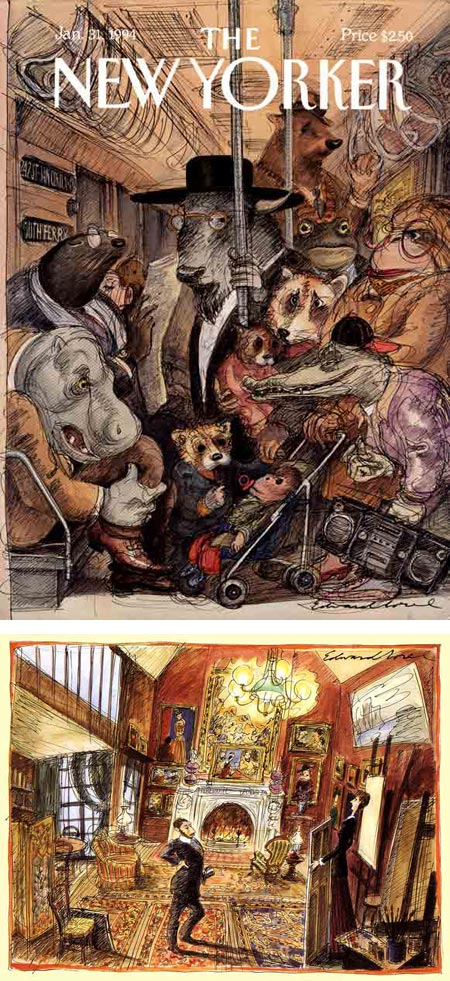
Edward Sorel’s wonderfully loose and gestural cartoon illustrations have been featured on the covers and interiors of magazines like The Atlantic, The New Yorker, Harpers, Forbes, The Nation, Esquire and The New York Times Magazine for a number of years.His pen and ink and watercolor images capture personalities, places and situations with wry humor and an uncanny sense of place.
Sorel studied at Cooper Union and was one of the co-founders of the legendary Push Pin Studios. He has had a number of one-man shows, including a 1998 multi-room show at the National Portrait Gallery in Washington, DC (see my post on The National Portrait Gallery).
A collection was published in conjunction with the show, Unauthorized Portraits from 1997. He has also illustrated a number of books and created numerous posters.
There is an interview here, conducted by artist Zina Saunders, along with Saunders’ portrait of Sorel. (Here’s my post on Zina Saunders.)
Sorel’s work has been compared to other modern masters of caricature like David Levine, and even to historic figures like Daumier and Hogarth.
Categories:
-
William Wendt
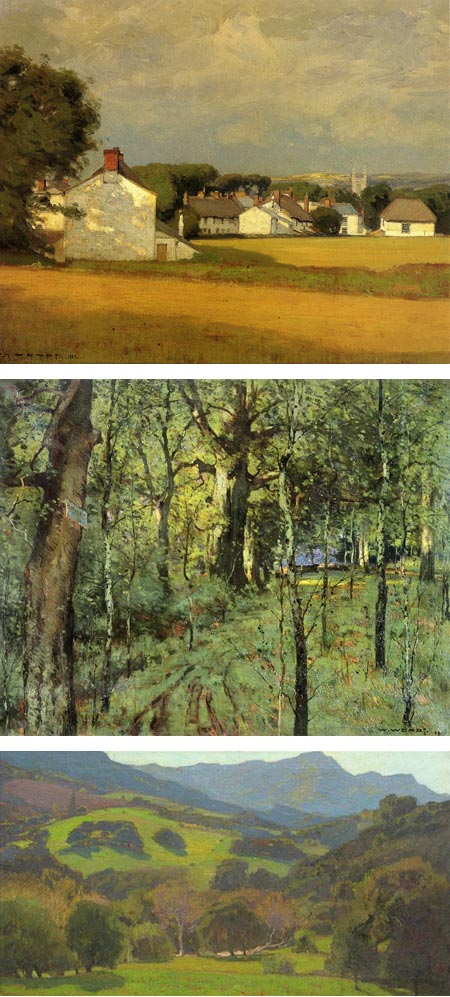
In an essay for the Laguna Art Museum, Michael McManus referred to the wave of American painters who brought the influence of the French Impressionists to California in the early 20th Century as “Impressionism’s Indian Summer”.Impressionism flowered late in California because it was largely a remote area before the turn of the century. The artists who came there early found a largely unspoiled and non-industrialized landscape, ideal for their endeavors. (For more on the timeline of California Impressionism, see my post on Guy Rose.)
Along with his friend George Gardner Symons, William Wendt was one of the Chicago area artists who came to California on the rail line that was completed in the late 1800’s.
Unlike Guy Rose, who was actually a student of Monet, Wendt only indulged in the all-out Impressionist dissolution of form in a flurry of paint strokes for a brief time. For most of his career, he painted in a more restrained palette, heavy in greens and browns, with broader strokes; to my eye more in keeping with some of the other American Impressionists like William Merrit Chase.
Though his colors were not as dazzling as those of some of his contemporaries, they were perfectly suited for his subjects. Wendt’s paintings carry a fresh, open feeling of the California countryside, rendered in the immediate style of paintings started, if not always finished, on location.
Categories:




Charley’s Picks
Bookshop.org
(Bookshop.org affilliate links; sales benefit independent bookshop owners; I get a small percentage to help support my work on Lines and Colors)

John Singer Sargent: Watercolors


Urban Sketching: Understanding Perspective


Charley’s Picks
Amazon
(Amazon.com affiliate links; sales go to a larger yacht for Jeff Bezos; but I get a small percentage to help support my work on Lines and Colors)
John Singer Sargent: Watercolors
Urban Sketching: Understanding Perspective