


Categories
- 3d CGI
- Amusements
- Animation
- Anime & Manga
- Art Materials
- Art Videos
- Blogroll
- Cartoons
- Color
- Comics
- Concept & Visual Dev.
- Creativity
- Digital Art
- Digital Painting
- Displaying Art on the Web
- Drawing
- Eye Candy for Today
- Gallery and Museum Art
- High-res Art Images
- Illustration
- Motion Graphics & Flash
- Museums
- Online Museums
- Outsider Art
- Painting
- Painting a Day
- Paleo Art
- Pastel, Conté & Chalk
- Pen & Ink
- Prints and Printmaking
- Reviews
- Sc-fi and Fantasy
- Sculpture & Dimensional
- Site Comments
- Sketching
- Storyboards
- Tools and Techniques
- Uncategorized
- Vector Art
- Videos & Podcasts
- Vision and Optics
- Watercolor and Gouache
- Webcomics
Archives
- September 2026
- August 2026
- July 2026
- June 2026
- May 2026
- April 2026
- March 2026
- February 2026
- January 2026
- December 2025
- November 2025
- October 2025
- September 2025
- August 2025
- July 2025
- June 2025
- May 2025
- January 2025
- December 2024
- November 2024
- October 2024
- September 2024
- August 2024
- June 2024
- April 2024
- March 2024
- February 2024
- January 2024
- December 2023
- November 2023
- October 2023
- September 2023
- August 2023
- July 2023
- May 2023
- April 2023
- March 2023
- February 2023
- January 2023
- December 2022
- November 2022
- September 2022
- August 2022
- July 2022
- June 2022
- May 2022
- April 2022
- March 2022
- February 2022
- January 2022
- December 2021
- November 2021
- October 2021
- September 2021
- August 2021
- July 2021
- June 2021
- May 2021
- April 2021
- March 2021
- February 2021
- January 2021
- December 2020
- November 2020
- October 2020
- September 2020
- August 2020
- July 2020
- June 2020
- May 2020
- April 2020
- March 2020
- February 2020
- January 2020
- December 2019
- November 2019
- October 2019
- September 2019
- August 2019
- July 2019
- June 2019
- May 2019
- April 2019
- March 2019
- February 2019
- January 2019
- December 2018
- November 2018
- October 2018
- September 2018
- August 2018
- July 2018
- June 2018
- May 2018
- April 2018
- March 2018
- February 2018
- January 2018
- December 2017
- November 2017
- October 2017
- September 2017
- August 2017
- July 2017
- June 2017
- May 2017
- April 2017
- March 2017
- February 2017
- January 2017
- December 2016
- November 2016
- October 2016
- September 2016
- August 2016
- July 2016
- June 2016
- May 2016
- April 2016
- March 2016
- February 2016
- January 2016
- December 2015
- November 2015
- October 2015
- September 2015
- August 2015
- July 2015
- June 2015
- May 2015
- April 2015
- March 2015
- February 2015
- January 2015
- December 2014
- November 2014
- October 2014
- September 2014
- August 2014
- July 2014
- June 2014
- May 2014
- April 2014
- March 2014
- February 2014
- January 2014
- December 2013
- November 2013
- October 2013
- September 2013
- August 2013
- July 2013
- June 2013
- May 2013
- April 2013
- March 2013
- February 2013
- January 2013
- December 2012
- November 2012
- October 2012
- September 2012
- August 2012
- July 2012
- June 2012
- May 2012
- April 2012
- March 2012
- February 2012
- January 2012
- December 2011
- November 2011
- October 2011
- September 2011
- August 2011
- July 2011
- June 2011
- May 2011
- April 2011
- March 2011
- February 2011
- January 2011
- December 2010
- November 2010
- October 2010
- September 2010
- August 2010
- July 2010
- June 2010
- May 2010
- April 2010
- March 2010
- February 2010
- January 2010
- December 2009
- November 2009
- October 2009
- September 2009
- August 2009
- July 2009
- June 2009
- May 2009
- April 2009
- March 2009
- February 2009
- January 2009
- December 2008
- November 2008
- October 2008
- September 2008
- August 2008
- July 2008
- June 2008
- May 2008
- April 2008
- March 2008
- February 2008
- January 2008
- December 2007
- November 2007
- October 2007
- September 2007
- August 2007
- July 2007
- June 2007
- May 2007
- April 2007
- March 2007
- February 2007
- January 2007
- December 2006
- November 2006
- October 2006
- September 2006
- August 2006
- July 2006
- June 2006
- May 2006
- April 2006
- March 2006
- February 2006
- January 2006
- December 2005
- November 2005
- October 2005
- September 2005
- August 2005
Relevant Blogs
Art, Painting & Sketch
- Gurney Journey
- Underpaintings
- Art and Influence
- Painting Perceptions
- Oil Painters of America
- Vasari Paint POV
- Flying Fox
- Urban Sketchers
- Bento (Smithsonian)
- Art Inconnu
- The Hidden Place
- Still Life
- Making a Mark
- The Art of the Landscape
- Exploring Color & Creativity
- Art Contrarian
- Artist A Day
- beinArt Surreal Art Collective
- Eye Level
- David Dunlop
- p.i.g.m.e.n.t.i.u.m
- CultureGrrl
- Joaquín Sorolla blog
- Artists in Pastel
“Painting a Day”
- A Painting a Day (Keiser)
- On Painting (Keiser)
- Julian Merrow-Smith
- Karen Jurick
- Jeffrey Hayes
- Carol Marine
- Abbey Ryan
- Daily Paintworks
Other Painting Blogs
- Virtual Gouache Land
- Neil Hollingsworth
- Marc Hanson
- Kevin Menck
- Marc Dalessio
- Larry Seiler
- Stapleton Kearns
- Colin Page
- Roos Schuring
- Hans Versfelt
- Titus Meeuws
- Régis Pettinari
- René Plein Air
- Belinda Del Pesco
- Robin Weiss
- Nathan Fowkes (Land Sketch)
- William Wray
- Frank Serrano
- Stephen Magsig
- Michael Chesley Johnson
- Twice a Week
- Sarah Wimperis
- Rob Adams
- Michael Cole Manley
- The Dirty Palette Club
- Mike Manley’s Draw!
Gallery Art & Illustration mix
Illustration
- Howard Pyle
- 100 Years of Illustration
- BibliOdyssey
- Illustration Art
- Today’s Inspiration
- Illustration Mundo
- Little Chimp Society
- Danny Gregory
- R D (John Martz
- Illustration Friday blog
- Monster Brains
- Illustrators & Illustrations (RU)
- Elwood H. Smith
- DaniDraws.com
- Designers Who Blog
- iSpot Blog
Sci-Fi & Fantasy
Illustration & Comics
Comics & Cartoons
- Comics Beat
- Robot 6
- Newsarama Blog
- Comic Vine
- Comics Alliance
- Forbidden Planet Int.
- Paolo Rivera
- Bolt City
- Flight
- Scott McCloud
- The Comics Journal
- Comixpedia
- Funnybook Babylon
- James Baker
- Middleton’s Sketchbook
- Boneville
- The Hotel Fred
- Paul Rivoche
- Daily Cartoonist
- Mad About Cartoons (William Wray)
- Digital Strips
Illustration & Concept
Animation & Concept
- Cartoon Brew
- Animation Blog
- Cold Hard Flash
- Concept Art World
- The CAB
- FY Concept Art
- Concept Ships
- Concept Robots
- John Nevarez
- Armand Serrano
- Marcos Mateu-Mestre
- all kinds of stuff (Kricfalusi)
- Yacin the faun (Man Arenas)
- Kelsey Mann
- Cre8tivemarks Blog
- Ice-Cream Monster Toon Cafe
- AAU Character & Creature Design
- AAU Animation Notes
- Articles and Texticles
Paleo & Scientific
Tools & Techniques
Other
Lists of Art Blogs
Art Image Resource Links
Historic Art Images
- Wikimedia Commons: Paintings
- Wikimedia Commons: Drawings
- The Athenaeum
- WikiArt (WikiPaintings)
- Google Art Project: Artists
- Google Art Project: Collections (Museums)
- ArtCyclopedia
- Web Gallery of Art
- Art Renewal Center
- Web Gallery of Impressionism
Auction Consolidation sites
Auction sites
- Sotheby’s
- Bonham’s
- Christies
- Heritage Auctions: Fine Art
- Heritage Auctions: Illustration
- Freeman’s Auctions
- Bukowskis
- Shannon’s
Image Search
Reverse Image Search (search by image)
- Tin Eye
- RevImg
- Google Image Search (camera icon)
- Bing Image Search (camera icon)
Promoting some friends and some clients of my website design business
- Twin Willows T’ai Chi studio in Wilmington DE. Taiji classes with Bryan Davis.
- Ray Hayward, Inspired Teacher of T’ai Chi ( Taiji ) in Minneapolis, Founder of Mindful Motion Tai Chi Academy
- OldHead Tattoo studio and Art Gallery in Wilmington DE. Tattoos and paintings by Bruce Gulick
- Sharon Domenico Art, pet portrait oil paintings
- Platinum Paperhanging, wallpaper hanging, Main Line and Philadelphia, PA
- Lisa Stone Design, interior designer, Main Line and Philadelphia, PA
- Studio12KPT, original art, prints, calendars and other custom printed items by Van Sickle & Rolleri
-
Theo Jansen

A number of sculpture related links have come up as a result of my post about Lawrence Northey last Thursday.Theo Jansen’s kinetic sculptures are particularly fascinating because they walk back and forth (literally) across the supposedly fixed line between art and engineering. These amazing artifacts are built of ultralight materials and constructed of levers and gears so that they become wind-driven and walk across the flat wet sand on beaches.
This video posted on glumbert.com probably shows them to best advantage. Their graceful, cantilevered legs and wing-like transparent films give them the appearance of animated skeletons of ghostly alien grazing animals.
He also has fabric-covered variations that look like anime robots come to life. Amazing.
Link courtesy of Karl Kofoed
Categories:
-
Tim Prentice

Another artist whose work crosses boundaries between disciplines, kinetic sculptor Tim Prentice was trained in architecture at Yale, founded a successful architectural firm, and went on to establish a studio to create kinetic sculpture.Prentice creates beautifully balanced and intricate mobile-like sculptures, flying out from the aerial paths first pioneered by Alexander Calder. His pieces, spin, turn, hover, glisten and dazzle, all the while performing a delicate act of balance with the forces of wind and gravity.
Categories:
-
Ree Treweek (update)
 When I first wrote about the delightfully original and idiosyncratic art of South African artist Ree Treweek back in March of 2006, I was a little disappointed in the lack of information about the artist and her work, and the limited number of her images available online.
I was pleased when artist/blogger Siouxfire (Michael Curry) wrote to say that he has posted an interview with Ree Treweek on his blog siouxwire.
In addition to her editorial illustrations, many of which were done under the name of Cheri Treweek, Ree Treweek has commercial clients that include Virgin Atlantic, Levi’s, Musica and HP, and she continues to move forward with her fascinating animation project, The Tale of How, a collaboration between herself, Jannes Hendrikz and Markus Smit, collectively known as The Blackheart Gang.
I also wrote about The Tale of How; in April of 2006. Since then, the sample video clip from the project has been extended by almost double, to about four and a half minutes.
The movie, a hybrid of animated drawings, live action manipulation of drawings and CGI, is mesmerizingly otherworldly and visually unique. The current clip (which weighs in at around 70mb), is available on The Blackheart Gang site.
(Though it’s obvious they mean for you to be able to download the clip, they’ve put the link in a Flash file, which means you can’t right-click/control-click to download, and some may have trouble downloading, rather than viewing it in Quicktime in the browser. If you’re using Firefox, you can go to Tools: Page Info, go to the Media tab, select the name of the file and click on “Save As” to download the file. There are other download options on No Fat Clips!)
The interview with Treweek on siouxwire includes sketches of her original ideas for The Tale of How, and in it Treweek talks about her influences and working methods: “I begin with the outlines, often drawing straight into pen when possible… I then do the patterning and detail. I generally draw all the elements as separates and then composite them together later. Usually I do all the coloring in Photoshop.”.
There is also some discussion of the collaborations on the animated film and the planned coffee-table book/DVD release.
Siouxfire also provides a more extensive list of links for additional information, including The Blackheart Gang on MySpace, and an article on Motionographer, in which there is a description of The Blackheart Gang’s collaborative process.
Categories:
-
Suncage (Jon Hall)
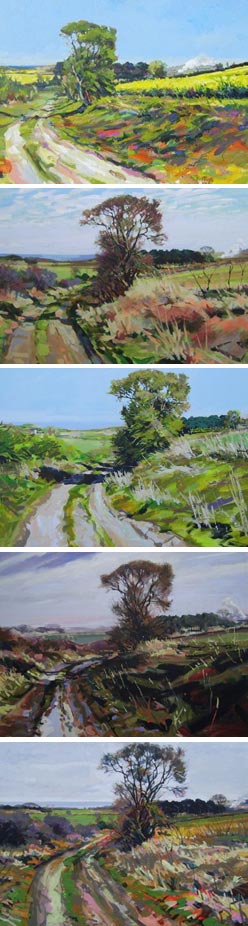
I will be the first to admit that, when it comes to painting “en plein air” (outdoors), I am a fair weather painter. Days when it’s even mildly chilly find me sitting cozily in font of a computer monitor, or the in the comfort of a heated studio indulging in the convenience of photographic reference.
That doesn’t stop me from admiring the determination of some dedicated plein air painters, and being outright amazed at others.
Suncage (pseudonym of UK painter Jon Hall) is in the latter category. He is astonishingly dedicated to painting outdoors regardless of circumstance; painting in wind, rain, cold, and all manner of unpleasant conditions.
His site and blog are a little short on introductory information, but some of this dedication may have come from a challenge he set for himself that he called “The Limners Contract“. (“Limner” is defined as someone who describes something by painting or drawing. It comes from a root meaning illuminator, from which we also get illustrator. Limner also can refer to ornamental painters in the American colonies.)
Suncage’s Limner’s contract was essentially a contract with himself to complete paintings from life, on site, every day for a year. In the course of the project he created over 500 painted sketches and chronicled the endeavor with photographs and video.
You can see come of Sungcage’s work in his online Gallery. He also maintains a blog, which is often devoted to Podcasts he makes about his plein air painting process.
His site includes a record of other painting projects, including ICE, the Robert Stephenson Awards in which he is painting a dozen icons of civil engineering in the country’s North East.
Last December, Suncage entered an open challenge form London’s National Gallery Podcast to create a piece of audio based on a picture in the National Gallery. He created the winning piece based on his impressions of the thoughts Pissarro may have had while painting a winter landscape in Fox Hill, Upper Norwood during his stay in London. Suncages’ own video about the piece, in which he intersperses the audio piece with his description of his own experience painting in the same location, may be a little confusing unless you’ve seen the original National Gallery Podcast in context (scroll down to view the Podcast. The segment on Fox Hill is a bit past halfway in the video.)
Suncage has provided numerous video accounts of his outdoor painting experiences. Those of you who, like myself, have seen one too many PowerPoint demos, may blanch as his overindulgence in iMovie/Keynote style video transitions, but the stories he has to tell about painting on location stand on their own.
He also has a preference for caging his voice in an echo effect and submerging it in electronica. Personally, I find these unnecessary distractions from his otherwise fascinating stories about painting on location and the challenges he has set himself in his desire to work under all conditions.
Of particular interest to me is his 12 Quick Exercises in painting the same scene repeatedly, as Monet did. Suncage works with this idea in multiple quick sketches on the same day, and in repeated visits to the same scene on different days, spaced both days apart and seasons apart. Within that process, he works in many different approaches to the application of tone and value (images above).
Categories:
-
Free Comic Book Day 2007

OK, so maybe you haven’t picked up a comic book since you were 12, and you’re so past that; or maybe you’ve never picked up a comic book and you’re so beyond that; or maybe you just associate comics with steroidal aberrations in spandex bashing into one another like runaway freight trains and you’re so not into that.Well, if you think comic books are what they used to be, or what you’ve been told they are, or what you only think they are, you could be so missing out on something you shouldn’t.
So,… tomorrow, Saturday, May 5th, 2007 is Free Comic Book Day! Here’s a great opportunity to casually drop by your friendly neighborhood comic book store, where the staff will be on their best behavior, prepared to accommodate newcomers to modern comics, happy to answer any questions, and handing out free, yes free, comics!
Free Comic Book Day has been going on for six years, and has grown each year. Comics companies large and small have published free special editions that showcase some of their best titles, and the comics store often put on sales, have guests, artist and writer signings and other events to make it as much of a celebration of comics as they can.
There is a web site devoted to the event, that contains a brief description, a list of frequently asked questions and other information about the event and comics in general.
In my post about last year’s Free Comic Book Day, I go into more detail about the event, talk a little about why you should take the time to check out modern comic books, and give a brief introduction to comic book specialty shops for those who haven’t dared to peer into the mysteries of what too often seems like a private club.
Not only will the stores have their doors wide open and the red carpet out, the free comics themselves will showcase some interesting titles. Of course there are the expected superhero books, from the the big publishers and independents, but there are many other titles appealing to kids and adults with a variety of other tastes.
There are 28 titles in all; you can see covers and descriptions here and here. In addition, many shops will add some titles from their own stock.
Notable this year is a Nexus comic by Mike Baron and Steve Rude, one of the best of the off-beat superheroes (preview here); a Linda Barry collection from Drawn and Quarterly; comics festival, a collection that includes artists like Darwyn Cooke and Hope Larson; a couple of how-to books on drawing and creating comics, Impact University and Wizard’s How to Draw sampler; a preview extract from Eddie Campbell’s new graphic novel, The Train Was Bang On Time (preview here); and some collections that showcase the continuing move of popular webcomics into print, like the Digital Webbing Jam and the Keenspot Spotlight.
So, what are you waiting for? Find your local comic book store and check it out on Saturday! You just might be so surprised.
Categories:
-
Lawrence Northey

I don’t often feature sculpture on lines and colors. I probably should consider it more often. Sculpture can have, after all, both lines and colors.In the case of Lawrence Northey’s wonderfull small scale sculptures (the one shown here, “Jim & George: Space Cadets” is 30 inches [76cm]), the colors are those of polished brass, aluminum, copper and glass, and the reflected colors of their environment; and the lines are the charmingly whimsical lines of cartoonlike robots.
OK, I’ll admit right off that I’m a complete sucker for robots, particularly shiny, reflective, steampunkishly mechanical robots with completely silly bubble headed space helmets and art deco ray guns, carrying anachronistic apparatus with dials and gauges and accompanied by equally silly mechanical dogs replete with dials and embossed lightning bolt insignia, so I may be inclined to like Northey’s approach.
Sculpture can be be visually appealing in a number of ways, but rarely is is as much outright fun as these beautifully crafted, meticulously detailed and marvelously imaginative creations from Northey’s hands.
Not only do his objects delight the eye with their rich metallic colors and sleek lines, many of Northey’s sculptures actually do things — move, sing, speak, produce music or “Zap!” sounds.
Northey has received recognition several times in the Spectrum collections of contemporary fantastic art and other publications. His gallery shows some of the range of his works. Much of his current work is commissioned. He also has multiple, but limited, editions of certain works.
His site lacks a bio or “About” page, but you can find one here.
Categories:



Charley’s Picks
Bookshop.org
(Bookshop.org affilliate links; sales benefit independent bookshop owners; I get a small percentage to help support my work on Lines and Colors)
Carlson’s Guide to Landscape Painting
Drawing and Sketching in Pencil

Bridgman’s Complete Guide to Drawing from Life
Charley’s Picks
Amazon
(Amazon.com affiliate links; sales go to a larger yacht for Jeff Bezos; but I get a small percentage to help support my work on Lines and Colors)
Carlson’s Guide to Landscape Painting
Drawing and Sketching in Pencil
Bridgman’s Complete Guide to Drawing from Life