


Categories
- 3d CGI
- Amusements
- Animation
- Anime & Manga
- Art Materials
- Art Videos
- Blogroll
- Cartoons
- Color
- Comics
- Concept & Visual Dev.
- Creativity
- Digital Art
- Digital Painting
- Displaying Art on the Web
- Drawing
- Eye Candy for Today
- Gallery and Museum Art
- High-res Art Images
- Illustration
- Motion Graphics & Flash
- Museums
- Online Museums
- Outsider Art
- Painting
- Painting a Day
- Paleo Art
- Pastel, Conté & Chalk
- Pen & Ink
- Prints and Printmaking
- Reviews
- Sc-fi and Fantasy
- Sculpture & Dimensional
- Site Comments
- Sketching
- Storyboards
- Tools and Techniques
- Uncategorized
- Vector Art
- Videos & Podcasts
- Vision and Optics
- Watercolor and Gouache
- Webcomics
Archives
- June 2026
- May 2026
- April 2026
- March 2026
- February 2026
- January 2026
- December 2025
- November 2025
- October 2025
- September 2025
- August 2025
- July 2025
- June 2025
- May 2025
- January 2025
- December 2024
- November 2024
- October 2024
- September 2024
- August 2024
- June 2024
- April 2024
- March 2024
- February 2024
- January 2024
- December 2023
- November 2023
- October 2023
- September 2023
- August 2023
- July 2023
- May 2023
- April 2023
- March 2023
- February 2023
- January 2023
- December 2022
- November 2022
- September 2022
- August 2022
- July 2022
- June 2022
- May 2022
- April 2022
- March 2022
- February 2022
- January 2022
- December 2021
- November 2021
- October 2021
- September 2021
- August 2021
- July 2021
- June 2021
- May 2021
- April 2021
- March 2021
- February 2021
- January 2021
- December 2020
- November 2020
- October 2020
- September 2020
- August 2020
- July 2020
- June 2020
- May 2020
- April 2020
- March 2020
- February 2020
- January 2020
- December 2019
- November 2019
- October 2019
- September 2019
- August 2019
- July 2019
- June 2019
- May 2019
- April 2019
- March 2019
- February 2019
- January 2019
- December 2018
- November 2018
- October 2018
- September 2018
- August 2018
- July 2018
- June 2018
- May 2018
- April 2018
- March 2018
- February 2018
- January 2018
- December 2017
- November 2017
- October 2017
- September 2017
- August 2017
- July 2017
- June 2017
- May 2017
- April 2017
- March 2017
- February 2017
- January 2017
- December 2016
- November 2016
- October 2016
- September 2016
- August 2016
- July 2016
- June 2016
- May 2016
- April 2016
- March 2016
- February 2016
- January 2016
- December 2015
- November 2015
- October 2015
- September 2015
- August 2015
- July 2015
- June 2015
- May 2015
- April 2015
- March 2015
- February 2015
- January 2015
- December 2014
- November 2014
- October 2014
- September 2014
- August 2014
- July 2014
- June 2014
- May 2014
- April 2014
- March 2014
- February 2014
- January 2014
- December 2013
- November 2013
- October 2013
- September 2013
- August 2013
- July 2013
- June 2013
- May 2013
- April 2013
- March 2013
- February 2013
- January 2013
- December 2012
- November 2012
- October 2012
- September 2012
- August 2012
- July 2012
- June 2012
- May 2012
- April 2012
- March 2012
- February 2012
- January 2012
- December 2011
- November 2011
- October 2011
- September 2011
- August 2011
- July 2011
- June 2011
- May 2011
- April 2011
- March 2011
- February 2011
- January 2011
- December 2010
- November 2010
- October 2010
- September 2010
- August 2010
- July 2010
- June 2010
- May 2010
- April 2010
- March 2010
- February 2010
- January 2010
- December 2009
- November 2009
- October 2009
- September 2009
- August 2009
- July 2009
- June 2009
- May 2009
- April 2009
- March 2009
- February 2009
- January 2009
- December 2008
- November 2008
- October 2008
- September 2008
- August 2008
- July 2008
- June 2008
- May 2008
- April 2008
- March 2008
- February 2008
- January 2008
- December 2007
- November 2007
- October 2007
- September 2007
- August 2007
- July 2007
- June 2007
- May 2007
- April 2007
- March 2007
- February 2007
- January 2007
- December 2006
- November 2006
- October 2006
- September 2006
- August 2006
- July 2006
- June 2006
- May 2006
- April 2006
- March 2006
- February 2006
- January 2006
- December 2005
- November 2005
- October 2005
- September 2005
- August 2005
Relevant Blogs
Art, Painting & Sketch
- Gurney Journey
- Underpaintings
- Art and Influence
- Painting Perceptions
- Oil Painters of America
- Vasari Paint POV
- Flying Fox
- Urban Sketchers
- Bento (Smithsonian)
- Art Inconnu
- The Hidden Place
- Still Life
- Making a Mark
- The Art of the Landscape
- Exploring Color & Creativity
- Art Contrarian
- Artist A Day
- beinArt Surreal Art Collective
- Eye Level
- David Dunlop
- p.i.g.m.e.n.t.i.u.m
- CultureGrrl
- Joaquín Sorolla blog
- Artists in Pastel
“Painting a Day”
- A Painting a Day (Keiser)
- On Painting (Keiser)
- Julian Merrow-Smith
- Karen Jurick
- Jeffrey Hayes
- Carol Marine
- Abbey Ryan
- Daily Paintworks
Other Painting Blogs
- Virtual Gouache Land
- Neil Hollingsworth
- Marc Hanson
- Kevin Menck
- Marc Dalessio
- Larry Seiler
- Stapleton Kearns
- Colin Page
- Roos Schuring
- Hans Versfelt
- Titus Meeuws
- Régis Pettinari
- René Plein Air
- Belinda Del Pesco
- Robin Weiss
- Nathan Fowkes (Land Sketch)
- William Wray
- Frank Serrano
- Stephen Magsig
- Michael Chesley Johnson
- Twice a Week
- Sarah Wimperis
- Rob Adams
- Michael Cole Manley
- The Dirty Palette Club
- Mike Manley’s Draw!
Gallery Art & Illustration mix
Illustration
- Howard Pyle
- 100 Years of Illustration
- BibliOdyssey
- Illustration Art
- Today’s Inspiration
- Illustration Mundo
- Little Chimp Society
- Danny Gregory
- R D (John Martz
- Illustration Friday blog
- Monster Brains
- Illustrators & Illustrations (RU)
- Elwood H. Smith
- DaniDraws.com
- Designers Who Blog
- iSpot Blog
Sci-Fi & Fantasy
Illustration & Comics
Comics & Cartoons
- Comics Beat
- Robot 6
- Newsarama Blog
- Comic Vine
- Comics Alliance
- Forbidden Planet Int.
- Paolo Rivera
- Bolt City
- Flight
- Scott McCloud
- The Comics Journal
- Comixpedia
- Funnybook Babylon
- James Baker
- Middleton’s Sketchbook
- Boneville
- The Hotel Fred
- Paul Rivoche
- Daily Cartoonist
- Mad About Cartoons (William Wray)
- Digital Strips
Illustration & Concept
Animation & Concept
- Cartoon Brew
- Animation Blog
- Cold Hard Flash
- Concept Art World
- The CAB
- FY Concept Art
- Concept Ships
- Concept Robots
- John Nevarez
- Armand Serrano
- Marcos Mateu-Mestre
- all kinds of stuff (Kricfalusi)
- Yacin the faun (Man Arenas)
- Kelsey Mann
- Cre8tivemarks Blog
- Ice-Cream Monster Toon Cafe
- AAU Character & Creature Design
- AAU Animation Notes
- Articles and Texticles
Paleo & Scientific
Tools & Techniques
Other
Lists of Art Blogs
Art Image Resource Links
Historic Art Images
- Wikimedia Commons: Paintings
- Wikimedia Commons: Drawings
- The Athenaeum
- WikiArt (WikiPaintings)
- Google Art Project: Artists
- Google Art Project: Collections (Museums)
- ArtCyclopedia
- Web Gallery of Art
- Art Renewal Center
- Web Gallery of Impressionism
Auction Consolidation sites
Auction sites
- Sotheby’s
- Bonham’s
- Christies
- Heritage Auctions: Fine Art
- Heritage Auctions: Illustration
- Freeman’s Auctions
- Bukowskis
- Shannon’s
Image Search
Reverse Image Search (search by image)
- Tin Eye
- RevImg
- Google Image Search (camera icon)
- Bing Image Search (camera icon)
Promoting some friends and some clients of my website design business
- Twin Willows T’ai Chi studio in Wilmington DE. Taiji classes with Bryan Davis.
- Ray Hayward, Inspired Teacher of T’ai Chi ( Taiji ) in Minneapolis, Founder of Mindful Motion Tai Chi Academy
- OldHead Tattoo studio and Art Gallery in Wilmington DE. Tattoos and paintings by Bruce Gulick
- Sharon Domenico Art, pet portrait oil paintings
- Platinum Paperhanging, wallpaper hanging, Main Line and Philadelphia, PA
- Lisa Stone Design, interior designer, Main Line and Philadelphia, PA
- Studio12KPT, original art, prints, calendars and other custom printed items by Van Sickle & Rolleri
-
Sargent watercolors at the Brooklyn Museum

John Singer Sargent, long dismissed by the art establishment as a facile painter of society portraits, has finally in recent years been getting something of his due as a painter.Beyond the technical mastery and delicious painterly flourish of his formal work in oil, Sargent was one of the great masters of the medium of watercolor; and it was in his watercolors, often painted while vacationing or traveling, that he found his greatest joy as an artist.
The Brooklyn Museum and the Museum of Fine Arts, Boston have put together an exhibition that draws on the Sargent watercolors in the collection of both museums.
Titled simply John Singer Sargent Watercolors, it consists of ninety-three works in watercolor with mixtures of opaque watercolor, bodycolor, graphite and whatever else Sargent could find to achieve his goals. To these they have added nine of Sargent’s oils — just in case the watercolors aren’t enough to leave you completely dazzled.
I consider this a must-see show if I can possibly make it, and hope to give you a subsequent first-hand report.
In the meanwhile, there is a catalog from the exhibition, John Singer Sargent Watercolors, that James Gurney reviews here.
I can also recommend an older book, The Watercolors of John Singer Singer Sargent by Carl Little, but judging from Gurney’s review, I would go for the new catalog first.
The exhibition will be at the Brooklyn Museum until July 28, 2013. (Incidentally, the Brooklyn Museum, as I write here, is a terrific museum in general, often unfairly overshadowed by its more famous counterparts in Manhattan.)
The exhibition then moves to the Museum of Fine Arts, Boston, where it will be on display from October 13, 2013 to January 20, 2014. The last stop will be at the Museum of Fine Arts, Houston, for which dates have not yet been set.
There is a small slideshow on the Brooklyn Museum page for the exhibit, but with a bit of clicking you can search their collections for John Singer Sargent Watercolors and access more works. Use the blue arrow at right of the top section of thumbnails to access more objects (their search interface needs work). On the page for an individual work, click on “Download” and choose a large size for larger images.
The MFA has an easier to navigate search; click on “Zoom” for larger images.
[Via Gurney Journey]
Categories:
-
Rodin’s Gates of Hell

The Gates of Hell was an ambitious and astonishing work by the French sculptor Auguste Rodin that was never realized in his lifetime.The sculpture exists in two versions, one of which was cast in bronze posthumously from reconstructed plaster casts. The work stands almost 30 feet (6m) high and 12 feet (4m) wide, with over 180 figures representing themes from Dante Alighieri’s Devine Comedy.
The sculpture contains many figures and sets of figures that were eventually developed into independent works by Rodin, including his famous The Thinker. Rodin worked on the doors off and on for 37 years, never actually finishing the work.
There is a video here that discusses the the work and the two different versions created by Rodin.
There are three original bronze casts, at the Musée Rodin in Paris, the Rodin Museum here in Philadelphia and the National Museum of Western Art in Tokyo.
Three more were subsequently cast by the Musée Rodin, and are in Zurich, Seoul, Korea and Stanford University in California.
Microbiologist and photographer J.W. Kern has taken a rather remarkable high-resolution (112 megapixel) photograph of the Stanford casting and made it available on Flickr (click on “Original” for the high-res version, which is 18mb). Here is Kern’s article about the sculpture and the photo.
[Via MetaFilter]
Categories:
-
Cartoon Kevin
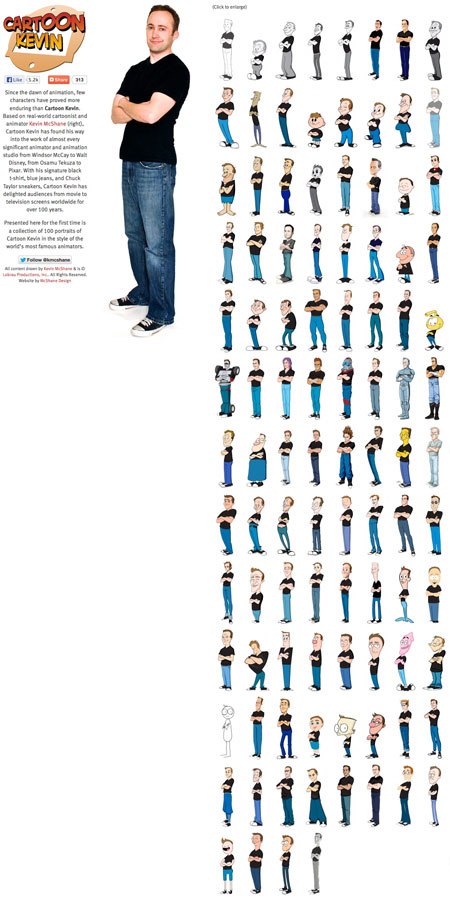
“Cartoon Kevin” is a project by Kevin McShane in which he has over a period of two years drawn cartoon self portraits in the style of 100 different animation artists, from Winsor McCay to this year’s fascinating Disney short, Paperman (my post here).When viewing the images, hover for the style, click for the larger version.
[Via Cartoon Brew]
Categories:
-
Girl With a Pearl Earring: Dutch Paintings From the Mauritshuis

While the Mauritshuis, The Royal Picture Gallery in The Hague, Netherlands, is undergoing renovations, some 35 wonderful examples of their extraordinary collection of paintings are touring the US.The group includes Vermeer’s Girl With a Pearl Earring, as well as treasures by Rembrandt, Frans Hals, Carel Fabritius, Rachel Ruysch, Jan Steen, Jacob von Ryisdael and others.
The show is currently at the de Young Museum in San Francisco, where it will be on display until June 2, 2013.
It then moves to the High Museum of Art in Atlanta, where it will be on display from June 23 to September 29, 2013.
A smaller subset of 15 works, titled Vermeer, Rembrandt, and Hals: Masterpieces of Dutch Painting from the Mauritshuis, including Girl with a Pearl Earring as well as works by Rembrandt, Hals, van Ruisdael, Steen and Fabritius, will be on display at the Frick Collection in New York from October 22, 2013 to January 19, 2014, which is when I hope to see them.
(Images above: Johnannes Vermeer, Carel Fabritius, Abraham van Beyeren, Jacob van Ruisdael, Reambrandt van Rijn)
[Addendum: Reader Ælle points to an interesting interview with Mauritshuis Director Emilie Gordenker on ArtsATL]
Categories:
-
Andrew Bosley

Andrew Bosley is a concept artist and illustrator currently working with Red Storm Entertainment in North Carolina.I first encountered Bosley back in 2007, when he had just graduated from the Illustration program at San Jose state University, and was kind enough to write and share with us a blog he had posted called A Little Bit of J.C. Leyendecker Greatness (my post here) in which he had scanned and posted 30 some Leyendecker covers and made them available to illustration lovers everywhere.
At the time, Bosley was just beginning to post his own work, but not much was available. Since then, I’m happy to say, Bosley has not only continued his blog, but has put up a website with a portfolio of his work, which is just a delight.
A mixture of professional and personal projects, the portfolio showcases Bosley’s stylistic range, from rendered cartoony illustration to retro fantasy to straight ahead concept characters and environments. All of them, though, demonstrate a comfortable and unforced approach to composition, color and execution.
His cover illustration for the new novel by Mike Resnick, The Doctor and the Dinosaur, (above, second from bottom) makes me want to pick up the story just to see if it carries the same paleo-steampunk feeling as the cover.
In addition to his site and blog, there is a portfolio of Bosley’s work on Concept Art World.
There is also an interesting additional feature on Bosley’s website — The Brainstormer. This is a codified version of a tried and true creativity jumpstarting process usually practiced by desperate artists and writers in the dead of night with scribbled lists of words on scraps of paper.
Bosley, with help from John Mitchell, created a wheel based version done in Flash for the website, in which three lists of words can be randomly or systematically aligned against one another, forming three word juxtapositions to spark creative imagery.
Better yet, there is now a Brainstormer iPhone/iPad app (above, bottom), created with the help of Joel Davis (article here) that takes the concept to another level, and offers additional add-on wheels of subjects specifically for characters, world building and imaginary animals.
Categories:
-
Art Model Tips
In my years of drawing from the model in life drawing sessions, as a student at the Pennsylvania Academy of the Fine Arts through additional classes at the Delaware Art Museum School, the Fleischer Art Memorial, the Philadelphia Sketch Club, the Plastic Club, the Delaware College of Art and Design and other venues, I’ve learned a couple of things about artist’s models.One is that posing for artists is much more demanding than outsiders realize. There is a tendency to think that modeling is “just sitting there” or “standing still”, and as such should be easy, but that’s simply not the case, particularly not when well done.
That’s the other thing I’ve found — that some models take it quite seriously and work to be very good at what they are doing. From an artist’s perspective, it makes a big difference.
Often in open studio sessions, as opposed to more formal classes, there is little guidance from the proctor other than length of pose or standing, sitting, etc., and it’s left to the model to invent the poses. Ideally, these should be interesting, with some suggestion of movement or dynamics, but not so off balance as to be difficult to hold for the pose sessions (usually 20 minutes at a time, often with the same pose repeated over several sessions).
The best models manage to be creative in these situations, as well as knowing how to hold a pose — again, not as simple as it sounds. I’ve never had a problem with models who will “shake out” in the middle of a pose, and then resume it accurately. Models who are not good at holding a pose are more likely to gradually slump into a different position over time, like a melting glacier.
Poor models will also make it obvious that they are bored, or just biding their time until they’re paid. Good ones make it obvious that they are doing what they do well, with thought and attention to the pose, even if they’re mentally in another world while holding the pose.
Artist models are generally not paid well, certainly not in comparison to the skill that some bring to the task, in particular those with a bit of dance or theater training who know how to use the position of their body expressively.
Artists who are fortunate to work with a good model, however, have a much better chance of producing interesting, expressive work. At its best, it’s something of a collaborative effort.
Models, however, remain something of a forgotten element in the art community (even though some of them are also artists), with fewer resources available than for artists in general.
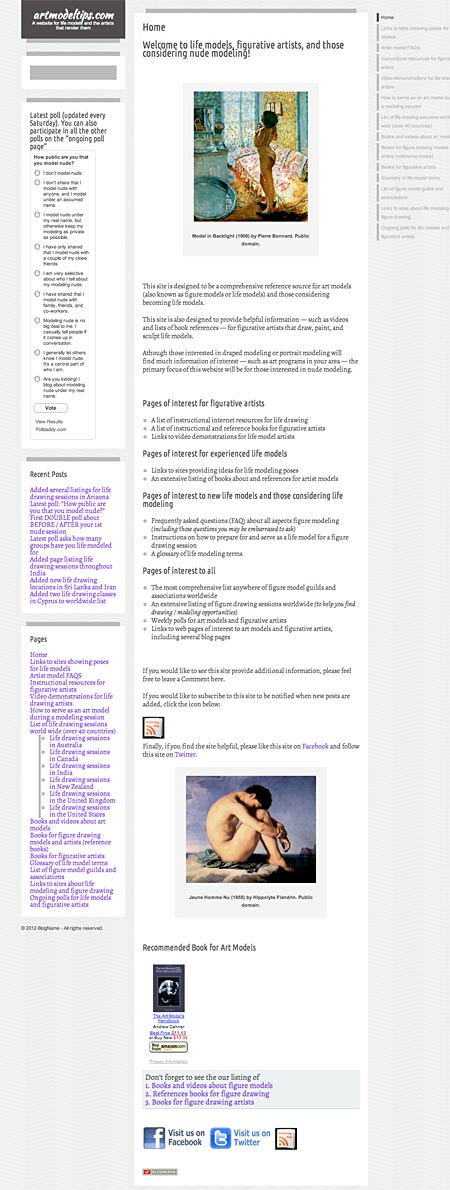
It’s nice to see a new (to me at least) website called artmodeltips.com that collects a number of resources of interest to those in involved in life modeling, as well as those who run drawing sessions or classes and hire and work with models.
It includes links to resources for life drawing sessions in 40 countries around the world, books and videos of interest to models, life model guilds and associations, instructional materials and other items of interest both to both models and to artists who do life drawing or painting.
The resources include The Art Model’s Handbook, and the Figure Drawing Classes, Workshops, Open Studios website (which I have written about previously), in itself a considerable resource for both models and artists.
[Via @StudioIncammina]
Categories:




Charley’s Picks
Bookshop.org
(Bookshop.org affilliate links; sales benefit independent bookshop owners; I get a small percentage to help support my work on Lines and Colors)

John Singer Sargent: Watercolors


Urban Sketching: Understanding Perspective


Charley’s Picks
Amazon
(Amazon.com affiliate links; sales go to a larger yacht for Jeff Bezos; but I get a small percentage to help support my work on Lines and Colors)
John Singer Sargent: Watercolors
Urban Sketching: Understanding Perspective