


Categories
- 3d CGI
- Amusements
- Animation
- Anime & Manga
- Art Materials
- Art Videos
- Blogroll
- Cartoons
- Color
- Comics
- Concept & Visual Dev.
- Creativity
- Digital Art
- Digital Painting
- Displaying Art on the Web
- Drawing
- Eye Candy for Today
- Gallery and Museum Art
- High-res Art Images
- Illustration
- Motion Graphics & Flash
- Museums
- Online Museums
- Outsider Art
- Painting
- Painting a Day
- Paleo Art
- Pastel, Conté & Chalk
- Pen & Ink
- Prints and Printmaking
- Reviews
- Sc-fi and Fantasy
- Sculpture & Dimensional
- Site Comments
- Sketching
- Storyboards
- Tools and Techniques
- Uncategorized
- Vector Art
- Videos & Podcasts
- Vision and Optics
- Watercolor and Gouache
- Webcomics
Archives
- May 2026
- April 2026
- March 2026
- February 2026
- January 2026
- December 2025
- November 2025
- October 2025
- September 2025
- August 2025
- July 2025
- June 2025
- May 2025
- January 2025
- December 2024
- November 2024
- October 2024
- September 2024
- August 2024
- June 2024
- April 2024
- March 2024
- February 2024
- January 2024
- December 2023
- November 2023
- October 2023
- September 2023
- August 2023
- July 2023
- May 2023
- April 2023
- March 2023
- February 2023
- January 2023
- December 2022
- November 2022
- September 2022
- August 2022
- July 2022
- June 2022
- May 2022
- April 2022
- March 2022
- February 2022
- January 2022
- December 2021
- November 2021
- October 2021
- September 2021
- August 2021
- July 2021
- June 2021
- May 2021
- April 2021
- March 2021
- February 2021
- January 2021
- December 2020
- November 2020
- October 2020
- September 2020
- August 2020
- July 2020
- June 2020
- May 2020
- April 2020
- March 2020
- February 2020
- January 2020
- December 2019
- November 2019
- October 2019
- September 2019
- August 2019
- July 2019
- June 2019
- May 2019
- April 2019
- March 2019
- February 2019
- January 2019
- December 2018
- November 2018
- October 2018
- September 2018
- August 2018
- July 2018
- June 2018
- May 2018
- April 2018
- March 2018
- February 2018
- January 2018
- December 2017
- November 2017
- October 2017
- September 2017
- August 2017
- July 2017
- June 2017
- May 2017
- April 2017
- March 2017
- February 2017
- January 2017
- December 2016
- November 2016
- October 2016
- September 2016
- August 2016
- July 2016
- June 2016
- May 2016
- April 2016
- March 2016
- February 2016
- January 2016
- December 2015
- November 2015
- October 2015
- September 2015
- August 2015
- July 2015
- June 2015
- May 2015
- April 2015
- March 2015
- February 2015
- January 2015
- December 2014
- November 2014
- October 2014
- September 2014
- August 2014
- July 2014
- June 2014
- May 2014
- April 2014
- March 2014
- February 2014
- January 2014
- December 2013
- November 2013
- October 2013
- September 2013
- August 2013
- July 2013
- June 2013
- May 2013
- April 2013
- March 2013
- February 2013
- January 2013
- December 2012
- November 2012
- October 2012
- September 2012
- August 2012
- July 2012
- June 2012
- May 2012
- April 2012
- March 2012
- February 2012
- January 2012
- December 2011
- November 2011
- October 2011
- September 2011
- August 2011
- July 2011
- June 2011
- May 2011
- April 2011
- March 2011
- February 2011
- January 2011
- December 2010
- November 2010
- October 2010
- September 2010
- August 2010
- July 2010
- June 2010
- May 2010
- April 2010
- March 2010
- February 2010
- January 2010
- December 2009
- November 2009
- October 2009
- September 2009
- August 2009
- July 2009
- June 2009
- May 2009
- April 2009
- March 2009
- February 2009
- January 2009
- December 2008
- November 2008
- October 2008
- September 2008
- August 2008
- July 2008
- June 2008
- May 2008
- April 2008
- March 2008
- February 2008
- January 2008
- December 2007
- November 2007
- October 2007
- September 2007
- August 2007
- July 2007
- June 2007
- May 2007
- April 2007
- March 2007
- February 2007
- January 2007
- December 2006
- November 2006
- October 2006
- September 2006
- August 2006
- July 2006
- June 2006
- May 2006
- April 2006
- March 2006
- February 2006
- January 2006
- December 2005
- November 2005
- October 2005
- September 2005
- August 2005
Relevant Blogs
Art, Painting & Sketch
- Gurney Journey
- Underpaintings
- Art and Influence
- Painting Perceptions
- Oil Painters of America
- Vasari Paint POV
- Flying Fox
- Urban Sketchers
- Bento (Smithsonian)
- Art Inconnu
- The Hidden Place
- Still Life
- Making a Mark
- The Art of the Landscape
- Exploring Color & Creativity
- Art Contrarian
- Artist A Day
- beinArt Surreal Art Collective
- Eye Level
- David Dunlop
- p.i.g.m.e.n.t.i.u.m
- CultureGrrl
- Joaquín Sorolla blog
- Artists in Pastel
“Painting a Day”
- A Painting a Day (Keiser)
- On Painting (Keiser)
- Julian Merrow-Smith
- Karen Jurick
- Jeffrey Hayes
- Carol Marine
- Abbey Ryan
- Daily Paintworks
Other Painting Blogs
- Virtual Gouache Land
- Neil Hollingsworth
- Marc Hanson
- Kevin Menck
- Marc Dalessio
- Larry Seiler
- Stapleton Kearns
- Colin Page
- Roos Schuring
- Hans Versfelt
- Titus Meeuws
- Régis Pettinari
- René Plein Air
- Belinda Del Pesco
- Robin Weiss
- Nathan Fowkes (Land Sketch)
- William Wray
- Frank Serrano
- Stephen Magsig
- Michael Chesley Johnson
- Twice a Week
- Sarah Wimperis
- Rob Adams
- Michael Cole Manley
- The Dirty Palette Club
- Mike Manley’s Draw!
Gallery Art & Illustration mix
Illustration
- Howard Pyle
- 100 Years of Illustration
- BibliOdyssey
- Illustration Art
- Today’s Inspiration
- Illustration Mundo
- Little Chimp Society
- Danny Gregory
- R D (John Martz
- Illustration Friday blog
- Monster Brains
- Illustrators & Illustrations (RU)
- Elwood H. Smith
- DaniDraws.com
- Designers Who Blog
- iSpot Blog
Sci-Fi & Fantasy
Illustration & Comics
Comics & Cartoons
- Comics Beat
- Robot 6
- Newsarama Blog
- Comic Vine
- Comics Alliance
- Forbidden Planet Int.
- Paolo Rivera
- Bolt City
- Flight
- Scott McCloud
- The Comics Journal
- Comixpedia
- Funnybook Babylon
- James Baker
- Middleton’s Sketchbook
- Boneville
- The Hotel Fred
- Paul Rivoche
- Daily Cartoonist
- Mad About Cartoons (William Wray)
- Digital Strips
Illustration & Concept
Animation & Concept
- Cartoon Brew
- Animation Blog
- Cold Hard Flash
- Concept Art World
- The CAB
- FY Concept Art
- Concept Ships
- Concept Robots
- John Nevarez
- Armand Serrano
- Marcos Mateu-Mestre
- all kinds of stuff (Kricfalusi)
- Yacin the faun (Man Arenas)
- Kelsey Mann
- Cre8tivemarks Blog
- Ice-Cream Monster Toon Cafe
- AAU Character & Creature Design
- AAU Animation Notes
- Articles and Texticles
Paleo & Scientific
Tools & Techniques
Other
Lists of Art Blogs
Art Image Resource Links
Historic Art Images
- Wikimedia Commons: Paintings
- Wikimedia Commons: Drawings
- The Athenaeum
- WikiArt (WikiPaintings)
- Google Art Project: Artists
- Google Art Project: Collections (Museums)
- ArtCyclopedia
- Web Gallery of Art
- Art Renewal Center
- Web Gallery of Impressionism
Auction Consolidation sites
Auction sites
- Sotheby’s
- Bonham’s
- Christies
- Heritage Auctions: Fine Art
- Heritage Auctions: Illustration
- Freeman’s Auctions
- Bukowskis
- Shannon’s
Image Search
Reverse Image Search (search by image)
- Tin Eye
- RevImg
- Google Image Search (camera icon)
- Bing Image Search (camera icon)
Promoting some friends and some clients of my website design business
- Twin Willows T’ai Chi studio in Wilmington DE. Taiji classes with Bryan Davis.
- Ray Hayward, Inspired Teacher of T’ai Chi ( Taiji ) in Minneapolis, Founder of Mindful Motion Tai Chi Academy
- OldHead Tattoo studio and Art Gallery in Wilmington DE. Tattoos and paintings by Bruce Gulick
- Sharon Domenico Art, pet portrait oil paintings
- Platinum Paperhanging, wallpaper hanging, Main Line and Philadelphia, PA
- Lisa Stone Design, interior designer, Main Line and Philadelphia, PA
- Studio12KPT, original art, prints, calendars and other custom printed items by Van Sickle & Rolleri
-
Illustration 30

I’ver written before about Illustration magazine, the beautiful quarterly periodical published by Dan Zimmer that showcases in-depth, lavishly illustrated articles on classic illustrators, both well known and undeservedly obscure, all presented with stunning production values.Illustration 30 is out, featuring articles on Ellen B. T. Pyle, one of Howard Pyle’s students who married his brother Walter (images above, top); the strikingly colorful works of Edwin Georgi (above, middle) and the bizarre egg tempera and scratchboard illustrations of Douglas Walters (above, bottom).
The Ellen Pyle article is particularly timely in that it coincides with an exhibit currently at the Delaware Art Museum, Illustrating Her World: Ellen B. T. Pyle, that runs until January 3, 2010. The museum participated in the preparation of the article.
The issue, which is 96 full color pages, also includes a nice In Memoriam to Frank Frazetta by Ralph Bakshi, a personal remembrance of Ernest Chiriaka by Zimmer, plus the usual letters, reviews, exhibition and event listings and ads of interest to those who love classic illustration.
But why just take my word for it when Zimmer has placed the entire Issue 30 online for you to flip through, not just in thumbnails but in full screen and zoomable (click on the preview at bottom or the “View the Digital Edition” link, when in the full screen version click on the pages to zoom).
In addition to the current issue, Zimmer has made a number of past issues available the in the same full screen zoomable format through the Issuu.com interface (see the related issue thumbnails in the right column).
These will give you a great idea of the beautiful art and incisive writing in the magazine. I’ll stress again, though, as I have often pointed out, that the onscreen versions of the images, not matter that they’re full screen, are low resolution compared to the way they appear in print, particularly with Illustration’s superb color and reproduction standards.
The print version of issue 30 can be ordered directly from the publisher for only $15 U.S., which includes shipping ($30 U.S. for international delivery); and a number of back issues are available for the same price. In addition there are special publications, books and DVDs of interest to fans of classic illustration, including the ability to pre order the the new H.J. Ward book shipping in November.
Zimmer is also now presiding over The Illustration Gallery, a new online gallery of illustration art originals for sale.
Categories:
-
Paul Madonna: All Over Coffee

“Predictable” is a word that, sadly, often applies to the contents of modern newspaper comics pages (what remains of them). In February of 2004 readers of the San Francisco Chronicle suddenly found themselves confronted with a new feature on the comics page, “All Over Coffee” by Paul Madonna, that set that notion nicely askew.As an East Coast resident, I don’t get the Chronicle, but I can imagine that, for some, the feature was a source of confusion, despite the paper’s introductory article; but for others the reaction must have similar to the one I had when I first encountered All Over Coffee on the web: “Wow. What is this?”
The feature consists of a drawing, usually a beautiful pen and wash drawing of buildings, streets, rooms or architectural elements in San Francisco (and sometimes Paris, Amsterdam and elsewhere) accompanied by a short bit of writing, a few lines to a few paragraphs.
The writing consists of seemingly random musings, comments, suggestions, observations and generally enigmatic phrases written into and juxtaposed against the subtle beauty of the wash drawings. The “strip” ostensibly revolves around two unseen characters, Maurice and Sarah, whose abstracted thoughts and conversations form the text.
The drawings themselves are sometimes as wonderfully quirky and thought provoking as the writing, bits of seemingly incongruent architecture, flashes of streets, textural patterns of rooftops, storefronts, house sides, museum interiors, apartment lobbies, alleyways, cornices, telephone wires and TV antennas, often wrapped in geometric shadows and rendered with an intense affection and attention to detail.
Is it art? Sure. Is it literature? Yeah, that too. Is it poetry? Sometimes. Is it comics? Well, no (in that it’s not sequential storytelling as far as I can discern). Is it fascinating and rewarding? Almost always.
Madonna’s wash drawings are simply wonderful; his sensitive linework, sure draftsmanship, masterful applications of wash and keen eye for light and shadow produce images that are uncannily evocative of place, even for those of us who have never been to San Francisco.
Even though I have been to Paris, I don’t find those images any more or less resonant than the ones of San Francisco; the “place” he evokes isn’t as much a geographical location as the immediacy of one’s own surroundings, the sense of noticing the scene, and the moment, in which you find yourself.
Combined with text that, almost regardless of its actual content, has the common thread of causing you to slow down and contemplate, the final piece produces a poetic suspension of the ordinary; or more accurately, a reframing of the ordinary as extraordinary.
Madonna’s drawing style manages to retain some of the informality of travel sketches (and some of the journalistic immediacy of sketchbooks by Robert Crumb and Chris Ware), even while refined to the point of a finished work. He seems to have found a delicate “just right” spot between the two. He exercises that balance within individual drawings, with passages of intense detail against blank walls and great negative shapes of skies, often criss-crossed with telephone wires, window frames and the edges of architectural forms in a rich and playful compositional geometry.
His website opens in rather newspaper-like columns with news, announcements and links to various features and projects. All Over Coffee has its own section.
There is a book collection of All Over Coffee that is available from Amazon or directly from the publisher, City Lights. As announced on the All Over Coffee main page, a new collection, Everything Is Its Own Reward (the name of which is taken from this panel) is due in April of 2011.
Madonna has also provided illustrations for other books, including A Writer’s San Francisco: A Guided Journey for the Creative Soul by Eric Maisel, and Nikko Concrete Commando by Delfin Vigil (a magazine-like MagCloud publication, click on “Show Preview” on the page).
The bulk of the All Over Coffee images available online are in the Purchase section, in which you can purchase either original art or fine art prints of All Over Coffee pages. You will find some redundancy between the two, but the features are numbered, and I doubt you will object to seeing a given piece more than once.
In his presentation of the images on the site, Madonna gives the date and location of each drawing and a brief comment on the piece and its creation.
All Over Coffee is also, of course, a continuing feature in the San Fancisco Chronicle and its online edition SFGate. You can follow the online version here and access the archives here.
In whatever form, in print on online, take Paul Madonna’s invitation to slow down, look around and maybe contemplate a bit, all over coffee.
[Via Escape into Life]
Categories:
-
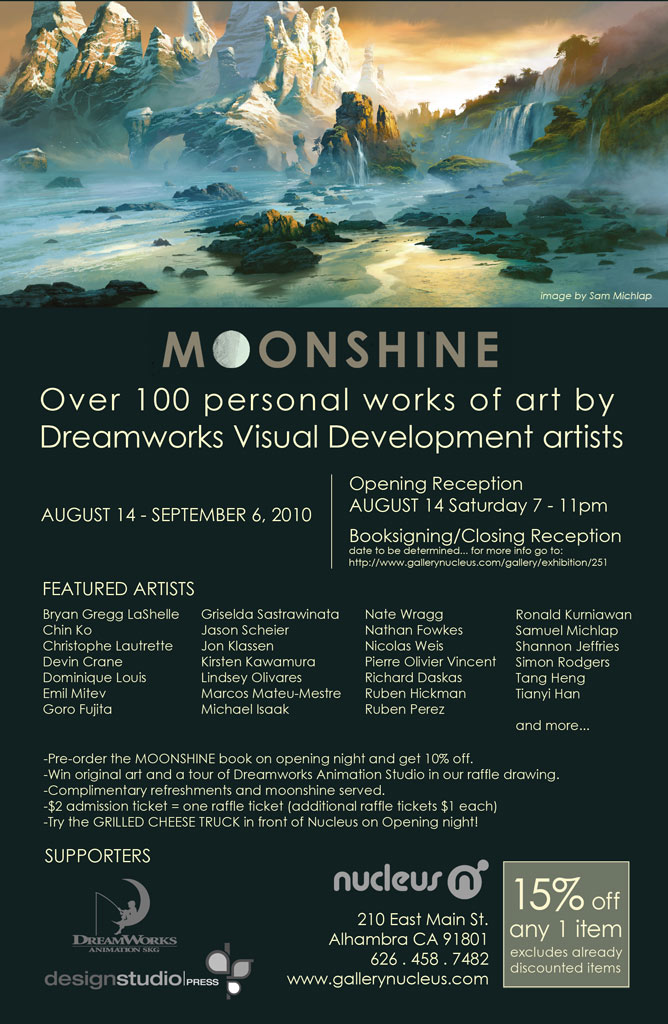
Moonshine

Moonshine is the name of a group show that opens this Saturday, August 24, 2010, at Gallery Nucleus in Alhambra California. It features the personal work of 45 concept artists, production designers, art directors and character designers from DreamWorks Studio.The list of participating artists includes a number of artists that I have featured here on Lines and Colors: Chris Appelhans, Goro Fujita, Marcos Mateu-Mastre, Samuel Michlap, Simon Rodgers, and Nate Wragg, among others (links are to my posts).
There is a list of artists, with links to their websites or blogs, on the Gallery Nucleus page for the exhibition. There will also be an online gallery of pieces, but as of this writing it’s not yet posted.
There is an opening reception Saturday from 7-11pm (with a $2 admission that serves as a raffle ticket), and a closing reception and book signing on Friday September 3rd from 7-10pm. There is a flyer for the show here.
The book signing refers to a book, also titled Moonshine (more here), that will accompany the exhibition. It will be the first to feature the personal art of DreamWorks creators. Additional volumes are planned.
The group has established a blog, Moonshine: DreamWorks Artists… After Dark, that features artwork and artist interviews, as well as links to the websites and blogs of the members.
(Images above: Goro Fujita, Chin Ko, Lindsay Olivares, Samuel Michlap)
[Via Cartoon Brew]
Categories:
-
Colin Campbell Cooper

Colin Campbell Cooper was an American impressionist painter active in the late 19th and early 20th Centuries. He was, within that rather loose classification, the foremost among them in the portrayal of architecture. He is also one of my personal favorites.Known for both his later paintings of California gardens and landmarks, as well as his earlier paintings of New York skyscrapers, Cooper also turned his lush palette and virtuoso brush to other subjects.
His painting of Lower Broadway in Wartime (above, 2nd down, right) is in the museum of the Pennsylvania Academy of the Fine Arts here in Philadelphia. I’ll sometimes stand and look at it for 15 or 20 minutes at a time. What’s not obvious from these small reproductions on the web is that Cooper’s paintings can be marvels of texture and color mixing, with luminous transitions of one color passage into another within the surface of a single wall.
Areas that appear highly detailed are in fact very painterly, with much more suggested than overtly painted. (I’ve listed links below to previous auction sales on Sotheby’s and Christie’s that can often be zoomed in to levels of considerable magnification.)
Cooper was born in Philadelphia and studied at the Pennsylvania Academy of the Fine Arts under Thomas Eakins, as well as training at the Académie Julian in Paris. He taught for a time at the Drexel Insitute of Art Science and Industry (now Drexel University, also home to such noted art teachers as Howard Pyle).
Cooper married Emma Lampert, herself a well known artist, and the couple traveled and painted in Europe and Aisa as well as across the U.S. Notably they traveled to India, at the time far off the track for even the most adventurous American and European travelers, and Cooper returned to create from his location sketches stunning paintings of the Taj Mahal, the palace gate at Udaipur and other locations rarely seen in the West.
After the death of his wife in 1920, Cooper moved to California, perhaps to start over. The move marked a separate phase of his career in which his style and subject matter changed and he exhibited a renewed interest in including figures in his paintings. He taught and later became Dean at the School of Painting at the Santa Barbara Community School of Arts.
There is currently an exhibition of Cooper’s work at the Santa Barbara Museum in California, Lasting Impressions: Colin Campbell Cooper, that runs until October 8, 2010.
As far as I know there is only one in-print book on Cooper’s work: East Coast/West Coast and Beyond: Colin Campbell Cooper, American Impressionist by Deborah Epstein Solon and William Gerdts (Gerdts is a well known authority and author of several books on American Impressionism). The book was from a 2007 exhibition at the Laguna Art Museum. My impression is that this is the same exhibition that is currently at the Santa Barbara Museum.
There is a very nice 10 page article on Cooper and the current exhibition in the August issue of American Art Review, written by Deborah Epstein Solon, co-author of the book mentioned above, and illustrated with numerous images of Cooper’s work. This issue is still on the shelves as of this writing and should eventually be available as a back issue from the publisher. Cooper’s work is also featured on the cover.
Categories:
-
deviantART Muro

For a while now deviantART, the online arts community portal, has been teasing it’s members and visitors with an “It’s coming..” campaign, touting an event to coincide with deviantART’s 10th anniversary on August 7th.The event was the release of deviantART Muro, a new online digital painting and drawing application that works in the browser.
While online drawing and painting interfaces are nothing new, this one is different in that it is made entirely in HTML5, rather than the normal approach of creating these apps in Flash. For those of us interested in the technology, it’s a striking achievement, and the most impressive use of HTML5 I’ve seen to date.
For the casual user, the most relevant advantage of creating the app in HTML5 is that it can be used on the iPad (and presumably the iPhone, though the interface would be quite small).
Beyond that, it’s just a very nicely implemented online drawing an painting tool, well designed, fluid, and able to respond to pressure sensitive input from Wacom tablets. It’s sophisticated in other ways, the “Pro” version, available at the flip of a switch at the top of the interface, allows for the use of layers (image above, top).
There are a range of brush types, adjustments and a nicely functional, if small, color picker. Both the Basic and Pro version of the interface are available free. There is a feature to login in and purchase more advanced brushes.
Images can uploaded directly to deviantART if you have an account, or exported (from the “Image” menu) as PNG files.
There is a gallery of work done in the app that is still small, but growing. The deviantART community is largely devoted to art styles related to concept art, science fiction and fantasy, but you can get an ides of the range of styles that could be accomplished with the app. (Images above, below the interface: ‘loish, nuevemonos, ‘len-yan).
While not a substitute for a dedicated digital painting app on your computer, this in-browser app is impressive, fun to work with and an indication of even better things to come.
[Via WebMonkey]
[Note: if you have trouble accessing the Muro interface, particularly in Firefox, please see this post’s comments, and let me know what your experience was.
If you encounter a request for a survey, my suggestion is to close the browser window and open another one and try again.]
Categories:
-
Pájaro
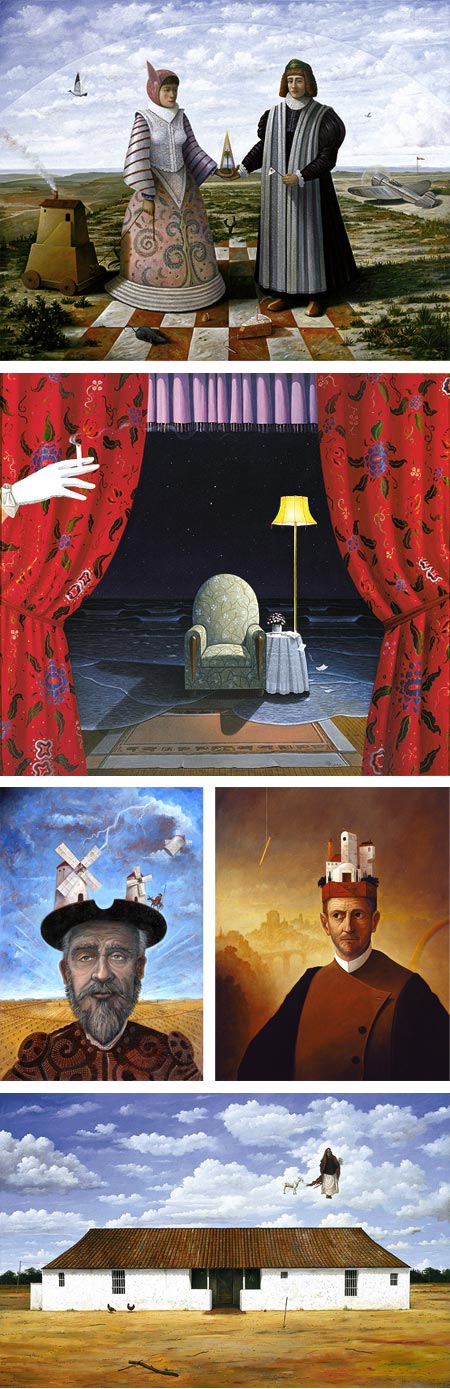
Pájaro (pronounced páh-hah-ro), who takes his name from a childhood nickname meaning “bird”, is a Venezuelan artist who spent much of his youth and adolescence in Spain.He embarked on his path as a self taught painter at the age of 23.
Returning to Venezuela he brought back with him the influence of European Medieval, Renaissance and Baroque art that expresses itself in an interesting mixture of styles, creating a form of visionary magic realism that he terms “Metarealism”
Pájaro draws on those aspects of classical art that he chooses and mixes them at will; Renaissance garbed figures, rendered with Baroque or even modern sensibilities, might appear in landscapes with the intricate detail and false atmospheric perspective of Medieval painting.
His subjects are dreamlike juxtapositions of figures, objects, times and places, rendered with an appealing eye for texture and tone, and usually painted with a muted, carefully controlled palette; though he occasionally applies high chroma passages.
Pájaro presents his subjects in compositions that feel somewhat theatrical, as though implying that he has stories to tell us, and with an intensity of rendering that imbues them with a feeling of personal significance.
On opening his website, there is a choice at bottom right to view the site in English. There is an “Enlarge” button to the lower right of most paintings; unfortunately, the JavaScript that opens the window for the enlargements takes some time, particularly on a large monitor.
Pájaro also has started a blog, though there is little content as yet.
Categories:




Charley’s Picks
Bookshop.org
(Bookshop.org affilliate links; sales benefit independent bookshop owners; I get a small percentage to help support my work on Lines and Colors)

John Singer Sargent: Watercolors


Urban Sketching: Understanding Perspective



Charley’s Picks
Amazon
(Amazon.com affiliate links; sales go to a larger yacht for Jeff Bezos; but I get a small percentage to help support my work on Lines and Colors)
John Singer Sargent: Watercolors
Urban Sketching: Understanding Perspective