


Categories
- 3d CGI
- Amusements
- Animation
- Anime & Manga
- Art Materials
- Art Videos
- Blogroll
- Cartoons
- Color
- Comics
- Concept & Visual Dev.
- Creativity
- Digital Art
- Digital Painting
- Displaying Art on the Web
- Drawing
- Eye Candy for Today
- Gallery and Museum Art
- High-res Art Images
- Illustration
- Motion Graphics & Flash
- Museums
- Online Museums
- Outsider Art
- Painting
- Painting a Day
- Paleo Art
- Pastel, Conté & Chalk
- Pen & Ink
- Prints and Printmaking
- Reviews
- Sc-fi and Fantasy
- Sculpture & Dimensional
- Site Comments
- Sketching
- Storyboards
- Tools and Techniques
- Uncategorized
- Vector Art
- Videos & Podcasts
- Vision and Optics
- Watercolor and Gouache
- Webcomics
Archives
- April 2026
- March 2026
- February 2026
- January 2026
- December 2025
- November 2025
- October 2025
- September 2025
- August 2025
- July 2025
- June 2025
- May 2025
- January 2025
- December 2024
- November 2024
- October 2024
- September 2024
- August 2024
- June 2024
- April 2024
- March 2024
- February 2024
- January 2024
- December 2023
- November 2023
- October 2023
- September 2023
- August 2023
- July 2023
- May 2023
- April 2023
- March 2023
- February 2023
- January 2023
- December 2022
- November 2022
- September 2022
- August 2022
- July 2022
- June 2022
- May 2022
- April 2022
- March 2022
- February 2022
- January 2022
- December 2021
- November 2021
- October 2021
- September 2021
- August 2021
- July 2021
- June 2021
- May 2021
- April 2021
- March 2021
- February 2021
- January 2021
- December 2020
- November 2020
- October 2020
- September 2020
- August 2020
- July 2020
- June 2020
- May 2020
- April 2020
- March 2020
- February 2020
- January 2020
- December 2019
- November 2019
- October 2019
- September 2019
- August 2019
- July 2019
- June 2019
- May 2019
- April 2019
- March 2019
- February 2019
- January 2019
- December 2018
- November 2018
- October 2018
- September 2018
- August 2018
- July 2018
- June 2018
- May 2018
- April 2018
- March 2018
- February 2018
- January 2018
- December 2017
- November 2017
- October 2017
- September 2017
- August 2017
- July 2017
- June 2017
- May 2017
- April 2017
- March 2017
- February 2017
- January 2017
- December 2016
- November 2016
- October 2016
- September 2016
- August 2016
- July 2016
- June 2016
- May 2016
- April 2016
- March 2016
- February 2016
- January 2016
- December 2015
- November 2015
- October 2015
- September 2015
- August 2015
- July 2015
- June 2015
- May 2015
- April 2015
- March 2015
- February 2015
- January 2015
- December 2014
- November 2014
- October 2014
- September 2014
- August 2014
- July 2014
- June 2014
- May 2014
- April 2014
- March 2014
- February 2014
- January 2014
- December 2013
- November 2013
- October 2013
- September 2013
- August 2013
- July 2013
- June 2013
- May 2013
- April 2013
- March 2013
- February 2013
- January 2013
- December 2012
- November 2012
- October 2012
- September 2012
- August 2012
- July 2012
- June 2012
- May 2012
- April 2012
- March 2012
- February 2012
- January 2012
- December 2011
- November 2011
- October 2011
- September 2011
- August 2011
- July 2011
- June 2011
- May 2011
- April 2011
- March 2011
- February 2011
- January 2011
- December 2010
- November 2010
- October 2010
- September 2010
- August 2010
- July 2010
- June 2010
- May 2010
- April 2010
- March 2010
- February 2010
- January 2010
- December 2009
- November 2009
- October 2009
- September 2009
- August 2009
- July 2009
- June 2009
- May 2009
- April 2009
- March 2009
- February 2009
- January 2009
- December 2008
- November 2008
- October 2008
- September 2008
- August 2008
- July 2008
- June 2008
- May 2008
- April 2008
- March 2008
- February 2008
- January 2008
- December 2007
- November 2007
- October 2007
- September 2007
- August 2007
- July 2007
- June 2007
- May 2007
- April 2007
- March 2007
- February 2007
- January 2007
- December 2006
- November 2006
- October 2006
- September 2006
- August 2006
- July 2006
- June 2006
- May 2006
- April 2006
- March 2006
- February 2006
- January 2006
- December 2005
- November 2005
- October 2005
- September 2005
- August 2005
Relevant Blogs
Art, Painting & Sketch
- Gurney Journey
- Underpaintings
- Art and Influence
- Painting Perceptions
- Oil Painters of America
- Vasari Paint POV
- Flying Fox
- Urban Sketchers
- Bento (Smithsonian)
- Art Inconnu
- The Hidden Place
- Still Life
- Making a Mark
- The Art of the Landscape
- Exploring Color & Creativity
- Art Contrarian
- Artist A Day
- beinArt Surreal Art Collective
- Eye Level
- David Dunlop
- p.i.g.m.e.n.t.i.u.m
- CultureGrrl
- Joaquín Sorolla blog
- Artists in Pastel
“Painting a Day”
- A Painting a Day (Keiser)
- On Painting (Keiser)
- Julian Merrow-Smith
- Karen Jurick
- Jeffrey Hayes
- Carol Marine
- Abbey Ryan
- Daily Paintworks
Other Painting Blogs
- Virtual Gouache Land
- Neil Hollingsworth
- Marc Hanson
- Kevin Menck
- Marc Dalessio
- Larry Seiler
- Stapleton Kearns
- Colin Page
- Roos Schuring
- Hans Versfelt
- Titus Meeuws
- Régis Pettinari
- René Plein Air
- Belinda Del Pesco
- Robin Weiss
- Nathan Fowkes (Land Sketch)
- William Wray
- Frank Serrano
- Stephen Magsig
- Michael Chesley Johnson
- Twice a Week
- Sarah Wimperis
- Rob Adams
- Michael Cole Manley
- The Dirty Palette Club
- Mike Manley’s Draw!
Gallery Art & Illustration mix
Illustration
- Howard Pyle
- 100 Years of Illustration
- BibliOdyssey
- Illustration Art
- Today’s Inspiration
- Illustration Mundo
- Little Chimp Society
- Danny Gregory
- R D (John Martz
- Illustration Friday blog
- Monster Brains
- Illustrators & Illustrations (RU)
- Elwood H. Smith
- DaniDraws.com
- Designers Who Blog
- iSpot Blog
Sci-Fi & Fantasy
Illustration & Comics
Comics & Cartoons
- Comics Beat
- Robot 6
- Newsarama Blog
- Comic Vine
- Comics Alliance
- Forbidden Planet Int.
- Paolo Rivera
- Bolt City
- Flight
- Scott McCloud
- The Comics Journal
- Comixpedia
- Funnybook Babylon
- James Baker
- Middleton’s Sketchbook
- Boneville
- The Hotel Fred
- Paul Rivoche
- Daily Cartoonist
- Mad About Cartoons (William Wray)
- Digital Strips
Illustration & Concept
Animation & Concept
- Cartoon Brew
- Animation Blog
- Cold Hard Flash
- Concept Art World
- The CAB
- FY Concept Art
- Concept Ships
- Concept Robots
- John Nevarez
- Armand Serrano
- Marcos Mateu-Mestre
- all kinds of stuff (Kricfalusi)
- Yacin the faun (Man Arenas)
- Kelsey Mann
- Cre8tivemarks Blog
- Ice-Cream Monster Toon Cafe
- AAU Character & Creature Design
- AAU Animation Notes
- Articles and Texticles
Paleo & Scientific
Tools & Techniques
Other
Lists of Art Blogs
Art Image Resource Links
Historic Art Images
- Wikimedia Commons: Paintings
- Wikimedia Commons: Drawings
- The Athenaeum
- WikiArt (WikiPaintings)
- Google Art Project: Artists
- Google Art Project: Collections (Museums)
- ArtCyclopedia
- Web Gallery of Art
- Art Renewal Center
- Web Gallery of Impressionism
Auction Consolidation sites
Auction sites
- Sotheby’s
- Bonham’s
- Christies
- Heritage Auctions: Fine Art
- Heritage Auctions: Illustration
- Freeman’s Auctions
- Bukowskis
- Shannon’s
Image Search
Reverse Image Search (search by image)
- Tin Eye
- RevImg
- Google Image Search (camera icon)
- Bing Image Search (camera icon)
Promoting some friends and some clients of my website design business
- Twin Willows T’ai Chi studio in Wilmington DE. Taiji classes with Bryan Davis.
- Ray Hayward, Inspired Teacher of T’ai Chi ( Taiji ) in Minneapolis, Founder of Mindful Motion Tai Chi Academy
- OldHead Tattoo studio and Art Gallery in Wilmington DE. Tattoos and paintings by Bruce Gulick
- Sharon Domenico Art, pet portrait oil paintings
- Platinum Paperhanging, wallpaper hanging, Main Line and Philadelphia, PA
- Lisa Stone Design, interior designer, Main Line and Philadelphia, PA
- Studio12KPT, original art, prints, calendars and other custom printed items by Van Sickle & Rolleri
-
Hiroshi Yoshida exhibit in Tokyo


Hiroshi Yoshida the wonderful Japanese printmaker — active in the late 19th and early 20th centuries — was trained in western art styles and painting and eventually combined those aesthetics with the traditions of Japanese art to create beautiful woodblock paints in the shin hanga style.
A new exhibition at the Tokyo Metropolitan Art Museum commemorates the 70th anniversary of Yoshida’s death, and the online highlights of the exhibition offer a selection of high quality examples of his prints. The exhibition runs until March 28, 2021. I don’t know how long the exhibition website will be onine.
For more images and links to his work, see my previous posts on Hiroshi Yoshida.
Categories:
-
Eye Candy for Today Mrs Smith watercolor of plums and caterpillars


Branch with a cluster of ripe plums and caterpillars, Mrs. Smith; watercolor, roughly 10 x 10 inches (25 x 25 cm). Link is to the image page on Wikimedia Commons. Original is in the Cooper Hewitt, Smithsonian Design Museum.
The image is credited to “Mrs. Smith”, based on a pencil signature at the lower right of the paper. Neither Wikimedia Commons nor the museum offer any clue as to who “Mrs. Smith” is, and I can find little elsewhere. The painting is dated 1830 and country of origin is listed as the UK. Beyond that, we’re on our own.
We can assume Mrs. Smith was a botanical artist of some skill if not of particular note.
Close up, she has used broad, painterly and seemingly casual marks to define her subject, but when seen from a normal distance, her colors and values are so accurate that the representation of the fruit, leaves, branch and insects is wonderfully naturalistic.
Categories:
-
Zufar Bikbov


Orignally from Russia, Zufar Bikbov is a painter now based in the U.S. whose landscapes and occasional still life paintings are painted with bold confidence based on a solid draftsmanship.
His color palettes are balanced between high chroma highlights and restrained supporting colors, giving a feeling of bright but naturalistic color.
I particularly admire the way he often suggests his landscape backgrounds with a minimum of detail, while maintaining a variety of color within them.
Bikbov’s website includes galleries of his work, and indicates that he sometimes conducts workshops via Zoom, though none are listed at the time of this writing.
Categories:
-
Eye Candy for Today: Pere Borrell del Caso trompe-lœil
 \
\

Two Laughing Girls, Pere Borrell del Caso; oil on canvas, roughly 27 x 27 inches (69 x 69 cm); link is to Wikimedia Commons, original is in the Museu del Modernisme Catalá, Barcelona.
Spanish painter Pere Borrell del Caso, who was active in the late 19th and early 20th centuries, is known for his trompe-l’œil paintings, in which the subjects are not only rendered realistically, but come forward with a dimensionality that seems to break the picture plane.
Though not his most dramatic or well known trompe-l’œil painting (which is Escaping Criticism), this one is my favorite, perhaps because it’s more subtle.
The painting of the girl’s faces — one highlighted, the other entirely in shadow, who appear to be looking directly at the viewer — is engaging enough. The relationship of their faces in light and dark already gives the painting depth.
The values of the dark and light faces are emphasized by the tone gradient behind them, light behind dark and dark behind light. The dimensionality is accentuated by the right hand of the girl in shadow, which is reaching forward into the light and pointing out at the viewer.
What kicks it over the top into trompe-l’œi eye candy is the sleeve and elbow of the girl in front.
Although the sleeve is dark compared to the rest of the figure, which keeps us from focusing on it right away, once we notice that it is apparently projecting out of the frame, resting on the edge and casting a shadow on it, we’re pulled into that wonderful uncertainty of what is real and what isn’t, which tickles the brain and is part of the joy of trompe-l’œi.
On closer examination, you can see that the inner ring of the frame, the same color and just as elaborately decorative as the rest of it, is false — part of the painting and not part of the actual frame.
Categories:
-
Charles Davis
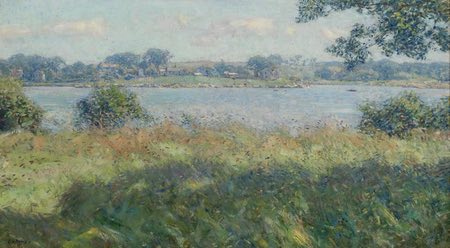

The work of Charles Harold Davis, an American painter active in the late 19th and early 20th centuries, shifted in style over the course of his career.
His early work shows his training at the Boston Museum of Fine Arts school, as well as his study in Europe at the Académie Julian (where he studied with Jules Joseph Lefebvre) and his subsequent time painting in the Forest of Fontainebleau.
There he was influenced by the painters of the Barbizon School, and his style shows tonalist leanings and eventually develops into an impressionist character. It is in the latter style that he painted a number of cloudscapes that he became noted for.
Categories:
-
Eye Candy for Today: Anders Zorn portrait etching


Guli II, Anders Zorn, etching, roughly 8 x 5 1/2 inches (20 x 15 cm). Link is to Bukowski’s auctions, which has a large image available from their page. I assume that the original of this particular impression is now in a private collection.
The etching is called Gulli II because the artist did a previous portrait etching of the same young woman, titled Gulli I. (Here is a print of that one in the Metropolitan Museum of Art.)
Anders Zorn, a remarkable Swedish painter who was active in the late 19th and early 20the centuries, is known for his beautiful portraits and genre scenes, as well as for his eponymous limited palette. He is less well known as a printmaker, but unjustly so.
In my opinion, he was among the best etchers in history, wielding his etching and drypoint needles with a simultaneous freedom and accuracy matched by few.
Look at the flurry of lines that make up the shading on the face — seemingly applied with casual abandon, some of their ends hooked with the sweep of the needle — then scroll back to the normal view and see how smoothly they blend into the delicate values of this sensitive portrait.
Even on the cheek on the shadowed side, where it appears that strokes have landed close to others, emphasizing some lines perhaps more definitively than he might have wanted were he trying to smooth out the tone more evenly, he still pulls off a rendering of the form that is believable.
I have to think that his hatching was done with quick strokes, aiming to capture the feeling rather than allowing caution to weigh down the effect of spontaneity.
Notice also, how few lines he has used to create the planes of the lit side of the face, and yet how definite the form is.
Despite the number of etched lines that make up this image, there are few, if any, that can be called outlines — even in the edges of the light and dark sides of the scarf where it meet’s the woman’s forehead.
Look at how the lips are formed. He’s etching like a painter.
For more, see my previous post on Anders Zorn’s etchings, as well as my other posts about Anders Zorn.
Categories:




Charley’s Picks
Bookshop.org
(Bookshop.org affilliate links; sales benefit independent bookshop owners; I get a small percentage to help support my work on Lines and Colors)

John Singer Sargent: Watercolors


Urban Sketching: Understanding Perspective


.jpg)

Charley’s Picks
Amazon
(Amazon.com affiliate links; sales go to a larger yacht for Jeff Bezos; but I get a small percentage to help support my work on Lines and Colors)
John Singer Sargent: Watercolors
Urban Sketching: Understanding Perspective