


Categories
- 3d CGI
- Amusements
- Animation
- Anime & Manga
- Art Materials
- Art Videos
- Blogroll
- Cartoons
- Color
- Comics
- Concept & Visual Dev.
- Creativity
- Digital Art
- Digital Painting
- Displaying Art on the Web
- Drawing
- Eye Candy for Today
- Gallery and Museum Art
- High-res Art Images
- Illustration
- Motion Graphics & Flash
- Museums
- Online Museums
- Outsider Art
- Painting
- Painting a Day
- Paleo Art
- Pastel, Conté & Chalk
- Pen & Ink
- Prints and Printmaking
- Reviews
- Sc-fi and Fantasy
- Sculpture & Dimensional
- Site Comments
- Sketching
- Storyboards
- Tools and Techniques
- Uncategorized
- Vector Art
- Videos & Podcasts
- Vision and Optics
- Watercolor and Gouache
- Webcomics
Archives
- April 2026
- March 2026
- February 2026
- January 2026
- December 2025
- November 2025
- October 2025
- September 2025
- August 2025
- July 2025
- June 2025
- May 2025
- January 2025
- December 2024
- November 2024
- October 2024
- September 2024
- August 2024
- June 2024
- April 2024
- March 2024
- February 2024
- January 2024
- December 2023
- November 2023
- October 2023
- September 2023
- August 2023
- July 2023
- May 2023
- April 2023
- March 2023
- February 2023
- January 2023
- December 2022
- November 2022
- September 2022
- August 2022
- July 2022
- June 2022
- May 2022
- April 2022
- March 2022
- February 2022
- January 2022
- December 2021
- November 2021
- October 2021
- September 2021
- August 2021
- July 2021
- June 2021
- May 2021
- April 2021
- March 2021
- February 2021
- January 2021
- December 2020
- November 2020
- October 2020
- September 2020
- August 2020
- July 2020
- June 2020
- May 2020
- April 2020
- March 2020
- February 2020
- January 2020
- December 2019
- November 2019
- October 2019
- September 2019
- August 2019
- July 2019
- June 2019
- May 2019
- April 2019
- March 2019
- February 2019
- January 2019
- December 2018
- November 2018
- October 2018
- September 2018
- August 2018
- July 2018
- June 2018
- May 2018
- April 2018
- March 2018
- February 2018
- January 2018
- December 2017
- November 2017
- October 2017
- September 2017
- August 2017
- July 2017
- June 2017
- May 2017
- April 2017
- March 2017
- February 2017
- January 2017
- December 2016
- November 2016
- October 2016
- September 2016
- August 2016
- July 2016
- June 2016
- May 2016
- April 2016
- March 2016
- February 2016
- January 2016
- December 2015
- November 2015
- October 2015
- September 2015
- August 2015
- July 2015
- June 2015
- May 2015
- April 2015
- March 2015
- February 2015
- January 2015
- December 2014
- November 2014
- October 2014
- September 2014
- August 2014
- July 2014
- June 2014
- May 2014
- April 2014
- March 2014
- February 2014
- January 2014
- December 2013
- November 2013
- October 2013
- September 2013
- August 2013
- July 2013
- June 2013
- May 2013
- April 2013
- March 2013
- February 2013
- January 2013
- December 2012
- November 2012
- October 2012
- September 2012
- August 2012
- July 2012
- June 2012
- May 2012
- April 2012
- March 2012
- February 2012
- January 2012
- December 2011
- November 2011
- October 2011
- September 2011
- August 2011
- July 2011
- June 2011
- May 2011
- April 2011
- March 2011
- February 2011
- January 2011
- December 2010
- November 2010
- October 2010
- September 2010
- August 2010
- July 2010
- June 2010
- May 2010
- April 2010
- March 2010
- February 2010
- January 2010
- December 2009
- November 2009
- October 2009
- September 2009
- August 2009
- July 2009
- June 2009
- May 2009
- April 2009
- March 2009
- February 2009
- January 2009
- December 2008
- November 2008
- October 2008
- September 2008
- August 2008
- July 2008
- June 2008
- May 2008
- April 2008
- March 2008
- February 2008
- January 2008
- December 2007
- November 2007
- October 2007
- September 2007
- August 2007
- July 2007
- June 2007
- May 2007
- April 2007
- March 2007
- February 2007
- January 2007
- December 2006
- November 2006
- October 2006
- September 2006
- August 2006
- July 2006
- June 2006
- May 2006
- April 2006
- March 2006
- February 2006
- January 2006
- December 2005
- November 2005
- October 2005
- September 2005
- August 2005
Relevant Blogs
Art, Painting & Sketch
- Gurney Journey
- Underpaintings
- Art and Influence
- Painting Perceptions
- Oil Painters of America
- Vasari Paint POV
- Flying Fox
- Urban Sketchers
- Bento (Smithsonian)
- Art Inconnu
- The Hidden Place
- Still Life
- Making a Mark
- The Art of the Landscape
- Exploring Color & Creativity
- Art Contrarian
- Artist A Day
- beinArt Surreal Art Collective
- Eye Level
- David Dunlop
- p.i.g.m.e.n.t.i.u.m
- CultureGrrl
- Joaquín Sorolla blog
- Artists in Pastel
“Painting a Day”
- A Painting a Day (Keiser)
- On Painting (Keiser)
- Julian Merrow-Smith
- Karen Jurick
- Jeffrey Hayes
- Carol Marine
- Abbey Ryan
- Daily Paintworks
Other Painting Blogs
- Virtual Gouache Land
- Neil Hollingsworth
- Marc Hanson
- Kevin Menck
- Marc Dalessio
- Larry Seiler
- Stapleton Kearns
- Colin Page
- Roos Schuring
- Hans Versfelt
- Titus Meeuws
- Régis Pettinari
- René Plein Air
- Belinda Del Pesco
- Robin Weiss
- Nathan Fowkes (Land Sketch)
- William Wray
- Frank Serrano
- Stephen Magsig
- Michael Chesley Johnson
- Twice a Week
- Sarah Wimperis
- Rob Adams
- Michael Cole Manley
- The Dirty Palette Club
- Mike Manley’s Draw!
Gallery Art & Illustration mix
Illustration
- Howard Pyle
- 100 Years of Illustration
- BibliOdyssey
- Illustration Art
- Today’s Inspiration
- Illustration Mundo
- Little Chimp Society
- Danny Gregory
- R D (John Martz
- Illustration Friday blog
- Monster Brains
- Illustrators & Illustrations (RU)
- Elwood H. Smith
- DaniDraws.com
- Designers Who Blog
- iSpot Blog
Sci-Fi & Fantasy
Illustration & Comics
Comics & Cartoons
- Comics Beat
- Robot 6
- Newsarama Blog
- Comic Vine
- Comics Alliance
- Forbidden Planet Int.
- Paolo Rivera
- Bolt City
- Flight
- Scott McCloud
- The Comics Journal
- Comixpedia
- Funnybook Babylon
- James Baker
- Middleton’s Sketchbook
- Boneville
- The Hotel Fred
- Paul Rivoche
- Daily Cartoonist
- Mad About Cartoons (William Wray)
- Digital Strips
Illustration & Concept
Animation & Concept
- Cartoon Brew
- Animation Blog
- Cold Hard Flash
- Concept Art World
- The CAB
- FY Concept Art
- Concept Ships
- Concept Robots
- John Nevarez
- Armand Serrano
- Marcos Mateu-Mestre
- all kinds of stuff (Kricfalusi)
- Yacin the faun (Man Arenas)
- Kelsey Mann
- Cre8tivemarks Blog
- Ice-Cream Monster Toon Cafe
- AAU Character & Creature Design
- AAU Animation Notes
- Articles and Texticles
Paleo & Scientific
Tools & Techniques
Other
Lists of Art Blogs
Art Image Resource Links
Historic Art Images
- Wikimedia Commons: Paintings
- Wikimedia Commons: Drawings
- The Athenaeum
- WikiArt (WikiPaintings)
- Google Art Project: Artists
- Google Art Project: Collections (Museums)
- ArtCyclopedia
- Web Gallery of Art
- Art Renewal Center
- Web Gallery of Impressionism
Auction Consolidation sites
Auction sites
- Sotheby’s
- Bonham’s
- Christies
- Heritage Auctions: Fine Art
- Heritage Auctions: Illustration
- Freeman’s Auctions
- Bukowskis
- Shannon’s
Image Search
Reverse Image Search (search by image)
- Tin Eye
- RevImg
- Google Image Search (camera icon)
- Bing Image Search (camera icon)
Promoting some friends and some clients of my website design business
- Twin Willows T’ai Chi studio in Wilmington DE. Taiji classes with Bryan Davis.
- Ray Hayward, Inspired Teacher of T’ai Chi ( Taiji ) in Minneapolis, Founder of Mindful Motion Tai Chi Academy
- OldHead Tattoo studio and Art Gallery in Wilmington DE. Tattoos and paintings by Bruce Gulick
- Sharon Domenico Art, pet portrait oil paintings
- Platinum Paperhanging, wallpaper hanging, Main Line and Philadelphia, PA
- Lisa Stone Design, interior designer, Main Line and Philadelphia, PA
- Studio12KPT, original art, prints, calendars and other custom printed items by Van Sickle & Rolleri
-
M.C. Escher
 M.C. Escher’s visions of strange worlds, impossible objects, and incredible tesselations form an extraordinary bridge between art and mathematics.
Critics often revile Escher and try to dismiss him as a creator of “decorative patterns” and “visual tricks”; and of course, he can’t possibly be a great artist because he’s (ugh!) popular with the (gasp!) masses! His images have been reproduced on countless posters, mugs, T-shirts, et cetera, which you’ve undoubtedly seen in a college dorm somewhere. Many of his images have become cultural icons to the point of being clichés, which is unfortunate because that makes it difficult to see them with the fresh eyes they deserve.
If the purpose of art is to communicate, Escher does that admirably, and he has definite things to say. If the purpose of art is to affect our emotions, Escher does that as well. He forces us to confront the possibility that our comfortable confidence in the reality of our senses may not be well founded. He demonstrates that what we think is visual truth may be illusion, and things we think unrelated may in fact be unexpectedly connected.
His thought-provoking juxtapositions of visual elements, disorienting perspective, startling geometry, unexpected spatial relationships and obsessively recursive surface patterns can halt someone in their tracks when they first encounter his work. People can become captivated by Escher’s images to an extraordinary degree. (You can see my own fascination with him in this early page from my webcomic.)
Escher mastered several printmaking techniques: woodcuts, wood engravings, even the arcane and difficult art of mezzotint, but the majority of his works are created with stone lithography, also a very demanding process.
The Official M.C. Escher Website is actually well done and has a fairly extensive gallery of his work, arranged by periods of the artist’s life. It also includes a biography, links to other sites of interest and short video interviews with Escher.
The official site’s gallery images are a bit small; there are larger ones on unofficial sites like: The Oldest Escher Collection on the Web and World of Escher (which has a lot of commercial stuff for sale, but the prints in the gallery have good-sized enlargements).
Some additional sites of interest: an Illustrated essay; The Mathematical Art of M.C. Escher on the Mathacademy site, fan site Neal’s Escher Page (with a nice list of links), Escher for Real (attempts to make actual objects that duplicate, at least from one angle, some of Escher’s “impossible” objects) and Tesselations.org, a site that explains tesselations, highlights Escher’s tesselations and shows you how to create some yourself.
None of the web images of his prints can compare with the reproductions in good books. M.C. Escher : 29 Master prints is wonderfully large and the reproductions are excellent. The Magic of M. C. Escher (J. L. Locker) is much more extensive and wonderfully done (out of print, but still available), and M. C. Escher is a nice, inexpensive volume.
Categories:
-
Frank Cho (Liberty Meadows)
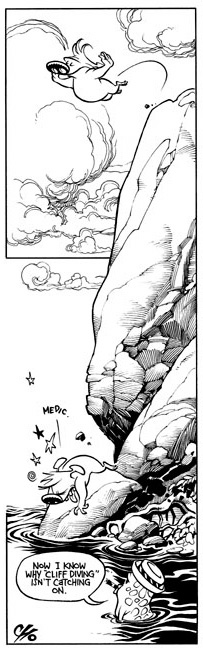 Frank Cho is a comics artist and illustrator best known as the creator of the Liberty Meadows newspaper comic strip, one of the best drawn syndicated strips in recent years. Cho’s wonderfully precise pen and ink work shows the influence of great pen and ink illustrators like Gibson, Cole and Booth and comics artists like Williamson, Wood and Frazetta.
The strip archive is on the Creators Syndicate site. The Liberty Meadows site is devoted more to Cho himself and his various projects. The home page functions as a news page and is linked to a news archive, both chock full of illustrations in pencil, ink and color. The site includes a gallery of uncensored versions of strips the newspapers wouldn’t run (Frank likes to joke about, well…, um… sex.)
In addition to galleries of strips, sketches and covers, the site features a checklist of Cho’s published work, an illustrated FAQ, fan art and links to a Frank Cho discussion board (on the World Famous Comics Community discussion board site).
The Frank Cho Sketchbook features both sketches and finished ink drawings, often showing the progression of a drawing from initial sketch to refined pencil drawing to finished ink rendering, which I really enjoy.
The FAQ includes some information on his tools, including his choice of pencils, pens (Pigma Micon felt tips!) and board, as well as the dimensions of his daily and Sunday strips.
There are several volumes available of Liberty Meadows collections, as well as a trade paperback of the Shanna, The She-Devil series he recently did for Marvel Comics.
There is also a Frank Cho Gallery on Budd Root’s Basement Comics featuring Cavewoman and dinosaurs (gotta love it).
Note: Both sites contain some mildly suggestive nudity. Avoid them if you’re likely to be offended.
Categories:
-
John Sibbick

I’ll say right off that I just love dinosaur art: beautiful paintings and drawings of fantastic animals that actually existed. Wonderful. I loved it when I was a kid and I love it now. (I have my own book of Dinosaur Cartoons, in fact.) Nothing like a nice colorful dinosaur picture to start out your day.Good Paleo art requires more than beautiful painting or drawing; it’s actually “paloeontological life reconstruction art” and, like all scientific illustration, must be scientifically accurate.
John Sibbick is one of the foremost dinosaur and paleo life artists in the field. In addition to his illustrations of dinosaurs, prehistoric sea life (including wonderfully weird trilobites) and other amazing prehistoric animals, Sibbick also creates sensational fantasy illustrations and beautiful scientific illustrations of modern animals.
He works most often in gouache, which lends itself well to his use of detailed textures and vivid colors. The Sketches Gallery on his site also includes renderings in pencil, colored pencil and pen and ink. His masteful use of texture, in all of the media he works in, is of particular interest.
Sibbick has illustrated some of the best books on prehistoric animals, including My Favorite Dinosaurs (aimed a kids, but wonderful illustrations). Dinosaurs a Global View, The Illustrated Encyclopedia of Pterosaurs and, in particular, the Illustrated Encyclopedia of Dinosaurs. (Out of print, but still around. Look for the edition that combines the latter two books in one volume.)
Categories:
-
Hayao Miyazaki (Studio Ghibli)

Hayao Miyazaki is arguably the greatest of all directors of “anime”, Japanese animation. He is noted for such classic animated films as Nausicaä of the Valley of the Wind, Laupta: The Castle in the Sky, My Neighbor Totoro, Kiki’s Delivery Service, Porco Rosso, Princess Mononoke, Spirited Away and, most recently, Howl’s Moving Castle (Amazon links).If you’re not familiar with most or any of those, it’s the fault of a narrow-minded American movie distribution system and/or Disney, who has the rights to distribute and promote Miyazaki’s films in the US, but apparently doesn’t have a clue how to do so. (To their credit, they’ve done a pretty good job with the packaging of the US DVD versions).
Miyazaki’s films are among the all-time most popular in his native Japan, and deservedly so. Filled with beautiful drawing, splendorous settings, engaging characters, adventure, mystery, charm and wit, his movies refuse to settle for clichéd “evil” villains, simplistic black and white visions of morality and the tired formulas that cripple many Hollywood animated features.
Don’t expect the super-fluid animation of classic Disney or Warner Brothers animation, it’s not a priority in Anime, instead look for amazing settings, wonderful characters, intelligent writing and a much broader range of subject matter than you will find in western animation.
My favorite of Miyazaki’s films is My Neighbor Totoro (Tonari no Totoro) (image above), a wonderful, magical animated story. For me it evokes certain aspects of childhood better than any other film (animated or otherwise): the “goes on forever” quality of a late summer afternoon, the deep fascination children can have with simple things, quiet moments that seem to reveal unspoken worlds, the terrible urgency of a lost sibling or sick parent and the blurred line between what is real and what is imagined and the (indistinguishable) wonder and delight inspired by both.
If you’re interested in Totoro, don’t buy the 20th Century Fox fullscreen edition, wait for the Disney widescreen 2-disk set due in March of 2006. There are also multi-disk sets of Miyszaki DVDs, a three pack (Spirited Away/Castle in the Sky/Kiki’s Delivery Service) and a six-pack (Castle in the Sky/Kiki’s Delivery Service/Nausicaa of the Valley of the Wind/Porco Rosso/Princess Mononoke/Spirited Away).
 Miyazaki established Studio Ghibli, a production house that produces most (but not all) of his films. Here is a link to the Studio Ghibli site (in Japanese) and the Google BETA translated version which is rough, but navigable.
Unfortunately the Studio Ghibli site doesn’t have a lot of easily accessible images. Here are some official movie sites: Princess Mononoke, Spirited Away, Howl’s Moving Castle and the (poorly done) Disney: Studio Ghibli site that is the official site for the others.
Here are some fan sites that have images:
A selection of Miyazaki film images from Planet Zot: Totoro , Kiki’s Delivery Service, Princess Mononoke, and Porco Rosso.
From WingSee’s Anime Haven: Nausicaä of the Valley of the Wind, Porco Rosso, Laputa: The Castle in the Sky , Kiki’s Delivery Service.
And some Totoro images from totoro.org.
The Studio Ghibli site isn’t very practical for non-Japanese speakers. For us the best source of general information on Miyazaki and Studio Ghibli is an unofficial, but excellent and extensive site called The Hayao Miyazaki Web at Nausicaa.net.
Categories:
-
Rembrandt: life, paintings, etchings, drawings and self portraits

Rembrandt: life, paintings, etchings, drawings and self portraits is the sister site to the amazing Essential Vermeer site I wrote about back in November. Both are created and maintained by artist Jonathan Janson.Rembrandt! What can you say about someone who is often billed as “the greatest artist in the history of Western art”, or (sometimes in the company of Valezquez) “the greatest of all painters”? Labels like that become masks that are difficult to see past. We see the legend and the name, not the artist; but clichés are hard to avoid when they contain truth.
We have little writing from Rembrandt. We know him from his remarkable artistic legacy and a fascinating visual biography in the form of over 90 self-portraits; but where he reveals himself most, I think, is in his drawings. Over 1,400 of his drawings survive, conservatively estimated at less than half of what he produced. (For most great artists we’re lucky to have a few dozen. For Vermeer and Franz Hals we have none.) Also unlike most of the great masters, the majority of Rembrandt’s drawings were not done as preparation for paintings, and very few were signed as pieces to be presented to friends or patrons. Most of his enormous outpouring of drawings were apparently done for himself, as visual record of his life and experience or simply for the joy in the act of drawing.
He drew almost anything in the world around him: trees, houses, marshes, reeds, boats, bridges, people in the street, people in costume, domestic and captive wild animals, children, beggars, merchants, his patrons, his wife, his family and himself. Rembrandt must have drawn with the ease and facility with which you or I walk or speak.
 That faculty for drawing expressed itself in an economy of line and fluid simplicity unmatched by any other drawings I have ever seen in Western art. (Chinese and and Japanese ink paintings are another story, but they had a different purpose and were also a definite influence on Rembrandt.)
In the same way that poetry distills pages of emotion and meaning into a few lines, Rembrandt compresses his fascination with the visual world into a few intensely meaningful ink lines.
Drawing most often with reed pen and bistre ink, at times with rapid, wildly calligraphic strokes, and adding quick expressive ink washes that speak worlds of volume and light, Rembrandt was a visual poet. He captured the essence of what he saw with a clarity and brevity that is transcendent.
Rembrandt’s etchings show his drawing skills at their most careful, since these were made for reproduction and sale, but he still shows a wonderful freedom and almost casual confidence when drawing with the etching needle.
Although not as mind-bogglingly comprehensive as the Essential Vermeer site, Rembrandt: life, paintings, etchings, drawings and self portraits is still an amazing resource, containing over 100 paintings, 50 drawings and the complete set of all 289 of his etchings, as well as biographical information, museum listings, links and more. Wow.
Addendum: I forgot to mention: there are seven Rembrandt etchings on view at the Philadelphia Museum of Art as part of an exhibition on Dutch Prints (to February 12, 2006), and a major show of Rembrandt prints and drawings will be at the National Gallery in November of 2006.
Categories:
-
Dodecaden (Man Arenas)
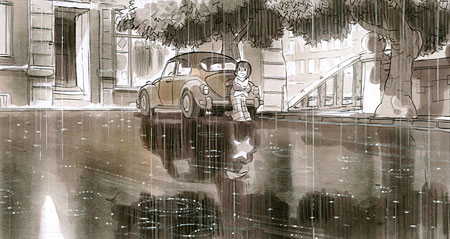
Man Arenas is a production designer and concept artist, primarily for animated films. His production designs, storyboards, location drawings and character designs are sometimes simple, sometimes complex but always beautifully realized, He works in a loose, confident drawing style that is full of life and just plain fun to look at.Many of the images on the Dodecaden site have a magnifying glass icon (usually at the upper right) that opens a wonderful hi-resolution version in a pop-up. Some of the images also have a word balloon icon that shows a comment about the image when you mouse over it.
Unfortunately, there’s very little information on the site about Arenas himself or his techniques. It looks like he starts many of the monochromatic images with an ocher line drawing, switches to black crayon or chalk for the final linework and finishes out with washes of what I’m guessing to be gouache, highlighted with white chalk.
There are terrific images throughout the site. Under the “Productions” link, they are arranged by type of project (Movies, Production, etc…) and under the “Artwork” link many of the same images are arranged by type of drawing (Storyboard, Character Design, Layout, etc…). My favorites are the beautiful tone drawings for an animated film called Laura’s Star (from Warner UK; here’s the movie site).
Addendum: reader fourmi (who has a very nice blog herself) wrote to let me know that Man Arenas also has a terrific blog called Yacin the Faun (some amazing stuff here), and Man wrote to mention that the Dodecaden site has several language versions: English, French and Spanish (links at the bottom of the pages), a great feature.
Categories:




Charley’s Picks
Bookshop.org
(Bookshop.org affilliate links; sales benefit independent bookshop owners; I get a small percentage to help support my work on Lines and Colors)

John Singer Sargent: Watercolors


Urban Sketching: Understanding Perspective


Charley’s Picks
Amazon
(Amazon.com affiliate links; sales go to a larger yacht for Jeff Bezos; but I get a small percentage to help support my work on Lines and Colors)
John Singer Sargent: Watercolors
Urban Sketching: Understanding Perspective