


Categories
- 3d CGI
- Amusements
- Animation
- Anime & Manga
- Art Materials
- Art Videos
- Blogroll
- Cartoons
- Color
- Comics
- Concept & Visual Dev.
- Creativity
- Digital Art
- Digital Painting
- Displaying Art on the Web
- Drawing
- Eye Candy for Today
- Gallery and Museum Art
- High-res Art Images
- Illustration
- Motion Graphics & Flash
- Museums
- Online Museums
- Outsider Art
- Painting
- Painting a Day
- Paleo Art
- Pastel, Conté & Chalk
- Pen & Ink
- Prints and Printmaking
- Reviews
- Sc-fi and Fantasy
- Sculpture & Dimensional
- Site Comments
- Sketching
- Storyboards
- Tools and Techniques
- Uncategorized
- Vector Art
- Videos & Podcasts
- Vision and Optics
- Watercolor and Gouache
- Webcomics
Archives
- June 2026
- May 2026
- April 2026
- March 2026
- February 2026
- January 2026
- December 2025
- November 2025
- October 2025
- September 2025
- August 2025
- July 2025
- June 2025
- May 2025
- January 2025
- December 2024
- November 2024
- October 2024
- September 2024
- August 2024
- June 2024
- April 2024
- March 2024
- February 2024
- January 2024
- December 2023
- November 2023
- October 2023
- September 2023
- August 2023
- July 2023
- May 2023
- April 2023
- March 2023
- February 2023
- January 2023
- December 2022
- November 2022
- September 2022
- August 2022
- July 2022
- June 2022
- May 2022
- April 2022
- March 2022
- February 2022
- January 2022
- December 2021
- November 2021
- October 2021
- September 2021
- August 2021
- July 2021
- June 2021
- May 2021
- April 2021
- March 2021
- February 2021
- January 2021
- December 2020
- November 2020
- October 2020
- September 2020
- August 2020
- July 2020
- June 2020
- May 2020
- April 2020
- March 2020
- February 2020
- January 2020
- December 2019
- November 2019
- October 2019
- September 2019
- August 2019
- July 2019
- June 2019
- May 2019
- April 2019
- March 2019
- February 2019
- January 2019
- December 2018
- November 2018
- October 2018
- September 2018
- August 2018
- July 2018
- June 2018
- May 2018
- April 2018
- March 2018
- February 2018
- January 2018
- December 2017
- November 2017
- October 2017
- September 2017
- August 2017
- July 2017
- June 2017
- May 2017
- April 2017
- March 2017
- February 2017
- January 2017
- December 2016
- November 2016
- October 2016
- September 2016
- August 2016
- July 2016
- June 2016
- May 2016
- April 2016
- March 2016
- February 2016
- January 2016
- December 2015
- November 2015
- October 2015
- September 2015
- August 2015
- July 2015
- June 2015
- May 2015
- April 2015
- March 2015
- February 2015
- January 2015
- December 2014
- November 2014
- October 2014
- September 2014
- August 2014
- July 2014
- June 2014
- May 2014
- April 2014
- March 2014
- February 2014
- January 2014
- December 2013
- November 2013
- October 2013
- September 2013
- August 2013
- July 2013
- June 2013
- May 2013
- April 2013
- March 2013
- February 2013
- January 2013
- December 2012
- November 2012
- October 2012
- September 2012
- August 2012
- July 2012
- June 2012
- May 2012
- April 2012
- March 2012
- February 2012
- January 2012
- December 2011
- November 2011
- October 2011
- September 2011
- August 2011
- July 2011
- June 2011
- May 2011
- April 2011
- March 2011
- February 2011
- January 2011
- December 2010
- November 2010
- October 2010
- September 2010
- August 2010
- July 2010
- June 2010
- May 2010
- April 2010
- March 2010
- February 2010
- January 2010
- December 2009
- November 2009
- October 2009
- September 2009
- August 2009
- July 2009
- June 2009
- May 2009
- April 2009
- March 2009
- February 2009
- January 2009
- December 2008
- November 2008
- October 2008
- September 2008
- August 2008
- July 2008
- June 2008
- May 2008
- April 2008
- March 2008
- February 2008
- January 2008
- December 2007
- November 2007
- October 2007
- September 2007
- August 2007
- July 2007
- June 2007
- May 2007
- April 2007
- March 2007
- February 2007
- January 2007
- December 2006
- November 2006
- October 2006
- September 2006
- August 2006
- July 2006
- June 2006
- May 2006
- April 2006
- March 2006
- February 2006
- January 2006
- December 2005
- November 2005
- October 2005
- September 2005
- August 2005
Relevant Blogs
Art, Painting & Sketch
- Gurney Journey
- Underpaintings
- Art and Influence
- Painting Perceptions
- Oil Painters of America
- Vasari Paint POV
- Flying Fox
- Urban Sketchers
- Bento (Smithsonian)
- Art Inconnu
- The Hidden Place
- Still Life
- Making a Mark
- The Art of the Landscape
- Exploring Color & Creativity
- Art Contrarian
- Artist A Day
- beinArt Surreal Art Collective
- Eye Level
- David Dunlop
- p.i.g.m.e.n.t.i.u.m
- CultureGrrl
- Joaquín Sorolla blog
- Artists in Pastel
“Painting a Day”
- A Painting a Day (Keiser)
- On Painting (Keiser)
- Julian Merrow-Smith
- Karen Jurick
- Jeffrey Hayes
- Carol Marine
- Abbey Ryan
- Daily Paintworks
Other Painting Blogs
- Virtual Gouache Land
- Neil Hollingsworth
- Marc Hanson
- Kevin Menck
- Marc Dalessio
- Larry Seiler
- Stapleton Kearns
- Colin Page
- Roos Schuring
- Hans Versfelt
- Titus Meeuws
- Régis Pettinari
- René Plein Air
- Belinda Del Pesco
- Robin Weiss
- Nathan Fowkes (Land Sketch)
- William Wray
- Frank Serrano
- Stephen Magsig
- Michael Chesley Johnson
- Twice a Week
- Sarah Wimperis
- Rob Adams
- Michael Cole Manley
- The Dirty Palette Club
- Mike Manley’s Draw!
Gallery Art & Illustration mix
Illustration
- Howard Pyle
- 100 Years of Illustration
- BibliOdyssey
- Illustration Art
- Today’s Inspiration
- Illustration Mundo
- Little Chimp Society
- Danny Gregory
- R D (John Martz
- Illustration Friday blog
- Monster Brains
- Illustrators & Illustrations (RU)
- Elwood H. Smith
- DaniDraws.com
- Designers Who Blog
- iSpot Blog
Sci-Fi & Fantasy
Illustration & Comics
Comics & Cartoons
- Comics Beat
- Robot 6
- Newsarama Blog
- Comic Vine
- Comics Alliance
- Forbidden Planet Int.
- Paolo Rivera
- Bolt City
- Flight
- Scott McCloud
- The Comics Journal
- Comixpedia
- Funnybook Babylon
- James Baker
- Middleton’s Sketchbook
- Boneville
- The Hotel Fred
- Paul Rivoche
- Daily Cartoonist
- Mad About Cartoons (William Wray)
- Digital Strips
Illustration & Concept
Animation & Concept
- Cartoon Brew
- Animation Blog
- Cold Hard Flash
- Concept Art World
- The CAB
- FY Concept Art
- Concept Ships
- Concept Robots
- John Nevarez
- Armand Serrano
- Marcos Mateu-Mestre
- all kinds of stuff (Kricfalusi)
- Yacin the faun (Man Arenas)
- Kelsey Mann
- Cre8tivemarks Blog
- Ice-Cream Monster Toon Cafe
- AAU Character & Creature Design
- AAU Animation Notes
- Articles and Texticles
Paleo & Scientific
Tools & Techniques
Other
Lists of Art Blogs
Art Image Resource Links
Historic Art Images
- Wikimedia Commons: Paintings
- Wikimedia Commons: Drawings
- The Athenaeum
- WikiArt (WikiPaintings)
- Google Art Project: Artists
- Google Art Project: Collections (Museums)
- ArtCyclopedia
- Web Gallery of Art
- Art Renewal Center
- Web Gallery of Impressionism
Auction Consolidation sites
Auction sites
- Sotheby’s
- Bonham’s
- Christies
- Heritage Auctions: Fine Art
- Heritage Auctions: Illustration
- Freeman’s Auctions
- Bukowskis
- Shannon’s
Image Search
Reverse Image Search (search by image)
- Tin Eye
- RevImg
- Google Image Search (camera icon)
- Bing Image Search (camera icon)
Promoting some friends and some clients of my website design business
- Twin Willows T’ai Chi studio in Wilmington DE. Taiji classes with Bryan Davis.
- Ray Hayward, Inspired Teacher of T’ai Chi ( Taiji ) in Minneapolis, Founder of Mindful Motion Tai Chi Academy
- OldHead Tattoo studio and Art Gallery in Wilmington DE. Tattoos and paintings by Bruce Gulick
- Sharon Domenico Art, pet portrait oil paintings
- Platinum Paperhanging, wallpaper hanging, Main Line and Philadelphia, PA
- Lisa Stone Design, interior designer, Main Line and Philadelphia, PA
- Studio12KPT, original art, prints, calendars and other custom printed items by Van Sickle & Rolleri
-
Framed Ink: Drawing and Composition for Visual Storytellers

It has been frequently pointed out that there is a close relationship between comics (or “graphic stories”), and film; in that both are visual storytelling mediums.The two arts share many of the same fundamental processes in constructing a visual story: scene composition, visual continuity, establishing shots, close ups, downshots, upshots, and so on; they even share a common terminology. The comic panel and the movie (or video) screen both frame the story.
Hence an appropriate name for Framed Ink: Drawing and Composition for Visual Storytellers, a new book from Marcos Mateu-Mestre, whose career spans both art forms.
Mateu-Mestre, as I pointed out in my post on him back in 2006, is primarily a visual development artist for feature animation, with credits that include We’re Back! A Dinosaur’s Story, Balto, The Prince of Egypt, Toto Sapore, Asterix and the Vikings and Surf’s Up.
He is also an illustrator and comics artist, and he brings his understanding of visual storytelling from both fields to bear in Framed Ink, which is a textbook for an often overlooked but vital aspect of both endeavors, composition.
Illustrators and other artists who work with single images are used to composition as a static aspect of an image, arranging elements to convey the intention of the work as strongly as possible. But in film and comics, composition is dynamic, it changes and flows with the story, and in fact, is vitally important to the process of telling the story.
It is through composition that viewers are given their bearings and understanding where the players are and what their physical relationship is to one another. It is through composition — camera angles, close ups, and other language of the camera — that much of the drama of both mediums is expressed.
After an overview of narrative art, Mateu-Mestre starts Framed Ink with the fundamentals of composing a single image within a story, the techniques of creating drama, focusing interest and expressing emotion with the composition. He demonstrates the use of complexity and simplicity, light and dark, size and distance and point of view to communicate the writer’s intention to the viewer.
He then moves into conveying motion, using sequential frames and changes in the drawings to create motion in the viewer’s mind (or in the case of concept art, to convey the writer or director’s intention for motion to the animators or cinematographer).
His subsequent focus is on continuity, a term you will often hear in reference to film and comics, but one that is often poorly understood, particularly given how vital it is in telling a story with comics. (In my own experience in creating comics, I’ve found continuity one of the most difficult aspects to handle properly, but one of the most important in successfully telling a visual story.)
The last chapter of Framed Ink delves into elements of composition that are specific to comics and graphic novels, as opposed to concept art or storyboards — the composition and arrangement of panels on a page, the relationship of story flow to panel layout, pacing a scene and the placement of word balloons.
Of course all of this is illustrated in Mateu-Mestre’s own drawings, and they are a treat. As I pointed out in my previous post, he has a wonderfully lively drawing style, with springy, zippy linework that seems to be dashed casually off the end of his pen, but somehow lands in exactly the right spot. He combines that with a masterful command of chiaroscuro and a comics artist’s gift for spotting blacks (reminding me at times of Alex Toth), to which he adds intermediate gray tones for a series of panels that look like a cross between classic adventure comics and film noir.
The drawings are beautiful and you could simply enjoy this as an art book, but for those involved with the challenges of visual storytelling, whether in visual development and storyboards for film, or in comics and graphic storytelling, Framed Ink is a must-have addition to an artist’s bookshelf.
I’ve posted a few frames from the book above, for more detail see the “Look Inside” feature for the book on Amazon.
(I noted with interest that Amazon (or the publisher) has used a quote from my previous post about Mateu-Mestre, in which I rave about his drawing style, as part of the Editorial Reviews for the book.)
For an even better look at the inside of the book, see the review on Parka Blogs.
Mateu-Mestre also maintains a Framed Ink news blog specifically for the book, as well as mentions on his regular blog, where you will also find examples of his concept art, graphic novel work and more.
Categories:
-
Salvator Rosa

Italian Baroque painter Salvator Rosa was known for his romantic (“sublime”) landscapes, battle scenes and marine paintings, as well as religious, allegorical and history paintings. He was also known as a rebel and free thinker, restless in his pursuit of intellectual and artistic exploration.Rosa was born and studied in Naples, though he studied for a time in Rome, and was strongly influenced by the Spanish painter José de Ribera.
He considered his marine and landscape paintings as less serious and important than his later religious and historical paintings, but they served him well in his early days of financial struggle, and are looked on more highly in retrospect as innovative for his time.
Rosa’s landscapes were among the first considered “romantic”. In them he pursued exaggerated views of craggy rocks, monumental ruins, overgrown wilderness, windswept mountains and dark caves, as well as picturesque scenes of shepherds on rugged hillsides and wild scenes of sailors, thieves and bandits. He also created works of brooding and dramatic allegory, often with macabre and horror tinged subjects.
He used deep chiaroscuro, dark but rich color and expressive brushwork to create his tempestuous dramas and haunting vistas.
Rosa is believed to have been influential on many landscape painters who followed, including the British Romantic painters and J.W.M. Turner.
In addition to painting, Rosa was a printmaker, poet, writer, musician and comic actor.
While in Rome he became friends with Pietro Testa and pioneering landscape artist Claude Lorraine. He was encouraged to leave Rome when his practice of comic acting made him enemies as well as admirers by satirizing the great sculptor, and powerful local figure, Bernini.
He found a warmer climate in Florence for several years, and returned to Naples for a time, but eventually returned to Rome and settled there, though his dealings with the arts establishment there remained unsettled and rife with controversy, including accusations of plagiarism for his satires (unfounded) and radical intellectual views that brought him under the unfavorable eye of the Inquisition.
There is an exhibition at the Dulwich Picture Gallery in London, Salvator Rosa (1615 – 1673): Bandits, Wilderness and Magic that is on view until November 28, 2010 and promises to be a major review of his work. The page for the exhibit only features a few images. There is a pagefor a video lecture about the exhibit, though I have so far been unable to get it to load successfully. There is a review of the exhibit on the Guardian.
I’ve listed some other resources below. You may have to dig a bit for the best work.
Rosa was a libertine, eccentric and free thinker, and associated with many of the scientific, philosophical and literary figures of his day. Many of his works bring their thought into light, exploring science and rationality as well as imagination, magic and the mystery and power of nature.
[Via ArtDaily.org]
Categories:
-
Peter de Sève: new website

Peter de Sève’s delightfully whimsical, wonderfully styled and beautifully rendered illustrations have become familiar to readers of The New Yorker, for which he has done a number of memorable covers, and other publications like Newsweek, Time, Smithsonian and Atlantic Monthly.Since I last wrote about him De Sève’s website has been revised and expanded, and now includes a delightful selection of sketches, as well as a section of his visual development art for films.
In addition there is a flip-through preview of his new book A Sketchy Past (though it suffers from one of those annoyingly cutesy page-flipping interfaces).
In addition to my Amazon link above, the book, along with four other Peter de Sève titles, can be ordered from Stuart Ng Books via links from artist’s site.
De Sève has also continued to update his blog, with posts about work in progress, preliminary sketches for New Yorker covers, character development sketches and more.
De Sève blends a cartoonist’s knack for wry humor and visually charming exaggerations with a watercolorist’s command of subtle colors, carefully controlled values and loosely elegant rendering.
His portrayal of animals, large and small, is particularly delightful. He gives them more character than many illustrators give to their images of people.
Categories:
-
Vermeer: Master of Light
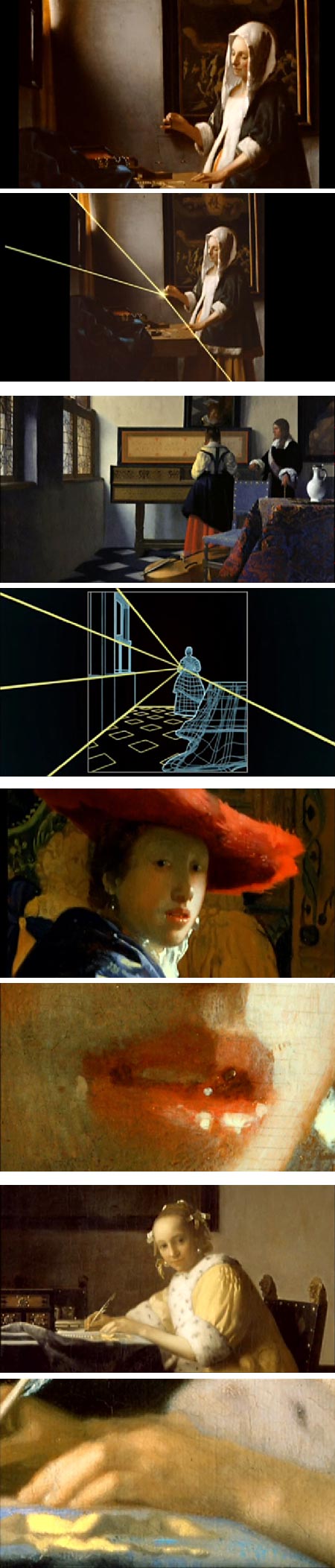
Vermeer: Master of Light is a short series of videos from the National Gallery of Art in Washington that explores some aspects of Vermeer’s paintings, like composition, color and diffuse edges, that are characteristic of his work and make a Vermeer a Vermeer.The series can be accessed on ArtBabble.
There are five episodes, plus a compilation that puts them together as one 20 minute video. Each features curators from the National Gallery discussing one of the museum’s Vermeers in terms of a particular aspect of the master’s approach.
You may want to start with The Music Lesson, Part 2 (second pair of images, above), lest you be initially put off by the drier analysis of Woman Holding a Balance, Part 1 (first pair of images, above).
I found it interesting in a discussion of elements that make a work characteristic of Vermeer, that the episode Girl with the Red Hat: Part 3 (third set of images, above) skips any mention of the fact that attribution of the painting to Vermeer has been questioned.
Camera Obscura, Part 4 offers a brief look at Vermeer’s use of the optical device as an aid in seeing.
Woman Writing a Letter, Part 5 (bottom pair of images, above) delves into Vermeer as a master of suggestion, creating the illusion that there is more than he has actually presented, as well as examining his use and mastery of diffuse edges.
The presentation itself is too brief, leaving you wanting more. You can do a search on ArtBabble for other video productions from the National Gallery, or plow into the overall resources there, either by searching or through their indexes of Series, Channels, Artists or Partners.
ArtBabble, as I mentioned in a previous post, is a terrific resource of videos about art, examining and discussing art in a number of categories.. Their motto is “Play Art Loud”.
If you are hungry for more Vermeer, you can spend hours on Jonathan Janson’s amazing resource Essential Vermeer.
Categories:
-
Paul Antonson
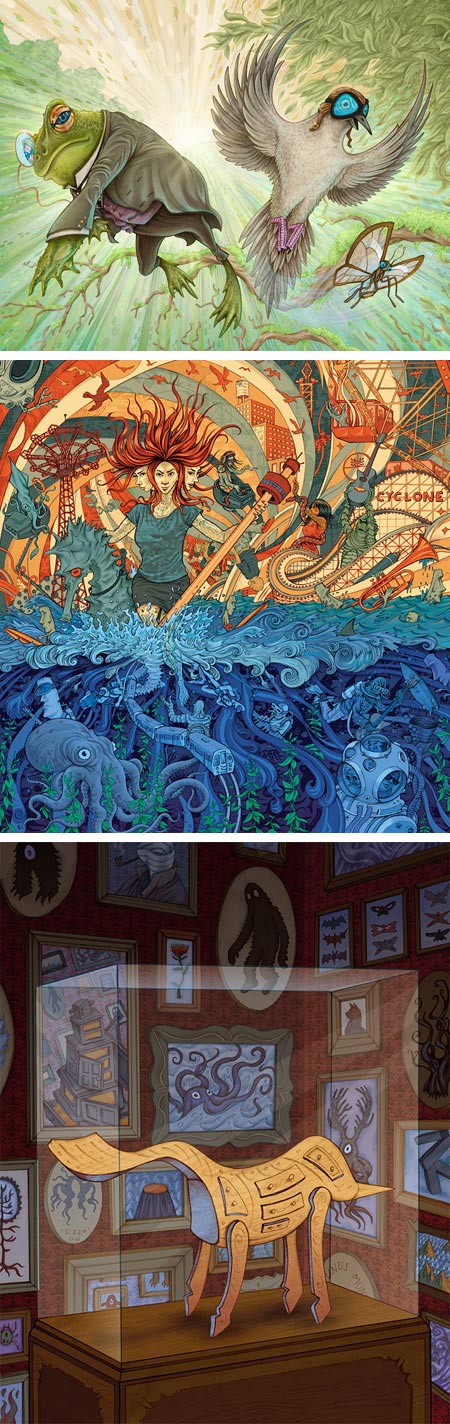
Sacramento based illustrator Paul Antonson has for several years done illustration and interactive design for the Wall Street Journal Online. He also has editorial clients that include The Village Voice, New York Press and The Onion. He is a children’s book illustrator as well.Antonson’s website includes work from various aspects of his career, and fun range of styles, along with personal projects and sketchbooks.
He combines a painter’s skills with a strong graphic sensibility, at times working with graphic patterns, at times riotously complex and at other times moving into a style that harkens to classic children’s’ book illustration.
Antonson is a contributor to the Invisibleman collaborative blog (see my post on Invisibleman from 2006). There you will find more descriptions of his individual pieces and working process, as well as additional artwork.
Categories:
-
Piranesi’s Prisons: Architecture of Mystery and Imagination

18th Century Venetian artist Giovanni Battista Piranesi was famous for his elaborate engravings of the fantastic architectural ruins of Rome.He is even more well known for a set of 14 copper plate etchings titled Carceri (“Prisons”). These are architectural fantasies, “capricious inventions” as they are described on the title page. Their monumental size, grand design and Escher-like defiance of architectural realities are a far cry from the shabby dungeons that were the actual prisons of the day.
Loosely based on stage set designs, they show Piranesi indulging in his fascination with monumental Roman architecture; creating a fanciful series of structures and interiors in which he gets to play with perspective, geometry, scale, lighting and shadow effects.
The Surrealists admired Piranesi’s dreamlike evocations of imaginary spaces, and students of etching have praised his exploration of the medium, using etching needles, burin and burnisher in a variety of ways to achieve his effects.
The Art Gallery of Albeta in Edmonton is hosting an exhibition of images from the Carceri d’invenzione (Imaginary Prisons) series titled Piranesi’s Prisons: Architecture of Mystery and Imagination that is on display until November 7, 2010.
There doesn’t seem to be a catalog associated with the exhibit. A book of the etching series, The Prisons / Le Carceri is available from Amazon.
The museum also doesn’t appear to have an online preview of the exhibition. I’ve listed some links and resources for Piranesi below.
The best images of Piranesi’s etchings I’ve found are on the New York Public Library Digital Gallery. Click on the images for a larger version; you can click through in sequence at either size. There is a zoom button that pops up a new window and allows you to zoom in on parts of the image, albeit in a frustratingly small window. (Note that in addition to impressions from the Prisons series, there are many more works here; there are 6 pages of thumbnails for Piranesi. Wonderful images of grand Roman architecture and more.)
There is also a nice section on Piranesi as part of the Heilbrunn Timeline of Art History, with a detail page on the Round Tower from Prison series. (See my post on the Heilbrunn Timeline of Art History.)
There is an interesting blog post from Murray Ewing about piranesi’s effect on pop culture and cinema, and for an interesting twist on Piranesi’s series by a contemporary collage artist, see my post on Emily Allchurch.
According to an early biography of Piranesi, he is reported to have said:
“I need to produce great ideas, and I believe that if I were commissioned to design a new universe, I would be mad enough to undertake it.”
[Thanks to ianehunt, @condottiere94 (Twitter page) for the suggestion]
Categories:




Charley’s Picks
Bookshop.org
(Bookshop.org affilliate links; sales benefit independent bookshop owners; I get a small percentage to help support my work on Lines and Colors)

John Singer Sargent: Watercolors


Urban Sketching: Understanding Perspective


Charley’s Picks
Amazon
(Amazon.com affiliate links; sales go to a larger yacht for Jeff Bezos; but I get a small percentage to help support my work on Lines and Colors)
John Singer Sargent: Watercolors
Urban Sketching: Understanding Perspective