


Categories
- 3d CGI
- Amusements
- Animation
- Anime & Manga
- Art Materials
- Art Videos
- Blogroll
- Cartoons
- Color
- Comics
- Concept & Visual Dev.
- Creativity
- Digital Art
- Digital Painting
- Displaying Art on the Web
- Drawing
- Eye Candy for Today
- Gallery and Museum Art
- High-res Art Images
- Illustration
- Motion Graphics & Flash
- Museums
- Online Museums
- Outsider Art
- Painting
- Painting a Day
- Paleo Art
- Pastel, Conté & Chalk
- Pen & Ink
- Prints and Printmaking
- Reviews
- Sc-fi and Fantasy
- Sculpture & Dimensional
- Site Comments
- Sketching
- Storyboards
- Tools and Techniques
- Uncategorized
- Vector Art
- Videos & Podcasts
- Vision and Optics
- Watercolor and Gouache
- Webcomics
Archives
- May 2026
- April 2026
- March 2026
- February 2026
- January 2026
- December 2025
- November 2025
- October 2025
- September 2025
- August 2025
- July 2025
- June 2025
- May 2025
- January 2025
- December 2024
- November 2024
- October 2024
- September 2024
- August 2024
- June 2024
- April 2024
- March 2024
- February 2024
- January 2024
- December 2023
- November 2023
- October 2023
- September 2023
- August 2023
- July 2023
- May 2023
- April 2023
- March 2023
- February 2023
- January 2023
- December 2022
- November 2022
- September 2022
- August 2022
- July 2022
- June 2022
- May 2022
- April 2022
- March 2022
- February 2022
- January 2022
- December 2021
- November 2021
- October 2021
- September 2021
- August 2021
- July 2021
- June 2021
- May 2021
- April 2021
- March 2021
- February 2021
- January 2021
- December 2020
- November 2020
- October 2020
- September 2020
- August 2020
- July 2020
- June 2020
- May 2020
- April 2020
- March 2020
- February 2020
- January 2020
- December 2019
- November 2019
- October 2019
- September 2019
- August 2019
- July 2019
- June 2019
- May 2019
- April 2019
- March 2019
- February 2019
- January 2019
- December 2018
- November 2018
- October 2018
- September 2018
- August 2018
- July 2018
- June 2018
- May 2018
- April 2018
- March 2018
- February 2018
- January 2018
- December 2017
- November 2017
- October 2017
- September 2017
- August 2017
- July 2017
- June 2017
- May 2017
- April 2017
- March 2017
- February 2017
- January 2017
- December 2016
- November 2016
- October 2016
- September 2016
- August 2016
- July 2016
- June 2016
- May 2016
- April 2016
- March 2016
- February 2016
- January 2016
- December 2015
- November 2015
- October 2015
- September 2015
- August 2015
- July 2015
- June 2015
- May 2015
- April 2015
- March 2015
- February 2015
- January 2015
- December 2014
- November 2014
- October 2014
- September 2014
- August 2014
- July 2014
- June 2014
- May 2014
- April 2014
- March 2014
- February 2014
- January 2014
- December 2013
- November 2013
- October 2013
- September 2013
- August 2013
- July 2013
- June 2013
- May 2013
- April 2013
- March 2013
- February 2013
- January 2013
- December 2012
- November 2012
- October 2012
- September 2012
- August 2012
- July 2012
- June 2012
- May 2012
- April 2012
- March 2012
- February 2012
- January 2012
- December 2011
- November 2011
- October 2011
- September 2011
- August 2011
- July 2011
- June 2011
- May 2011
- April 2011
- March 2011
- February 2011
- January 2011
- December 2010
- November 2010
- October 2010
- September 2010
- August 2010
- July 2010
- June 2010
- May 2010
- April 2010
- March 2010
- February 2010
- January 2010
- December 2009
- November 2009
- October 2009
- September 2009
- August 2009
- July 2009
- June 2009
- May 2009
- April 2009
- March 2009
- February 2009
- January 2009
- December 2008
- November 2008
- October 2008
- September 2008
- August 2008
- July 2008
- June 2008
- May 2008
- April 2008
- March 2008
- February 2008
- January 2008
- December 2007
- November 2007
- October 2007
- September 2007
- August 2007
- July 2007
- June 2007
- May 2007
- April 2007
- March 2007
- February 2007
- January 2007
- December 2006
- November 2006
- October 2006
- September 2006
- August 2006
- July 2006
- June 2006
- May 2006
- April 2006
- March 2006
- February 2006
- January 2006
- December 2005
- November 2005
- October 2005
- September 2005
- August 2005
Relevant Blogs
Art, Painting & Sketch
- Gurney Journey
- Underpaintings
- Art and Influence
- Painting Perceptions
- Oil Painters of America
- Vasari Paint POV
- Flying Fox
- Urban Sketchers
- Bento (Smithsonian)
- Art Inconnu
- The Hidden Place
- Still Life
- Making a Mark
- The Art of the Landscape
- Exploring Color & Creativity
- Art Contrarian
- Artist A Day
- beinArt Surreal Art Collective
- Eye Level
- David Dunlop
- p.i.g.m.e.n.t.i.u.m
- CultureGrrl
- Joaquín Sorolla blog
- Artists in Pastel
“Painting a Day”
- A Painting a Day (Keiser)
- On Painting (Keiser)
- Julian Merrow-Smith
- Karen Jurick
- Jeffrey Hayes
- Carol Marine
- Abbey Ryan
- Daily Paintworks
Other Painting Blogs
- Virtual Gouache Land
- Neil Hollingsworth
- Marc Hanson
- Kevin Menck
- Marc Dalessio
- Larry Seiler
- Stapleton Kearns
- Colin Page
- Roos Schuring
- Hans Versfelt
- Titus Meeuws
- Régis Pettinari
- René Plein Air
- Belinda Del Pesco
- Robin Weiss
- Nathan Fowkes (Land Sketch)
- William Wray
- Frank Serrano
- Stephen Magsig
- Michael Chesley Johnson
- Twice a Week
- Sarah Wimperis
- Rob Adams
- Michael Cole Manley
- The Dirty Palette Club
- Mike Manley’s Draw!
Gallery Art & Illustration mix
Illustration
- Howard Pyle
- 100 Years of Illustration
- BibliOdyssey
- Illustration Art
- Today’s Inspiration
- Illustration Mundo
- Little Chimp Society
- Danny Gregory
- R D (John Martz
- Illustration Friday blog
- Monster Brains
- Illustrators & Illustrations (RU)
- Elwood H. Smith
- DaniDraws.com
- Designers Who Blog
- iSpot Blog
Sci-Fi & Fantasy
Illustration & Comics
Comics & Cartoons
- Comics Beat
- Robot 6
- Newsarama Blog
- Comic Vine
- Comics Alliance
- Forbidden Planet Int.
- Paolo Rivera
- Bolt City
- Flight
- Scott McCloud
- The Comics Journal
- Comixpedia
- Funnybook Babylon
- James Baker
- Middleton’s Sketchbook
- Boneville
- The Hotel Fred
- Paul Rivoche
- Daily Cartoonist
- Mad About Cartoons (William Wray)
- Digital Strips
Illustration & Concept
Animation & Concept
- Cartoon Brew
- Animation Blog
- Cold Hard Flash
- Concept Art World
- The CAB
- FY Concept Art
- Concept Ships
- Concept Robots
- John Nevarez
- Armand Serrano
- Marcos Mateu-Mestre
- all kinds of stuff (Kricfalusi)
- Yacin the faun (Man Arenas)
- Kelsey Mann
- Cre8tivemarks Blog
- Ice-Cream Monster Toon Cafe
- AAU Character & Creature Design
- AAU Animation Notes
- Articles and Texticles
Paleo & Scientific
Tools & Techniques
Other
Lists of Art Blogs
Art Image Resource Links
Historic Art Images
- Wikimedia Commons: Paintings
- Wikimedia Commons: Drawings
- The Athenaeum
- WikiArt (WikiPaintings)
- Google Art Project: Artists
- Google Art Project: Collections (Museums)
- ArtCyclopedia
- Web Gallery of Art
- Art Renewal Center
- Web Gallery of Impressionism
Auction Consolidation sites
Auction sites
- Sotheby’s
- Bonham’s
- Christies
- Heritage Auctions: Fine Art
- Heritage Auctions: Illustration
- Freeman’s Auctions
- Bukowskis
- Shannon’s
Image Search
Reverse Image Search (search by image)
- Tin Eye
- RevImg
- Google Image Search (camera icon)
- Bing Image Search (camera icon)
Promoting some friends and some clients of my website design business
- Twin Willows T’ai Chi studio in Wilmington DE. Taiji classes with Bryan Davis.
- Ray Hayward, Inspired Teacher of T’ai Chi ( Taiji ) in Minneapolis, Founder of Mindful Motion Tai Chi Academy
- OldHead Tattoo studio and Art Gallery in Wilmington DE. Tattoos and paintings by Bruce Gulick
- Sharon Domenico Art, pet portrait oil paintings
- Platinum Paperhanging, wallpaper hanging, Main Line and Philadelphia, PA
- Lisa Stone Design, interior designer, Main Line and Philadelphia, PA
- Studio12KPT, original art, prints, calendars and other custom printed items by Van Sickle & Rolleri
-
Frida Kahlo

As this self portrait makes startlingly clear, the life and art of Mexican painter Frida Kahlo are inextricably intertwined with that of Diego Rivera, her mentor, husband and largest artistic influence.It’s also difficult to separate her from her times and the other strong-willed and influential people she encountered in her life, from political figures like Leon Trotsky (she and Rivera were supporters of Communism when it seemed more like a social revolution than an excuse for another bunch of totalitarian governments), to the avant garde artists in Paris who were ripping up the fabric of art and making some bizarre new material out of its remnants.
Kahlo is often referred to as a Surrealist. You will occasionally hear me rant about the casual misuse of that term, and Kahlo, who associated with the original Surrealists and knew exactly what was and wasn’t Surrealism, did not consider herself a Surrealist; saying: “They thought I was a Surrealist, but I wasn’t. I never painted dreams. I painted my own reality.”
She later came to despise the intellectual snobbery and coldness of Breton and the other Paris Surrealists, saying of them, “They are so damn ‘intellectual’ and rotten that I can’t stand them anymore….I [would] rather sit on the floor in the market of Toluca and sell tortillas, than have anything to do with those ‘artistic’ bitches of Paris.”
Kahlo was, to say the least, outspoken, both verbally and in the confrontational, in-your-face directness of her paintings. Many of her works are self portraits and, in essence, all of her work is autobiographical. In a time when her contemporaries in Mexico, like Rivera, were painting large, bold murals depicting the noble struggles of the poor and downtrodden workers, and Mexico’s 1910 revolution, Kahlo chose a much more intimate, though no less bold, path for her art.
Her self portraits look at first, in spite of their imaginative overtones of symbolism and visionary art, to be very direct and honest appraisals. After comparing them to some photographs, however, I think they were actually intentionally (perhaps subconsciously) harsh, almost always emphasizing her mustache and “unibrow” effect which, while visible in photographs, seem much more pronounced in her paintings. I see her work as self-critical; it is hard edged and at times is obviously an expression of pain, disappointment and emotional turmoil.
She paints her images with an undeniable force of personality and a painting style that borrows some of its power from traditional Mexican art forms, as well as the image juxtapositions employed by the Surrealists, the melodramatic murals of her husband and his comtemporaries, and the bold primitivism of artists like Rousseau.
The personal and self-confessional nature of her work, her feminist and communist beliefs, and the turmoil of her life, have made her something of a hero to many, and she is sometimes exemplified as a victimized woman; though I find it hard to see someone of such obvious strength of will and force of character as a timid victim.
She did have great difficulties to overcome, however. Her life with, and two marriages to Rivera were filled with infidelity and difficulties from the outset. Her painting career began in convalescence from a trolley accident as a teenager, that crushed many bones and broke her back in three places. In her later years she said: “I have had two accidents in my life – the streetcar crash and Diego Rivera”. She also had polio as a child and was in physical pain much of her life and unable to have children. Lest we get all misty-eyed, there is also indication that she was not the kindest or nicest individual herself, and was often not spoken well of by artists and others who encountered her.
I’ll point out here that I have not seen Frida, the popular movie about her which starred Salma Hayek, nor have I seen the documentaries on PBS or A&E. I have also not seen her originals in person, so my knowledge of her life and work comes from images in print or online.
This year marks the 100th anniversary of her birth, and the Museum of the Palace of Fine Arts in Mexico City, her birthplace, has mounted the largest ever exhibition of her work, Frida Kahlo 1907 — 2007 National Homage, which runs from now through August 19, 2007. The museum does not have images online, but I’ve gathered some other resources for you below.
Exhibition links via Art Knowledge News
Categories:
-
Gobelins students’ Annecy animations
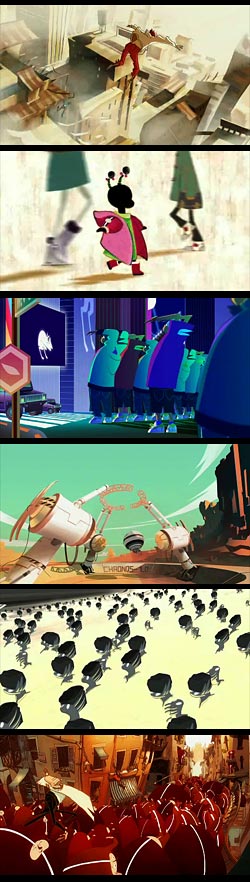 Each year in June, the beautiful town of Annecy in the Rhone-Alpes region of eastern France temporarily becomes the animation hub of the world, as it plays host to the Annecy International Animated Film Festival and Market.
Annecy is the number one international competitive animation festival. Animators, and animation students, from around the world come to put on a display of their best work.
So each year animation students from the remarkable Paris based Gobelins school of art and animation gather in small teams and create short animations devoted to the upcoming festival; as I reported in my post on last year’s entries from Gobelins animation students.
Like their predecessors, this year’s entries are also wonderfully clever and marvelously realized. The films are short (90 seconds or so) and are largely wordless, so language is not a barrier to enjoyment. The only requirement seems to be that the films are in essence a short introduction to the festival, so the students are free to let their imaginations run wild.
Here is the main Animation page on the Gobelins site, which lists both this year’s entries and those from 2006. (Google Translate version here.)
The 2007 entries are (images at left, top to bottom):
Le grande Arche by Jean-Michel Boesch, Quentin Baillieux, Manuel Tanon-Tchi and Sébastien Vovau;
Keep Walking by Carlo Vogele, Antonin Herveet, Sophia Chevrier, Cécile Francoia and Leah Ordonia;
Anima facta est by Lucie Arnissolle, Maël Gourmelen, Léah F. Ordonia, Célia Riviere and Setpen Vuillemin;
Chronos 1.0 by Wassim Boutales, Yann Boyer, Vincent Mahe and Bruno Mangyoku;
Nano by Stéphane Vlavonou, Sébastien Rouxel, Stéphane Chung, Nicolas Rubio and Nima Azarba; and
Emile et les fabuleux petits monsieurs by Jean-Nicolas Arnoux, Tom Haugomat, Charles-André Lefebvre, and Louis Tardivier.
Though I liked all of the entries, my favorite is Chronos 1.0, a short time travel adventure with a wonderful concept.
My timely reminder for the Gobelins Annecy shorts, as usual, is Michael Hirsh’s Articles and Texticles blog, which has both an initial post and an update on this year’s entries.
Categories:
-
Chiho Aoshima

Working digitally in a vector art program (presumably Illustrator), and outputting her images on a large scale printer, Chiho Aoshima creates wall-size installations, “wallpapers” and environments.Coming from a background that did not include any formal art training, Aoshima’s images are full of brightly colored, cartoon style landscapes, citiscapes and fantasy environments, populated with cheery-looking anime and manga inspired characters, usually young women, often engaged in vaguely horrific activities.
Aoshima can be associated with the “superflat” movement, popular among young Japanese artists, that emphasizes the two dimensionality and simplified forms that make up their visual vocabulary.
Aoshima’s work can have an interesting juxtaposition of images that at first have the appearance of colorful innocence, and on second glance can be disconcertingly morbid, producing a feeling of pop comics storybook illustrations gone horribly wrong.
I haven’t had a chance to see her work in person, but I get the feeling that scale makes a difference (as it usually does). Her images are often highly detailed and include small elements that may not be visible in reproductions, and are displayed at a size intended to have an immersive quality.
The galleries I list below often include photos of the large scale and wall size works printed and mounted in place, so you can get a idea of their size and presentation, which sometimes includes sculptural objects or printed floors.
Link via Ann Marshall
Categories:
-
The Power of Art: Van Gogh & Picasso

The Power of Art is a new PBS series, based on the book by Simon Schama, and made with his cooperation and participation.In a series of eight broadcasts, the program will examine eight artists and their impact on the history of art, and on the cultural, political and social currents of their time. In the process, the shows will apparently focus on one painting by each artist that the author considers particularly significant and explore that work in depth.
I learned about this series from Nita Leland’s Exploring Color and Creativity (I reviewed her recent book The New Creative Artist back in February.) While I have not read the book on which the series is based, Leland has. She mentions it here and in her post on the PBS special notes that it is the emphasis on the social, political and business aspects, which are not often brought to light, that she found most intriguing.
The eight artists to be featured in the series are Vincent van Gogh, Pablo Picasso, Caravaggio, Gian Lorenzo Bernini, Rembrandt van Rijn, Jacques-LouisDavid, J.W.M. Turner and Mark Rothko.
Excuse me? Mark Rothko?
To me, throwing someone like Rothko into that group is like doing a special on Mozart, Bach, Beethoven and Brahams and tossing in Axl Rose, but I’ll try to bite my tongue and bear in mind that perhaps the political and social implications are more important here than the accomplishments of the artists. I won’t know until I’ve seen the program.
The first installment of the series starts tonight, Monday, June 18th at 9PM Eastern on most PBS stations, and is devoted to Van Gogh. It will be followed immediately by the second program in the series, which centers on Picasso.
PBS has a web site in support of the series that has a section for each artist along with an “Explore the Painting” feature that shows some interesting points about the work from the commentary in the program.
The Van Gogh program will focus on Wheatfield with Crows (image above, top), often assumed to be Van Gogh’s last painting. Though that is far from certain, much symbolism has been read into the painting as a result. It will be interesting to see the program’s take on its significance. One of the fascinating things about this painting is that it was part of a series of paintings of wheatfields that that Van Gogh painted in a very unusual elongated shape, on canvasses with an almost cinematic aspect ratio (bearing in mind that this was 1890, and the word “cinematic” was essentially meaningless).
The original painting is in the Van Gogh Museum in Amsterdam. The “Show Enlargement” feature on their site, while a poor substitute for a nice big digital image, does let you zoom way in on the image and see it in greater detail than on the PBS site.
For the Picasso segment, the focus will be on his amazing anti-war masterpiece Guernica (image above, bottom); also, interestingly enough, painted on a large canvas with elongated, cinematic proportions. The original painting is now in the Museo Nacional Centro de Arte Renia Sofia in Madrid, to where it was moved in 1992, stirring up controversy because it defied Picasso’s wish that it be displayed at the Prado. (There is a larger version here, click for enlargement.) There is some history on the painting from a different PBS special here.
It’s interesting to note that a large scale tapestry copy of Guernica, a painting in which Picasso expresses his horror at the cost of war and his “…abhorrence of the military caste which has sunk Spain in an ocean of pain and death”, hangs in the United Nations building in New York at the entrance of the Security Council chamber. The tapestry was a gift to the United Nations by Nelson Rockefeller and was meant to be a reminder to all nations of the terrible price of war in human suffering.
On the day in 2003 when Colin Powell and John Negroponte gave their press conference at the UN in a effort to stir up support for the war in Iraq, a large blue curtain was placed over the work. Excuses were made that it was a request of the TV crews to simplify a distracting background, but word got out from the attending diplomats that it was actually representatives of the US government that had pressured UN officials to have it covered during the conference.
The power of art, you say?
Categories:
-
Correggio (Antonio di Pellegrino Allegri)
 OK, so you’re Jupiter, the most powerful of Roman gods (Zeus in the Greek stories), and apparently the randiest as well, and you’d like to add the beautiful but shy river goddess Io to your long list of conquests; most of whom you’ve caged into a liaison by some form of deception or disguise. What to do…?
Let’s see now,… you did the turning into as a swan routine with Leda, appeared in drag as Diana, goddess of chastity, to seduce Callisto, came on to Antiope as a satyr, turned into a golden shower to reach Danae in her tower (OK, stop that snickering in the back row), and did the abduction thing with Europa,… what’s left?
Hey! How about appearing as a cloud and wrapping Io in your airy but irresistible embrace before she realizes that she’s been had. By Jove, that’s a great idea!
Apparently 16th Century painter Antonio di Pellegrino Allegri, who is known by “Correggio”, the name of his native town, thought so too, and made the story of Jupiter and Io the subject of the most striking of a series of paintings of the “Loves of Jupiter” commissioned by Federigo Gonzaga in the early 1500’s. The others included The Abduction of Ganymede, Leda and the Swan and Danae.
The painting of Jupiter seducing Io in the form of a cloud is striking in its depiction of the god’s countenance emerging from the cloud to kiss Io’s sensually upturned face, the beautiful modeling and delicate tones of her figure, luminous against the contrast of the dark cloud and the bizarre cloud/hand that enfolds her. The original is in the Kunsthstoriches Museum in Vienna.
Correggio was a masterful painter of the High Renaissance who was most active in the city of Parma. His influences included Mantegna and Leonardo, whose impact you can see in the delicate rendering of faces, hand positions and sfumato technique in Correggio’s early works. In his later career Correggio’s daring use of perspective, brilliant colors and dramatic compositions heralded the arrival of the Baroque period.
One of the most notable of Correggio’s works is the Assumption of the Virgin, painted on the inside of the cupola of the cathedral of Parma. In this large scale fresco (35′ x 40′, 11m x 12m) he creates an astonishing illusionary space in which your view is lifted into a swirling vault of clouds, ringed with angels and saints and blazing with a core of heavenly light.
I’ve listed some resources for Correggio below, including a posting of quotes from the chapter on him from Vasari’s Lives of the Artists. Correggio also left some masterful drawings, though I haven’t had much luck finding examples of them on the web. Try searcing Amazon and others for books.
And what of Io? Well, in addition to having her story be the subject of numerous other paintings, she had the Ionian Sea is named after her passage, as well having one of the innermost moons of the planet Jupiter named after her by Galileo. And while most of the 63 (count ’em) moons of the largest planet in our neighborhood are named after Jupiter’s female conquests, Io is notable as the most volcanically active body in the Solar System. Hot love, indeed.
Meanwhile, what happens to poor innocently seduced Io in the next exciting episode of The Loves of Jupiter? Well, we have the sitcom-like scene in which Jupiter turns Io into a cow (yes, a cow) before jealous wife Juno arrives on the scene. Juno susses the deal and asks Jupiter for the gift of simple cow, which he can’t refuse, of course, and Juno puts the lock on Io by putting her under the watchful eyes of Argos, who has a hundred of ’em (eyes, that is) and never closes more than a couple at a time. The guardian is later lulled to sleep by Mercury with music and stories, Mercury lops off his head and Io is released; and eventually, in some accounts, becomes the first queen of Egypt. And you thought Desperate Housewives had outrageous plots.
Categories:
-
David Bull
 In the days long before the convenience of offset printing and the sophisticated inkjet technology of Giclée prints, artists who wanted to create more than one copy of an artwork had to utilize printmaking techniques that were often elaborate and time consuming, though somewhat less so than creating multiple originals.
These days many of these same processes are still used by artists who make works involving multiple copies, both to set them apart from the more commercial process of having images of the work reproduced by photomechanical printing, and because they have a passion for the printmaking process itself, in spite of the work involved.
I suspect that love of the process accounts for a lot in the case of Tokyo based woodblock printer David Bull, who works in the painstaking methods of traditional Japanese woodblock prints.
In addition to his own work as a printmaker, Bull has created an maintains an extensive website at woodblock.com.
The opening page of the site is arranged to allow you to access the multiple facets of the site, involving different projects, as though they were different, independent websites. I found this arrangement a bit confusing, and to me his “front page” makes a better entry point and serves the purpose of a more traditional home page, with introductory material and more thorough navigation.
Those already interested in printmaking, if they aren’t already familiar with the site, will find hours worth of material to get lost in, both about Bull’s own work and technique and more general features, including a “Woodblock RoundTable” (discussions of the process in a blog format), a mini-site devoted to the woodblock prints of John Edgar Platt and a “Handbook of Japanese Printmaking Techniques” to which Bull continues to add material. Though somewhat awkwardly arranged (the intention is to have two windows open, using one for navigation), the Handbook has one of the most thorough descriptions of the process I’ve ever encountered.
Those of us whose appreciation of woodblock printing is more as observers than participants will find some fascinating highlights, notably a slideshow of the process of printing his piece “River in Summer“, which slowly animates through the sequence of impressions, or can be navigated manually with controls the pop from the bottom on mouseover.
Color woodblock printing involves multiple impressions, in which differently carved blocks, each painstakingly cut to leave a certain area in relief to receive ink, are printed over the same sheet of paper in precise alilgnment, each carrying a particular color of ink to areas of the image.
This printmaking process is hundreds of years old and is the fundamental basis of modern printing technology; except that, instead of discreet areas of solid color, images are broken into a series of dots using photographic screens, the arrangement of which, like Seurat’s pointillist paintings, combine in the eye to form larger areas of various colors. Plates are made using (usually) four colors (cyan, magenta, yellow and black), and printed in sequence on the same sheet or roll of paper, creating an image with the illusion of a much wide range of colors. Underlying it all, though, is that same idea of multiple impressions of separate color plates on the same image that is central to color woodblock printing.
It feels like some kind of weirdly poetic circle closing when reading about the continuation of this centuries old method of creating multiple images via the electronic “publishing” system of the net. For some reason, I just love that.
The woodblock.com web site also contains a more detailed step-by-step description the color woodblock process for Bull’s “River in Summer” print (images above left) that goes through the individual impressions (which, to my surprise, begin with a blank impression to prepare the surface of the paper), and shows the print in each of it’s 31 stages (impression #17, above, second image), along with images of the individual impressions printed separately (impression #17 shown alone, above, third image) all the way to the finished piece (image above, bottom).
Bull’s detailed description of the process will give you a deeper appreciation not only of his own work, and color woodblock printing in general, but of the work of some of the wonderful Japanese printmakers I’ve featured in the past on lines and colors, like Katasushika Hokusai, Hiroshi Yoshida, Kawase Hasui and Ito Shinsui.
Categories:




Charley’s Picks
Bookshop.org
(Bookshop.org affilliate links; sales benefit independent bookshop owners; I get a small percentage to help support my work on Lines and Colors)

John Singer Sargent: Watercolors


Urban Sketching: Understanding Perspective


Charley’s Picks
Amazon
(Amazon.com affiliate links; sales go to a larger yacht for Jeff Bezos; but I get a small percentage to help support my work on Lines and Colors)
John Singer Sargent: Watercolors
Urban Sketching: Understanding Perspective