


Categories
- 3d CGI
- Amusements
- Animation
- Anime & Manga
- Art Materials
- Art Videos
- Blogroll
- Cartoons
- Color
- Comics
- Concept & Visual Dev.
- Creativity
- Digital Art
- Digital Painting
- Displaying Art on the Web
- Drawing
- Eye Candy for Today
- Gallery and Museum Art
- High-res Art Images
- Illustration
- Motion Graphics & Flash
- Museums
- Online Museums
- Outsider Art
- Painting
- Painting a Day
- Paleo Art
- Pastel, Conté & Chalk
- Pen & Ink
- Prints and Printmaking
- Reviews
- Sc-fi and Fantasy
- Sculpture & Dimensional
- Site Comments
- Sketching
- Storyboards
- Tools and Techniques
- Uncategorized
- Vector Art
- Videos & Podcasts
- Vision and Optics
- Watercolor and Gouache
- Webcomics
Archives
- May 2026
- April 2026
- March 2026
- February 2026
- January 2026
- December 2025
- November 2025
- October 2025
- September 2025
- August 2025
- July 2025
- June 2025
- May 2025
- January 2025
- December 2024
- November 2024
- October 2024
- September 2024
- August 2024
- June 2024
- April 2024
- March 2024
- February 2024
- January 2024
- December 2023
- November 2023
- October 2023
- September 2023
- August 2023
- July 2023
- May 2023
- April 2023
- March 2023
- February 2023
- January 2023
- December 2022
- November 2022
- September 2022
- August 2022
- July 2022
- June 2022
- May 2022
- April 2022
- March 2022
- February 2022
- January 2022
- December 2021
- November 2021
- October 2021
- September 2021
- August 2021
- July 2021
- June 2021
- May 2021
- April 2021
- March 2021
- February 2021
- January 2021
- December 2020
- November 2020
- October 2020
- September 2020
- August 2020
- July 2020
- June 2020
- May 2020
- April 2020
- March 2020
- February 2020
- January 2020
- December 2019
- November 2019
- October 2019
- September 2019
- August 2019
- July 2019
- June 2019
- May 2019
- April 2019
- March 2019
- February 2019
- January 2019
- December 2018
- November 2018
- October 2018
- September 2018
- August 2018
- July 2018
- June 2018
- May 2018
- April 2018
- March 2018
- February 2018
- January 2018
- December 2017
- November 2017
- October 2017
- September 2017
- August 2017
- July 2017
- June 2017
- May 2017
- April 2017
- March 2017
- February 2017
- January 2017
- December 2016
- November 2016
- October 2016
- September 2016
- August 2016
- July 2016
- June 2016
- May 2016
- April 2016
- March 2016
- February 2016
- January 2016
- December 2015
- November 2015
- October 2015
- September 2015
- August 2015
- July 2015
- June 2015
- May 2015
- April 2015
- March 2015
- February 2015
- January 2015
- December 2014
- November 2014
- October 2014
- September 2014
- August 2014
- July 2014
- June 2014
- May 2014
- April 2014
- March 2014
- February 2014
- January 2014
- December 2013
- November 2013
- October 2013
- September 2013
- August 2013
- July 2013
- June 2013
- May 2013
- April 2013
- March 2013
- February 2013
- January 2013
- December 2012
- November 2012
- October 2012
- September 2012
- August 2012
- July 2012
- June 2012
- May 2012
- April 2012
- March 2012
- February 2012
- January 2012
- December 2011
- November 2011
- October 2011
- September 2011
- August 2011
- July 2011
- June 2011
- May 2011
- April 2011
- March 2011
- February 2011
- January 2011
- December 2010
- November 2010
- October 2010
- September 2010
- August 2010
- July 2010
- June 2010
- May 2010
- April 2010
- March 2010
- February 2010
- January 2010
- December 2009
- November 2009
- October 2009
- September 2009
- August 2009
- July 2009
- June 2009
- May 2009
- April 2009
- March 2009
- February 2009
- January 2009
- December 2008
- November 2008
- October 2008
- September 2008
- August 2008
- July 2008
- June 2008
- May 2008
- April 2008
- March 2008
- February 2008
- January 2008
- December 2007
- November 2007
- October 2007
- September 2007
- August 2007
- July 2007
- June 2007
- May 2007
- April 2007
- March 2007
- February 2007
- January 2007
- December 2006
- November 2006
- October 2006
- September 2006
- August 2006
- July 2006
- June 2006
- May 2006
- April 2006
- March 2006
- February 2006
- January 2006
- December 2005
- November 2005
- October 2005
- September 2005
- August 2005
Relevant Blogs
Art, Painting & Sketch
- Gurney Journey
- Underpaintings
- Art and Influence
- Painting Perceptions
- Oil Painters of America
- Vasari Paint POV
- Flying Fox
- Urban Sketchers
- Bento (Smithsonian)
- Art Inconnu
- The Hidden Place
- Still Life
- Making a Mark
- The Art of the Landscape
- Exploring Color & Creativity
- Art Contrarian
- Artist A Day
- beinArt Surreal Art Collective
- Eye Level
- David Dunlop
- p.i.g.m.e.n.t.i.u.m
- CultureGrrl
- Joaquín Sorolla blog
- Artists in Pastel
“Painting a Day”
- A Painting a Day (Keiser)
- On Painting (Keiser)
- Julian Merrow-Smith
- Karen Jurick
- Jeffrey Hayes
- Carol Marine
- Abbey Ryan
- Daily Paintworks
Other Painting Blogs
- Virtual Gouache Land
- Neil Hollingsworth
- Marc Hanson
- Kevin Menck
- Marc Dalessio
- Larry Seiler
- Stapleton Kearns
- Colin Page
- Roos Schuring
- Hans Versfelt
- Titus Meeuws
- Régis Pettinari
- René Plein Air
- Belinda Del Pesco
- Robin Weiss
- Nathan Fowkes (Land Sketch)
- William Wray
- Frank Serrano
- Stephen Magsig
- Michael Chesley Johnson
- Twice a Week
- Sarah Wimperis
- Rob Adams
- Michael Cole Manley
- The Dirty Palette Club
- Mike Manley’s Draw!
Gallery Art & Illustration mix
Illustration
- Howard Pyle
- 100 Years of Illustration
- BibliOdyssey
- Illustration Art
- Today’s Inspiration
- Illustration Mundo
- Little Chimp Society
- Danny Gregory
- R D (John Martz
- Illustration Friday blog
- Monster Brains
- Illustrators & Illustrations (RU)
- Elwood H. Smith
- DaniDraws.com
- Designers Who Blog
- iSpot Blog
Sci-Fi & Fantasy
Illustration & Comics
Comics & Cartoons
- Comics Beat
- Robot 6
- Newsarama Blog
- Comic Vine
- Comics Alliance
- Forbidden Planet Int.
- Paolo Rivera
- Bolt City
- Flight
- Scott McCloud
- The Comics Journal
- Comixpedia
- Funnybook Babylon
- James Baker
- Middleton’s Sketchbook
- Boneville
- The Hotel Fred
- Paul Rivoche
- Daily Cartoonist
- Mad About Cartoons (William Wray)
- Digital Strips
Illustration & Concept
Animation & Concept
- Cartoon Brew
- Animation Blog
- Cold Hard Flash
- Concept Art World
- The CAB
- FY Concept Art
- Concept Ships
- Concept Robots
- John Nevarez
- Armand Serrano
- Marcos Mateu-Mestre
- all kinds of stuff (Kricfalusi)
- Yacin the faun (Man Arenas)
- Kelsey Mann
- Cre8tivemarks Blog
- Ice-Cream Monster Toon Cafe
- AAU Character & Creature Design
- AAU Animation Notes
- Articles and Texticles
Paleo & Scientific
Tools & Techniques
Other
Lists of Art Blogs
Art Image Resource Links
Historic Art Images
- Wikimedia Commons: Paintings
- Wikimedia Commons: Drawings
- The Athenaeum
- WikiArt (WikiPaintings)
- Google Art Project: Artists
- Google Art Project: Collections (Museums)
- ArtCyclopedia
- Web Gallery of Art
- Art Renewal Center
- Web Gallery of Impressionism
Auction Consolidation sites
Auction sites
- Sotheby’s
- Bonham’s
- Christies
- Heritage Auctions: Fine Art
- Heritage Auctions: Illustration
- Freeman’s Auctions
- Bukowskis
- Shannon’s
Image Search
Reverse Image Search (search by image)
- Tin Eye
- RevImg
- Google Image Search (camera icon)
- Bing Image Search (camera icon)
Promoting some friends and some clients of my website design business
- Twin Willows T’ai Chi studio in Wilmington DE. Taiji classes with Bryan Davis.
- Ray Hayward, Inspired Teacher of T’ai Chi ( Taiji ) in Minneapolis, Founder of Mindful Motion Tai Chi Academy
- OldHead Tattoo studio and Art Gallery in Wilmington DE. Tattoos and paintings by Bruce Gulick
- Sharon Domenico Art, pet portrait oil paintings
- Platinum Paperhanging, wallpaper hanging, Main Line and Philadelphia, PA
- Lisa Stone Design, interior designer, Main Line and Philadelphia, PA
- Studio12KPT, original art, prints, calendars and other custom printed items by Van Sickle & Rolleri
-
Joseph Paquet

Sitting astride the Arno river, like a ruby on a blue ribbon, Firenze (Florence to us English speakers) is one if Italy’s most beautiful cities. (How the British got “Florence” out of “Firenze”, I don’t know.) Firenze, (OK, OK, I’ll call it Florence) is also the official sister city of Philadelphia, here in the U.S., a fact of which I would wager most residents of both cities are unaware.Florence was the center of the italian Renaissance and has been painted by some of the greatest artists in history, but I was particularly intrigued to see it painted by a contemporary American realist like Joseph Paquet (images above top left and right). These are part of a one-artist show at the Coleman Fine Art gallery in Charleston, South Carolina called “Mostly Florence“, that runs from now to June 2nd, 2007.
Paquet works in a loose, open style, not quite impressionist, but full of lively brushstrokes and rich color. He also has a solid ability to see and use value contrasts, a characteristic of his work that particularly shines in his paintings of Florence, with its wonderful architecture brought into high relief in the warm sun of the Tuscan plains. I was immediately reminded of my own time in Florence, more strongly than I would be by viewing photographs. I particularly enjoy his night scenes, both of intimate street corners and the sweeping vistas looking out over the Duomo from the Piazzalle Michelangelo and other vantage points in the hills “Alta Arno”.
Those same qualities of Paquet’s work also stand out in his painting of “Industrial Landscape” here in the U.S., as well as his more traditional landscapes, which are also highly evocative of time and place. The work on Paquet’s own site is divided into those categories, along with “Interiors and Portraits” and “Seascapes and Marine”, but within the broader classifications of work that is currently available or achived.
Paquet studied at the School of Visual Arts in New York, and his work includes plein air landscapes from that city as well as from his native Minnesota and from his travels. He also studied with John Osborne, who he credits with enabling him to see beyond the scene before him, particularly when creating a studio work based on sketches painted on location, and utilize his own artistic judgement in creating his compositions.
Paquet’s work has been featured in the Washington Post Sunday Magazine, the Classical Realism Journal, The Artist Magazine and American Artist.
Categories:
-
Syd Mead (update)
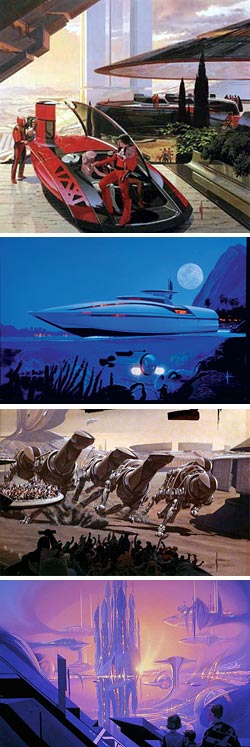 When I first wrote about futurist, concept artist and industrial designer extraordinaire Syd Mead back in November of 2005, I expressed my disappointment with the lack of a gallery on his official site. Unfortunately, that hasn’t changed.
In the intervening year and a half, the official site has changed little, except to add an annoyingly slow Flash introduction; and still, to my utter disbelief, offers no real gallery of Syd Mead’s terrific art, and therefore provides no reason why someone should care about who Syd Mead is, or why they should be on the site unless they already know who Syd mead is. (What are they thinking?)
The terrific books that have been published over the years as collections of his work are unfortunately out of print, and the official site says there are no plans to republish any of them (making their lack of an online gallery even more inexplicable). You may be able to find some of them used if you search Amazon or eBay.
The Bookstore on the site, though it no longer functions as a store, does contain some small images of work from the books. If you click on any of the book titles, it comes up in a little pop-up window. The rest of the site has some scattered small images from Christmas cards and snowboards, but offers no real opportunity to view his paintings in a meaningful way.
Fortunately, there are other resources on the web that I can point you to to give you some idea of how terrific his work is, and give you at least a hint as to his importance in the ranks of influential concept artists and futurist illustrators.
There is a reasonably good gallery on the Gnomon Workshop site, and there are unofficial gallery sites here and here. You can also get an idea from doing a Google image search. You can find an illustrated article on Promotex and an interview on Anime.com.
Mead set the standards for modern futuristic design and influenced two generations of concept artists and designers.
Once you’ve gotten a taste of his groundbreaking visionary art, you may have an idea of why the one significant recent addition to the official site is of interest. A new documentary had become available about the work and influence of Syd Mead, as told in interviews with Mead and a number of the people who worked closely with him on some of his most influential projects. The film is called VISUAL FUTURIST: The Art & Life of Syd Mead and is available through the official site.
Also, the instructional DVDs that were offered by the Gnomon Workshop, where Mead has been an instructor, are still available through both the Syd Mead site and the Gnomon site.
Categories:
-
John Avon
 (Image above © Wizards of the Coast)
English fantasy artist John Avon is one of many in his field who have made the transition from traditional media like oil and acrylic to digital painting. In the section of his site devoted to biography and technique, he goes into more detail than most about the reasons for his choice and the advantages he sees in painting digitally, particularly in a field based on creating complex paintings on deadline.
In addition he goes into some detail on his basic working process, and also mentions some of his favorite artists in the field, including Todd Lockwood, Kev Walker, Daren Bader, Mark Zug and Donato Giancola, concept artist Anthony Waters, and comic book artists Glen Fabry and Carl Critchlow.
Avon counts Wizards of the Coast as his largest client and has been doing illustrations for their fantasy themed Magic: The Gathering card based game for a number of years. The galleries on his site showcase his paintings for the project going back 12 years. The paintings are arranged by year, which also organizes them according to the game module for which they were created.
Avon uses the digital painting tools in Photoshop and Painter to paint richly detailed, highly rendered images of environments, monsters and magical objects, imbuing each with atmosphere, color and drama. He very often utilizes the technique of casting an image in an almost monochromatic light, with brilliant accents of another color to create contrast and focus.
His landscapes, structures and objects are wonderfully imaginative and, even within the fantasy theme of the Magic: The Gathering projects, often take on an other-worldly science fiction feeling; suggesting that magical realms might resemble distant planets, and perhaps vice-versa.
Categories:
-
Theo Jansen

A number of sculpture related links have come up as a result of my post about Lawrence Northey last Thursday.Theo Jansen’s kinetic sculptures are particularly fascinating because they walk back and forth (literally) across the supposedly fixed line between art and engineering. These amazing artifacts are built of ultralight materials and constructed of levers and gears so that they become wind-driven and walk across the flat wet sand on beaches.
This video posted on glumbert.com probably shows them to best advantage. Their graceful, cantilevered legs and wing-like transparent films give them the appearance of animated skeletons of ghostly alien grazing animals.
He also has fabric-covered variations that look like anime robots come to life. Amazing.
Link courtesy of Karl Kofoed
Categories:
-
Tim Prentice

Another artist whose work crosses boundaries between disciplines, kinetic sculptor Tim Prentice was trained in architecture at Yale, founded a successful architectural firm, and went on to establish a studio to create kinetic sculpture.Prentice creates beautifully balanced and intricate mobile-like sculptures, flying out from the aerial paths first pioneered by Alexander Calder. His pieces, spin, turn, hover, glisten and dazzle, all the while performing a delicate act of balance with the forces of wind and gravity.
Categories:
-
Ree Treweek (update)
 When I first wrote about the delightfully original and idiosyncratic art of South African artist Ree Treweek back in March of 2006, I was a little disappointed in the lack of information about the artist and her work, and the limited number of her images available online.
I was pleased when artist/blogger Siouxfire (Michael Curry) wrote to say that he has posted an interview with Ree Treweek on his blog siouxwire.
In addition to her editorial illustrations, many of which were done under the name of Cheri Treweek, Ree Treweek has commercial clients that include Virgin Atlantic, Levi’s, Musica and HP, and she continues to move forward with her fascinating animation project, The Tale of How, a collaboration between herself, Jannes Hendrikz and Markus Smit, collectively known as The Blackheart Gang.
I also wrote about The Tale of How; in April of 2006. Since then, the sample video clip from the project has been extended by almost double, to about four and a half minutes.
The movie, a hybrid of animated drawings, live action manipulation of drawings and CGI, is mesmerizingly otherworldly and visually unique. The current clip (which weighs in at around 70mb), is available on The Blackheart Gang site.
(Though it’s obvious they mean for you to be able to download the clip, they’ve put the link in a Flash file, which means you can’t right-click/control-click to download, and some may have trouble downloading, rather than viewing it in Quicktime in the browser. If you’re using Firefox, you can go to Tools: Page Info, go to the Media tab, select the name of the file and click on “Save As” to download the file. There are other download options on No Fat Clips!)
The interview with Treweek on siouxwire includes sketches of her original ideas for The Tale of How, and in it Treweek talks about her influences and working methods: “I begin with the outlines, often drawing straight into pen when possible… I then do the patterning and detail. I generally draw all the elements as separates and then composite them together later. Usually I do all the coloring in Photoshop.”.
There is also some discussion of the collaborations on the animated film and the planned coffee-table book/DVD release.
Siouxfire also provides a more extensive list of links for additional information, including The Blackheart Gang on MySpace, and an article on Motionographer, in which there is a description of The Blackheart Gang’s collaborative process.
Categories:




Charley’s Picks
Bookshop.org
(Bookshop.org affilliate links; sales benefit independent bookshop owners; I get a small percentage to help support my work on Lines and Colors)

John Singer Sargent: Watercolors


Urban Sketching: Understanding Perspective


Charley’s Picks
Amazon
(Amazon.com affiliate links; sales go to a larger yacht for Jeff Bezos; but I get a small percentage to help support my work on Lines and Colors)
John Singer Sargent: Watercolors
Urban Sketching: Understanding Perspective