


Categories
- 3d CGI
- Amusements
- Animation
- Anime & Manga
- Art Materials
- Art Videos
- Blogroll
- Cartoons
- Color
- Comics
- Concept & Visual Dev.
- Creativity
- Digital Art
- Digital Painting
- Displaying Art on the Web
- Drawing
- Eye Candy for Today
- Gallery and Museum Art
- High-res Art Images
- Illustration
- Motion Graphics & Flash
- Museums
- Online Museums
- Outsider Art
- Painting
- Painting a Day
- Paleo Art
- Pastel, Conté & Chalk
- Pen & Ink
- Prints and Printmaking
- Reviews
- Sc-fi and Fantasy
- Sculpture & Dimensional
- Site Comments
- Sketching
- Storyboards
- Tools and Techniques
- Uncategorized
- Vector Art
- Videos & Podcasts
- Vision and Optics
- Watercolor and Gouache
- Webcomics
Archives
- June 2026
- May 2026
- April 2026
- March 2026
- February 2026
- January 2026
- December 2025
- November 2025
- October 2025
- September 2025
- August 2025
- July 2025
- June 2025
- May 2025
- January 2025
- December 2024
- November 2024
- October 2024
- September 2024
- August 2024
- June 2024
- April 2024
- March 2024
- February 2024
- January 2024
- December 2023
- November 2023
- October 2023
- September 2023
- August 2023
- July 2023
- May 2023
- April 2023
- March 2023
- February 2023
- January 2023
- December 2022
- November 2022
- September 2022
- August 2022
- July 2022
- June 2022
- May 2022
- April 2022
- March 2022
- February 2022
- January 2022
- December 2021
- November 2021
- October 2021
- September 2021
- August 2021
- July 2021
- June 2021
- May 2021
- April 2021
- March 2021
- February 2021
- January 2021
- December 2020
- November 2020
- October 2020
- September 2020
- August 2020
- July 2020
- June 2020
- May 2020
- April 2020
- March 2020
- February 2020
- January 2020
- December 2019
- November 2019
- October 2019
- September 2019
- August 2019
- July 2019
- June 2019
- May 2019
- April 2019
- March 2019
- February 2019
- January 2019
- December 2018
- November 2018
- October 2018
- September 2018
- August 2018
- July 2018
- June 2018
- May 2018
- April 2018
- March 2018
- February 2018
- January 2018
- December 2017
- November 2017
- October 2017
- September 2017
- August 2017
- July 2017
- June 2017
- May 2017
- April 2017
- March 2017
- February 2017
- January 2017
- December 2016
- November 2016
- October 2016
- September 2016
- August 2016
- July 2016
- June 2016
- May 2016
- April 2016
- March 2016
- February 2016
- January 2016
- December 2015
- November 2015
- October 2015
- September 2015
- August 2015
- July 2015
- June 2015
- May 2015
- April 2015
- March 2015
- February 2015
- January 2015
- December 2014
- November 2014
- October 2014
- September 2014
- August 2014
- July 2014
- June 2014
- May 2014
- April 2014
- March 2014
- February 2014
- January 2014
- December 2013
- November 2013
- October 2013
- September 2013
- August 2013
- July 2013
- June 2013
- May 2013
- April 2013
- March 2013
- February 2013
- January 2013
- December 2012
- November 2012
- October 2012
- September 2012
- August 2012
- July 2012
- June 2012
- May 2012
- April 2012
- March 2012
- February 2012
- January 2012
- December 2011
- November 2011
- October 2011
- September 2011
- August 2011
- July 2011
- June 2011
- May 2011
- April 2011
- March 2011
- February 2011
- January 2011
- December 2010
- November 2010
- October 2010
- September 2010
- August 2010
- July 2010
- June 2010
- May 2010
- April 2010
- March 2010
- February 2010
- January 2010
- December 2009
- November 2009
- October 2009
- September 2009
- August 2009
- July 2009
- June 2009
- May 2009
- April 2009
- March 2009
- February 2009
- January 2009
- December 2008
- November 2008
- October 2008
- September 2008
- August 2008
- July 2008
- June 2008
- May 2008
- April 2008
- March 2008
- February 2008
- January 2008
- December 2007
- November 2007
- October 2007
- September 2007
- August 2007
- July 2007
- June 2007
- May 2007
- April 2007
- March 2007
- February 2007
- January 2007
- December 2006
- November 2006
- October 2006
- September 2006
- August 2006
- July 2006
- June 2006
- May 2006
- April 2006
- March 2006
- February 2006
- January 2006
- December 2005
- November 2005
- October 2005
- September 2005
- August 2005
Relevant Blogs
Art, Painting & Sketch
- Gurney Journey
- Underpaintings
- Art and Influence
- Painting Perceptions
- Oil Painters of America
- Vasari Paint POV
- Flying Fox
- Urban Sketchers
- Bento (Smithsonian)
- Art Inconnu
- The Hidden Place
- Still Life
- Making a Mark
- The Art of the Landscape
- Exploring Color & Creativity
- Art Contrarian
- Artist A Day
- beinArt Surreal Art Collective
- Eye Level
- David Dunlop
- p.i.g.m.e.n.t.i.u.m
- CultureGrrl
- Joaquín Sorolla blog
- Artists in Pastel
“Painting a Day”
- A Painting a Day (Keiser)
- On Painting (Keiser)
- Julian Merrow-Smith
- Karen Jurick
- Jeffrey Hayes
- Carol Marine
- Abbey Ryan
- Daily Paintworks
Other Painting Blogs
- Virtual Gouache Land
- Neil Hollingsworth
- Marc Hanson
- Kevin Menck
- Marc Dalessio
- Larry Seiler
- Stapleton Kearns
- Colin Page
- Roos Schuring
- Hans Versfelt
- Titus Meeuws
- Régis Pettinari
- René Plein Air
- Belinda Del Pesco
- Robin Weiss
- Nathan Fowkes (Land Sketch)
- William Wray
- Frank Serrano
- Stephen Magsig
- Michael Chesley Johnson
- Twice a Week
- Sarah Wimperis
- Rob Adams
- Michael Cole Manley
- The Dirty Palette Club
- Mike Manley’s Draw!
Gallery Art & Illustration mix
Illustration
- Howard Pyle
- 100 Years of Illustration
- BibliOdyssey
- Illustration Art
- Today’s Inspiration
- Illustration Mundo
- Little Chimp Society
- Danny Gregory
- R D (John Martz
- Illustration Friday blog
- Monster Brains
- Illustrators & Illustrations (RU)
- Elwood H. Smith
- DaniDraws.com
- Designers Who Blog
- iSpot Blog
Sci-Fi & Fantasy
Illustration & Comics
Comics & Cartoons
- Comics Beat
- Robot 6
- Newsarama Blog
- Comic Vine
- Comics Alliance
- Forbidden Planet Int.
- Paolo Rivera
- Bolt City
- Flight
- Scott McCloud
- The Comics Journal
- Comixpedia
- Funnybook Babylon
- James Baker
- Middleton’s Sketchbook
- Boneville
- The Hotel Fred
- Paul Rivoche
- Daily Cartoonist
- Mad About Cartoons (William Wray)
- Digital Strips
Illustration & Concept
Animation & Concept
- Cartoon Brew
- Animation Blog
- Cold Hard Flash
- Concept Art World
- The CAB
- FY Concept Art
- Concept Ships
- Concept Robots
- John Nevarez
- Armand Serrano
- Marcos Mateu-Mestre
- all kinds of stuff (Kricfalusi)
- Yacin the faun (Man Arenas)
- Kelsey Mann
- Cre8tivemarks Blog
- Ice-Cream Monster Toon Cafe
- AAU Character & Creature Design
- AAU Animation Notes
- Articles and Texticles
Paleo & Scientific
Tools & Techniques
Other
Lists of Art Blogs
Art Image Resource Links
Historic Art Images
- Wikimedia Commons: Paintings
- Wikimedia Commons: Drawings
- The Athenaeum
- WikiArt (WikiPaintings)
- Google Art Project: Artists
- Google Art Project: Collections (Museums)
- ArtCyclopedia
- Web Gallery of Art
- Art Renewal Center
- Web Gallery of Impressionism
Auction Consolidation sites
Auction sites
- Sotheby’s
- Bonham’s
- Christies
- Heritage Auctions: Fine Art
- Heritage Auctions: Illustration
- Freeman’s Auctions
- Bukowskis
- Shannon’s
Image Search
Reverse Image Search (search by image)
- Tin Eye
- RevImg
- Google Image Search (camera icon)
- Bing Image Search (camera icon)
Promoting some friends and some clients of my website design business
- Twin Willows T’ai Chi studio in Wilmington DE. Taiji classes with Bryan Davis.
- Ray Hayward, Inspired Teacher of T’ai Chi ( Taiji ) in Minneapolis, Founder of Mindful Motion Tai Chi Academy
- OldHead Tattoo studio and Art Gallery in Wilmington DE. Tattoos and paintings by Bruce Gulick
- Sharon Domenico Art, pet portrait oil paintings
- Platinum Paperhanging, wallpaper hanging, Main Line and Philadelphia, PA
- Lisa Stone Design, interior designer, Main Line and Philadelphia, PA
- Studio12KPT, original art, prints, calendars and other custom printed items by Van Sickle & Rolleri
-
Robert S. Duncanson


Robert S. Duncanson might be the most significant American landscape painter you never heard of. There is even some confusion about his name and the national origin of his father.
Referred to by critics in the early part of the 19th century as the “best landscape painter in the west”, Duncanson spent much of his career in the Ohio Valley. Though popular during his lifetime, demand for his work faded after his death, but has since regained critical and scholarly favor.
You will find references to to his mother as the descendent of slaves from Virginia — which is accurate — but characterizations of his father as “Scottish-Canadian” are apparently untrue, as is the middle name “Scott” that you will find in many listings (perhaps due to the same misunderstanding). According to Duncanson scholar Joseph D. Ketner II, his middle name was actually “Seldon”, and you will find both names assigned to him in various bios.
Duncanson was able to travel and exhibit in Europe, possibly sponsored initially by an abolitionist organization, and is considered the first African American painter to achieve international acclaim.
People were impressed then, as they are now, by the dramatic sweep and atmospheric range of his large scale landscapes. Though I’ve tried to include a few detail crops, most of the images of his paintings I’ve shown here don’t demonstrate the appeal of his work, and I suggest following the links provided — particularly to the Smithsonian American Art Museum and the Google Art Project — to see his work in high resolution and greater detail.
There is something about the visual texture, lighting effects and choice of subject in Duncanson’s work that give me a feeling almost of magic realism. Like his Hudson River School contemporaries, from whom he took inspiration, many of his compositions were invented, or referenced from various locations and assembled in an invented whole.
Such is the case of what is considered his masterpiece, a painting titled “Land of the Lotus Eaters“, that was inspired by a poem of Alfred Lord Tennyson (images above, bottom, with detail). Unfortunately, most images of this painting appear to me as though the green passages have been suppressed in reproduction, but I haven’t been able to find a more definitive version.
Categories:
-
James Ransome
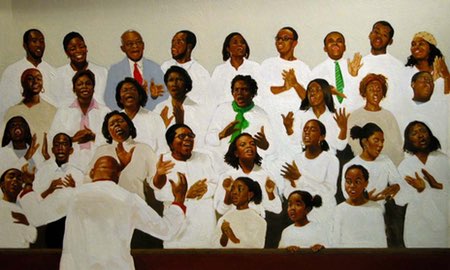

James E. Ransome is an award winning American illustrator of children’s books, with over 60 books — as well as murals, posters editorial illustration and gallery paintings — to his name. He has been awarded the Coretta Scott King and NAACP Image awards, and was named one of 75 authors and illustrators everyone should know by the Children’s Book Council.
Ransome studied illustration at Pratt Institute, and credits prior study of film making and photography with helping to shape his approach. His style is naturalistic, with a nicely fluid feeling to many of his figures. While at Pratt, he encountered well known illustrator Jerry Pinkney, who he now counts as a friend and mentor.
Ransome’s website has galleries of his illustration as well as other paintings and drawings. There are two process videos that show him working with watercolor and with a preliminary drawing. In addition, Ransome is featured in a series of Videos from KidLit TV titled Young at Art, in which he gives demonstrates fundamental art techniques for kids.
Ransome has prints of some of his pieces available on Etsy.
Ransome is married to author Lesa-Cline-Ransome, and has illustrated a number of her biographical children’s titles.
Categories:
-
Eye Candy for Today: Henry Tanner’s Flight Into Egypt


Flight Into Egypt, Henry Ossawa Tanner
Oil on canvas, roughly 29 x 26 inches (74 x 66 cm). Link is to a reasonably large file on Wikimedia Commons; original is in the Metropolitian Museum of Art
As he did in many of his biblically themed canvasses, Tanner brings to bear his uncanny touch with light and shadow to dramatize this scene from the story of the flight of the Holy Family from the assassins of King Herod.
The Metropolitan Museum’s website points out that the story was a favorite of Tanner’s, who related it to the flight of African Americans from persecution in the South. Tanner himself fled the systematic prejudice he encountered as an African American painter, emigrating to France where he found greater acceptance and respect.
There is so much to admire in this piece — the carefully crafted value statement, the shadows playing against the wall, the striking glow of light from the lantern, the repeated forms of the arches and large shadow form, and the wonderfully tactile nature of the paint surface and brush marks, in particular as they define the hard and soft edges of the forms.
Categories:
-
Jerry Pinkney
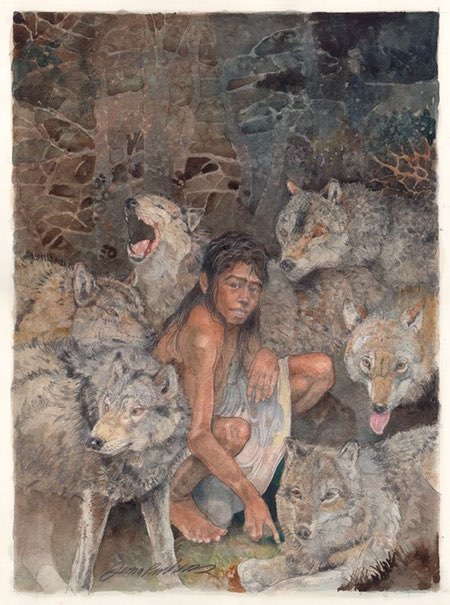

Jerry Pinkney is a renowned American children’s book illustrator and writer — winner of numerous awards including the Caldecott Medal, Caldecott Honors and Corretta Scott King Awards, as well as awards from The New York Times, the Society of Illustrators and others. His illustration credits include over 100 books as well as editorial and institutional illustration.
Pinkney works primarily in watercolor and drawing media. His illustrations often have an appealing feeling of casual looseness that can conceal the solid composition and careful draftsmanship on which they’re based. I particularly enjoy his wonderful use of texture
The Jerry Pinkney Studio website is informative, and has some slideshows of his work in categories like Children’s Books, Illustrated Novels and so on, but it doesn’t make the best showcase for his work.
The best examples I’ve found are on the Norman Rockwell Museum’s Digital Tour of a Jerry Pinkney exhibit: Imaginings. There is an accompanying video of Pinkney speaking, along with other videos, in the “Media” section of the Pinkney Studio site (I can’t give you a direct link because the site is in frames, for reasons that elude me).
There is also a page devoted to Pinkney in the Artists’s listings of the NRM website, that includes some images.
You can find many of his books on Bookshop.org or Amazon.com (affiliate link).
Categories:
-
Edward Mitchell Bannister
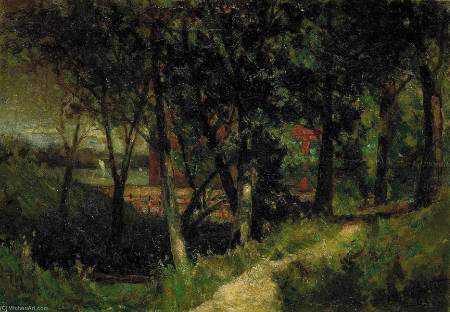

Edward Mitchell Bannister was a Canadian-American painter active in the late 19h century. Born in New Brunswick, he emigrated to the U.S. — initially to Boston — and spent much of his life and career in Providence, Rhode Island.
Though he painted a variety of subjects, Bannister is known primarily for his serene pastoral landscapes, done in the American Tonalist manner.
Bannister had little formal art education, and could not afford to travel to Europe to study like many of his American contemporaries.
For someone self taught, he quickly gained recognition and honors, one of which was a bronze medal for his painting “Under the Oaks” (the current location of which is unknown) at the 1876 Centennial Exposition in Philadelphia. When he went to receive his award, the judges wanted to withdraw the bronze on discovering that Bannister was African American. The other competitors insisted that the award be given as initially judged and he received the bronze medal.
Bannister was a strong supporter of the effort to gain equal rights for African Americans, but chose not to make overt social issues a subject of his painting, preferring instead to focus on a more spiritual sense of harmony and peace.
In keeping with other American Tonalist painters, who were strongly influenced by the painters of the French Barbizon School, Bannister often grouped his masses into strong value shapes, at times so dark as to be almost silhouettes.
It has been suggested that some of Bannisters paintings have grown darker over time. Perhaps this is due to a painting practice, medium or other factor that he might have been discouraged from using if he had access to formal art education; I don’t know.
Bannister’s dark value statements and brusque brush work gave way to a lighter, more Impressionist influenced style later in his career. Bannister was a board member of the Rhode Isand School of Design and a founder of the Providence Art Club.
Categories:
-
Eye Candy for Today: Bierstadt’s Mountain Brook


Mountain Brook, Albert Bierstadt
Oil on canvas, roughly 44 x 36 in (12 x 92 cm), in the collection of the Art Institute of Chicago, whose site includes both a zoomable and downloadable version of the high-res image.
German-American painter Albert Bierstadt, who is associated with both the Hudson River and Rocky Mountain schools of painting, is known primarily for his grand and dramatic vistas of mountains and related landscape, but I find fascination in his more intimate subjects.
In this one — likely an invented scene culled from his trips through the White Mountains in New England — he gives us a tranquil scene of a mountain brook, but alive with a different kind of drama, one of light, shadow and texture.
Categories:




Charley’s Picks
Bookshop.org
(Bookshop.org affilliate links; sales benefit independent bookshop owners; I get a small percentage to help support my work on Lines and Colors)

John Singer Sargent: Watercolors


Urban Sketching: Understanding Perspective


Charley’s Picks
Amazon
(Amazon.com affiliate links; sales go to a larger yacht for Jeff Bezos; but I get a small percentage to help support my work on Lines and Colors)
John Singer Sargent: Watercolors
Urban Sketching: Understanding Perspective