


Categories
- 3d CGI
- Amusements
- Animation
- Anime & Manga
- Art Materials
- Art Videos
- Blogroll
- Cartoons
- Color
- Comics
- Concept & Visual Dev.
- Creativity
- Digital Art
- Digital Painting
- Displaying Art on the Web
- Drawing
- Eye Candy for Today
- Gallery and Museum Art
- High-res Art Images
- Illustration
- Motion Graphics & Flash
- Museums
- Online Museums
- Outsider Art
- Painting
- Painting a Day
- Paleo Art
- Pastel, Conté & Chalk
- Pen & Ink
- Prints and Printmaking
- Reviews
- Sc-fi and Fantasy
- Sculpture & Dimensional
- Site Comments
- Sketching
- Storyboards
- Tools and Techniques
- Uncategorized
- Vector Art
- Videos & Podcasts
- Vision and Optics
- Watercolor and Gouache
- Webcomics
Archives
- August 2026
- July 2026
- June 2026
- May 2026
- April 2026
- March 2026
- February 2026
- January 2026
- December 2025
- November 2025
- October 2025
- September 2025
- August 2025
- July 2025
- June 2025
- May 2025
- January 2025
- December 2024
- November 2024
- October 2024
- September 2024
- August 2024
- June 2024
- April 2024
- March 2024
- February 2024
- January 2024
- December 2023
- November 2023
- October 2023
- September 2023
- August 2023
- July 2023
- May 2023
- April 2023
- March 2023
- February 2023
- January 2023
- December 2022
- November 2022
- September 2022
- August 2022
- July 2022
- June 2022
- May 2022
- April 2022
- March 2022
- February 2022
- January 2022
- December 2021
- November 2021
- October 2021
- September 2021
- August 2021
- July 2021
- June 2021
- May 2021
- April 2021
- March 2021
- February 2021
- January 2021
- December 2020
- November 2020
- October 2020
- September 2020
- August 2020
- July 2020
- June 2020
- May 2020
- April 2020
- March 2020
- February 2020
- January 2020
- December 2019
- November 2019
- October 2019
- September 2019
- August 2019
- July 2019
- June 2019
- May 2019
- April 2019
- March 2019
- February 2019
- January 2019
- December 2018
- November 2018
- October 2018
- September 2018
- August 2018
- July 2018
- June 2018
- May 2018
- April 2018
- March 2018
- February 2018
- January 2018
- December 2017
- November 2017
- October 2017
- September 2017
- August 2017
- July 2017
- June 2017
- May 2017
- April 2017
- March 2017
- February 2017
- January 2017
- December 2016
- November 2016
- October 2016
- September 2016
- August 2016
- July 2016
- June 2016
- May 2016
- April 2016
- March 2016
- February 2016
- January 2016
- December 2015
- November 2015
- October 2015
- September 2015
- August 2015
- July 2015
- June 2015
- May 2015
- April 2015
- March 2015
- February 2015
- January 2015
- December 2014
- November 2014
- October 2014
- September 2014
- August 2014
- July 2014
- June 2014
- May 2014
- April 2014
- March 2014
- February 2014
- January 2014
- December 2013
- November 2013
- October 2013
- September 2013
- August 2013
- July 2013
- June 2013
- May 2013
- April 2013
- March 2013
- February 2013
- January 2013
- December 2012
- November 2012
- October 2012
- September 2012
- August 2012
- July 2012
- June 2012
- May 2012
- April 2012
- March 2012
- February 2012
- January 2012
- December 2011
- November 2011
- October 2011
- September 2011
- August 2011
- July 2011
- June 2011
- May 2011
- April 2011
- March 2011
- February 2011
- January 2011
- December 2010
- November 2010
- October 2010
- September 2010
- August 2010
- July 2010
- June 2010
- May 2010
- April 2010
- March 2010
- February 2010
- January 2010
- December 2009
- November 2009
- October 2009
- September 2009
- August 2009
- July 2009
- June 2009
- May 2009
- April 2009
- March 2009
- February 2009
- January 2009
- December 2008
- November 2008
- October 2008
- September 2008
- August 2008
- July 2008
- June 2008
- May 2008
- April 2008
- March 2008
- February 2008
- January 2008
- December 2007
- November 2007
- October 2007
- September 2007
- August 2007
- July 2007
- June 2007
- May 2007
- April 2007
- March 2007
- February 2007
- January 2007
- December 2006
- November 2006
- October 2006
- September 2006
- August 2006
- July 2006
- June 2006
- May 2006
- April 2006
- March 2006
- February 2006
- January 2006
- December 2005
- November 2005
- October 2005
- September 2005
- August 2005
Relevant Blogs
Art, Painting & Sketch
- Gurney Journey
- Underpaintings
- Art and Influence
- Painting Perceptions
- Oil Painters of America
- Vasari Paint POV
- Flying Fox
- Urban Sketchers
- Bento (Smithsonian)
- Art Inconnu
- The Hidden Place
- Still Life
- Making a Mark
- The Art of the Landscape
- Exploring Color & Creativity
- Art Contrarian
- Artist A Day
- beinArt Surreal Art Collective
- Eye Level
- David Dunlop
- p.i.g.m.e.n.t.i.u.m
- CultureGrrl
- Joaquín Sorolla blog
- Artists in Pastel
“Painting a Day”
- A Painting a Day (Keiser)
- On Painting (Keiser)
- Julian Merrow-Smith
- Karen Jurick
- Jeffrey Hayes
- Carol Marine
- Abbey Ryan
- Daily Paintworks
Other Painting Blogs
- Virtual Gouache Land
- Neil Hollingsworth
- Marc Hanson
- Kevin Menck
- Marc Dalessio
- Larry Seiler
- Stapleton Kearns
- Colin Page
- Roos Schuring
- Hans Versfelt
- Titus Meeuws
- Régis Pettinari
- René Plein Air
- Belinda Del Pesco
- Robin Weiss
- Nathan Fowkes (Land Sketch)
- William Wray
- Frank Serrano
- Stephen Magsig
- Michael Chesley Johnson
- Twice a Week
- Sarah Wimperis
- Rob Adams
- Michael Cole Manley
- The Dirty Palette Club
- Mike Manley’s Draw!
Gallery Art & Illustration mix
Illustration
- Howard Pyle
- 100 Years of Illustration
- BibliOdyssey
- Illustration Art
- Today’s Inspiration
- Illustration Mundo
- Little Chimp Society
- Danny Gregory
- R D (John Martz
- Illustration Friday blog
- Monster Brains
- Illustrators & Illustrations (RU)
- Elwood H. Smith
- DaniDraws.com
- Designers Who Blog
- iSpot Blog
Sci-Fi & Fantasy
Illustration & Comics
Comics & Cartoons
- Comics Beat
- Robot 6
- Newsarama Blog
- Comic Vine
- Comics Alliance
- Forbidden Planet Int.
- Paolo Rivera
- Bolt City
- Flight
- Scott McCloud
- The Comics Journal
- Comixpedia
- Funnybook Babylon
- James Baker
- Middleton’s Sketchbook
- Boneville
- The Hotel Fred
- Paul Rivoche
- Daily Cartoonist
- Mad About Cartoons (William Wray)
- Digital Strips
Illustration & Concept
Animation & Concept
- Cartoon Brew
- Animation Blog
- Cold Hard Flash
- Concept Art World
- The CAB
- FY Concept Art
- Concept Ships
- Concept Robots
- John Nevarez
- Armand Serrano
- Marcos Mateu-Mestre
- all kinds of stuff (Kricfalusi)
- Yacin the faun (Man Arenas)
- Kelsey Mann
- Cre8tivemarks Blog
- Ice-Cream Monster Toon Cafe
- AAU Character & Creature Design
- AAU Animation Notes
- Articles and Texticles
Paleo & Scientific
Tools & Techniques
Other
Lists of Art Blogs
Art Image Resource Links
Historic Art Images
- Wikimedia Commons: Paintings
- Wikimedia Commons: Drawings
- The Athenaeum
- WikiArt (WikiPaintings)
- Google Art Project: Artists
- Google Art Project: Collections (Museums)
- ArtCyclopedia
- Web Gallery of Art
- Art Renewal Center
- Web Gallery of Impressionism
Auction Consolidation sites
Auction sites
- Sotheby’s
- Bonham’s
- Christies
- Heritage Auctions: Fine Art
- Heritage Auctions: Illustration
- Freeman’s Auctions
- Bukowskis
- Shannon’s
Image Search
Reverse Image Search (search by image)
- Tin Eye
- RevImg
- Google Image Search (camera icon)
- Bing Image Search (camera icon)
Promoting some friends and some clients of my website design business
- Twin Willows T’ai Chi studio in Wilmington DE. Taiji classes with Bryan Davis.
- Ray Hayward, Inspired Teacher of T’ai Chi ( Taiji ) in Minneapolis, Founder of Mindful Motion Tai Chi Academy
- OldHead Tattoo studio and Art Gallery in Wilmington DE. Tattoos and paintings by Bruce Gulick
- Sharon Domenico Art, pet portrait oil paintings
- Platinum Paperhanging, wallpaper hanging, Main Line and Philadelphia, PA
- Lisa Stone Design, interior designer, Main Line and Philadelphia, PA
- Studio12KPT, original art, prints, calendars and other custom printed items by Van Sickle & Rolleri
-
Gustave Caillebotte
 Gustave Caillebotte is one of my two favorite “ignored” Impressionists. (The other being Alfred Sisley, who simply doesn’t get the respect he deserves.) Like Sisley, I find Caillebotte to be less formulaic and slavish to the “ideals” of Impressionism, and more likely to paint directly, leaning a bit more toward Courbet’s realism than the “major” Impressionist painters.
Caillebotte was a man of means and was a patron and collector of Impressionist art as well as a painter, and organized (read “financed”) many of the Impressionist exhibitions. He is also credited with introducing Impressionist art to museums by posthumously donating many of the great pieces in his collection to the French government, which accepted the controversial art very reluctantly.
He was also different from the other impressionists in his choice of subject and light conditions. Although he would occasionally paint the kind of sun-drenched countryside and riverbank scenes that were staple subjects for the “painters of light”, Caillebotte often chose a darker palette and was actually more likely to paint landscapes and city scenes in overcast conditions, or even when it was actually raining or snowing, something more common in Japanese and Chinese art at the time than European art.
He also often painted interiors in which, like Degas, he would challenge the formal compositions of the Academic painters by showing a large area of floor and a small area of the rest of the room, as in The Floor Scrapers and The Floor Strippers. Although not the draughtsman that Degas was, his figures and portraits also brought him closer to Degas than to the other Impressionists who did figurative work.
Caillebotte is responsible for some of my very favorite Impressionist images, such as Rooftops under Snow and Riverbank in the Rain (above left). His most widely recognized work depicts a Paris street in the rain; that and the rooftops are usually the only images of his you see in books on Impressionism, if he is mentioned at all.
While he was working Caillebotte was reviled by the art establishment along with the other Impressionist painters. When the art critics finally woke up and realized the power of Impressionist works, he was still dissed off as “minor” and mentioned more as a patron then a painter. Fortunately Caillebotte is receiving renewed interest in recent years from the people who actually matter (i.e. you and I) and the art establishment is sluggishly coming around to recognizing him as the major painter that he was. Who knows, maybe there’s hope for poor Alfred as well.
There is an excellent volume on his life, work and working method, Gustave Caillebotte by Kirk Varnedoe, as well as several other books out there about him. I give several links below to galleries. There are brief bios here and here.
After being dazzled by Monet’s explosions of light and color, it’s easy to miss the quiet, subtle magic that infuses Caillebotte’s paintings. Give him a chance and he’ll wow you with the haunting beauty of subdued light, mist, rain and cloudy skies.
Categories:
-
Virgil Finlay
 Virgil Finlay was one of the greatest science fiction and fantasy artists. He started working for Weird Tales in 1935 and continued to work for that magazine and others for over 35 years. He was a prolific artist and created more than 2,500 images.
Although Finlay created many color cover paintings for magazines, the majority of his images, and what he was renowned for, were stunningly rendered black and white illustrations.
Finlay was a master of pen and ink. Obviously influenced by pen and ink greats like Joseph Clement Coll, Edwin Austin Abbey and Franklin Booth (see my post on Flesk Publications’ volumes on Coll and Booth), he developed his own unique style and range of ink drawing techniques.
Finlay worked in a combination of hatching, the use of small lines to create tone in pen and ink, stipple, the application of hundreds (or thousands) of tiny dots to create an even smoother and almost photorealistic tone, and scratchboard, the application of ink to a clay-coated white board which is then scratched away with a sharp instrument to reveal white lines.
Many artists would work in any one of these techniques; Finlay’s unique approach was to combine them in the same drawing, giving him the ability to utilize an extraordinary range of tone and texture. He was noted in particular for his beautiful and elaborate stipple work.
He also had an amazing range of imagination, his drawings included delicately rendered classical beauty, wild science fiction, startling fantasy and wonderfully rendered astrological images (in the latter part of his career, he did work for several astrology magazines).
The astounding level of detail he lavished on his drawings indicated an intense devotion to his work, particularly given the short deadlines and low pay rates that were characteristic of working for the pulp science fiction magazines.
I give several links at the end of the post, The first is to a gallery of smaller images, but some of his better ones, the other two are to galleries with nice large images. None of them, however, give you the real flavor of Finlay’s extraordinarily fine detail work like a good high-resolution print image can. They also don’t demonstrate the broad range of style and subject matter an don’t include many of his most famous and striking images.
There were some excellent and inexpensive books of his work published in the early ’90s. Though out of print now, they were popular enough that you can find copies on Amazon, eBay, and Alibris.
Here are a few titles in that series: Virgil Finlay’s Strange Science, Virgil Finlay’s Phantasms, Virgil Finlay’s far beyond, Virgil Finlay’s Women of the Ages, and not in the series, but also a nice inexpensive volume of his work for astrology magazines, Virgil Finlay: An Astrology Sketch Book. At the very least, try to find some of his books in a public or university library just to get a glimpse of what his work looks like in print.
You may have gleaned from my attempt to utilize every superlative in my word-box that Finlay is one of my favorite illustrators. I think he is just amazing. If you like pen and ink drawing and/or classic science fiction and fantasy illustration, don’t miss out on Virgil Finlay.
Categories:
-
Creative Latitude: Cat’s fancy
 Designers who blog is a terrific blog that I wrote about back in December. It features blogs by designers, illustrators and others in related disciplines.
Each month DWB author Catherine (cat) Morley picks a number of the blogs that have a common topic and interviews the blog creators.
She then posts the interviews, along with a screenshot from the blogs and sometimes a DWB header with a photo of the blog creator, on her Cat’s fancy column on Creative Latitude, a cooperative site for graphic designers.
This month (February) she is featuring blogs by illustrators. There are several blogs and their creators showcased, including lines and colors and yours truly.
There is also a feature on the popular illustration blog Drawn!, and its primary creator John Martz, which should be of interest to most readers of lines and colors.
Categories:
-
The Zoomquilt
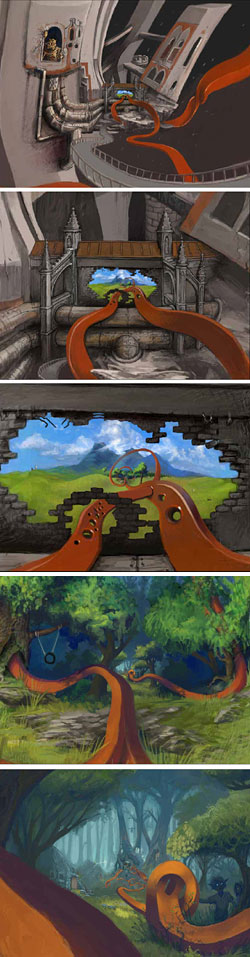 The Zoomquilt is a collaborative art project between 15 artists and a Flash designer.
There is also a non-animated HTML version (offline at the main site, mirror here), but the Flash version is definitely better.
Like Nosepilot, The Zoomquilt is essentially a diversion, a visual toy meant to amuse and entertain, and just maybe make you look at things a little differently.
While Nosepilot has been on the web for at least eight or nine years, I first encountered The Zoomquilt a little over a year ago, so I think it’s relatively new.
The project is the brainchild of German graphic design student Nikolaus Baumgarten. The other artists are listed on the intro page with links (in some cases to their own portfolios, in others to mirrors of The Zoomquilt).
From the intro screen, choose your version (choose Flash) and, as the intro screen explains, click and drag up to move forward, into the image, or click and drag down to move backward, causing the image to recede.
Either way the animation progresses from scene into scene, passing through image elements that serve as portals to the next scene.
The disparate scenes are tied together by a couple of morphing ribbon shapes that you basically follow through the various “worlds”.
The images are bizarre, often grotesque, which I think makes it a little easier to blend the different artists’ styles, and the progression from one scene to the next is nicely done.
The fact that you are controlling the movement adds to the fun. The overall effect is hypnotic.
Categories:
-
Christian Lorenz Scheurer
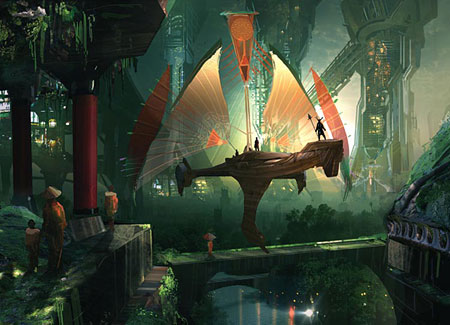
Christian Lorenz Scheurer is a concept artist who has worked on films like The Fifth Element, Titanic, The Matrix, Animatrix, Final Fantasy, What Dreams May Come and The Day After Tomorrow. Born in Switzerland but now living in California, Scheurer initially studied to create graphic novels but realized he wanted to pursue a career in concept art after being struck by lightning (literally).The Movies section of his site has a selection of his concept art for many of the films he has contributed to. The Games section, similarly, has concept art from many of the games he has worked on, including GoldenEye: Rogue Agent, Lord of the Rings: RotK, and Final Fantasy IX. The Paintings section contains some striking images that don’t seem to be tied to a particular project.
The sketchbooks in the Sketches section are a particular treat, filled with flights of fancy in a loose, comics-like drawing style, slightly reminiscent of Moebius at times. This is probably my favorite part of the site and enough to make me wish he had kept up his interest in doing graphic novels. The Characters Sketches section (bottom right link on the Sketches page) has drawn and painted versions of the same sketches side-by side, something I particularly enjoy.
The Projects section has art from several projects, including a fascinating “secret project” (that looks like it may be a theme park installation) and Entropia, Scheurer’s own book project.
Entropia is an art/story book about a fantastic land (called Entropia), packaged as a book about rare stamps from that land. There is a separate and rather elaborate web site devoted to the book.
Scheurer seems to work both digitally in traditional media. He is an instructor in “analog media” (a misuse of the term “analog”, they mean “traditional” media) at Gnomon Workshop, but his instructional DVDs are in digital concept art techniques, such as Introduction to Digital Painting in Adobe Photoshop and Advanced Digital Painting in Adobe Photoshop (which includes the image shown above). Here is his gallery on the Gnomon Workshop site.
There is an extensively illustrated interview with Sheurer in the CG Channel site.
Categories:
-
Olduvai George (Carl Buell)

Olduvai George is a blog title and online identity for natural history illustrator Carl Buell. (The name is a play on Olduvai Gorge, a large ravine in Tanzania where some of the earliest human remains have been found.)Buell has a passionate fascination with animals, living and extinct, although his work has him most often illustrating animals that lived in the last 65 million years (after the disappearance of the dinosaurs). His robust, colorful illustration style uses texture and color relationships to give the animals a real sense of physical presence.
He works in both traditional media and digital painting, working primarily in Photoshop for the latter. You’ll also find work in acrylic posted on the site (image above). Here is his step-by-step walk through of his digital illustration of a mammoth, and a more abbreviated look at the drawings for a color image of a bird.
The links that say “Click here for a larger, more detailed image” link to Buell’s Photostream on Flickr. While it’s nice to be able to leaf through the images that way, and I think there are a few on Flickr not on the blog, the images are disappointingly not much (or any) bigger then the images on the blog. They’re good sized on the blog postings, I would just enjoy seeing more of the details because the images seem rich in detail and texture.
There are both color and black and white illustrations posted on the site. Some of the black and white ones are preparatory drawings for color pieces, some are finished (and nicely rendered) black and white illustrations.
Check out this wonderful black and white landscape, inspired in part by Ansel Adams’ photographic techniques.
Link via John Nack on Adobe and Drawn!.
[Addendum: As of June, 2010 — Buell seems to have abandoned the Olduvai George blog, it’s gone. He has a largely incomplete website that appears to be in the early stages of construction, I don’t know how current it is. In the meanwhile, his Flickr account looks like it’s been updated recently.]
Categories:



Charley’s Picks
Bookshop.org
(Bookshop.org affilliate links; sales benefit independent bookshop owners; I get a small percentage to help support my work on Lines and Colors)
Carlson’s Guide to Landscape Painting
Drawing and Sketching in Pencil

Bridgman’s Complete Guide to Drawing from Life
Charley’s Picks
Amazon
(Amazon.com affiliate links; sales go to a larger yacht for Jeff Bezos; but I get a small percentage to help support my work on Lines and Colors)
Carlson’s Guide to Landscape Painting
Drawing and Sketching in Pencil
Bridgman’s Complete Guide to Drawing from Life