


Categories
- 3d CGI
- Amusements
- Animation
- Anime & Manga
- Art Materials
- Art Videos
- Blogroll
- Cartoons
- Color
- Comics
- Concept & Visual Dev.
- Creativity
- Digital Art
- Digital Painting
- Displaying Art on the Web
- Drawing
- Eye Candy for Today
- Gallery and Museum Art
- High-res Art Images
- Illustration
- Motion Graphics & Flash
- Museums
- Online Museums
- Outsider Art
- Painting
- Painting a Day
- Paleo Art
- Pastel, Conté & Chalk
- Pen & Ink
- Prints and Printmaking
- Reviews
- Sc-fi and Fantasy
- Sculpture & Dimensional
- Site Comments
- Sketching
- Storyboards
- Tools and Techniques
- Uncategorized
- Vector Art
- Videos & Podcasts
- Vision and Optics
- Watercolor and Gouache
- Webcomics
Archives
- May 2026
- April 2026
- March 2026
- February 2026
- January 2026
- December 2025
- November 2025
- October 2025
- September 2025
- August 2025
- July 2025
- June 2025
- May 2025
- January 2025
- December 2024
- November 2024
- October 2024
- September 2024
- August 2024
- June 2024
- April 2024
- March 2024
- February 2024
- January 2024
- December 2023
- November 2023
- October 2023
- September 2023
- August 2023
- July 2023
- May 2023
- April 2023
- March 2023
- February 2023
- January 2023
- December 2022
- November 2022
- September 2022
- August 2022
- July 2022
- June 2022
- May 2022
- April 2022
- March 2022
- February 2022
- January 2022
- December 2021
- November 2021
- October 2021
- September 2021
- August 2021
- July 2021
- June 2021
- May 2021
- April 2021
- March 2021
- February 2021
- January 2021
- December 2020
- November 2020
- October 2020
- September 2020
- August 2020
- July 2020
- June 2020
- May 2020
- April 2020
- March 2020
- February 2020
- January 2020
- December 2019
- November 2019
- October 2019
- September 2019
- August 2019
- July 2019
- June 2019
- May 2019
- April 2019
- March 2019
- February 2019
- January 2019
- December 2018
- November 2018
- October 2018
- September 2018
- August 2018
- July 2018
- June 2018
- May 2018
- April 2018
- March 2018
- February 2018
- January 2018
- December 2017
- November 2017
- October 2017
- September 2017
- August 2017
- July 2017
- June 2017
- May 2017
- April 2017
- March 2017
- February 2017
- January 2017
- December 2016
- November 2016
- October 2016
- September 2016
- August 2016
- July 2016
- June 2016
- May 2016
- April 2016
- March 2016
- February 2016
- January 2016
- December 2015
- November 2015
- October 2015
- September 2015
- August 2015
- July 2015
- June 2015
- May 2015
- April 2015
- March 2015
- February 2015
- January 2015
- December 2014
- November 2014
- October 2014
- September 2014
- August 2014
- July 2014
- June 2014
- May 2014
- April 2014
- March 2014
- February 2014
- January 2014
- December 2013
- November 2013
- October 2013
- September 2013
- August 2013
- July 2013
- June 2013
- May 2013
- April 2013
- March 2013
- February 2013
- January 2013
- December 2012
- November 2012
- October 2012
- September 2012
- August 2012
- July 2012
- June 2012
- May 2012
- April 2012
- March 2012
- February 2012
- January 2012
- December 2011
- November 2011
- October 2011
- September 2011
- August 2011
- July 2011
- June 2011
- May 2011
- April 2011
- March 2011
- February 2011
- January 2011
- December 2010
- November 2010
- October 2010
- September 2010
- August 2010
- July 2010
- June 2010
- May 2010
- April 2010
- March 2010
- February 2010
- January 2010
- December 2009
- November 2009
- October 2009
- September 2009
- August 2009
- July 2009
- June 2009
- May 2009
- April 2009
- March 2009
- February 2009
- January 2009
- December 2008
- November 2008
- October 2008
- September 2008
- August 2008
- July 2008
- June 2008
- May 2008
- April 2008
- March 2008
- February 2008
- January 2008
- December 2007
- November 2007
- October 2007
- September 2007
- August 2007
- July 2007
- June 2007
- May 2007
- April 2007
- March 2007
- February 2007
- January 2007
- December 2006
- November 2006
- October 2006
- September 2006
- August 2006
- July 2006
- June 2006
- May 2006
- April 2006
- March 2006
- February 2006
- January 2006
- December 2005
- November 2005
- October 2005
- September 2005
- August 2005
Relevant Blogs
Art, Painting & Sketch
- Gurney Journey
- Underpaintings
- Art and Influence
- Painting Perceptions
- Oil Painters of America
- Vasari Paint POV
- Flying Fox
- Urban Sketchers
- Bento (Smithsonian)
- Art Inconnu
- The Hidden Place
- Still Life
- Making a Mark
- The Art of the Landscape
- Exploring Color & Creativity
- Art Contrarian
- Artist A Day
- beinArt Surreal Art Collective
- Eye Level
- David Dunlop
- p.i.g.m.e.n.t.i.u.m
- CultureGrrl
- Joaquín Sorolla blog
- Artists in Pastel
“Painting a Day”
- A Painting a Day (Keiser)
- On Painting (Keiser)
- Julian Merrow-Smith
- Karen Jurick
- Jeffrey Hayes
- Carol Marine
- Abbey Ryan
- Daily Paintworks
Other Painting Blogs
- Virtual Gouache Land
- Neil Hollingsworth
- Marc Hanson
- Kevin Menck
- Marc Dalessio
- Larry Seiler
- Stapleton Kearns
- Colin Page
- Roos Schuring
- Hans Versfelt
- Titus Meeuws
- Régis Pettinari
- René Plein Air
- Belinda Del Pesco
- Robin Weiss
- Nathan Fowkes (Land Sketch)
- William Wray
- Frank Serrano
- Stephen Magsig
- Michael Chesley Johnson
- Twice a Week
- Sarah Wimperis
- Rob Adams
- Michael Cole Manley
- The Dirty Palette Club
- Mike Manley’s Draw!
Gallery Art & Illustration mix
Illustration
- Howard Pyle
- 100 Years of Illustration
- BibliOdyssey
- Illustration Art
- Today’s Inspiration
- Illustration Mundo
- Little Chimp Society
- Danny Gregory
- R D (John Martz
- Illustration Friday blog
- Monster Brains
- Illustrators & Illustrations (RU)
- Elwood H. Smith
- DaniDraws.com
- Designers Who Blog
- iSpot Blog
Sci-Fi & Fantasy
Illustration & Comics
Comics & Cartoons
- Comics Beat
- Robot 6
- Newsarama Blog
- Comic Vine
- Comics Alliance
- Forbidden Planet Int.
- Paolo Rivera
- Bolt City
- Flight
- Scott McCloud
- The Comics Journal
- Comixpedia
- Funnybook Babylon
- James Baker
- Middleton’s Sketchbook
- Boneville
- The Hotel Fred
- Paul Rivoche
- Daily Cartoonist
- Mad About Cartoons (William Wray)
- Digital Strips
Illustration & Concept
Animation & Concept
- Cartoon Brew
- Animation Blog
- Cold Hard Flash
- Concept Art World
- The CAB
- FY Concept Art
- Concept Ships
- Concept Robots
- John Nevarez
- Armand Serrano
- Marcos Mateu-Mestre
- all kinds of stuff (Kricfalusi)
- Yacin the faun (Man Arenas)
- Kelsey Mann
- Cre8tivemarks Blog
- Ice-Cream Monster Toon Cafe
- AAU Character & Creature Design
- AAU Animation Notes
- Articles and Texticles
Paleo & Scientific
Tools & Techniques
Other
Lists of Art Blogs
Art Image Resource Links
Historic Art Images
- Wikimedia Commons: Paintings
- Wikimedia Commons: Drawings
- The Athenaeum
- WikiArt (WikiPaintings)
- Google Art Project: Artists
- Google Art Project: Collections (Museums)
- ArtCyclopedia
- Web Gallery of Art
- Art Renewal Center
- Web Gallery of Impressionism
Auction Consolidation sites
Auction sites
- Sotheby’s
- Bonham’s
- Christies
- Heritage Auctions: Fine Art
- Heritage Auctions: Illustration
- Freeman’s Auctions
- Bukowskis
- Shannon’s
Image Search
Reverse Image Search (search by image)
- Tin Eye
- RevImg
- Google Image Search (camera icon)
- Bing Image Search (camera icon)
Promoting some friends and some clients of my website design business
- Twin Willows T’ai Chi studio in Wilmington DE. Taiji classes with Bryan Davis.
- Ray Hayward, Inspired Teacher of T’ai Chi ( Taiji ) in Minneapolis, Founder of Mindful Motion Tai Chi Academy
- OldHead Tattoo studio and Art Gallery in Wilmington DE. Tattoos and paintings by Bruce Gulick
- Sharon Domenico Art, pet portrait oil paintings
- Platinum Paperhanging, wallpaper hanging, Main Line and Philadelphia, PA
- Lisa Stone Design, interior designer, Main Line and Philadelphia, PA
- Studio12KPT, original art, prints, calendars and other custom printed items by Van Sickle & Rolleri
-
New Metropolitan Museum of Art website

The websites of the world’s great art museums, as well as those for numerous smaller museums, serve as a resource both for visitors to the institution and for those who are interested in viewing and accessing online information about the artworks in the museum’s collections.As someone who routinely scours the web in search of great art images, I can testify that art museum websites vary in quality and usefulness on those counts from good to disappointing to appallingly bad. It’s astonishing how many major museums allow their online presence to fall into the latter two categories.
The website for the Metropolitan Museum of Art in New York, one of the world’s great art museums and one that has been fairly adept in its adaptation of modern technology, has always been something of a mixed bag — professional and competent, with lots of information online, some of it very well presented, but with a somewhat clunky search system, some frustrating dead ends, disappointingly small images and an overall feeling that things could somehow be better.
Evidently those responsible for the museum’s website have also been of the opinion that it could be better, and after what is undoubtedly a great deal of thought, planning and hard work, have just unveiled a new website that is likely the best major art museum website in the world.
The redesigned interface is elegant, understated and when presenting the artworks, quietly beautiful. The website has been reorganized, streamlined and made more usable at almost every level.
The new home page, which thankfully dispenses with the pointless splash page from the old site, offers easy access to a number of paths into the site’s contents without overwhelming or confusing the visitor.
The listings for exhibitions are likewise simplified and at the same time more graphically appealing, the search feature is drastically improved and much more useful than its predecessor, and the listings for individual objects are a brilliant combination of clear, uncluttered presentation and easy access to deeper levels of information.
The Heilbrunn Timeline of Art History, an online feature I have written about before, is not dramatically changed, but has been integrated into the other parts of the site more fully, putting this great resource to even better use.
A new MetMedia section collects videos, podcasts and web interactive features into an easy to use central interface.
Best of all perhaps, is the new image enlargement feature, in many cases replacing the disappointingly small images that used to represent the objects at their most detailed with a new full screen image viewer that is lightning fast and a joy to use.
I don’t know if the work was done in-house or by a third party design firm. If the latter, they deserve more recognition than the site gives them, but if the new site was created by museum staff, which I believe is the case, they just handed numerous high-end website design firms their lunch and sent them packing by showing them how a large scale website (of any kind) should be done. [Addendum: Lines and Colors reader Caz was kind enough to inform me that the site was designed by Cogapp, a design firm from Brighton, UK with offices in New York. The also designed the new website for the Barnes Foundation here in Philadelphia. My hat’s off to them.]
In the process there are few trade-offs; the horrible long-string URLs (web page addresses) for individual pages utilized by the old site, which were difficult to copy and paste, send to a friend, or add to an article, have been replaced by short, human-readable addresses. The downside for someone like me is that the dozens, if not hundreds of links I’ve made to the Met’s site over the last 6 years are now broken and have to be replaced, but I’ll gladly accept that for the easier to use addresses going forward.
For those who can physically visit the museum, not only are the exhibition listings and visitor information sections much improved, there is a new zoomable interactive museum map that allows you to pinpoint specific galleries within the museum and explore their contents, as well as suggested itineraries for those who can’t devote a week or two to exploring the museum’s extensive and extraordinarily rich collections.
Exploring the collections and works online is now a genuine pleasure, so much so that I will issue my Major Timesink Warning about visiting.
The elegance, ease of use and intelligent application of sophisticated interface design principles throughout make the new Metropolitan Museum of Art website a shining example that we can only hope many other art museums will aspire to emulate.
There is a press release about the new site here.
Categories:
-
El Mac

Miles ‘Mac’ MacGregor, AKA “El Mac” is an artist based between Los Angeles and Phoenix. He started out painting with acrylics and doing graffiti, moved into murals and developed a focus on faces and portraits, both in a photorealist style and in his unique signature style.He sometimes collaborates with an artist known as Retna who adds abstract lettering and design to Mac’s portraits and faces. Mac’s signature style involves a fascinating use of patterns and lines that simultaneously add texture and definition to the forms, along with gradations, following the form like topographical maps.
Mac’s website has galleries of murals (“spraypaint”), photorealism, acrylic on canvas (“Brushwork”) and pencil drawings. Most of the paintings are accompanied by larger images and detail crops in which you can see the patterns as paint strokes. In addition, there are some photos of Mac working on the paintings that give you an idea of scale.
The scale of his mural images is likewise revealed in supplementary photos that pull back from the wall and show the surrounding environment.
El Mac also maintains a blog with additional images of murals, paintings and work in progress. He states his influences as “…Mexican & Chicano culture of Phoenix and the American Southwest, religious art, pin-up art, graffiti, and a wide range of classic artists such as Caravaggio, Mucha, and Vermeer”.
[Via MetaFilter]
Categories:
-
Museum Day 2011

Museum Day, a day each year on which hundreds of participating museums around the US offer free admission (for those who have gotten tickets in advance), is tomorrow, Saturday, September 24, 2011.The event is sponsored and coordinated by Smithsonian magazine. From the website description:
In the spirit of Smithsonian Museums, who offer free admission everyday, Museum Day is an annual event hosted by Smithsonian magazine in which participating museums across the country open their doors to anyone presenting a Museum Day Ticket…for free.
You must order tickets in advance, which can easily be done online, for one of the participating museums, two tickets per household.
The venues page lets you search for nearby (or distant) participating museums by way of typing in an address, searching a Google Map, or using a drop-down menu to search by state.
For more (and information on the North American Reciprocal Museum Program), see my post on Museum Day 2010.
(Images above, some participating art museums in the NYC area: Morgan Library and Museum, Brooklyn Museum, Newark Museum)
Categories:
-
David Fuhrer

David Fuhrer is a Swiss concept artist, illustrator and designer based in Bern. His website showcases a range of his illustration, design and other images, both fanciful personal projects and more practical work for clients.When visiting his site you can choose between Flash or HTML versions, but in either case, open your browser to full screen as the images scale up with the window, and Fuhrer’s digital paintings are intricately detailed and work on an expansive range of scale.
In both his freeform constructions in which fantastic landscape elements seem to melt and grow in wildly sculptural shapes and his glistening space scenes in which the lights of technological elements dot oddly shaped planes and structures, Fuhrer uses detail to convey a dramatic sense of scale.
I’ve tried to show this with detail crops accompanying each of the images above. Viewing them in large size on his site, however, gives a much better effect.
Fuhrer also has a gallery on Behance Network that includes work not currently on his site.
[Via io9]
Categories:
-
Arcadia Fine Arts Small Works Show

Arcadia Fine Arts is a gallery in New York noted for its devotion to contemporary representational art. The represent a number of artists I have featured here on Lines and Colors.There current exhibition is The Small Works Show, a group show featuring several of the artists they represent, and a good opportunity to sample a cross section of those artists.
There is a slideshow style preview of works in the exhibition on the Arcadia website (best viewed at full screen, toggle at upper right of the interface).
Though the show is ostensibly limited to works under 12×12″ (30x30cm), I noted some in the preview that were larger. Regardless, there is a wonderful selection of work and artists, and more work from most of those artists can be accessed from the listings on the home page of the website.
Note that after the show ends, the link I’ve provided will be to a different show; I don’t think the gallery archives online presentations of previous exhibitions. In that case, just look through the gallery’s regular listing of artists. There are some terrific artists represented here.
The Small Works Show at Arcadia Fine Arts is on view until September 30, 2011.
(Images above: Daniel Adel, Jorge Alberto, Matthew Cornell, Nancy Depew, Robert Libarace, Joahua Suda, Jeremy Lipking, Joseph Todorovich)
Categories:
-
Cherries from Chauvet’s Orchard

Ruth Phillips is an English cellist living Provence, France. She is married to Julian Merrow-Smith, an artist I have written about previously.After Duane Keiser, Merrow-Smith is one of the earliest pioneers of the “painting a day” painter/blogger model of creating small daily paintings and offering them for sale over the internet. He also happens to be one of my favorite contemporary painters. I’ve been following his daily paintings blog, Postcard from Provence, since 2006.
In one of my previous posts about Merrow-Smith, I pointed out that watching the images of his postcard paintings arrive by email day after day, as well as traveling back through time by looking through his extensive archive of previous work (over 1,600 at this point), was particularly appealing because I saw within the series of paintings a story, as the landscapes and the fruits and vegetables gathered from local markets for still life paintings changed with the seasons, and as Merrow-Smith worked, experimented and grew as a painter over time.
Here, then, is another side of that story, along with Phillips’ own, as she works to balance her life as a cellist, a wife, an artist’s assistant, an Englishwoman in Provence, a homeowner and an observer of the life, and lives, around her.
In her book Cherries from Chauvet’s Orchard: A Memoir of Provence, Phillips has given us a verbal parallel to her husband’s postcard sized paintings — small colorful glimpses of other places and other lives.
In succinct, three or four page chapters, she paints vivid short scenes of life in Provence, lives of the villages in which she and her husband have lived, lives of the individuals they have encountered and lives of some of the people who have purchased Merrow-Smith’s paintings.
The latter glimpses are often told in the individuals’ own words, included in italics as chapter beginning or chapter ending quotes. They were gathered in response to a request Phillips sent out for the purchasers to write with short accounts of their particular Merrow-Smith painting or paintings, where they were hung and what they meant in their lives. She received a much more extensive response than expected, from which she culled down selected accounts to season the book.
Each chapter of Cherries is titled as one of Merrow-Smith’s paintings, sometimes directly related to the subject of the chapter, sometimes just in a metaphorical relationship. The quotes, likewise, are sometimes directly and sometimes obliquely related to the subject of the chapter.
Within these short postcard-like glimpses, Phillips manages to tell the story of her relationship with Merrow-Smith, the beginnings of their marriage and their efforts to make an uninhabitable shell of a house in Southern France into a living home and studio against the tide of an arcane rural French bureaucracy, as well as the story of how “the painter who never painted” became an early practitioner of the “painting a day” discipline, and eventually one of the most successful of the painter/bloggers — artists who pioneered the use of the internet to bypass traditional gallery markets and take their work directly to their patrons around the world, even from a small village in rural France with spotty dial-up internet access.
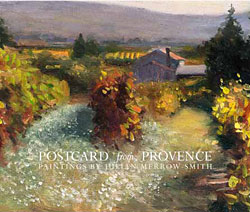 The book, save for its cover, is not illustrated, but the perfect companion volume exists in the form of Merrow-Smith’s beautiful collection Postcard from Provence: Paintings by Julian Merrow-Smith (my review here). Of course, if you already have Postcard from Provence, Cherries from Chauvet’s Orchard makes the perfect companion to that book.
I found it particularly enjoyable to have my copy of Postcard from Provence handy as I read Cherries, and leisurely turn between them, each providing “color” for the other.
Cherries from Chauvet’s Orchard can be ordered directly from Merrow-Smith’s website, as can the Postcard from Provence volume. Both are also available from Amazon, Barnes & Noble and other booksellers in the US and UK (links are provided on the site). You can read a sample of Cherries on fReado.
In addition to her website, Phillips writes two blogs, cello notes and meanwhile (here in France). In the latter, she chronicles her life in Southern France, in some ways providing a continuation and extension of Cherries from Chauvet’s Orchard.
The episodes in the book’s short chapters, some sweet, some sour, are like the eponymous cherries picked from their Provençal neighbor’s orchard. They can be read as a memoir, a love story, a series of character sketches, an account of an artist’s progress or the chronicle of the early stages of a shift in the paradigm of how art is created and sold in the 21st Century. Take your pick.
Categories:




Charley’s Picks
Bookshop.org
(Bookshop.org affilliate links; sales benefit independent bookshop owners; I get a small percentage to help support my work on Lines and Colors)

John Singer Sargent: Watercolors


Urban Sketching: Understanding Perspective


Charley’s Picks
Amazon
(Amazon.com affiliate links; sales go to a larger yacht for Jeff Bezos; but I get a small percentage to help support my work on Lines and Colors)
John Singer Sargent: Watercolors
Urban Sketching: Understanding Perspective