


Categories
- 3d CGI
- Amusements
- Animation
- Anime & Manga
- Art Materials
- Art Videos
- Blogroll
- Cartoons
- Color
- Comics
- Concept & Visual Dev.
- Creativity
- Digital Art
- Digital Painting
- Displaying Art on the Web
- Drawing
- Eye Candy for Today
- Gallery and Museum Art
- High-res Art Images
- Illustration
- Motion Graphics & Flash
- Museums
- Online Museums
- Outsider Art
- Painting
- Painting a Day
- Paleo Art
- Pastel, Conté & Chalk
- Pen & Ink
- Prints and Printmaking
- Reviews
- Sc-fi and Fantasy
- Sculpture & Dimensional
- Site Comments
- Sketching
- Storyboards
- Tools and Techniques
- Uncategorized
- Vector Art
- Videos & Podcasts
- Vision and Optics
- Watercolor and Gouache
- Webcomics
Archives
- May 2026
- April 2026
- March 2026
- February 2026
- January 2026
- December 2025
- November 2025
- October 2025
- September 2025
- August 2025
- July 2025
- June 2025
- May 2025
- January 2025
- December 2024
- November 2024
- October 2024
- September 2024
- August 2024
- June 2024
- April 2024
- March 2024
- February 2024
- January 2024
- December 2023
- November 2023
- October 2023
- September 2023
- August 2023
- July 2023
- May 2023
- April 2023
- March 2023
- February 2023
- January 2023
- December 2022
- November 2022
- September 2022
- August 2022
- July 2022
- June 2022
- May 2022
- April 2022
- March 2022
- February 2022
- January 2022
- December 2021
- November 2021
- October 2021
- September 2021
- August 2021
- July 2021
- June 2021
- May 2021
- April 2021
- March 2021
- February 2021
- January 2021
- December 2020
- November 2020
- October 2020
- September 2020
- August 2020
- July 2020
- June 2020
- May 2020
- April 2020
- March 2020
- February 2020
- January 2020
- December 2019
- November 2019
- October 2019
- September 2019
- August 2019
- July 2019
- June 2019
- May 2019
- April 2019
- March 2019
- February 2019
- January 2019
- December 2018
- November 2018
- October 2018
- September 2018
- August 2018
- July 2018
- June 2018
- May 2018
- April 2018
- March 2018
- February 2018
- January 2018
- December 2017
- November 2017
- October 2017
- September 2017
- August 2017
- July 2017
- June 2017
- May 2017
- April 2017
- March 2017
- February 2017
- January 2017
- December 2016
- November 2016
- October 2016
- September 2016
- August 2016
- July 2016
- June 2016
- May 2016
- April 2016
- March 2016
- February 2016
- January 2016
- December 2015
- November 2015
- October 2015
- September 2015
- August 2015
- July 2015
- June 2015
- May 2015
- April 2015
- March 2015
- February 2015
- January 2015
- December 2014
- November 2014
- October 2014
- September 2014
- August 2014
- July 2014
- June 2014
- May 2014
- April 2014
- March 2014
- February 2014
- January 2014
- December 2013
- November 2013
- October 2013
- September 2013
- August 2013
- July 2013
- June 2013
- May 2013
- April 2013
- March 2013
- February 2013
- January 2013
- December 2012
- November 2012
- October 2012
- September 2012
- August 2012
- July 2012
- June 2012
- May 2012
- April 2012
- March 2012
- February 2012
- January 2012
- December 2011
- November 2011
- October 2011
- September 2011
- August 2011
- July 2011
- June 2011
- May 2011
- April 2011
- March 2011
- February 2011
- January 2011
- December 2010
- November 2010
- October 2010
- September 2010
- August 2010
- July 2010
- June 2010
- May 2010
- April 2010
- March 2010
- February 2010
- January 2010
- December 2009
- November 2009
- October 2009
- September 2009
- August 2009
- July 2009
- June 2009
- May 2009
- April 2009
- March 2009
- February 2009
- January 2009
- December 2008
- November 2008
- October 2008
- September 2008
- August 2008
- July 2008
- June 2008
- May 2008
- April 2008
- March 2008
- February 2008
- January 2008
- December 2007
- November 2007
- October 2007
- September 2007
- August 2007
- July 2007
- June 2007
- May 2007
- April 2007
- March 2007
- February 2007
- January 2007
- December 2006
- November 2006
- October 2006
- September 2006
- August 2006
- July 2006
- June 2006
- May 2006
- April 2006
- March 2006
- February 2006
- January 2006
- December 2005
- November 2005
- October 2005
- September 2005
- August 2005
Relevant Blogs
Art, Painting & Sketch
- Gurney Journey
- Underpaintings
- Art and Influence
- Painting Perceptions
- Oil Painters of America
- Vasari Paint POV
- Flying Fox
- Urban Sketchers
- Bento (Smithsonian)
- Art Inconnu
- The Hidden Place
- Still Life
- Making a Mark
- The Art of the Landscape
- Exploring Color & Creativity
- Art Contrarian
- Artist A Day
- beinArt Surreal Art Collective
- Eye Level
- David Dunlop
- p.i.g.m.e.n.t.i.u.m
- CultureGrrl
- Joaquín Sorolla blog
- Artists in Pastel
“Painting a Day”
- A Painting a Day (Keiser)
- On Painting (Keiser)
- Julian Merrow-Smith
- Karen Jurick
- Jeffrey Hayes
- Carol Marine
- Abbey Ryan
- Daily Paintworks
Other Painting Blogs
- Virtual Gouache Land
- Neil Hollingsworth
- Marc Hanson
- Kevin Menck
- Marc Dalessio
- Larry Seiler
- Stapleton Kearns
- Colin Page
- Roos Schuring
- Hans Versfelt
- Titus Meeuws
- Régis Pettinari
- René Plein Air
- Belinda Del Pesco
- Robin Weiss
- Nathan Fowkes (Land Sketch)
- William Wray
- Frank Serrano
- Stephen Magsig
- Michael Chesley Johnson
- Twice a Week
- Sarah Wimperis
- Rob Adams
- Michael Cole Manley
- The Dirty Palette Club
- Mike Manley’s Draw!
Gallery Art & Illustration mix
Illustration
- Howard Pyle
- 100 Years of Illustration
- BibliOdyssey
- Illustration Art
- Today’s Inspiration
- Illustration Mundo
- Little Chimp Society
- Danny Gregory
- R D (John Martz
- Illustration Friday blog
- Monster Brains
- Illustrators & Illustrations (RU)
- Elwood H. Smith
- DaniDraws.com
- Designers Who Blog
- iSpot Blog
Sci-Fi & Fantasy
Illustration & Comics
Comics & Cartoons
- Comics Beat
- Robot 6
- Newsarama Blog
- Comic Vine
- Comics Alliance
- Forbidden Planet Int.
- Paolo Rivera
- Bolt City
- Flight
- Scott McCloud
- The Comics Journal
- Comixpedia
- Funnybook Babylon
- James Baker
- Middleton’s Sketchbook
- Boneville
- The Hotel Fred
- Paul Rivoche
- Daily Cartoonist
- Mad About Cartoons (William Wray)
- Digital Strips
Illustration & Concept
Animation & Concept
- Cartoon Brew
- Animation Blog
- Cold Hard Flash
- Concept Art World
- The CAB
- FY Concept Art
- Concept Ships
- Concept Robots
- John Nevarez
- Armand Serrano
- Marcos Mateu-Mestre
- all kinds of stuff (Kricfalusi)
- Yacin the faun (Man Arenas)
- Kelsey Mann
- Cre8tivemarks Blog
- Ice-Cream Monster Toon Cafe
- AAU Character & Creature Design
- AAU Animation Notes
- Articles and Texticles
Paleo & Scientific
Tools & Techniques
Other
Lists of Art Blogs
Art Image Resource Links
Historic Art Images
- Wikimedia Commons: Paintings
- Wikimedia Commons: Drawings
- The Athenaeum
- WikiArt (WikiPaintings)
- Google Art Project: Artists
- Google Art Project: Collections (Museums)
- ArtCyclopedia
- Web Gallery of Art
- Art Renewal Center
- Web Gallery of Impressionism
Auction Consolidation sites
Auction sites
- Sotheby’s
- Bonham’s
- Christies
- Heritage Auctions: Fine Art
- Heritage Auctions: Illustration
- Freeman’s Auctions
- Bukowskis
- Shannon’s
Image Search
Reverse Image Search (search by image)
- Tin Eye
- RevImg
- Google Image Search (camera icon)
- Bing Image Search (camera icon)
Promoting some friends and some clients of my website design business
- Twin Willows T’ai Chi studio in Wilmington DE. Taiji classes with Bryan Davis.
- Ray Hayward, Inspired Teacher of T’ai Chi ( Taiji ) in Minneapolis, Founder of Mindful Motion Tai Chi Academy
- OldHead Tattoo studio and Art Gallery in Wilmington DE. Tattoos and paintings by Bruce Gulick
- Sharon Domenico Art, pet portrait oil paintings
- Platinum Paperhanging, wallpaper hanging, Main Line and Philadelphia, PA
- Lisa Stone Design, interior designer, Main Line and Philadelphia, PA
- Studio12KPT, original art, prints, calendars and other custom printed items by Van Sickle & Rolleri
-
Figure Drawing for All it’s Worth, Andrew Loomis

When I was in my late teens, earnestly trying to learn the art and craft of comic book illustration, I stumbled across a find in the dusty shelves of a used bookstore that popped my eyes open and sent me home feeling like I had struck gold.It was a copy of Figure Drawing for All it’s Worth (also here) by Andrew Loomis, and in a way it was gold — a classic instructional art book by a master illustrator that has come to be regarded as a “must-have” by comics artists, illustrators and artists of all kinds, particularly those who must “invent” the figure — draw people in a variety of positions without model or reference.
Those artists, like myself, were lucky to have found a copy. Classic that it is, the book has been out of print for decades, leaving those who understand its worth (if you’ll excuse the expression) wondering when, if ever, the book would be republished.
Used copies in good condition have been selling in the $100 to $200 range (and higher), and though images of the book’s pages have appeared in various places on the internet, they leave much to be desired in comparison to the actual book.
Extracts of Figure Drawing for All its Worth, and its superb companion volume, Drawing the Head and Hands, were published as Drawing: Figures in Action and Drawing: The Head, respectively, from Walter Foster Books some years ago. Large in dimensions and inexpensive, they were worth picking up, but at 32 pages they were more pamphlets than books, representing a small fraction of the original books’ actual content and a poor substitute for the real thing.
So artists were left haunting used bookstores, hoping copies would show up from someone’s attic for which the bookstore owner would not know the value. Having copies of Loomis books became a bit of a status symbol in certain artists’ circles. And why, we would repeatedly ask, have these treasures not been republished?
So it was with a combination of delight and reservation that I responded to the news that Figure Drawing for All its Worth had finally been republished; the question being what kind of treatment it would receive in terms of quality of reproduction.
When I received my review copy of the new edition from Titan Books, not only was I pleased that they have been respectful of the original edition and the importance of the book, I was delighted to see that they have gone well beyond that. This is an absolutely beautiful facsimile edition, superbly reproduced with crisp, beautiful illustrations on softly textured, slightly off-white paper — looking for all the world as if you had just pulled it off the shelf in 1943.
Wow.
Not only that, they have been respectful of the wallets of starving artists everywhere, pricing the hardcover edition at only $40. A steal.
Andrew Loomis was a well respected and influential mid-20th Century illustrator (see my post on the extensive article that appeared in Illustration magazine), but he is better known today for his series of instructional books, of which Figure Drawing for All its Worth and Drawing the Head and Hands are the stars.
Though his instruction is valuable to those studying from life as well as those who are inventing the figure, his emphasis is on constructing the figure, understanding the underlying anatomy and geometry and on perceiving the figure as form, with volume. The figure exists in, and occupies, space. Loomis gives you keys to placing figures in perspective, working with foreshortening, and getting an intuitive grasp of elements of the human body as volumetric forms.
Countless artists (myself included) credit Loomis with opening their eyes to these concepts and revolutionizing their approach to drawing the figure. Loomis has been influential on generations of illustrators and comics artists in particular, as he speaks directly to the challenges they face in constructing figures and placing them in relation to their environment in a variety of positions and views, as well as in dynamic poses showing the figure in motion.
Not only is Loomis knowledgable, insightful and good at conveying what he knows about drawing (which is considerable), his own drawings are elegant, with graceful gestures, economy of notation, fluid lines and crisp rendering.
The combination qualified him to create some of the best art instruction books ever written. Long deserving of being republished, they are as relevant now as they were when first published, if not more so. The text is as sharp and crisp as the drawings, leading you through a course of discovery and offering a solid grounding in the traditional fundamentals of drawing the human form, as well as tips from one of the notable illustrators of the 20th Century.
In short, Figure Drawing for All its Worth is a treasure.
The next best news? Titan is set to release another Loomis Classic, Drawing the Head and Hands, in October!
[Important note: the images of the book interior above are taken from internet scans of older editions and do not give an accurate representation of the superb quality of the illustrations in the new edition.]
Categories:
-
Gabriel Metsu

Just as the attribution of individual artworks changes over time, raising or lowering the fortunes of collectors and museums in the process, the perceived importance of particular artists, and their place in art history, changes as well — depending on who is writing history at the time.Gabriel Metsu was one of the most important and well respected painters of the 17th Century, and remained the star of the Golden Age of Dutch painting well into the 19th. It wasn’t until the early 20th Century that Johannes Vermeer, largely ignored over that time and now held in such high esteem as to approach reverence among some (yours truly included), began to eclipse his contemporary.
Critics in those centuries praised Metsu and wrote of Vermeer as one of his imitators; collectors turned down Vermeers in favor of Metsus, or bought them because they were sold as Metsus.
How history has changed.
Like Vermeer and another contemporary, Pieter de Hooch, Metsu painted scenes of domestic life, often illuminated by light spilling into the room from a window at the very edge of the composition; light that is given a character of its own and a stage of objects and a wall in the room on which to perform.
The other characters, the people in the scenes, also had their parts as actors. Where Vermeer’s luxuriously clad young men an women live in an enigmatic suspension of time, their thoughts and purpose only vaguely hinted at, Metsu was more of an overt storyteller, with clearer emotional suggestions, though his stories were also left largely to the imagination of the viewer.
Man Writing a Letter (above, top) and Woman Reading a Letter (second down) were meant as companion pieces, each suggesting part of the same story. Metsu’s genre scenes spoke to the character of his times, and found wide acceptance among collectors. Vermeer, though a product of his times, was perhaps not indicative of them, and has risen to a higher status in the last 100 years than he found in his own age.
Metsu is receiving renewed attention, however, in part due to an exhibition of 35 of his most highly regarded works organized by the National Gallery of Ireland, Dublin, in cooperation with the Rijksmuseum, Amsterdam and the National Gallery of Art, Washington.
Having been on view in the other two venues, the show is now at the National Gallery in Washington until July 24, 2011. There is a catalog, Gabriel Metsu, Rediscovered Master of the Dutch Golden Age (more here), accompanying the exhibition, and I’ve gathered some reviews and resources below.
Far from being disadvantageous, it may be that comparisons to Vermeer’s work, particularly in paintings like the two at top and Woman with a Sick Child (third down) spark interest among 21st Century art lovers, bringing Metsu back into the light and place in history that he deserves.
[Suggestion courtesy of Eric Lee Smith]
Categories:
-
Judsons Plein Air Journal
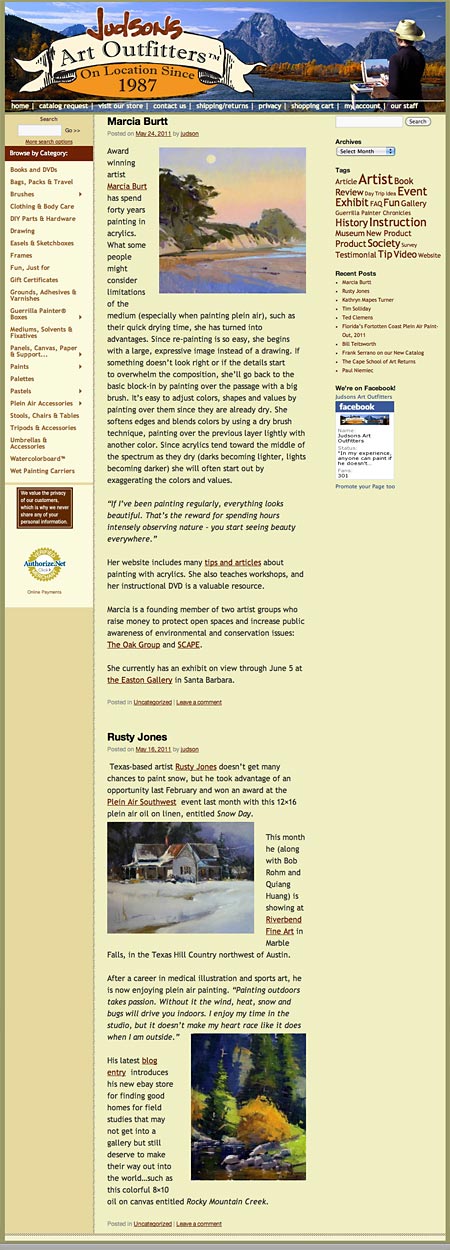
Judsons Art Outfitters is a company that manufactures and sells plein air painting supplies, including a popular line of pochade boxes (see my 2008 post on pochade boxes).Since 2008, they have been maintaining a blog on plein air artists both contemporary and historic, plein air techniques, plein air competitions and other events of interest to plein air painters, and of course, materials.
The blog, titled Judsons Plein Air Journal, inclides short profiles of the featured artists, along with sample images and links to their websites.
In 2010 they moved the blog from its original home on Blogger and integrated it into their main product website. The archives are now on the new site as well, though you may find them easier to browse using the right hand menu bar on the old blog.
Categories:
-
Carter Goodrich

Illustrator, author and character designer Carter Goodrich has a drawing a rendering style that is so springy, energetic and full of lively linework and color, that it’s just a complete joy to look through his portfolio.Even though his website has fairly extensive galleries of his book illustrations, New Yorker covers, editorial illustrations and character design for films like Despicable Me, Ratatouille, Shreck and Finding Nemo, I came away wanting more.
Goodrich’s film work has garnered him multiple AISFA Annie award nominations, and the award itself for his designs for Ratatouille.
His books as author and illustrator include A Creature was Stirring, The Hermit Crab and Say Hello to Zorro.
[Suggestion courtesy of Chris Sheban (see my post on Chris Sheban)]
Categories:
-
Golden: Dutch and Flemish Masterworks from the Van Otterloo Collection

Extraordinary examples of works form the golden era of Dutch and Flemish painting, drawn from what is one of the finest collections still in private hands, are on display at the Peabody Essex Museum in Salem, Massachusetts until June 19, 2011.Golden: Dutch and Flemish Masterworks from the Rose-Marie and Eijk van Otterloo Collection showcases almost 70 works from the collection, the owners of which have been called “the most important collectors you’ve never heard of” by arts writer Judith Dobrzynski.
The section for the exhibit on the museum’s website shows 12 of the paintings. In addition there are two interactive features, accessed from links in the right-hand column, highlighting Jan van der Heyden’s View of the WesterKerk, Amsterdam (image above, second down), and Isaack Kodijck’s Barber-Surgeon Tending a Peasant’s Foot (above, third down).
Contemporary painter Jeffrey Hayes, who I’ve written about previously, was kind enough to let me know about the exhibit. He has an enthusiastic review of it on his site in which he remarks in particular about the two works in the show by Gerritt Dou (image above, top).
The collectors promise that their remarkable collection is destined to be made public at some point, but have not made any announcements about a specific museum that might wind up as home to the works.
(Images above; Gerritt Dou, Jan van der Heyden, Isaack Kodijck, Rembrandt van Rijn, Willem Claesz)
Categories:
-
Jeffrey Catherine Jones, 1944-2011

I was sorry to hear that Jeffrey Catherine Jones died yesterday at the age of 67.Jones, As I reported in my brief 2006 post, was an influential fantasy artist and illustrator who also did comics and gallery art.
Part of The Studio, a renowned group of illustrators and comics artists in the 1970’s that included Barry Windsor-Smith, Berni Wrightson and Michael William Kaluta, Jones had been called “the greatest living painter” by Frank Frazetta.
Jones helped introduce classical art themes into comics, but was primarily known for her atmospheric, painterly and wonderfully textural paintings for fantasy book covers.
There are a couple of collections of Jones’ work that appear to be out of print, but can be found used: The Art of Jeffrey Jones, Jeffrey Jones: A Life in Art and Age of Innocence: The Romantic Art of Jeffrey Jones. There is also a Jeffrey Jones Sketchbook, which is more readily available.
Maria Cabardo has been working on a film about Jones’ life and art titled Better Things: The Life and Choices of Jeffrey Catherine Jones. Her studio, MaCab films, initiated a Kickstarter project to fund the film but it fell short. I believe they are still soliciting donations directly, though I don’t know the current status of the project. There is another clip here.
There is a nice tribute to Jones on the Muddy Colors blog.
Categories:




Charley’s Picks
Bookshop.org
(Bookshop.org affilliate links; sales benefit independent bookshop owners; I get a small percentage to help support my work on Lines and Colors)

John Singer Sargent: Watercolors


Urban Sketching: Understanding Perspective



Charley’s Picks
Amazon
(Amazon.com affiliate links; sales go to a larger yacht for Jeff Bezos; but I get a small percentage to help support my work on Lines and Colors)
John Singer Sargent: Watercolors
Urban Sketching: Understanding Perspective