


Categories
- 3d CGI
- Amusements
- Animation
- Anime & Manga
- Art Materials
- Art Videos
- Blogroll
- Cartoons
- Color
- Comics
- Concept & Visual Dev.
- Creativity
- Digital Art
- Digital Painting
- Displaying Art on the Web
- Drawing
- Eye Candy for Today
- Gallery and Museum Art
- High-res Art Images
- Illustration
- Motion Graphics & Flash
- Museums
- Online Museums
- Outsider Art
- Painting
- Painting a Day
- Paleo Art
- Pastel, Conté & Chalk
- Pen & Ink
- Prints and Printmaking
- Reviews
- Sc-fi and Fantasy
- Sculpture & Dimensional
- Site Comments
- Sketching
- Storyboards
- Tools and Techniques
- Uncategorized
- Vector Art
- Videos & Podcasts
- Vision and Optics
- Watercolor and Gouache
- Webcomics
Archives
- May 2026
- April 2026
- March 2026
- February 2026
- January 2026
- December 2025
- November 2025
- October 2025
- September 2025
- August 2025
- July 2025
- June 2025
- May 2025
- January 2025
- December 2024
- November 2024
- October 2024
- September 2024
- August 2024
- June 2024
- April 2024
- March 2024
- February 2024
- January 2024
- December 2023
- November 2023
- October 2023
- September 2023
- August 2023
- July 2023
- May 2023
- April 2023
- March 2023
- February 2023
- January 2023
- December 2022
- November 2022
- September 2022
- August 2022
- July 2022
- June 2022
- May 2022
- April 2022
- March 2022
- February 2022
- January 2022
- December 2021
- November 2021
- October 2021
- September 2021
- August 2021
- July 2021
- June 2021
- May 2021
- April 2021
- March 2021
- February 2021
- January 2021
- December 2020
- November 2020
- October 2020
- September 2020
- August 2020
- July 2020
- June 2020
- May 2020
- April 2020
- March 2020
- February 2020
- January 2020
- December 2019
- November 2019
- October 2019
- September 2019
- August 2019
- July 2019
- June 2019
- May 2019
- April 2019
- March 2019
- February 2019
- January 2019
- December 2018
- November 2018
- October 2018
- September 2018
- August 2018
- July 2018
- June 2018
- May 2018
- April 2018
- March 2018
- February 2018
- January 2018
- December 2017
- November 2017
- October 2017
- September 2017
- August 2017
- July 2017
- June 2017
- May 2017
- April 2017
- March 2017
- February 2017
- January 2017
- December 2016
- November 2016
- October 2016
- September 2016
- August 2016
- July 2016
- June 2016
- May 2016
- April 2016
- March 2016
- February 2016
- January 2016
- December 2015
- November 2015
- October 2015
- September 2015
- August 2015
- July 2015
- June 2015
- May 2015
- April 2015
- March 2015
- February 2015
- January 2015
- December 2014
- November 2014
- October 2014
- September 2014
- August 2014
- July 2014
- June 2014
- May 2014
- April 2014
- March 2014
- February 2014
- January 2014
- December 2013
- November 2013
- October 2013
- September 2013
- August 2013
- July 2013
- June 2013
- May 2013
- April 2013
- March 2013
- February 2013
- January 2013
- December 2012
- November 2012
- October 2012
- September 2012
- August 2012
- July 2012
- June 2012
- May 2012
- April 2012
- March 2012
- February 2012
- January 2012
- December 2011
- November 2011
- October 2011
- September 2011
- August 2011
- July 2011
- June 2011
- May 2011
- April 2011
- March 2011
- February 2011
- January 2011
- December 2010
- November 2010
- October 2010
- September 2010
- August 2010
- July 2010
- June 2010
- May 2010
- April 2010
- March 2010
- February 2010
- January 2010
- December 2009
- November 2009
- October 2009
- September 2009
- August 2009
- July 2009
- June 2009
- May 2009
- April 2009
- March 2009
- February 2009
- January 2009
- December 2008
- November 2008
- October 2008
- September 2008
- August 2008
- July 2008
- June 2008
- May 2008
- April 2008
- March 2008
- February 2008
- January 2008
- December 2007
- November 2007
- October 2007
- September 2007
- August 2007
- July 2007
- June 2007
- May 2007
- April 2007
- March 2007
- February 2007
- January 2007
- December 2006
- November 2006
- October 2006
- September 2006
- August 2006
- July 2006
- June 2006
- May 2006
- April 2006
- March 2006
- February 2006
- January 2006
- December 2005
- November 2005
- October 2005
- September 2005
- August 2005
Relevant Blogs
Art, Painting & Sketch
- Gurney Journey
- Underpaintings
- Art and Influence
- Painting Perceptions
- Oil Painters of America
- Vasari Paint POV
- Flying Fox
- Urban Sketchers
- Bento (Smithsonian)
- Art Inconnu
- The Hidden Place
- Still Life
- Making a Mark
- The Art of the Landscape
- Exploring Color & Creativity
- Art Contrarian
- Artist A Day
- beinArt Surreal Art Collective
- Eye Level
- David Dunlop
- p.i.g.m.e.n.t.i.u.m
- CultureGrrl
- Joaquín Sorolla blog
- Artists in Pastel
“Painting a Day”
- A Painting a Day (Keiser)
- On Painting (Keiser)
- Julian Merrow-Smith
- Karen Jurick
- Jeffrey Hayes
- Carol Marine
- Abbey Ryan
- Daily Paintworks
Other Painting Blogs
- Virtual Gouache Land
- Neil Hollingsworth
- Marc Hanson
- Kevin Menck
- Marc Dalessio
- Larry Seiler
- Stapleton Kearns
- Colin Page
- Roos Schuring
- Hans Versfelt
- Titus Meeuws
- Régis Pettinari
- René Plein Air
- Belinda Del Pesco
- Robin Weiss
- Nathan Fowkes (Land Sketch)
- William Wray
- Frank Serrano
- Stephen Magsig
- Michael Chesley Johnson
- Twice a Week
- Sarah Wimperis
- Rob Adams
- Michael Cole Manley
- The Dirty Palette Club
- Mike Manley’s Draw!
Gallery Art & Illustration mix
Illustration
- Howard Pyle
- 100 Years of Illustration
- BibliOdyssey
- Illustration Art
- Today’s Inspiration
- Illustration Mundo
- Little Chimp Society
- Danny Gregory
- R D (John Martz
- Illustration Friday blog
- Monster Brains
- Illustrators & Illustrations (RU)
- Elwood H. Smith
- DaniDraws.com
- Designers Who Blog
- iSpot Blog
Sci-Fi & Fantasy
Illustration & Comics
Comics & Cartoons
- Comics Beat
- Robot 6
- Newsarama Blog
- Comic Vine
- Comics Alliance
- Forbidden Planet Int.
- Paolo Rivera
- Bolt City
- Flight
- Scott McCloud
- The Comics Journal
- Comixpedia
- Funnybook Babylon
- James Baker
- Middleton’s Sketchbook
- Boneville
- The Hotel Fred
- Paul Rivoche
- Daily Cartoonist
- Mad About Cartoons (William Wray)
- Digital Strips
Illustration & Concept
Animation & Concept
- Cartoon Brew
- Animation Blog
- Cold Hard Flash
- Concept Art World
- The CAB
- FY Concept Art
- Concept Ships
- Concept Robots
- John Nevarez
- Armand Serrano
- Marcos Mateu-Mestre
- all kinds of stuff (Kricfalusi)
- Yacin the faun (Man Arenas)
- Kelsey Mann
- Cre8tivemarks Blog
- Ice-Cream Monster Toon Cafe
- AAU Character & Creature Design
- AAU Animation Notes
- Articles and Texticles
Paleo & Scientific
Tools & Techniques
Other
Lists of Art Blogs
Art Image Resource Links
Historic Art Images
- Wikimedia Commons: Paintings
- Wikimedia Commons: Drawings
- The Athenaeum
- WikiArt (WikiPaintings)
- Google Art Project: Artists
- Google Art Project: Collections (Museums)
- ArtCyclopedia
- Web Gallery of Art
- Art Renewal Center
- Web Gallery of Impressionism
Auction Consolidation sites
Auction sites
- Sotheby’s
- Bonham’s
- Christies
- Heritage Auctions: Fine Art
- Heritage Auctions: Illustration
- Freeman’s Auctions
- Bukowskis
- Shannon’s
Image Search
Reverse Image Search (search by image)
- Tin Eye
- RevImg
- Google Image Search (camera icon)
- Bing Image Search (camera icon)
Promoting some friends and some clients of my website design business
- Twin Willows T’ai Chi studio in Wilmington DE. Taiji classes with Bryan Davis.
- Ray Hayward, Inspired Teacher of T’ai Chi ( Taiji ) in Minneapolis, Founder of Mindful Motion Tai Chi Academy
- OldHead Tattoo studio and Art Gallery in Wilmington DE. Tattoos and paintings by Bruce Gulick
- Sharon Domenico Art, pet portrait oil paintings
- Platinum Paperhanging, wallpaper hanging, Main Line and Philadelphia, PA
- Lisa Stone Design, interior designer, Main Line and Philadelphia, PA
- Studio12KPT, original art, prints, calendars and other custom printed items by Van Sickle & Rolleri
-
Rembrandt’s Self Portrait as the Apostle Paul

Rembrandt created one of the most extraordinary visual autobiographies in the history of art in the form of over 80 self portraits in paintings, drawings and etchings.At times he used himself as a model for a historical or Biblical subject, in this case as the Apostle Paul, seen with the characteristic manuscript and sword (the hilt of which is visible under his cloak).
Here we see Rembrandt exhibiting his astonishing skill as a painter.
From the deft rough strokes that define the head wrapping to the physical texture of the scumbling on the intensly rendered face, Rembrandt applies shockingly modern contrasts of color and texture, pulling the face from the darkness of the background in a mastery of chiaroscuro second to none (I won’t get into the Rembrandt vs. Caravaggio arguments – grin).
Rembrandt is about 55 here, the painting is dated 1661. It’s interesting to compare this work with some of his other portraits, like this one at his easel eight year later.
You can see more of Rembrandt’s self portraits in a selection here on the Rembrandt van Rijn site created by Jonathan Janson, who is also responsible for the wonderful Essential Vermeer site (see my post on Essential Vermeer).
The original of this work is in the Rijksmuseum in Amsterdam (large version here).
There is a nice book of Rembrandt’s self portraits, Rembrandt by Himself by National Gallery London Publications. You may have to look around a bit to find a copy.
Rembrandt looks weary here; once the most successful and sought after painter in Amsterdam, his fortunes were fading. The year before he was forced to sell his house and etching press and seek more modest accommodations. He had made antagonists of the Painter’s Guild, who had made it difficult for him to ply his skills legally; a problem he circumvented by placing his wife and son as owners of his business; and his latest commission for city hall, granted because the painter originally contracted had died, would be rejected.
Rembrant’s visual autobiography is a tale of both triumph and tragedy; but the telling, the paintings themselves, are undeniable high marks in the history of art.
Categories:
-
Danny van Ryswyk

Danny van Ryswyk is an artist from the Netherlands.When I originally wrote this post he was painting high-chroma, detailed still life subjects using the techniques of the Dutch masters, painting on mahogany wood panels.
In an interesting turn of artistic direction, he is now working in monochromatic digital media in the vein of pop surrealism, using 21st century tech to evoke a feeling of 19th century photography.
The pieces on his blog, of which he is offering limited edition giclée prints, are not yet extensive in number but will undoubtedly be added to over time.
(Note: some pieces should be considered NSFW.)
[Post edited July, 2012]
Categories:
-
Grzegorz Wróbel
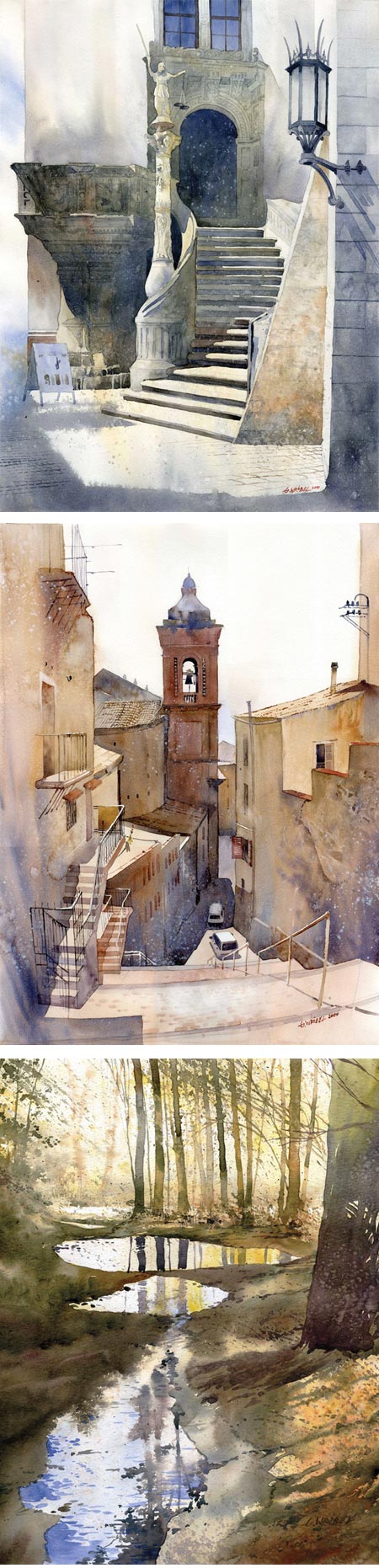
Grzegorz Wróbel is an architectural designer from Poland. He paints street scenes and, as you might expect, architectural subjects, in beautiful crisp watercolor paintings.He evidently developed a drawing and watercolor style for the purpose of architectural presentation, but also engages in watercolor painting of existing scenes, either for his own satisfaction or as gallery art.
Wróbel has a deft command of his medium, painting with clear, fresh color, a beautifully handled mixture of sharp and blurred edges, wonderful applications of subtle texture, and a solid grounding of draftsmanship and composition.
Wróbel knows how to draw the line (so to speak) between too much rendering and just enough, precise drawing and loose interpretation. He has keen eye for selecting the most important elements in an architectural scene and emphasizing those, while producing an overall composition alive with appealing color and value transitions.
For a quick introduction, see this article on Empty Kingdom, which is where I discovered Wróbel. It features several of his images reproduced fairly large.
For more see the extensive galleries on Wróbel’s deviantART page, which apparently serves as his website. There you will find, in addition to his townscapes and street scenes (many of which are linked to larger versions), more traditional landscapes, a few fantasy subjects, figurative work and even paintings of monster trucks.
There are a couple of step-by-step walkthroughs that give some idea of his technique.
Categories:
-
Sci-fi illustrations by Shigeru Komatsuzaki
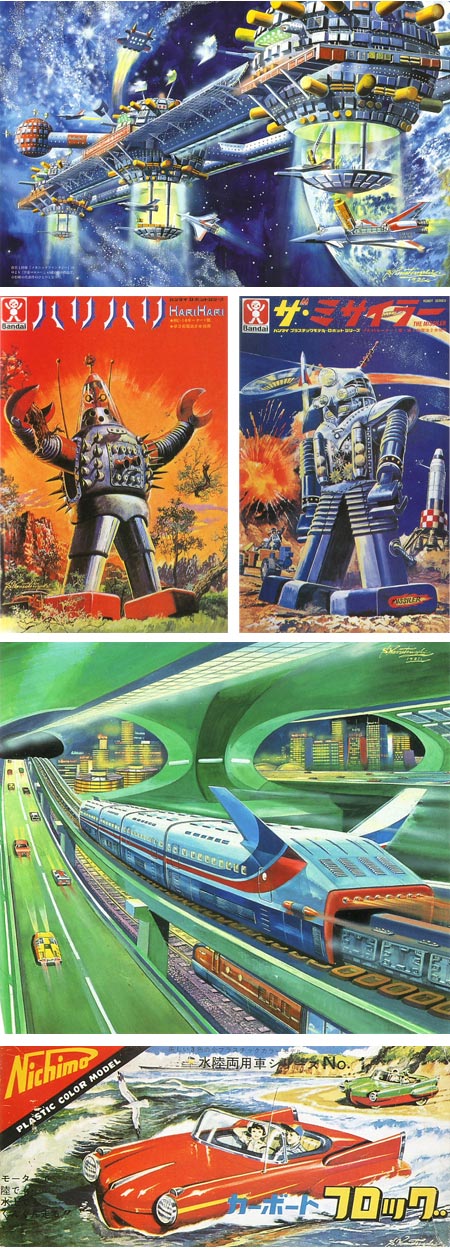
Let us celebrate the wonderful cheesiness and eye-popping kid-allowance-bait futurism of these 1960’s and 70’s magazine and plastic model kit box illustrations by Japanese illustrator Shigeru Komatsuzaki.Giant destroyer robots! Undersea super tunnel! Space Train! Thunderbirds! And, of course “Frog car boat”!
Not only has the Pink Tentacle blog made these marvels available for your edification and amusement, they have provided a small link under each one to a larger image; certain to leave you stupefied in bizarro geeky retro Japanese pop culture wonderment overload.
Yowza!
[Via MetaFilter and Popular Science]
Categories:
-
Telling Stories: Norman Rockwell from the Collections of George Lucas and Steven Spielberg
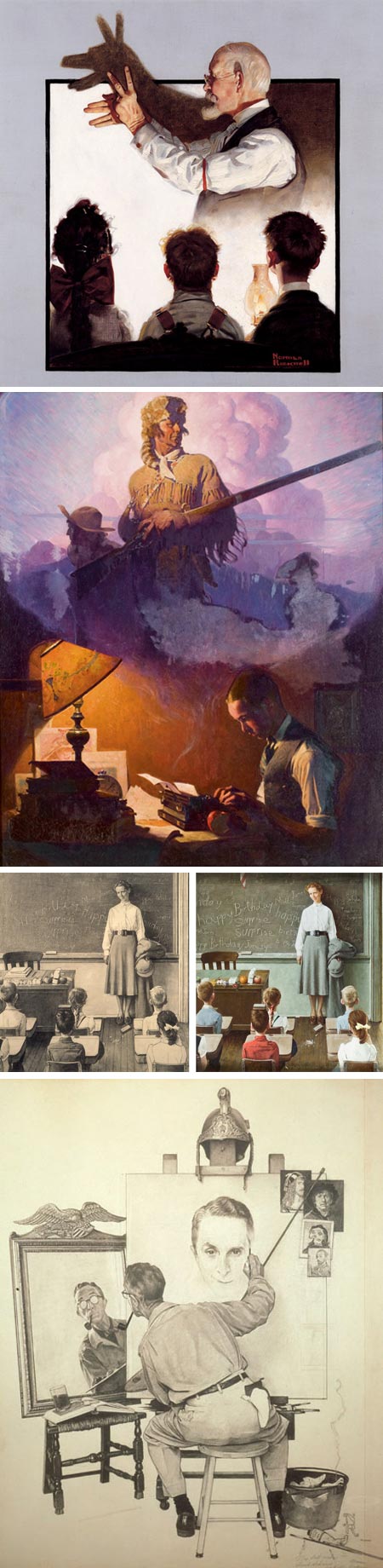
Apparently movie directors George Lucas and Steven Spielberg are both avid collectors of the work of the great American illustrator Norman Rockwell. Unlike those of us who might indulge in a fondness for Rockwell by collecting old Saturday Evening Post covers, Lucas and Spielberg can afford to collect Rockwell’s originals, and have done so extensively.Telling Stories: Norman Rockwell from the Collections of George Lucas and Steven Spielberg is a new exhibition at the Smithsonian American Art Museum in Washington, D.C. that runs from now until January 2, 2011.
The museum has a slideshow on its website (be sure to click on the individual images for the larger versions) that shows the fascinating range of Rockewell’s work represented, from iconically famous works to pieces you just never see. There are also a number of Rockwell’s drawings, some preliminaries for famous works, as well as a painted rough for at least one painting. The slideshow contains almost 60 images.
Both directors, who recognize their role as storytellers, admire Rockwell’s mastery of the power of illustration in telling stores. Spielberg, who conceived of the exhibition and convinced Lucas to join him, said of Rockwell: “He was always on my mind because I had a great deal of respect for how he could tell stories in a single frozen image. Entire stories.”
There is some additional backstory and insight on the exhibition in a review on the New York Times.
Categories:
-
Machinarium
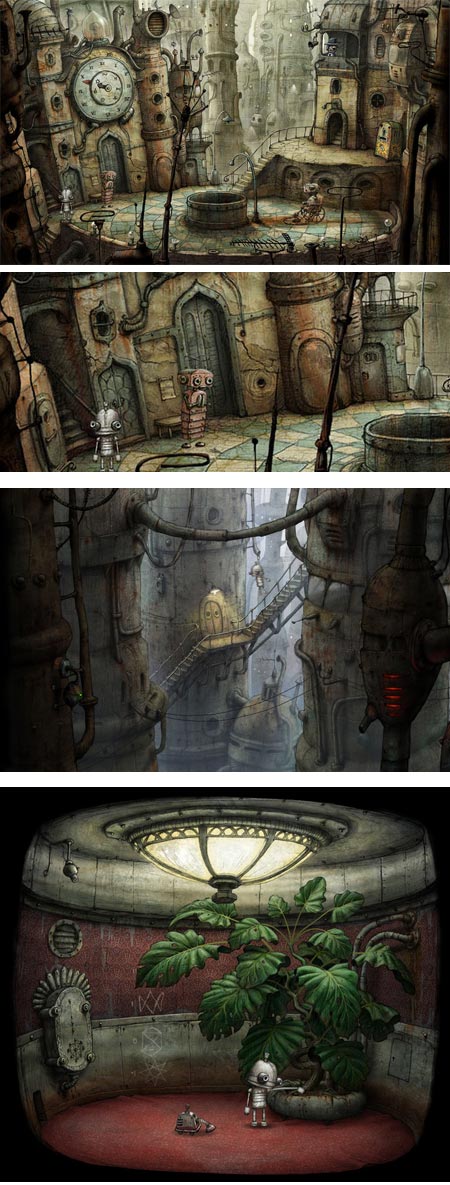
Machinarium is a point-and-click adventure game with a unique look; the product of hand drawn environments and characters by artists from Amanita Design.The game, as far as I understand it, involves moving a small robot through a series of environments in search of something. The images have a wonderful quality of texture, imaginative design and a sense of atmosphere and age.
There is a trailer on the website for the game, and, despite the disclaimer that has been there for months, there is also a playable online demo as well as a downloadable demo available from the Amanita Design Blog.
There are also large wallpaper size images available on the Machinarium site. (I can’t give you direct links because the site is in Flash.)
Last fall, before the game’s release, Boing Boing featured an article with preliminary concept sketches by Jakub Dvorský and Adolf Lachman, as well as finished screen captures from the game.
I believe Adolf Lachman is the lead artist. You can find more of his work here.
Categories:




Charley’s Picks
Bookshop.org
(Bookshop.org affilliate links; sales benefit independent bookshop owners; I get a small percentage to help support my work on Lines and Colors)

John Singer Sargent: Watercolors


Urban Sketching: Understanding Perspective


Charley’s Picks
Amazon
(Amazon.com affiliate links; sales go to a larger yacht for Jeff Bezos; but I get a small percentage to help support my work on Lines and Colors)
John Singer Sargent: Watercolors
Urban Sketching: Understanding Perspective