


Categories
- 3d CGI
- Amusements
- Animation
- Anime & Manga
- Art Materials
- Art Videos
- Blogroll
- Cartoons
- Color
- Comics
- Concept & Visual Dev.
- Creativity
- Digital Art
- Digital Painting
- Displaying Art on the Web
- Drawing
- Eye Candy for Today
- Gallery and Museum Art
- High-res Art Images
- Illustration
- Motion Graphics & Flash
- Museums
- Online Museums
- Outsider Art
- Painting
- Painting a Day
- Paleo Art
- Pastel, Conté & Chalk
- Pen & Ink
- Prints and Printmaking
- Reviews
- Sc-fi and Fantasy
- Sculpture & Dimensional
- Site Comments
- Sketching
- Storyboards
- Tools and Techniques
- Uncategorized
- Vector Art
- Videos & Podcasts
- Vision and Optics
- Watercolor and Gouache
- Webcomics
Archives
- April 2026
- March 2026
- February 2026
- January 2026
- December 2025
- November 2025
- October 2025
- September 2025
- August 2025
- July 2025
- June 2025
- May 2025
- January 2025
- December 2024
- November 2024
- October 2024
- September 2024
- August 2024
- June 2024
- April 2024
- March 2024
- February 2024
- January 2024
- December 2023
- November 2023
- October 2023
- September 2023
- August 2023
- July 2023
- May 2023
- April 2023
- March 2023
- February 2023
- January 2023
- December 2022
- November 2022
- September 2022
- August 2022
- July 2022
- June 2022
- May 2022
- April 2022
- March 2022
- February 2022
- January 2022
- December 2021
- November 2021
- October 2021
- September 2021
- August 2021
- July 2021
- June 2021
- May 2021
- April 2021
- March 2021
- February 2021
- January 2021
- December 2020
- November 2020
- October 2020
- September 2020
- August 2020
- July 2020
- June 2020
- May 2020
- April 2020
- March 2020
- February 2020
- January 2020
- December 2019
- November 2019
- October 2019
- September 2019
- August 2019
- July 2019
- June 2019
- May 2019
- April 2019
- March 2019
- February 2019
- January 2019
- December 2018
- November 2018
- October 2018
- September 2018
- August 2018
- July 2018
- June 2018
- May 2018
- April 2018
- March 2018
- February 2018
- January 2018
- December 2017
- November 2017
- October 2017
- September 2017
- August 2017
- July 2017
- June 2017
- May 2017
- April 2017
- March 2017
- February 2017
- January 2017
- December 2016
- November 2016
- October 2016
- September 2016
- August 2016
- July 2016
- June 2016
- May 2016
- April 2016
- March 2016
- February 2016
- January 2016
- December 2015
- November 2015
- October 2015
- September 2015
- August 2015
- July 2015
- June 2015
- May 2015
- April 2015
- March 2015
- February 2015
- January 2015
- December 2014
- November 2014
- October 2014
- September 2014
- August 2014
- July 2014
- June 2014
- May 2014
- April 2014
- March 2014
- February 2014
- January 2014
- December 2013
- November 2013
- October 2013
- September 2013
- August 2013
- July 2013
- June 2013
- May 2013
- April 2013
- March 2013
- February 2013
- January 2013
- December 2012
- November 2012
- October 2012
- September 2012
- August 2012
- July 2012
- June 2012
- May 2012
- April 2012
- March 2012
- February 2012
- January 2012
- December 2011
- November 2011
- October 2011
- September 2011
- August 2011
- July 2011
- June 2011
- May 2011
- April 2011
- March 2011
- February 2011
- January 2011
- December 2010
- November 2010
- October 2010
- September 2010
- August 2010
- July 2010
- June 2010
- May 2010
- April 2010
- March 2010
- February 2010
- January 2010
- December 2009
- November 2009
- October 2009
- September 2009
- August 2009
- July 2009
- June 2009
- May 2009
- April 2009
- March 2009
- February 2009
- January 2009
- December 2008
- November 2008
- October 2008
- September 2008
- August 2008
- July 2008
- June 2008
- May 2008
- April 2008
- March 2008
- February 2008
- January 2008
- December 2007
- November 2007
- October 2007
- September 2007
- August 2007
- July 2007
- June 2007
- May 2007
- April 2007
- March 2007
- February 2007
- January 2007
- December 2006
- November 2006
- October 2006
- September 2006
- August 2006
- July 2006
- June 2006
- May 2006
- April 2006
- March 2006
- February 2006
- January 2006
- December 2005
- November 2005
- October 2005
- September 2005
- August 2005
Relevant Blogs
Art, Painting & Sketch
- Gurney Journey
- Underpaintings
- Art and Influence
- Painting Perceptions
- Oil Painters of America
- Vasari Paint POV
- Flying Fox
- Urban Sketchers
- Bento (Smithsonian)
- Art Inconnu
- The Hidden Place
- Still Life
- Making a Mark
- The Art of the Landscape
- Exploring Color & Creativity
- Art Contrarian
- Artist A Day
- beinArt Surreal Art Collective
- Eye Level
- David Dunlop
- p.i.g.m.e.n.t.i.u.m
- CultureGrrl
- Joaquín Sorolla blog
- Artists in Pastel
“Painting a Day”
- A Painting a Day (Keiser)
- On Painting (Keiser)
- Julian Merrow-Smith
- Karen Jurick
- Jeffrey Hayes
- Carol Marine
- Abbey Ryan
- Daily Paintworks
Other Painting Blogs
- Virtual Gouache Land
- Neil Hollingsworth
- Marc Hanson
- Kevin Menck
- Marc Dalessio
- Larry Seiler
- Stapleton Kearns
- Colin Page
- Roos Schuring
- Hans Versfelt
- Titus Meeuws
- Régis Pettinari
- René Plein Air
- Belinda Del Pesco
- Robin Weiss
- Nathan Fowkes (Land Sketch)
- William Wray
- Frank Serrano
- Stephen Magsig
- Michael Chesley Johnson
- Twice a Week
- Sarah Wimperis
- Rob Adams
- Michael Cole Manley
- The Dirty Palette Club
- Mike Manley’s Draw!
Gallery Art & Illustration mix
Illustration
- Howard Pyle
- 100 Years of Illustration
- BibliOdyssey
- Illustration Art
- Today’s Inspiration
- Illustration Mundo
- Little Chimp Society
- Danny Gregory
- R D (John Martz
- Illustration Friday blog
- Monster Brains
- Illustrators & Illustrations (RU)
- Elwood H. Smith
- DaniDraws.com
- Designers Who Blog
- iSpot Blog
Sci-Fi & Fantasy
Illustration & Comics
Comics & Cartoons
- Comics Beat
- Robot 6
- Newsarama Blog
- Comic Vine
- Comics Alliance
- Forbidden Planet Int.
- Paolo Rivera
- Bolt City
- Flight
- Scott McCloud
- The Comics Journal
- Comixpedia
- Funnybook Babylon
- James Baker
- Middleton’s Sketchbook
- Boneville
- The Hotel Fred
- Paul Rivoche
- Daily Cartoonist
- Mad About Cartoons (William Wray)
- Digital Strips
Illustration & Concept
Animation & Concept
- Cartoon Brew
- Animation Blog
- Cold Hard Flash
- Concept Art World
- The CAB
- FY Concept Art
- Concept Ships
- Concept Robots
- John Nevarez
- Armand Serrano
- Marcos Mateu-Mestre
- all kinds of stuff (Kricfalusi)
- Yacin the faun (Man Arenas)
- Kelsey Mann
- Cre8tivemarks Blog
- Ice-Cream Monster Toon Cafe
- AAU Character & Creature Design
- AAU Animation Notes
- Articles and Texticles
Paleo & Scientific
Tools & Techniques
Other
Lists of Art Blogs
Art Image Resource Links
Historic Art Images
- Wikimedia Commons: Paintings
- Wikimedia Commons: Drawings
- The Athenaeum
- WikiArt (WikiPaintings)
- Google Art Project: Artists
- Google Art Project: Collections (Museums)
- ArtCyclopedia
- Web Gallery of Art
- Art Renewal Center
- Web Gallery of Impressionism
Auction Consolidation sites
Auction sites
- Sotheby’s
- Bonham’s
- Christies
- Heritage Auctions: Fine Art
- Heritage Auctions: Illustration
- Freeman’s Auctions
- Bukowskis
- Shannon’s
Image Search
Reverse Image Search (search by image)
- Tin Eye
- RevImg
- Google Image Search (camera icon)
- Bing Image Search (camera icon)
Promoting some friends and some clients of my website design business
- Twin Willows T’ai Chi studio in Wilmington DE. Taiji classes with Bryan Davis.
- Ray Hayward, Inspired Teacher of T’ai Chi ( Taiji ) in Minneapolis, Founder of Mindful Motion Tai Chi Academy
- OldHead Tattoo studio and Art Gallery in Wilmington DE. Tattoos and paintings by Bruce Gulick
- Sharon Domenico Art, pet portrait oil paintings
- Platinum Paperhanging, wallpaper hanging, Main Line and Philadelphia, PA
- Lisa Stone Design, interior designer, Main Line and Philadelphia, PA
- Studio12KPT, original art, prints, calendars and other custom printed items by Van Sickle & Rolleri
-
Linda Olafsdottir
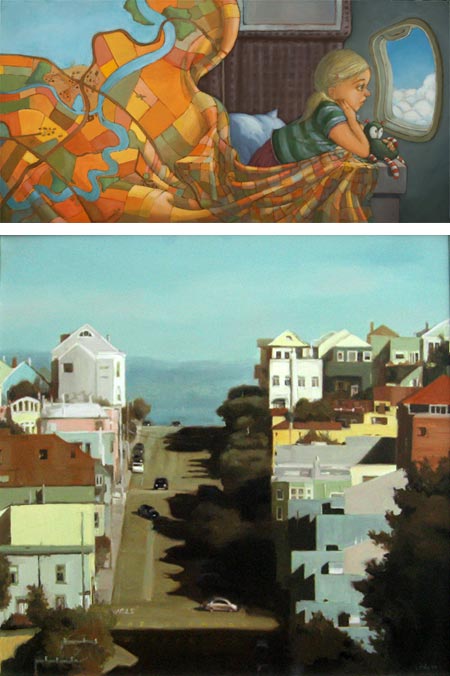
Linda Olafsdottir was born in Reykjavík, Iceland, studied at the Iceland Academy of the Arts, and then moved to San Francisco to study at the Academy of Art University. She now resides in California.Her web site has examples of both her illustration and her gallery paintings, as well as a sketchbook section and a blog.
Olafsdottir’s illustrations have an appealing innocence and charm, and range from sketch-like to more naturalistically rendered. Her gallery painting likewise show a range of approach. I found many of the drawings in her sketchbook particularly appealing.
Her blog includes many preliminary sketches for her finished illustrations, and often puts the images in context with the book project for which they were completed.
Categories:
-
Nancy Friese
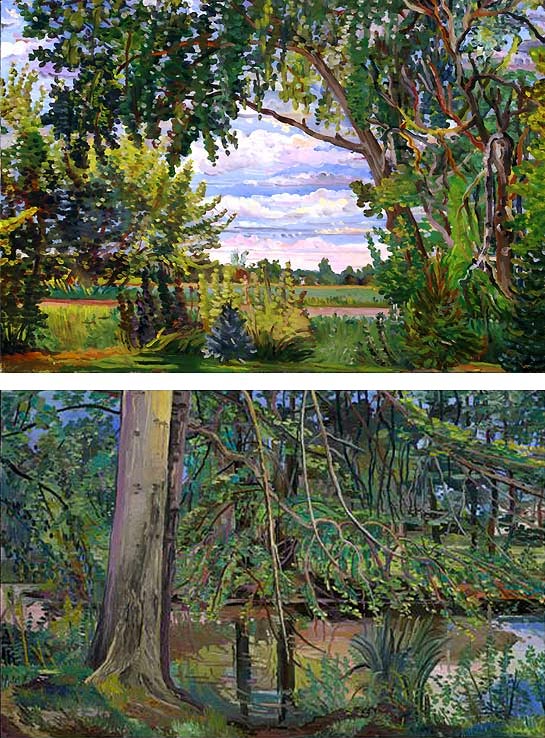
Nancy Friese is a painter and printmaker who studied at the Yale University School of Art, the graduate painting program at the University of California, Berkeley and the Art Academy of Cincinnati. She divides her time between Rhode Island and North Dakota and teaches at Rhode Island School of Design.Her landscape paintings have a bright, almost effervescent feeling of splashes of color, with radiant high-chroma passages contrasted with more subtle hues.
At times her oil paintings have a bit of a feeling of gouache, in areas of color that are perceived as shapes, rather than blended passages or impressionistic dabs.
Her skies are frequently filled with roiling cumulous clouds, glowing with violets and reds. There is often a feeling of motion in her canvasses, not in the sense of depicting objects in motion, but a feeling that the colors themselves are in motion.
The color feels like it is straining against its bounds, as if trying to burst from the canvas, but is securely held in place by her firmly balanced compositions.
One might think from looking at her work that they are studio paintings, but my understanding is that most, if not all, of her canvasses are painted on location; and many of them are large scale.
Her web site has a gallery of oils, as well as a selection of prints and watercolors.
There is a good article about the artist on Painting Perceptions, which is where I encountered her work.
Categories:
-
Matteo Pericoli
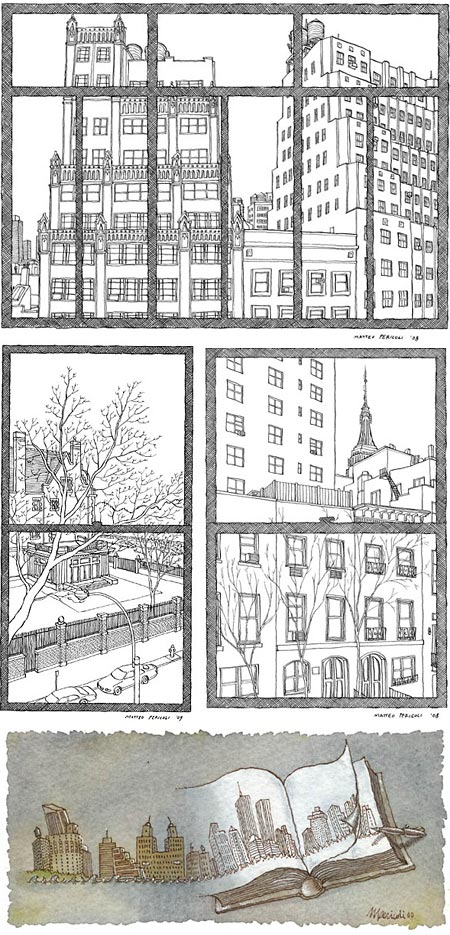
Matteo Pericoli is an Italian architect, illustrator and author. His drawings have appeared in numerous publications, including The New Yorker, The New York Times, Travel and Leisure and Conde Nast Traveller.He is known for his Manhattan Unfurled project, in which he drew two 37 foot (11 meter) long scrolls with detailed skylines of the East and West sides of Manhattan. The drawings took two years and encompassed over 1,500 buildings and 19 bridges.
These were collected into a book, presented as a 24 panel, 22 foot (6.7 meter) long fold-out. You can see a very small scrolling version of them on Pericoli’s web site.
Pericoli also did a 397 foot (121 meter) mural called Skyline of the World for The American Airlines terminal at JFK Airport, depicting an amalgamation of many of the world’s great buildings and skylines.
Pericoli has a new project, also released as a book, The City Out My Window: 63 Views on New York; in which he captures the view, not out of his own window, but out of the windows of notable New York residents, like David Byrne (image above, top), Stephen Colbert, Tom Wolfe, Nora Ephron, Wynton Marsailis, Philip Glass, Annie Leibovitz, Mikail Barishnikov and many others.
Along with his drawings, Pericoli has collected comments from the individuals about their view; many of whom also say that his drawings have caused them to see their familiar view with fresh eyes. There is a pop-up from the link in the title on this page, that shows a few of the drawings and comments.
There is an article and slide show of drawings from the project on the NYT site; and there was a story on Pericoli this morning on the CBS Sunday Morning magazine show.
There is also a selection of other drawings on Pericoli’s web site.
Categories:
-
David Wyatt
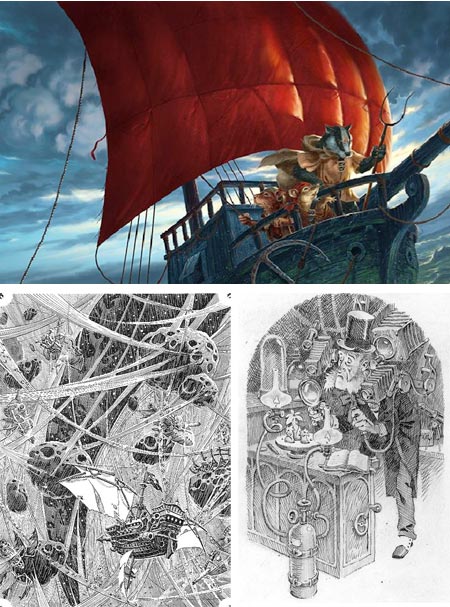
David Wyatt is a UK illustrator known for his fantasy themed work.He has illustrated books by a number of notable authors, including J.R.R. Tolkein, Terry Prachett, Phillip Pullman, Brian Jaques and Diana Wynne Jones.
After a brief bit of comics work on Tharg’s Future Shock for 2000AD, and a stint in a rock band, Wyatt focused on illustration.
He started working in traditional painting and drawing media, moved into digital illustration, and is now returning to occasional work in traditional media.
I was particularly taken with his pen and ink interior illustrations for Phillip Reeve’s Larklight series (images above, bottom). His intricate style is well suited to the “steampunk” settings of an alternate universe in which space travel is taking place in the Victorian era.
The pen and ink style carries over from his illustrations for The Hobbit and Lord of the Rings.
Unfortunately, Wyatt’s web site is a bit awkwardly arranged. There are sections listed at the bottom of the home page graphic, as well as a “current portfolio”, each of which must be entered separately, and browsing is made more difficult by uncooperative JavaScript thumbnail sliders.
Images in the current portfolio are a bit larger than the others, so you may want to start there. It includes work from his latest book project, Peter Pan in Scarlet by Geraldine McCaughrean.
[Addendum: Wyatt has moved his website to: www.davidwyattillustration.com and his blog to: http://davidwyattillustration.wordpress.com and also still maintains a gallery on deviantART.]
[Via Eric Orchard]
Categories:
-
Sandra Allen
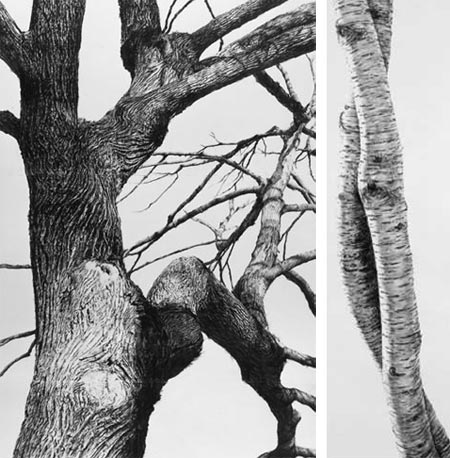
Sandra Allen draws highly detailed and carefully rendered images of individual trees. Her charcoal and pencil drawings are large scale, often 6 feet (1.8meters) in height or more.Allen received a BFA from UMass Dartmouth School of Art and an MFA from Yale University School of Art; and is represented in the collections of the Museum of Fine Arts Boston, The Fogg Art Museum, Harvard University and the Yale University Art Gallery, among others.
In 2001 she started her series of tree drawings which she likens to “portraits”. They are represented without their foliage, and she revels in their structure as revealed by shadows of the forms overlapping other forms.
Her work is currently on exhibit at the New Britain Museum of American Art until January 24, 2010.
Categories:
-
Walter Wick
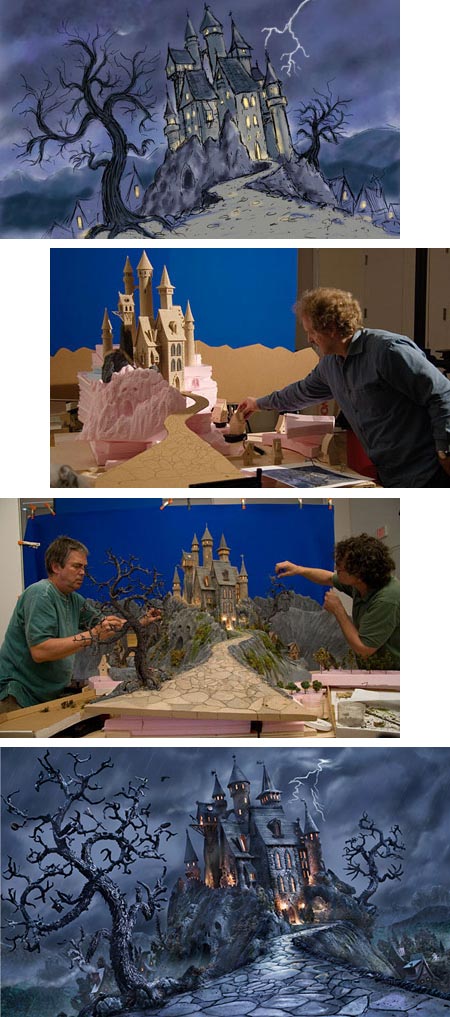
Walter Wick is a photo illustrator and children’s book author, best known for his highly popular “I Spy” and “Can You See What I See” books.Wick works photographically, but instead of taking photographs of real world scenes, he constructs small dioramas, painstakingly designed, intricately crafted and carefully lit, that he then photographs. In a sense, his compositions are sculpted.
Wick starts with a sketch (image above, top), which is the basis for the model, often prepared by model makers out of polyurethane foam, then painted and finished, theatrically lit and photographed. Effects and certain elements, the sky in the case of the image shown here, are digitally painted in Photoshop.
The final images have a quality quite unlike either regular illustration or 3-D CGI. Perhaps the closest analogy is the models used in stop-motion animation, like Coraline.
There is a visual charm inherent in miniature scenes and dioramas that is unique. (I’m particularly fond of it, perhaps because my father, among his other skills, was a museum model maker.)
The Walter Wick site has a “Features” section with many delightful series of photographic mini-essays on how individual illustrations were created; several from each book series, as well as from his latest book, Walter Wick’s Optical Tricks.
There is an exhibit called Walter Wick: Games, Gizmos and Toys in the Attic, organized by the New Britain Museum of Art, that is currently at the Arkell Museum in Canajoharie, New York until February 15, 2010.
Painter, illustrator and blogger James Gurney (see my recent post on Imaginative Realism: How to Paint What Doesn’t Exist) recently had the opportunity to visit Wick’s studio in Connecticut, and reports on the visit in this post on his blog Gurney Journey.
Categories:




Charley’s Picks
Bookshop.org
(Bookshop.org affilliate links; sales benefit independent bookshop owners; I get a small percentage to help support my work on Lines and Colors)

John Singer Sargent: Watercolors


Urban Sketching: Understanding Perspective


Charley’s Picks
Amazon
(Amazon.com affiliate links; sales go to a larger yacht for Jeff Bezos; but I get a small percentage to help support my work on Lines and Colors)
John Singer Sargent: Watercolors
Urban Sketching: Understanding Perspective