


Categories
- 3d CGI
- Amusements
- Animation
- Anime & Manga
- Art Materials
- Art Videos
- Blogroll
- Cartoons
- Color
- Comics
- Concept & Visual Dev.
- Creativity
- Digital Art
- Digital Painting
- Displaying Art on the Web
- Drawing
- Eye Candy for Today
- Gallery and Museum Art
- High-res Art Images
- Illustration
- Motion Graphics & Flash
- Museums
- Online Museums
- Outsider Art
- Painting
- Painting a Day
- Paleo Art
- Pastel, Conté & Chalk
- Pen & Ink
- Prints and Printmaking
- Reviews
- Sc-fi and Fantasy
- Sculpture & Dimensional
- Site Comments
- Sketching
- Storyboards
- Tools and Techniques
- Uncategorized
- Vector Art
- Videos & Podcasts
- Vision and Optics
- Watercolor and Gouache
- Webcomics
Archives
- April 2026
- March 2026
- February 2026
- January 2026
- December 2025
- November 2025
- October 2025
- September 2025
- August 2025
- July 2025
- June 2025
- May 2025
- January 2025
- December 2024
- November 2024
- October 2024
- September 2024
- August 2024
- June 2024
- April 2024
- March 2024
- February 2024
- January 2024
- December 2023
- November 2023
- October 2023
- September 2023
- August 2023
- July 2023
- May 2023
- April 2023
- March 2023
- February 2023
- January 2023
- December 2022
- November 2022
- September 2022
- August 2022
- July 2022
- June 2022
- May 2022
- April 2022
- March 2022
- February 2022
- January 2022
- December 2021
- November 2021
- October 2021
- September 2021
- August 2021
- July 2021
- June 2021
- May 2021
- April 2021
- March 2021
- February 2021
- January 2021
- December 2020
- November 2020
- October 2020
- September 2020
- August 2020
- July 2020
- June 2020
- May 2020
- April 2020
- March 2020
- February 2020
- January 2020
- December 2019
- November 2019
- October 2019
- September 2019
- August 2019
- July 2019
- June 2019
- May 2019
- April 2019
- March 2019
- February 2019
- January 2019
- December 2018
- November 2018
- October 2018
- September 2018
- August 2018
- July 2018
- June 2018
- May 2018
- April 2018
- March 2018
- February 2018
- January 2018
- December 2017
- November 2017
- October 2017
- September 2017
- August 2017
- July 2017
- June 2017
- May 2017
- April 2017
- March 2017
- February 2017
- January 2017
- December 2016
- November 2016
- October 2016
- September 2016
- August 2016
- July 2016
- June 2016
- May 2016
- April 2016
- March 2016
- February 2016
- January 2016
- December 2015
- November 2015
- October 2015
- September 2015
- August 2015
- July 2015
- June 2015
- May 2015
- April 2015
- March 2015
- February 2015
- January 2015
- December 2014
- November 2014
- October 2014
- September 2014
- August 2014
- July 2014
- June 2014
- May 2014
- April 2014
- March 2014
- February 2014
- January 2014
- December 2013
- November 2013
- October 2013
- September 2013
- August 2013
- July 2013
- June 2013
- May 2013
- April 2013
- March 2013
- February 2013
- January 2013
- December 2012
- November 2012
- October 2012
- September 2012
- August 2012
- July 2012
- June 2012
- May 2012
- April 2012
- March 2012
- February 2012
- January 2012
- December 2011
- November 2011
- October 2011
- September 2011
- August 2011
- July 2011
- June 2011
- May 2011
- April 2011
- March 2011
- February 2011
- January 2011
- December 2010
- November 2010
- October 2010
- September 2010
- August 2010
- July 2010
- June 2010
- May 2010
- April 2010
- March 2010
- February 2010
- January 2010
- December 2009
- November 2009
- October 2009
- September 2009
- August 2009
- July 2009
- June 2009
- May 2009
- April 2009
- March 2009
- February 2009
- January 2009
- December 2008
- November 2008
- October 2008
- September 2008
- August 2008
- July 2008
- June 2008
- May 2008
- April 2008
- March 2008
- February 2008
- January 2008
- December 2007
- November 2007
- October 2007
- September 2007
- August 2007
- July 2007
- June 2007
- May 2007
- April 2007
- March 2007
- February 2007
- January 2007
- December 2006
- November 2006
- October 2006
- September 2006
- August 2006
- July 2006
- June 2006
- May 2006
- April 2006
- March 2006
- February 2006
- January 2006
- December 2005
- November 2005
- October 2005
- September 2005
- August 2005
Relevant Blogs
Art, Painting & Sketch
- Gurney Journey
- Underpaintings
- Art and Influence
- Painting Perceptions
- Oil Painters of America
- Vasari Paint POV
- Flying Fox
- Urban Sketchers
- Bento (Smithsonian)
- Art Inconnu
- The Hidden Place
- Still Life
- Making a Mark
- The Art of the Landscape
- Exploring Color & Creativity
- Art Contrarian
- Artist A Day
- beinArt Surreal Art Collective
- Eye Level
- David Dunlop
- p.i.g.m.e.n.t.i.u.m
- CultureGrrl
- Joaquín Sorolla blog
- Artists in Pastel
“Painting a Day”
- A Painting a Day (Keiser)
- On Painting (Keiser)
- Julian Merrow-Smith
- Karen Jurick
- Jeffrey Hayes
- Carol Marine
- Abbey Ryan
- Daily Paintworks
Other Painting Blogs
- Virtual Gouache Land
- Neil Hollingsworth
- Marc Hanson
- Kevin Menck
- Marc Dalessio
- Larry Seiler
- Stapleton Kearns
- Colin Page
- Roos Schuring
- Hans Versfelt
- Titus Meeuws
- Régis Pettinari
- René Plein Air
- Belinda Del Pesco
- Robin Weiss
- Nathan Fowkes (Land Sketch)
- William Wray
- Frank Serrano
- Stephen Magsig
- Michael Chesley Johnson
- Twice a Week
- Sarah Wimperis
- Rob Adams
- Michael Cole Manley
- The Dirty Palette Club
- Mike Manley’s Draw!
Gallery Art & Illustration mix
Illustration
- Howard Pyle
- 100 Years of Illustration
- BibliOdyssey
- Illustration Art
- Today’s Inspiration
- Illustration Mundo
- Little Chimp Society
- Danny Gregory
- R D (John Martz
- Illustration Friday blog
- Monster Brains
- Illustrators & Illustrations (RU)
- Elwood H. Smith
- DaniDraws.com
- Designers Who Blog
- iSpot Blog
Sci-Fi & Fantasy
Illustration & Comics
Comics & Cartoons
- Comics Beat
- Robot 6
- Newsarama Blog
- Comic Vine
- Comics Alliance
- Forbidden Planet Int.
- Paolo Rivera
- Bolt City
- Flight
- Scott McCloud
- The Comics Journal
- Comixpedia
- Funnybook Babylon
- James Baker
- Middleton’s Sketchbook
- Boneville
- The Hotel Fred
- Paul Rivoche
- Daily Cartoonist
- Mad About Cartoons (William Wray)
- Digital Strips
Illustration & Concept
Animation & Concept
- Cartoon Brew
- Animation Blog
- Cold Hard Flash
- Concept Art World
- The CAB
- FY Concept Art
- Concept Ships
- Concept Robots
- John Nevarez
- Armand Serrano
- Marcos Mateu-Mestre
- all kinds of stuff (Kricfalusi)
- Yacin the faun (Man Arenas)
- Kelsey Mann
- Cre8tivemarks Blog
- Ice-Cream Monster Toon Cafe
- AAU Character & Creature Design
- AAU Animation Notes
- Articles and Texticles
Paleo & Scientific
Tools & Techniques
Other
Lists of Art Blogs
Art Image Resource Links
Historic Art Images
- Wikimedia Commons: Paintings
- Wikimedia Commons: Drawings
- The Athenaeum
- WikiArt (WikiPaintings)
- Google Art Project: Artists
- Google Art Project: Collections (Museums)
- ArtCyclopedia
- Web Gallery of Art
- Art Renewal Center
- Web Gallery of Impressionism
Auction Consolidation sites
Auction sites
- Sotheby’s
- Bonham’s
- Christies
- Heritage Auctions: Fine Art
- Heritage Auctions: Illustration
- Freeman’s Auctions
- Bukowskis
- Shannon’s
Image Search
Reverse Image Search (search by image)
- Tin Eye
- RevImg
- Google Image Search (camera icon)
- Bing Image Search (camera icon)
Promoting some friends and some clients of my website design business
- Twin Willows T’ai Chi studio in Wilmington DE. Taiji classes with Bryan Davis.
- Ray Hayward, Inspired Teacher of T’ai Chi ( Taiji ) in Minneapolis, Founder of Mindful Motion Tai Chi Academy
- OldHead Tattoo studio and Art Gallery in Wilmington DE. Tattoos and paintings by Bruce Gulick
- Sharon Domenico Art, pet portrait oil paintings
- Platinum Paperhanging, wallpaper hanging, Main Line and Philadelphia, PA
- Lisa Stone Design, interior designer, Main Line and Philadelphia, PA
- Studio12KPT, original art, prints, calendars and other custom printed items by Van Sickle & Rolleri
-
Peter de Sève (update)

Peter de Sève, a terrific illustrator, New Yorker cover artist and character designer for animated feature films, who I wrote about back in 2006, has a new children’s book (Hooray!), a new blog (double Hooray!) and is the subject of a new monograph (triple Hooray!).The children’s book is The Duchess of Whimsey, written by his wife, Randall de Sève, the blog is called A Sketchy Past, the Art of Peter de Sève, and the monograph is titled the same, A Sketchy Past, the Art of Peter de Sève (look for the link to download a beautiful PDF preview of the book under the images in the right hand column; Amazon link here).
More Hoorays: there is an audio interview with De Sève on Sidebar (look for “Click Here” link at bottom of post), a video interview (conducted by Bobby Chiu) on Imaginism Studios; and word has it that there is a tutorial DVD in the works at Massive Black (no direct info yet).
There is also a nice selection of original art for sale on the Arludik Gallery. The site is unfortunately in frames so I can give you a direct link. Click on his image at top left an follow through the work, drawings first, then color works.
De Sève has a sharp, lively style, springy with confident draftsmanship and sparkling with whimsey. He wields it with aplomb across the range of his endeavors. He deftly captures light, movement, expression and energy in his pen and watercolor pieces, and somehow makes it look easy. His solid background in traditional drawing technique serves him well in his imaginative expressions of wild characters and delightfully loopy animals.
The new book, which I haven’t had the chance to pick up yet, has over 200 pages of full color art, and promises to be a first class treat.
Hooray!
Addendum: Parka, of the always enlightening blog Parka Blogs, was kind enough to point out in this post’s comments the that new monograph is currently available from the publisher, Stuart Ng and Amazon France, and will soon be available from Amazon Canada, but is listed on the U.S. Amazon site with a release date of May, 1010 (go figure).
Categories:
-
Butch Belair

Butch Belair is a photographer and digital artist based in Brooklyn, NY.He indicates that he drew extensively as a child, but lost interest in drawing for a time and only returned to the practice a few years ago. He began to carry a pen and sketchbook and draw his surroundings, and has since added watercolor to his sketching materials.
Belair says he considers drawing his form of meditation, an escape from the stresses of working, and devotes time to it whenever he can.
His watercolor sketches of city scenes, particularly those of row homes or industrial and commercial structures, are wonderful in their contrasts of texture light and shadow.
He takes on complex scenes as a challenge, working immediately in ink and watercolor, without preliminary pencil sketches, on subjects like metal bridgework and elevated train structures.
He now frequently works in 5×8 watercolor sketchbooks and has posted a Flicker stream of his sketches.
Belair also contributes to Urban Sketchers, which is where I encountered his work.
Categories:
-
Don Ivan Punchatz (1936-2009)

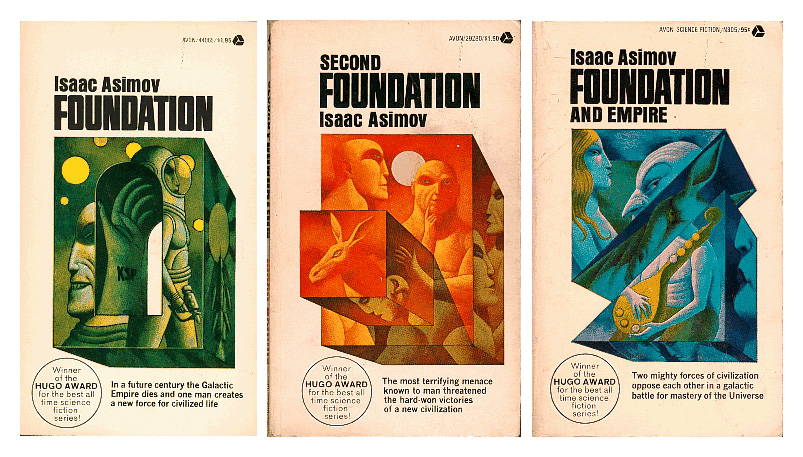
Don Ivan Punchatz was one of the outstanding talents in late 20th Century illustration. It’s unlikely that you have not seen his illustrations somewhere, whether on book covers or in magazines like Time, Newsweek, Playboy, Esquire, Rolling Stone, National Geographic or National Lampoon.Personally, I remember being struck by his cover illustrations for the Avon editions of Isaac Asimov’s Foundation trilogy.
Punchatz had a versatile range, a solid command of painting technique, and a wild imagination. He particularly excelled at conceptual metaphor, carrying complex ideas through in images that had more than one layer of meaning.
Ray Bradbury said of him: “His ability to touch men with acrylic and melt them into beasts, or touch beasts with oil and ink – and: voila! they are senators or brokers – is endlessly stunning. Metaphor, after all, is the universal language. He could teach at Berlitz!”
In addition to his work as an illustrator, Punchatz was influential on other illustrators in a more direct way. He was one of the few to move away from the New York publishing center, and established a studio in Texas that became the model for several others.
Due to the detailed nature of his style, and the difficulty of creating images on deadline, he hired several assistants, and, according to illustrator and comics artist Gary Panter, who was one of them, ran his studio like a Renaissance workshop. As was also the case with Renaissance workshops, many of his assistants went on to become accomplished artists in their own right.
Punchatz taught illustration and graphic design at Texas Christian University and was a guest instructor at Syracuse University. He was also recognized outside of the illustration field, and his work in in the collections of the Dallas Art Museum and the Smithsonian Portrait Gallery.
Don Ivan Punchatz died of cardiac arrest on October 22nd. Unfortunately, I can’t find a major collection of his work online, but I’ve gathered a few sites below that either have bios or examples of his work.
Many are familiar with Punchatz primarily for his famous cover for the hugely popular game Doom, for which he unfortunately turned down royalties, opting instead for a flat fee. Like many freelance artists, Punchatz was not as strong at business as he might have been.
Also like many freelance illustrators and artists, Punchatz was without medical insurance, and his widow is now facing a mountain of medical bills from his hospitalization. Donations can be made to Sandra Punchatz, c/o Lewis Glaser, TCU School of Art, TCU, Box 298000, Fort Worth TX 76129.
[Suggestion and donation address courtesy of Larry Roibal]
(Any of you Republicans out there want to tell me again why you’re conducting this embarrassingly shameful fight to prevent health care reform in the U.S.?)
Addendum: Despite my comment above, I have suspended comments on this post. I simply don’t have time to admin a continuing political debate, as valuable as lively discussion may be. The original post is about Don Ivan Punchatz, and I have let his son Greg close out the discussion in the comments section. -Charley
Categories:
-
Donato Giancola paints “The Mechanic”
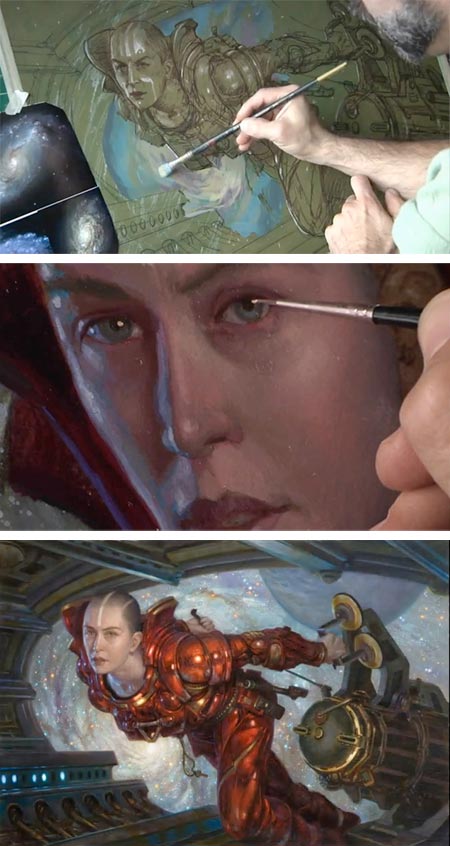
Donato Giancola, the renowned science fiction and fantasy illustrator that I wrote about previously last year and in 2005, has a new instructional DVD (more details here), published by Massive Black Media, in which the camera follows him through the creation of “The Mechanic” (larger version here), an painting that was created specifically for the demonstration.While you might expect a painting developed for an instructional DVD to be more quickly realized than Giancola’s highly finessed professional work, he turns in a work worthy of the 18 Chesley Awards he has garnered, showcasing his strengths not only as an imaginative science fiction artist, but as a strong figurative painter, steeped in the techniques of traditional oil painting.
The demonstration goes from initial sketches to reference photography through the step by step creation of the finished painting. The two disc DVD is $60 and runs 5 hours, but there is a 6 minute+ trailer on YouTube, that is instructive in it’s own right, in addition to giving a good taste of the quality of the DVD.
Giancola presents his thoughts with clarity, explaining his process in some detail, while the director alternates between time-lapse segments, in which some of the more extended periods of painting are condensed, and real-time segments in which the most salient parts of Giancola’s painting process are demonstrated.
Categories:
-
Jon Foster (update 2)

Jon Foster, who I wrote about previously here and here, has a new web site.It is simultaneously wonderful and frustrating. It’s wonderful, of course, because it features even more of Foster’s elegant, painterly, and superbly accomplished illustrations, old and new; and now includes a terrific section of sketches.
It’s frustrating because it simply doesn’t do justice to how good his paintings are. Size and resolution, as they often are in web galleries, are the limitation here. You can certainly get a taste by browsing through the site, but I have to emphasize that it’s worth seeking out his work in print, as I pointed out before.
Unfortunately, both collections of his work are out of print and commanding high prices used, but if you have copies of the Spectrum collections of fantastic art, you may find some Foster treasures in them (I don’t have a list of the particular volumes).
There is a gallery on the Tor.com site that is much more limited than Foster’s site, but has slightly larger images. There is an audio interview with Foster on Sidebar, part 1 and part 2.
[Via The Art Department]
Categories:
-
Chris Ware’s Unmasked
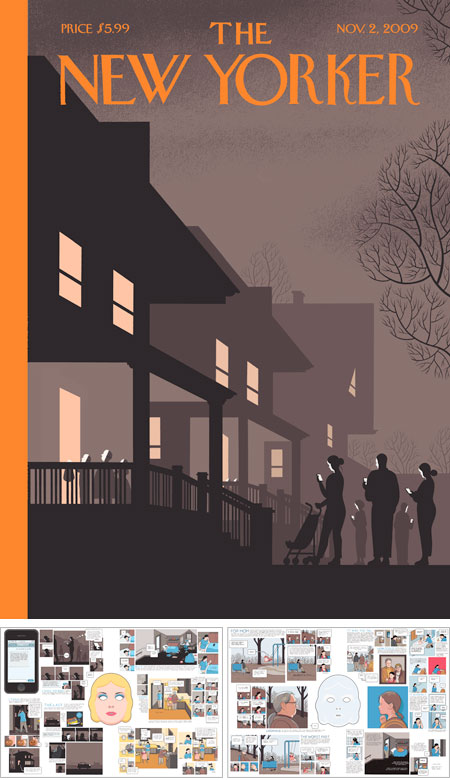
Unmasked is a Halloween themed cover and four page comic story (two double page spreads) for the November 2nd issue of The New Yorker, by Chris Ware.In a fashion Chris Ware fans have come to expect, the hilarious but subtle cover leads seamlessly into the story, a poignant look at generational and family relations, told in his sublime graphic style.
Ware constructs comics in the way a fine woodworker might construct an inlaid box, crafting each element with refined precision, interlocking elements that might seem unrelated to form a unified whole. Notice the parallels between panels in the second two-page spread, the interweaving of the panel designs with the exterior and interior of the masks and the repeated theme of the phone, carried forward form the cover. Also take note of Ware’s superb control of color and his interesting abandonment of perspective for isometric projection in many panels.
Also note that Ware manages to tell a complete short story in four pages, something many contemporary comics writers can’t seem to do in 6 or more 24-page issues.
Beautiful work.
[Via Daring Fireball]
Categories:




Charley’s Picks
Bookshop.org
(Bookshop.org affilliate links; sales benefit independent bookshop owners; I get a small percentage to help support my work on Lines and Colors)

John Singer Sargent: Watercolors


Urban Sketching: Understanding Perspective


Charley’s Picks
Amazon
(Amazon.com affiliate links; sales go to a larger yacht for Jeff Bezos; but I get a small percentage to help support my work on Lines and Colors)
John Singer Sargent: Watercolors
Urban Sketching: Understanding Perspective