


Categories
- 3d CGI
- Amusements
- Animation
- Anime & Manga
- Art Materials
- Art Videos
- Blogroll
- Cartoons
- Color
- Comics
- Concept & Visual Dev.
- Creativity
- Digital Art
- Digital Painting
- Displaying Art on the Web
- Drawing
- Eye Candy for Today
- Gallery and Museum Art
- High-res Art Images
- Illustration
- Motion Graphics & Flash
- Museums
- Online Museums
- Outsider Art
- Painting
- Painting a Day
- Paleo Art
- Pastel, Conté & Chalk
- Pen & Ink
- Prints and Printmaking
- Reviews
- Sc-fi and Fantasy
- Sculpture & Dimensional
- Site Comments
- Sketching
- Storyboards
- Tools and Techniques
- Uncategorized
- Vector Art
- Videos & Podcasts
- Vision and Optics
- Watercolor and Gouache
- Webcomics
Archives
- April 2026
- March 2026
- February 2026
- January 2026
- December 2025
- November 2025
- October 2025
- September 2025
- August 2025
- July 2025
- June 2025
- May 2025
- January 2025
- December 2024
- November 2024
- October 2024
- September 2024
- August 2024
- June 2024
- April 2024
- March 2024
- February 2024
- January 2024
- December 2023
- November 2023
- October 2023
- September 2023
- August 2023
- July 2023
- May 2023
- April 2023
- March 2023
- February 2023
- January 2023
- December 2022
- November 2022
- September 2022
- August 2022
- July 2022
- June 2022
- May 2022
- April 2022
- March 2022
- February 2022
- January 2022
- December 2021
- November 2021
- October 2021
- September 2021
- August 2021
- July 2021
- June 2021
- May 2021
- April 2021
- March 2021
- February 2021
- January 2021
- December 2020
- November 2020
- October 2020
- September 2020
- August 2020
- July 2020
- June 2020
- May 2020
- April 2020
- March 2020
- February 2020
- January 2020
- December 2019
- November 2019
- October 2019
- September 2019
- August 2019
- July 2019
- June 2019
- May 2019
- April 2019
- March 2019
- February 2019
- January 2019
- December 2018
- November 2018
- October 2018
- September 2018
- August 2018
- July 2018
- June 2018
- May 2018
- April 2018
- March 2018
- February 2018
- January 2018
- December 2017
- November 2017
- October 2017
- September 2017
- August 2017
- July 2017
- June 2017
- May 2017
- April 2017
- March 2017
- February 2017
- January 2017
- December 2016
- November 2016
- October 2016
- September 2016
- August 2016
- July 2016
- June 2016
- May 2016
- April 2016
- March 2016
- February 2016
- January 2016
- December 2015
- November 2015
- October 2015
- September 2015
- August 2015
- July 2015
- June 2015
- May 2015
- April 2015
- March 2015
- February 2015
- January 2015
- December 2014
- November 2014
- October 2014
- September 2014
- August 2014
- July 2014
- June 2014
- May 2014
- April 2014
- March 2014
- February 2014
- January 2014
- December 2013
- November 2013
- October 2013
- September 2013
- August 2013
- July 2013
- June 2013
- May 2013
- April 2013
- March 2013
- February 2013
- January 2013
- December 2012
- November 2012
- October 2012
- September 2012
- August 2012
- July 2012
- June 2012
- May 2012
- April 2012
- March 2012
- February 2012
- January 2012
- December 2011
- November 2011
- October 2011
- September 2011
- August 2011
- July 2011
- June 2011
- May 2011
- April 2011
- March 2011
- February 2011
- January 2011
- December 2010
- November 2010
- October 2010
- September 2010
- August 2010
- July 2010
- June 2010
- May 2010
- April 2010
- March 2010
- February 2010
- January 2010
- December 2009
- November 2009
- October 2009
- September 2009
- August 2009
- July 2009
- June 2009
- May 2009
- April 2009
- March 2009
- February 2009
- January 2009
- December 2008
- November 2008
- October 2008
- September 2008
- August 2008
- July 2008
- June 2008
- May 2008
- April 2008
- March 2008
- February 2008
- January 2008
- December 2007
- November 2007
- October 2007
- September 2007
- August 2007
- July 2007
- June 2007
- May 2007
- April 2007
- March 2007
- February 2007
- January 2007
- December 2006
- November 2006
- October 2006
- September 2006
- August 2006
- July 2006
- June 2006
- May 2006
- April 2006
- March 2006
- February 2006
- January 2006
- December 2005
- November 2005
- October 2005
- September 2005
- August 2005
Relevant Blogs
Art, Painting & Sketch
- Gurney Journey
- Underpaintings
- Art and Influence
- Painting Perceptions
- Oil Painters of America
- Vasari Paint POV
- Flying Fox
- Urban Sketchers
- Bento (Smithsonian)
- Art Inconnu
- The Hidden Place
- Still Life
- Making a Mark
- The Art of the Landscape
- Exploring Color & Creativity
- Art Contrarian
- Artist A Day
- beinArt Surreal Art Collective
- Eye Level
- David Dunlop
- p.i.g.m.e.n.t.i.u.m
- CultureGrrl
- Joaquín Sorolla blog
- Artists in Pastel
“Painting a Day”
- A Painting a Day (Keiser)
- On Painting (Keiser)
- Julian Merrow-Smith
- Karen Jurick
- Jeffrey Hayes
- Carol Marine
- Abbey Ryan
- Daily Paintworks
Other Painting Blogs
- Virtual Gouache Land
- Neil Hollingsworth
- Marc Hanson
- Kevin Menck
- Marc Dalessio
- Larry Seiler
- Stapleton Kearns
- Colin Page
- Roos Schuring
- Hans Versfelt
- Titus Meeuws
- Régis Pettinari
- René Plein Air
- Belinda Del Pesco
- Robin Weiss
- Nathan Fowkes (Land Sketch)
- William Wray
- Frank Serrano
- Stephen Magsig
- Michael Chesley Johnson
- Twice a Week
- Sarah Wimperis
- Rob Adams
- Michael Cole Manley
- The Dirty Palette Club
- Mike Manley’s Draw!
Gallery Art & Illustration mix
Illustration
- Howard Pyle
- 100 Years of Illustration
- BibliOdyssey
- Illustration Art
- Today’s Inspiration
- Illustration Mundo
- Little Chimp Society
- Danny Gregory
- R D (John Martz
- Illustration Friday blog
- Monster Brains
- Illustrators & Illustrations (RU)
- Elwood H. Smith
- DaniDraws.com
- Designers Who Blog
- iSpot Blog
Sci-Fi & Fantasy
Illustration & Comics
Comics & Cartoons
- Comics Beat
- Robot 6
- Newsarama Blog
- Comic Vine
- Comics Alliance
- Forbidden Planet Int.
- Paolo Rivera
- Bolt City
- Flight
- Scott McCloud
- The Comics Journal
- Comixpedia
- Funnybook Babylon
- James Baker
- Middleton’s Sketchbook
- Boneville
- The Hotel Fred
- Paul Rivoche
- Daily Cartoonist
- Mad About Cartoons (William Wray)
- Digital Strips
Illustration & Concept
Animation & Concept
- Cartoon Brew
- Animation Blog
- Cold Hard Flash
- Concept Art World
- The CAB
- FY Concept Art
- Concept Ships
- Concept Robots
- John Nevarez
- Armand Serrano
- Marcos Mateu-Mestre
- all kinds of stuff (Kricfalusi)
- Yacin the faun (Man Arenas)
- Kelsey Mann
- Cre8tivemarks Blog
- Ice-Cream Monster Toon Cafe
- AAU Character & Creature Design
- AAU Animation Notes
- Articles and Texticles
Paleo & Scientific
Tools & Techniques
Other
Lists of Art Blogs
Art Image Resource Links
Historic Art Images
- Wikimedia Commons: Paintings
- Wikimedia Commons: Drawings
- The Athenaeum
- WikiArt (WikiPaintings)
- Google Art Project: Artists
- Google Art Project: Collections (Museums)
- ArtCyclopedia
- Web Gallery of Art
- Art Renewal Center
- Web Gallery of Impressionism
Auction Consolidation sites
Auction sites
- Sotheby’s
- Bonham’s
- Christies
- Heritage Auctions: Fine Art
- Heritage Auctions: Illustration
- Freeman’s Auctions
- Bukowskis
- Shannon’s
Image Search
Reverse Image Search (search by image)
- Tin Eye
- RevImg
- Google Image Search (camera icon)
- Bing Image Search (camera icon)
Promoting some friends and some clients of my website design business
- Twin Willows T’ai Chi studio in Wilmington DE. Taiji classes with Bryan Davis.
- Ray Hayward, Inspired Teacher of T’ai Chi ( Taiji ) in Minneapolis, Founder of Mindful Motion Tai Chi Academy
- OldHead Tattoo studio and Art Gallery in Wilmington DE. Tattoos and paintings by Bruce Gulick
- Sharon Domenico Art, pet portrait oil paintings
- Platinum Paperhanging, wallpaper hanging, Main Line and Philadelphia, PA
- Lisa Stone Design, interior designer, Main Line and Philadelphia, PA
- Studio12KPT, original art, prints, calendars and other custom printed items by Van Sickle & Rolleri
-
Rudolph Zallinger
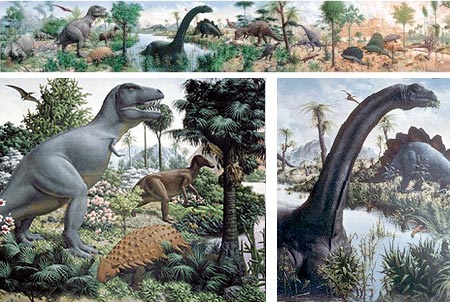
I’ve wanted to do a post on Rudolph Zallinger for some time, but I keep putting it off in the hope that more of his work will be posted on the web. Unfortunately, that doesn’t seem to be happening. I may still be able to make some people who aren’t already familiar with him aware of his work, even if I can’t show you a great deal of it.Zallinger was one of the pioneers of of paleontological art, perhaps second only to Charles R. Knight in that respect. Zallinger is best known for his stunning 110×16′ (33.5×4.9m) mural, The Age of Reptiles, that covers the entire east wall of the Yale Peabody Museum’s Great Hall (watermarked poster version here).
The mural depicts the evolution of life on earth over 300 million years, with different sections, separated by the visual device of foreground trees, for geologic periods. It was painted with egg tempera in the fresco secco method; meaning “dry plaster”, as opposed to the more familiar traditional method of painting with into wet plaster (buon fresco) as practiced by Michelangelo for his frescos in the Sistine Chapel.
Rudolph Franz Zallinger was born in Irkutsk, Siberia to Austrian and Polish parents. They eventually emigrated to the U.S. and settled in Seattle where Rudolph was raised. His early interest in art was encouraged; and at age 17 he started study at Yale University’s School of Fine Arts on a merit scholarship as a painting major, and was also trained in illustration. He taught at the school after graduating.
He also started doing some scientific illustration and his talents were noticed by the director of the Yale Peabody Museum, who approached him about the possibility of doing a mural on the museum’s east wall.
Zallinger undertook a six month crash course in prehistoric plant and animal life and comparative anatomy with scientists from Yale and Harvard, and spent a year and a half creating preliminary studies and sketches before commencing work on the mural, which took three and a half years. The museum appointed him “artist in residence” a post he held for the remainder of his life.
Life magazine commissioned Zallenger for a series of illustrations and covers depicting prehistoric life, and his work also appeared in several books, notably The World We Live In, culled from the Life magazine articles, and The Giant Golden Book of Dinosaurs and Other Prehistoric Reptiles (which I still have my treasured copy of — look for it used, see a preview here).
One of his commissions for the magazine was later expanded into a new mural at the Yale Peabody Museum of Natural History as The Age of Mammals, depicting prehistoric mammals that, though they don’t get the same press, are every bit as wonderfully weird as the dinosaurs.
The past is always changing, particularly the distant past, as new information is brought to light. Knight’s active, leaping dinosaurs were replaced by Zallinger’s slow, gravity-bound behemoths, which were based on the prevailing scientific theories of the time. In them you’ll see the classic upright, tail dragging stance of tyrannosaurs, and elongated sauropods semi-submerded to support their weight, that were characteristic of mid-20th Century paleo art. It was Zallinger, in fact, who set the standards for that art, the artistic component of which has seldom, if ever, been matched.
Since then, the continued revision of our vision of the past has gone back to more lively dinosaurs with very different interpretations of anatomical reconstruction (which some modern paleo artists carry too far, indulging in fanciful depictions of 5 ton tyrannosaurs sprinting like leopards and brachiosaurs rearing on their hind legs in defiance of physics and bio mechanics).
The Yale Alumni Magazine commissioned contemporary artist Alan Male to create a virtual update of Zallinger’s mural, showing the animals in a more modern interpretation.
As anachronistic as they may seem in light of modern interpretations of dinosaurs, Zallinger’s inspired visions still have an uncommon visual power, unlike any paleontological artist before or since. They are now best appreciated as artworks, and powerfully evocative artworks. Zallinger studied traditional painting techniques and his paintings of dinosaurs look as though they are the interpretation of a Renaissance master, which I find just an amazingly great combination.
Reportedly Daniel Varney Thompson, the most authoritative translator of Cennino Cennini’s 15th-century classic The Art of Painting, on seeing The Age of Reptiles nearing completion, stated: “That wall is the most important since the 15th Century”.
Unfortunately, the Peabody Yale site is a bit confusingly organized; and, though it has information about the murals, including podcasts by contemporary scientists on the subject, and an article on the making of the mural by Zallinger himself; it is disappointing shy on images. They seem so desperately paranoid that someone will print a low-res version on a T-shirt or something, that they would apparently rather let Zallinger languish in obscurity than give the web audience a taste of how fantastic his work was.
Though I have never seen the actual murals (they’re high on my list whenever I get to Massachusetts), I have had the privilege of seeing a small (perhaps 12×50″) preparatory painting for the larger work.
I simply love the feeling in Zallinger’s work, his Renaissance flavored visions of steamy prehistoric jungles where hulking, leather skinned giants lashed at one another in slow motion fury under storm-darkened skies — wonderful stuff.
Categories:
-
Chris Sprouse

Chris Sprouse is an American comics artist whose clean elegant drawing style lies somewhere between the open line styles of European comics and the more heavily rendered styles common in American mainstream comics.Sprouse is most noted for his work on Alan Moore’s Tom Strong, a comics series that combined some of the best elements of Lee/Kirby stories for The Fantastic Four, the early Challengers of the Unknown comics and the Doc Savage pulp novels.
The series was wonderfully fun and beautifully drawn, and Sprouse was the perfect choice to bring it to life. It was, in fact, designed around his predilections. Moore fashioned all of the titles in his ABC comics line around his co-creators strengths and drawing styles. In Sprouse’s case, that meant lots of high-tech gadgets, spaceships, and a robust family of characters. Sprouse garnered two Eisner awards for his work on the series. The image above shows one of his covers for the series in pencilled and finished form.
Unlike the tendency on the part of a lot of superhero artists to go over the top in trying to make their characters look “super”, Sprouse stays grounded in a more naturalistic portrayal of people, giving his stories an extra feeling of realism, in spite of the delightful degree of lively stylization in his drawing style. His figures, in particular, have the kind of power-under-the-surface feeling you see in athletes, as opposed to the too-musclebound-to-do-anything-but-grimace style all too common in superhero comics.
Sprouse has also worked for other major comics companies on titles like Legionnaires, Supreme and Midnighter. He drew a Star Wars story for Dark Horse, Star Wars: Splinter in the Mind’s Eye, and an under-appreciated science fiction graphic story called Ocean with Warren Ellis. His most recent project was Wildstorm’s Number of the Beast, written by Scott Beatty.
As far as I can determine, Sprouse does not have a web site or blog, so I’ve dug up what resources I can find. There is an unofficial gallery of his work on Comic Art Community.
Addendum: Johnny Bacardi was kind enough to write and let us know that Sprouse does, in fact, have a blog. (Thanks!)
Categories:
-
“Painting a Day” Blogs (Round 7)
 I’ve been reporting on the “Painting a Day” phenomenon since well before it was a phenomenon, since my initial 2005 post on Duane Keiser (left); who originated the practice in its commonly understood form of painting one small painting each day and posting it on a blog, usually also offering it for sale.
The demands of the practice frequently encourage artists to paint small still life subjects of objects close at hand, fruit, china, painting supplies and so on, but a number of painters focus more on landscape and painting en plein air, so I’ll concentrate on some of those for this round. These painters usually work a little larger than the daily painters who focus on still life, roughly 8×10″ (20x25cm) instead of 6×8″ (15x20cm).
Though Keiser largely concentrates on still life, he does paint landscape, and I like to mention him in these posts.
Here are some other daily painters who concentrate more on landscape than on still life.
 John K. Harrell is a Denver based painter. His subjects include the Colorado countryside, as well as paintings from his travels in the U.S. and Europe. Harrell has a nice economy of notation, in which impressionist handling is used for areas like foliage and textured surfaces where broken color is most effective; but like the American Impressionist painters from the turn of the last century he has not locked himself into rendering everything with short strokes, allowing larger areas of color to predominate when appropriate.
While most daily painters work in oil, Harrell works in acrylic and occasionally pastel. He seems to be using thickened acrylics, though, as they have a feeling of surface texture and brush strokes. Harrell also is a participant in the Daily Impressionist Painters group blog and has a dedicated web site that features his larger and more finished work.
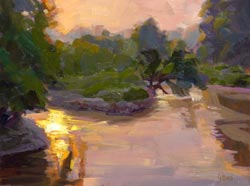 Christopher Greco is a daily painter who paints primarily en plein air. His loose, painterly handling of landscape subjects is particularly effective, I think, in his paintings of small creeks and streams.
He also paints landscapes with structures in them, like houses, barns, garages and storefronts, where his succinct brushwork defines their forms in a series of brief strokes. Greco makes a point of saying that he doesn’t “edit” his work, in that every painting is posted, so that we see his daily progress as he experiments and grows as a painter.
 Edward B. Gordon is a painter from Germany and has been practicing the painting a day regimen for longer than most, since November of 2006, and credits Duane Keiser with his impetus to begin the practice. He posts small paintings of a variety of subjects including figures, landscapes and still life.
He has a nicely angular approach to brushwork, laying in individual brush strokes that serve to define a plane. Unfortunately, his posted images are a bit small, leaving me wishing there were lager versions in addition, though he does occasionally post detail images of some of them.
Note: he has some kind of Flash map/comment widget running in his sidebar that my copy of Safari momentarily choked on. Your milage may vary.
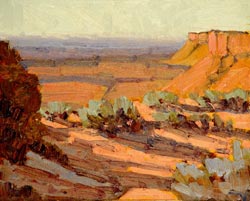 George Coll lives in Colorado and his daily paintings are of the mountainous landscape surrounding him. Coll treks from his two acre property out into the back country with with 2 pack llamas carrying his supplies (now that’s different). His location paintings are often in the muted tones of daylight softened by the shadows of the mountains, accented with brilliant light on distant peaks.
He also paints figures and town scenes and his blog will occasionally feature images of his larger works, done in the studio from his location sketches. Coll also has a web site that showcases his larger finished work.
 Candy Barr is a painter from Vermont who frequently paints landscapes. Her paintings are sometimes very straightforward in their color palette and at other times “pushed” into brighter, almost expressionistic color.
She also has a web site on which you will find her larger pantings. Of particular interest are her “floaters“, images of nude figures floating in water.
Categories:
-
More Gustav Tenggren treasures from ASIFA

The indefatigable archivists at the ASIFA-Hollywood Animation Archive continue to amaze, amuse, entertain and enlighten us with great examples of Golden Age illustration that are being added to their database.Notably, they have added to their considerable reserve of dazzlingly beautiful illustrations by Gustaf Tenggren, an underappreciated Swedish illustrator who I wrote about previously here and here. The latest article includes images from a rare 1923 edition of Grimm’s Fairy Tales.
Tenggren’s illustrations carry some of the best pictorial elements to be found in the work of his contemporaries Arthur Rackham, Kay Neilsen and Edmund Dulac, and his equally underappreciated countryman, John Bauer, along with his own unique style that probably had equal influence on them.
Tenggren was at his best illustrating fairy tales, but he ventured into other territory, and other posts on the ASIFA Archive include some of his early work in styles rarely seen, like his illustrations for Nethaniel Hawthorne’s Wonderbook and Tanglewood Tales, Johanna Spyri’s Heidi and Juan and Juanita by Frances Courtenay Baylor, all three of which are featured in this article.
In addition they have posted two of Tenggren’s other books, D’aulnoy’s Fairy Tales (from which the image above is taken) and The Good Dog Book in this article.
I’ve listed some of the other ASIFA articles on Tenggren below. You’ll find links to them, and lots of other amazing work, in the Classic Illustration section of their “Top Ten Reasons to Contribute to A-HAA” page, which, as they point out, is just the tip of the iceberg.
As always with the ASIFA posts, click on the image for stunning high-resolution versions that begin to do justice to this amazing artist’s landmark illustrations.
Categories:
-
Arthur Mount (update)

What strikes me about Arthur Mount’s crisp, clean illustrations is what he leaves out.I’m not just talking about the degree to which he simplifies his images, extracting from his reference material just those visual elements that are crucial to conveying the subject, but the line he draws (if you’ll excuse the expression) between a final piece and the temptation to add more.
There are areas in his drawings, particularly of faces, in which most artists would find it difficult to resist adding more, like shadows on noses. Mount holds back, leaving a kind of dynamic balance between rendering and abstraction that walks the edge, and works wonderfully.
He conveys much with his carefully placed and shaped areas of color (which I presume are drawn in a vector illustration program), choosing colors that, though they appear naturalistic, are actually not the colors you might find in a photograph or representational painting of the subject, but are carefully designed to “fill in” for a wider range of colors, a bit like bass players who fill in for rhythm guitar in power pop trios.
I first wrote about Arthur Mount back in 2005. Since then he has added considerably to his portfolio. In addition to his people, who include a number of famous faces, he has sections for architecture, places, objects and maps.
Both his “Storyboards” and “Instructional” sections contain some fascinating wordless storytelling.
Once you pop up a detail image from a thumbnail, you can move forward or backward through the gallery selections. It’s worth noting that simply clicking on the image will move you forward, a nice usability touch.
Mount has an extensive client list, including The New York Times, Fortune, GQ, The London Times, Popular Science, and a number of commercial clients. The Selected Projects section walks though a few of his projects in depth.
I really enjoy beautifully done diagrams, which at their best are a seamless blend of art and design. Mount brings those design skills to his illustrations, with a control of negative space that is the powerful foundation on which he builds his clear, forceful images.
Categories:
-
Pochade Boxes
This post was updated May 10, 2018.

 Though the practice by individuals can be traced back further, painting en plein air, meaning in the plain air or simply painting out of doors, was first practiced in significant numbers by artists in the Forest of Fontainbleau in the mid 19th Century.
Around that time, the advent of soft metal tubes for carrying paint and the development of the “box easel”, or “French easel” as it is more commonly known today (image at left), made it much more practical to carry painting equipment into the field. The practice was subsequently made even more popular by the French Impressionists, and by painters influenced by them in America and elsewhere.
Plein air painting has undergone something of a renaissance in the last 20 years or so, a phenomenon which seems to be growing. As in the 19th Century, there is new equipment that makes the practice easier and more practical, notably a new generation of pochade boxes.
Pochade is a French word meaning a small painted sketch, particularly one painted in oils, out of doors, and often in preparation for a larger, more finished work. I think it’s one of those French words that’s actually used more commonly among non French speakers. It’s derived from a 19th Century French verb, pocher, meaning to sketch.
A pochade box, then, is a portable painting box with a built in easel, meant to facilitate the creation of small alla prima paintings or sketches.
A pochade box shouldn’t be confused with a simple painting box, which holds painting supplies and a wooden palette, but has no provision for acting as an easel.
Modern pochade boxes are fitted with tripod mounts which allow them to be set up in an extremely flexible fashion, and carried to the painting site more easily than the traditional outdoor painting box/easel combination known as a French easel.
Portable easels
French easels are still in wide use and have many adherents, and they are better suited for some things, such as handling large scale paintings and stretched canvasses (as opposed to panels).

There are also a number of other types of dedicated outdoor portable easels for that purpose, like the Soltek, SunEden or Take-it-Easel (image above, left to right), or the Coulter Plein Air System (not pictured).Some of these can be less expensive than a pochade box/tripod combination and are generally lighter and easier to set up than French easels, but are generally not as flexible or easy to adjust in terms of the position of the panel and palette as a pochade box mounted on a photographic tripod. If you haven’t decided on your ideal outdoor painting solution yet, you should give them a look.
I’ve recently added an article about these options:
French (Box) Easels, Field Easels and Other Plein Air Painting SystemsPochade boxes
For small scale paintings, the pochade box is becoming the outdoor painting platform of choice.
Some will say that anything larger than 6×8″ doesn’t count as a “pochade”, but the modern boxes are bridging the gap between that definition and the function of French easels, the larger ones easily handling 12×16″ (30x40cm) panels or even larger.
I did a bit of research this year before acquiring my own pochade box, and I’ll try to give you the benefit of my rather exhaustive search with an overview of what I found.
Most pochade boxes are designed to handle flat painting panels, like primed Masonite, or canvas attached to a board, though some will also hold (but not carry) small stretched canvases.
Pochade boxes come in a variety of sizes, usually to fit standard size panels, such as 6×8″, 8×10″, 9×12″, etc. The smaller boxes are lighter but also have a smaller palette area, though most manufacturers offer palette extensions or add-ons of some kind, as well as ways of attaching fluid cups and holding brushes.
Most pochade boxes are primarily aimed at oil painting, but some of the manufacturers also have pastel or watercolor models, and oil oriented boxes can be adapted for watercolor with the addition of a watercolor palette, as many of them have panel holders that will open to a reasonably flat position.
Types of pochade boxes
 Pochade boxes fall into two major configurations; the first type, I’ll call “palette and panel only”, the second, I’ll call “all in one” (obviously not official terms of any sort).
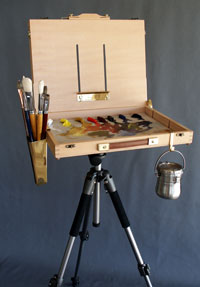
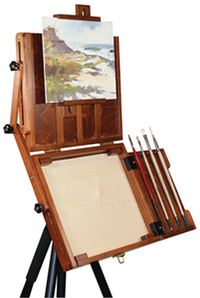
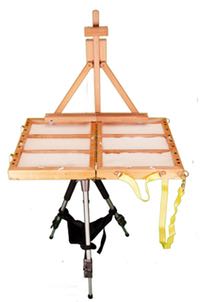
The former is a combination of a recessed palette surface, usually a wood traditionally used for palettes, like birch (which some artists cover with a sheet of glass or plexiglass), with an attached, hinged panel holder, forming the easel. The whole unit has a standard photographic tripod mount underneath that allows for it to be adjusted and set in virtually any position when mounted on the tripod (Open Box M 8×10 above left)
The painting panel is held in place by a variety of mechanisms, depending on the manufacturer. There is also variation in the means of adjusting the angle of the easel back.
For the palette and panel style boxes, painting supplies and wet panels are carried separately, and the manufacturers often sell complete “kits” that fit into a wooden box, cloth bag or carrying pack.
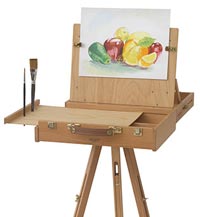
 The “all in one” style pochade box not only provides a palette and easel, but also incorporates storage for painting supplies and/or the built in provision for carrying wet panels. (Alla Prima Pochade “Bitterroot” at left)
The advantage of the all in one style is that everything is in one unit, and, depending on the configuration, the painting supplies are at hand in drawers or compartments right there near the palette while you’re painting. The disadvantage is that the all in one boxes are bulkier and heavier, and require a more sturdy (and expensive) tripod.
“Palette and panel only” style pochade boxes
This is one of the most popular and well regarded manufacturers of this type of pochade box. They use a spring loaded horizontal clip system to hold the panels, which allows access to all parts of the panel without obstruction.
Their complete kit includes a walnut carrying box and matched wet panel holder. They also have lightweight kits with a soft pack instead of the outer box.
In addition, they make “palm boxes“, meant to be held to the hand with a strap instead of mounted on a tripod. You can also purchase the palette/panel holders separately, without the panel carrier and outer box.
I note that, among others, James Gurney, who is a dedicated plein air painter as well as a talented studio painter and illustrator, uses and recommends an Open Box M pochade box. I have a high regard for Gurney’s expertise. Gurney’s blog, Gurney Journey, has a number of posts in which you can see good shots of his Open Box M pochade box in use.
Open Box M has dedicated models for pastels and watercolor. The boxes range from 8×10″ to 12×16″. They also carry Manfrotto tripods and a line of plein air painting accessories.
EASyL and ProChade are brand names for pochade boxes from Artwork Essentials. These also have their adherents among well known painters. Notably, Kevin Macpherson, who some of you may recognize as the author of some very popular (and quite good) books on painting, has given the ProChade model his official endorsement.
The EASyL and ProChade models use a vertical spring-mounted holder that does not restrict the size of the panel horizontally (though past a certain point, you would overload the box). The boxes range from 10×12″ to 12×16″.
The EASyL models (though not the ProChade) provide carrying for wet (or dry) panels in the back of the easel, placing them somewhere between the panel and palette style and all in one style of boxes. Some of the models offer a limited compartment separate from the palette area for carrying a few supplies. You can order a separator grid that fits in the recessed palette area for pastels.
When looking at the product pages on their site, note that they offer downloadable PDF files that go into more detail about the boxes than the web pages. There is also a PDF chart comparing their various boxes side by side. Their boxes come with a matched tripod.
Like Open Box M, Artwork Essentials carries a line of pochade box and plein air painting accessories, in their case one of the most complete, including a clamp-on lightweight umbrella and even plein air style picture frames.
Sienna is a relatively new (to me) entry in the field, and has rapidly been adopted by art suppliers like Dick Blick and others, as well as by Amazon.
They offer a line of two sizes of pochade boxes, an optional Supply Box, a panel carrier, watercolor and pastel inserts, a Sienna branded tripod and a new line of separate panel and palette style portable easels.
The panel holding system is wood and seems reasonably flexible in terms of panel size, the larger box holding panels or canvasses up to 17″ (43cm) high and the smaller up to 15″ (38cm).
These boxes seem to offer a less expensive alternative to some of the other models in this category. I have to wonder, though, how well their wooden panel angle mechanism will hold up in comparison to the metal systems used by other makers.
Reader Paul Forest describes them as a good beginner’s box. See his comment on this article’s 2011 follow-up post.
The Strada Easel is essentially an all metal variation on a pochade box (most of which are made from wood). It was designed by painter Bryan Mark Taylor.
There area a variety of sizes. They also sell tripods and ballheads they feel are well matched to their easels.
Edge Pro Gear makes pochades that have a form factor similar to laptop computers, giving them a more modern look than some boxes.
The Paintbook and Sketchbook easels have glass palettes. Edge also carries appropriately matched tripods, detachable trays, lighting gear and other supplies.
Don Dos Santos has a review on Muddy Colors.
Edgmon makes a line of pochade boxes for pastel and watercolor as well as oil.
“All in one” style pochade boxes
This is the brand of pochade boxes you will most commonly encounter in retail settings, art supply stores and online art suppliers, along with newcomers Craftech Sienna, Mabef and some French easel manufacturers. The other brands usually have to be ordered directly from the manufacturer.
Judson’s has a line of pochade boxes and accessories and sell their own branded tripods as well. They show a typical setup for oils, watermedia and pastels.
The Guerrilla Painter boxes feature a compartmented space beneath the palette area, accessed by sliding the palette surface to one side. They are probably the deepest boxes on the market with the most space for supplies.
The hinged back holds two wet panels. If I understand the configuration correctly, one of them is the active panel, which is held in place by clips. The clips in this case do not appear to be spring mounted or adjustable, apparently limiting the horizontal size of the panel to the size of the box unless you use an optional adapter. They indicate that the box can accommodate larger panels vertically, but it seems to be one of the least flexible of the panel holder systems.
 Jusdon’s has more recently introduced an additional line of “French Resistance” pochade boxes (image at left), with a different configuration in which the box bottom, or a section of it, is the palette. These have a more flexible panel holder system.
Judson’s also sells umbrellas and a broad range of other pochade and general painting supplies and accessories. They also make small “ThumBox” models, with a thumb hole in the bottom, for holding like a traditional artist’s palette, in addition to the tripod mount. The thumb boxes are 6×8″ and the Guerrilla Box comes in 9×12″ or 12×16″ sizes.
Though tripods are not included with the boxes as they are with ArtWork Essentials, Judson’s site is helpful in that they offer separate tripods matched to their boxes, eliminating the need to guess at what’s appropriate.
Easel manufacturer Mabef, who also makes French easels, offers a 13×16″ pochade box that handles panels up to 9×12″. It looks like there is storage for materials and two panels.
They also offer an accompanying wooden tripod that is somewhat unique in the field and is apparently based on their French Easel legs. While not as versatile or sturdy as a professional camera tripod, it’s relatively inexpensive.
This UK manufacturer of various styles of easels offers three pochade boxes, though it doesn’t look to me as though they can be tripod mounted and are evidently meant to be used on a table. One fits 203x152mm (8×6″) and the other 360x255mm (14×10″). They also offer a watercolor pochade box meant to fit an A5 pad in the lid.
It doesn’t look at though the lid angles are very adjustable.
This is a small “thumb” style box, meant to be held in the hand with the thumb through a hole in the bottom like a traditional palette. It’s made by Jullian, who manufacture the most popular French Easel, and branded for art supply company Utrecht. The box itself is 7×9″ and fits panels 6×8″ (horizontal) or 8×10″ (vertical).
The UK Jullian site (scroll down the page) shows them as sold with a set of paints and brushes and includes a panel sized at 22x16cm.
Alla Prima Pochade boxes are crafted by a single woodworker, Ben Haggett, though he is a full time dedicated pochade box maker as well as a plein air painter.
Alla Prima has a full line of sizes and styles and should be thought of in the same league with the larger manufacturers like Open Box M, EASyL and Guerrilla.
I have to make a bit of a disclaimer at this point.
After doing the research you’re getting the benefit of here, looking at all of the options I could find, and determining that my personal preference was for an all in one style box, I decided on one from Alla Prima Pochade. I was very impressed with the design, features and evident craftsmanship.
I then approached Haggett about redoing the Alla Prima Pochade web site, to which he agreed, and he is now my client. The web site you’ll see if you visit is the one I designed. So I can no longer say I’m unbiased; though I was when I initially made my decision to choose one of his boxes.
Haggett is wonderfully clever. His boxes feature several different configurations, based on the size of the box and the best solution he can design to accommodate carrying panels, brushes and other supplies in each. He also has unorthodox and clever solutions for the hinge mechanism, using torsion springs that eliminate the need for knobs or wingnuts.
His panel holder solution is equally unorthodox and remarkably flexible, consisting of a lower panel rest held in place by (uncommonly strong) magnets, that move in channels behind the panel holder, and a sheet-spring top clip. Like the EASyL models there is no restraint to the horizontal size, though you can only carry that so far without the box becoming unwieldy.
 Magnets also close the box lid, which holds four 1/8″ thick panels (or two 1/4″). The panel storage has a removable adapter that allows for carrying smaller panels, e.g. the 10×12 model can carry a 10×12, 9×12, 6×8 and 8×10 all at the same time. The magnets also make it easy to stick palette knives to the box when working, though palette knife painters have to be careful when painting in the vicinity of the bottom panel holder.
In the smallest, 6×8″, model, he uses a sliding palette to cover the storage bin, like the Guerrilla Painter configuration. In the 8×10, he has a single drawer. Both feature clip-on palette extenders.
The larger boxes, 10×12″ and 11×14″, utilize two drawers that can extend in a balanced manner when painting, one of which can hold a palette extension and both of which are drilled to serve as brush holders.
There are “lite” versions of his two biggest models – essentially palette and panel holder only variations with no drawers. They still incorporate brush and wet panel storage (2 panels instead of 4). Haggett can also build custom pochade boxes on request.
All of his boxes can be extended with optional “piggyback adapters” that tie into the box when closed (with magnets and a strap) to allow for carrying larger panels than the lid would normally accommodate (e.g. the 6×8 box can carry 8×10″ panels, the 10×12 can carry 12×16″). The piggyback can hang from the tripod when painting to serve as an extra bin.
The Alla Prima Pochade boxes themselves range in size from 6×8″ to 11×14″; the 11×14 can handle up to 14×18″ panels with its piggyback.
Like most of the other manufacturers, he also sells separate wet panel carriers for extra storage. Alla Prima doesn’t sell tripods, but Haggett does give a few suggestions.
Their are videos of Haggett demonstrating the boxes and how they work, that are also available on YouTube.
I got the 10×12 “Bitterroot” model (image at the top of the article shows my box in use) and I’ve been very pleased. The box is physically beautiful and a joy to use. My father was a woodworker and museum model maker and I know good woodworking when I see it. The cleverness is put to good use and the box is extremely easy to set up, and everything just seems to be exactly where I need it while painting. Plus the thing smells great.
Tripods

Except for some of the handheld models, most pochade boxes are fitted with tripod mounts, though you can certainly use them in your lap or on a table. I’ve mentioned in the course of the article that although some boxes come with tripods, most don’t.Even the lightest boxes are heavier than most cameras, so your $30 K-Mart tripod probably won’t hold them very well except for the smallest models. For the all in one style, the largest of which can weigh in at 8-10lbs or more with paint and panels in them, you’ll want a sturdy professional tripod.
If you’re serious, look at a professional specialty camera store (as opposed to typical mall stores), if possible, take your pochade box with you. Some of the brands mentioned include Bogen (Bogen Junior or Bogen Digi), Velbon and Silk. James Gurney uses a Velbon CX 444 for his relatively light Open Box M. For my all in one Bitterroot, that has drawers for supplies in addition to the panel carrier lid, I went a little overboard and got a Bogen Manfrotto 190 (at left) and a 488 head (tripods and heads are often separate units at the professional level).
For those who have a heavy box like mine and want a cheaper option, you might investigate this Ravelli APGL3. I can’t speak from personal experience, but it looks suitable. There are a number of cheaper options, but I can’t predict their quality or stability. Reviews from buyers on sites like Amazon can sometimes be helpful if you can compare enough of them.
As Ben Haggett points out, though, a tripod for a pochade box doesn’t have to be rock steady as it does for a camera with a large lens, and you can often get away with overloading them beyond spec; as long as they don’t have a flimsy head or quick release shoe that will break under strain.
Check eBay, Craig’s List or your parents’ attic. You’ll be surprised how many tripods are gathering dust somewhere, waiting to be used.
Painting Panels

There are various sources for buying or making primed or canvas covered panels. I sacrifice money to save time and buy already prepared 1/8″ panels that fit easily into panel carriers.I’ve used the smooth Ampersand Gessobord panels from Dick Blick and other art supply houses, and liked them fine; but I now prefer the real canvas surface of the Canvas Plein Air Panels from RayMar Art.
For those inclined to make their own painting panels, there are some resources on this Squidoo lens from Sue Favinger Smith and this step by step on Making a Canvas Board by Larry Seiler.
Box Sizes
When I give sizes for the boxes, it’s a reference to the size of the panels they hold, not their outer dimensions. For the benefit of those outside the US here is a rough conversion of common panel and box sizes:
6×8″ — 15x20cm
8×10″ — 20x25cm
9x 12″ — 23x30cm
10×12″ — 25x30cm
11×14″ — 27x35cm
12×16″ — 30x40cmDo it Yourself pochade boxes
If you’re inclined to woodworking, or simple tinkering, there are some DIY options. I’ve moved the original content about them from this article into two more recent and expanded articles:
DIY Pochade Boxes – make your own cheap pochade box from simple materials
DIY Cigar Box Pochade Boxes – make your own cheap pochade box from a cigar box
Categories:










Charley’s Picks
Bookshop.org
(Bookshop.org affilliate links; sales benefit independent bookshop owners; I get a small percentage to help support my work on Lines and Colors)

John Singer Sargent: Watercolors


Urban Sketching: Understanding Perspective


Charley’s Picks
Amazon
(Amazon.com affiliate links; sales go to a larger yacht for Jeff Bezos; but I get a small percentage to help support my work on Lines and Colors)
John Singer Sargent: Watercolors
Urban Sketching: Understanding Perspective