


Categories
- 3d CGI
- Amusements
- Animation
- Anime & Manga
- Art Materials
- Art Videos
- Blogroll
- Cartoons
- Color
- Comics
- Concept & Visual Dev.
- Creativity
- Digital Art
- Digital Painting
- Displaying Art on the Web
- Drawing
- Eye Candy for Today
- Gallery and Museum Art
- High-res Art Images
- Illustration
- Motion Graphics & Flash
- Museums
- Online Museums
- Outsider Art
- Painting
- Painting a Day
- Paleo Art
- Pastel, Conté & Chalk
- Pen & Ink
- Prints and Printmaking
- Reviews
- Sc-fi and Fantasy
- Sculpture & Dimensional
- Site Comments
- Sketching
- Storyboards
- Tools and Techniques
- Uncategorized
- Vector Art
- Videos & Podcasts
- Vision and Optics
- Watercolor and Gouache
- Webcomics
Archives
- May 2026
- April 2026
- March 2026
- February 2026
- January 2026
- December 2025
- November 2025
- October 2025
- September 2025
- August 2025
- July 2025
- June 2025
- May 2025
- January 2025
- December 2024
- November 2024
- October 2024
- September 2024
- August 2024
- June 2024
- April 2024
- March 2024
- February 2024
- January 2024
- December 2023
- November 2023
- October 2023
- September 2023
- August 2023
- July 2023
- May 2023
- April 2023
- March 2023
- February 2023
- January 2023
- December 2022
- November 2022
- September 2022
- August 2022
- July 2022
- June 2022
- May 2022
- April 2022
- March 2022
- February 2022
- January 2022
- December 2021
- November 2021
- October 2021
- September 2021
- August 2021
- July 2021
- June 2021
- May 2021
- April 2021
- March 2021
- February 2021
- January 2021
- December 2020
- November 2020
- October 2020
- September 2020
- August 2020
- July 2020
- June 2020
- May 2020
- April 2020
- March 2020
- February 2020
- January 2020
- December 2019
- November 2019
- October 2019
- September 2019
- August 2019
- July 2019
- June 2019
- May 2019
- April 2019
- March 2019
- February 2019
- January 2019
- December 2018
- November 2018
- October 2018
- September 2018
- August 2018
- July 2018
- June 2018
- May 2018
- April 2018
- March 2018
- February 2018
- January 2018
- December 2017
- November 2017
- October 2017
- September 2017
- August 2017
- July 2017
- June 2017
- May 2017
- April 2017
- March 2017
- February 2017
- January 2017
- December 2016
- November 2016
- October 2016
- September 2016
- August 2016
- July 2016
- June 2016
- May 2016
- April 2016
- March 2016
- February 2016
- January 2016
- December 2015
- November 2015
- October 2015
- September 2015
- August 2015
- July 2015
- June 2015
- May 2015
- April 2015
- March 2015
- February 2015
- January 2015
- December 2014
- November 2014
- October 2014
- September 2014
- August 2014
- July 2014
- June 2014
- May 2014
- April 2014
- March 2014
- February 2014
- January 2014
- December 2013
- November 2013
- October 2013
- September 2013
- August 2013
- July 2013
- June 2013
- May 2013
- April 2013
- March 2013
- February 2013
- January 2013
- December 2012
- November 2012
- October 2012
- September 2012
- August 2012
- July 2012
- June 2012
- May 2012
- April 2012
- March 2012
- February 2012
- January 2012
- December 2011
- November 2011
- October 2011
- September 2011
- August 2011
- July 2011
- June 2011
- May 2011
- April 2011
- March 2011
- February 2011
- January 2011
- December 2010
- November 2010
- October 2010
- September 2010
- August 2010
- July 2010
- June 2010
- May 2010
- April 2010
- March 2010
- February 2010
- January 2010
- December 2009
- November 2009
- October 2009
- September 2009
- August 2009
- July 2009
- June 2009
- May 2009
- April 2009
- March 2009
- February 2009
- January 2009
- December 2008
- November 2008
- October 2008
- September 2008
- August 2008
- July 2008
- June 2008
- May 2008
- April 2008
- March 2008
- February 2008
- January 2008
- December 2007
- November 2007
- October 2007
- September 2007
- August 2007
- July 2007
- June 2007
- May 2007
- April 2007
- March 2007
- February 2007
- January 2007
- December 2006
- November 2006
- October 2006
- September 2006
- August 2006
- July 2006
- June 2006
- May 2006
- April 2006
- March 2006
- February 2006
- January 2006
- December 2005
- November 2005
- October 2005
- September 2005
- August 2005
Relevant Blogs
Art, Painting & Sketch
- Gurney Journey
- Underpaintings
- Art and Influence
- Painting Perceptions
- Oil Painters of America
- Vasari Paint POV
- Flying Fox
- Urban Sketchers
- Bento (Smithsonian)
- Art Inconnu
- The Hidden Place
- Still Life
- Making a Mark
- The Art of the Landscape
- Exploring Color & Creativity
- Art Contrarian
- Artist A Day
- beinArt Surreal Art Collective
- Eye Level
- David Dunlop
- p.i.g.m.e.n.t.i.u.m
- CultureGrrl
- Joaquín Sorolla blog
- Artists in Pastel
“Painting a Day”
- A Painting a Day (Keiser)
- On Painting (Keiser)
- Julian Merrow-Smith
- Karen Jurick
- Jeffrey Hayes
- Carol Marine
- Abbey Ryan
- Daily Paintworks
Other Painting Blogs
- Virtual Gouache Land
- Neil Hollingsworth
- Marc Hanson
- Kevin Menck
- Marc Dalessio
- Larry Seiler
- Stapleton Kearns
- Colin Page
- Roos Schuring
- Hans Versfelt
- Titus Meeuws
- Régis Pettinari
- René Plein Air
- Belinda Del Pesco
- Robin Weiss
- Nathan Fowkes (Land Sketch)
- William Wray
- Frank Serrano
- Stephen Magsig
- Michael Chesley Johnson
- Twice a Week
- Sarah Wimperis
- Rob Adams
- Michael Cole Manley
- The Dirty Palette Club
- Mike Manley’s Draw!
Gallery Art & Illustration mix
Illustration
- Howard Pyle
- 100 Years of Illustration
- BibliOdyssey
- Illustration Art
- Today’s Inspiration
- Illustration Mundo
- Little Chimp Society
- Danny Gregory
- R D (John Martz
- Illustration Friday blog
- Monster Brains
- Illustrators & Illustrations (RU)
- Elwood H. Smith
- DaniDraws.com
- Designers Who Blog
- iSpot Blog
Sci-Fi & Fantasy
Illustration & Comics
Comics & Cartoons
- Comics Beat
- Robot 6
- Newsarama Blog
- Comic Vine
- Comics Alliance
- Forbidden Planet Int.
- Paolo Rivera
- Bolt City
- Flight
- Scott McCloud
- The Comics Journal
- Comixpedia
- Funnybook Babylon
- James Baker
- Middleton’s Sketchbook
- Boneville
- The Hotel Fred
- Paul Rivoche
- Daily Cartoonist
- Mad About Cartoons (William Wray)
- Digital Strips
Illustration & Concept
Animation & Concept
- Cartoon Brew
- Animation Blog
- Cold Hard Flash
- Concept Art World
- The CAB
- FY Concept Art
- Concept Ships
- Concept Robots
- John Nevarez
- Armand Serrano
- Marcos Mateu-Mestre
- all kinds of stuff (Kricfalusi)
- Yacin the faun (Man Arenas)
- Kelsey Mann
- Cre8tivemarks Blog
- Ice-Cream Monster Toon Cafe
- AAU Character & Creature Design
- AAU Animation Notes
- Articles and Texticles
Paleo & Scientific
Tools & Techniques
Other
Lists of Art Blogs
Art Image Resource Links
Historic Art Images
- Wikimedia Commons: Paintings
- Wikimedia Commons: Drawings
- The Athenaeum
- WikiArt (WikiPaintings)
- Google Art Project: Artists
- Google Art Project: Collections (Museums)
- ArtCyclopedia
- Web Gallery of Art
- Art Renewal Center
- Web Gallery of Impressionism
Auction Consolidation sites
Auction sites
- Sotheby’s
- Bonham’s
- Christies
- Heritage Auctions: Fine Art
- Heritage Auctions: Illustration
- Freeman’s Auctions
- Bukowskis
- Shannon’s
Image Search
Reverse Image Search (search by image)
- Tin Eye
- RevImg
- Google Image Search (camera icon)
- Bing Image Search (camera icon)
Promoting some friends and some clients of my website design business
- Twin Willows T’ai Chi studio in Wilmington DE. Taiji classes with Bryan Davis.
- Ray Hayward, Inspired Teacher of T’ai Chi ( Taiji ) in Minneapolis, Founder of Mindful Motion Tai Chi Academy
- OldHead Tattoo studio and Art Gallery in Wilmington DE. Tattoos and paintings by Bruce Gulick
- Sharon Domenico Art, pet portrait oil paintings
- Platinum Paperhanging, wallpaper hanging, Main Line and Philadelphia, PA
- Lisa Stone Design, interior designer, Main Line and Philadelphia, PA
- Studio12KPT, original art, prints, calendars and other custom printed items by Van Sickle & Rolleri
-
Wikipedia Color Resources
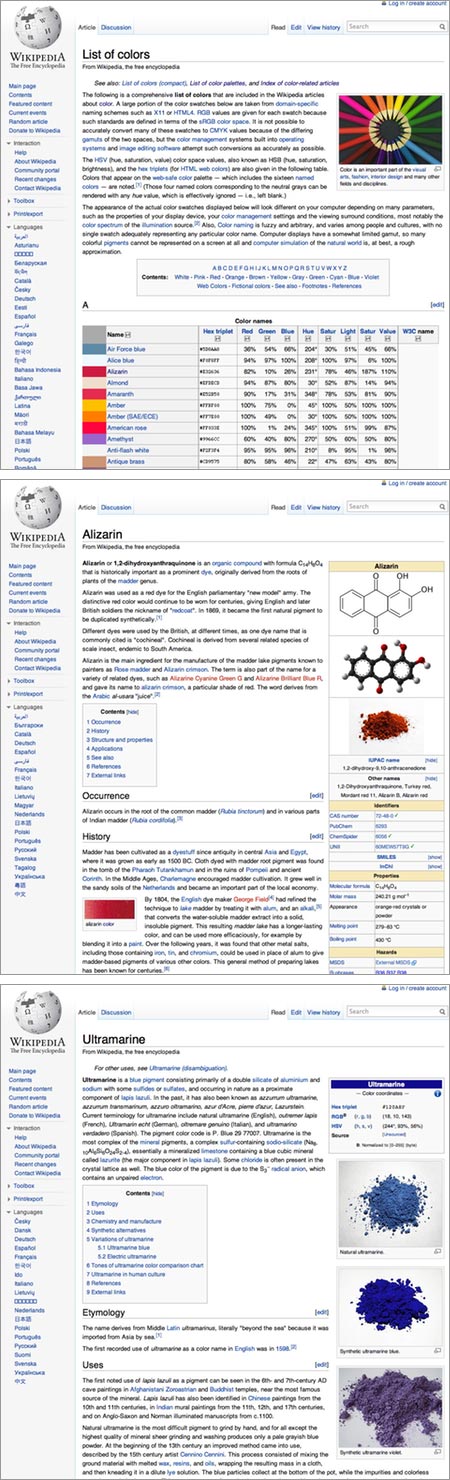
There are lots of color resources on the web, for artists, designers and others, but an often overlooked one is Wikipedia, the venerable user-edited online encyclopedia.Whatever you may say about the reliability of the information on Wikipedia (or from Britannica, or any other single resource, for that matter), I rarely consider a source like Wikipedia a place to end a search, but, like Google, a place to begin one.
Though not specifically an artist’s resource, Wikipedia’s color related articles are numerous and varied.
You might find it interesting to start with their “List of Colors“. The list includes a lot of non-artist colors, like “British Racing Green” and “Psychedelic Purple”, but the familiar artist pigments are there too. Links for those lead to articles with information about the pigment, including source materials, history, chemical composition, lightfastness, typical use, hazardous qualities, color system numbers and sometimes more.
Some are grouped; Cadmium Yellow, Cadmium Orange and Cadmium Red all lead to a single entry for “Cadmium pigments“, but some have more extensive and interesting listings, like the history behind Ultramarine.
There are articles about Color Theory, Color Vision, the Color Wheel, Complimentary Color, Primary Color, Hue, Saturation and many other related topics.
Though hardly an exhaustive resource on color for artists, it does seem a valuable resource to add to your virtual palette.
Categories:
-
Google Art Project

Wow.There are times I just want to hug the internet, and say “I love you Internet!“.
Google, that monolithic giant of search, advertising, maps, stats and online software, whose offerings and initiatives have ranged from the amazing (search, maps) to the not-so wonderful (privacy issues), has spun off a new initiative for which I will forgive most of their transgressions.
Google on Monday unveiled a new feature called Google Art Project that is nothing short of wonderful and amazing, and, if Google’s history is any indication, stands to become even more wonderful and amazing as time goes on.
The project is an online archive of ultra-high-resolution images of great works of art.
Google has applied their “Street View” technology, familiar for providing zoomable street-level images within the context of Google Maps, to the display of both the works and the galleries in which they reside.
Google Street View has been put to unofficial art related use before, notably with the Virtual Paintout (my post here) in which artists virtually “visit” a specified location by way of Google Street View, and use the images as reference for “on location” paintings.
Here, the technology is being put to much different use by Google, allowing some of the best views of great paintings available online.
At the moment they are working with 17 museums, each of which has contributed one or more gigapixel level images to the project; and an impressive start it is:
Alte Nationalgalerie, Berlin – Germany
Freer Gallery of Art, Smithsonian, Washington DC – USA
The Frick Collection, NYC – USA
Gemäldegalerie, Berlin – Germany
The Metropolitan Museum of Art, NYC – USA
MoMA, The Museum of Modern Art, NYC – USA
Museo Reina Sofia, Madrid – Spain
Museo Thyssen – Bornemisza, Madrid – Spain
Museum Kampa, Prague – Czech Republic
National Gallery, London – UK
Palace of Versailles – France
Rijksmuseum, Amsterdam – The Netherlands
The State Hermitage Museum, St Petersburg – Russia
State Tretyakov Gallery, Moscow – Russia
Tate Britain, London – UK
Uffizi Gallery, Florence – Italy
Van Gogh Museum, Amsterdam – The NetherlandsStarting from a list that appears on the project’s home page when you mouse over the initial image, you can choose a museum, then browse the museum’s corridors, or go right to an artwork.
Unlike the stingy feeling so many museums project with tiny preview images and zooming images that have to be scrolled in frustratingly small little windows, the artworks here are available in a full screen zooming interface, and when I say “zoom” I mean it really zooms, down to an astonishing level of detail.
This is like the Haltadefinizione project that I wrote about here, but with a better interface and without the annoyance of watermarking.
In the images above, I’ve chosen to visit the Rijksmuseum in Amsterdam and zoom in to a nose-up-against-the-canvas view of Rembrandt’s The Shooting Company of Frans Banning Cocq, commonly known as The Night Watch.
Though the Flash drop-down for browsing museums and works is a bit glitchy, the interface’s provision for scrolling and zooming is wonderfully fluid, and the ability to get your eyeballs right up to Rembrandt’s textural brushwork is just delicious.
I’ve left the zooming control in my images just to demonstrate it, but it and other interface elements politely melt away when not in use. In the upper right is a Visitor Guide button, which provides a general introduction to the project (there is also a short introductory video here), and an info (“i”) button which gives access to an information panel with a menu of options for information about the painting, provided by the museum in which it hangs.
Of note in that menu are links to “More Works by this Artist” and “More Works in this Museum”, which can lead to a nice browsing experience.
There are some amazing images to be seen, including The Harvesters by Pieter Bruegel the Elder in the Metropolitan Museum of Art, Van Gogh’s The Starry Night at the MoMA, Hans Holbein’s enigmatic The Ambassadors (my post here) in the National Gallery, London and (be still my beating heart) Botticelli’s The Birth of Venus in the Uffizi!
Wow.
I’ll give my Major Time Sink Warning and bid you enjoy!
All art on the internet should be like this.
[Via MetaFilter]
Categories:
-
Lan Ying

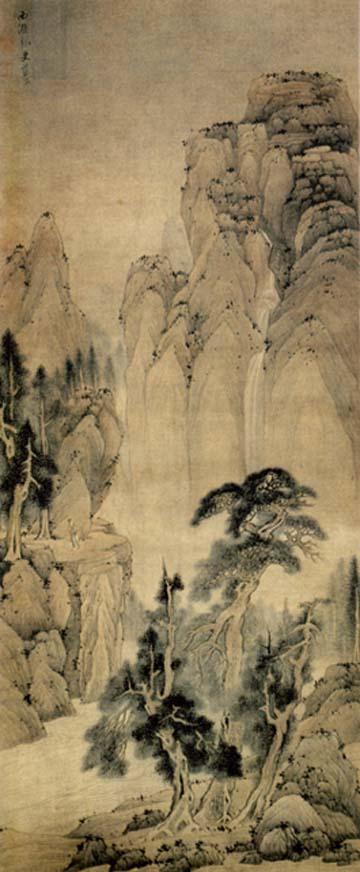
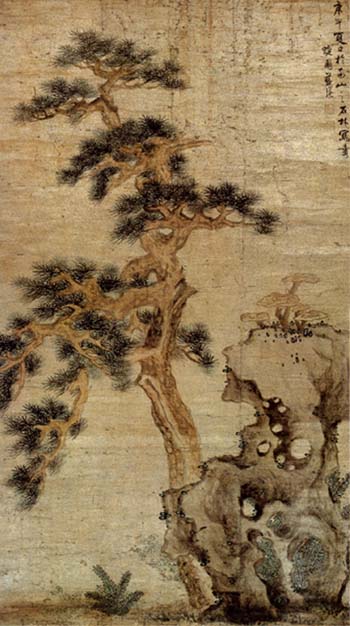
Lan Ying was a Chinese painter active in the early 17th Century (late Ming dynasty). He was noted for his paintings of flowers, plants and landscapes. The latter were beautiful examples of a kind of Chinese landscape painting I particularly enjoy, with delicate, softly toned calligraphic linework and beautifully handled washes, evocative of mist, atmosphere and subtle suggestions of texture.Lan Ying was also noted for his portrayals of fascinatingly complex rocks, of a kind often chosen for gardens as suggestive of miniature mountains (image above, bottom right, featured here).
He was considered representative of the Zhe School of Chinese painters. I’ve see a number of his works in which the title indicates that he is deliberately painting in the style of particular artists that preceded him whose work he greatly admired.
Categories:
-
Super Bowl Art Bet

It’s long been a tradition for mayors and other representatives of rival American cities to make wagers on the outcomes of major, season-ending sporting events like the Baseball World Series and, in particular, the Super Bowl football game.Last year, prompted by a dare from Modern Art Notes writer Tyler Green, two art museums from cities whose teams were in the Super Bowl made a bet of major art loans against the outcome of the game.
After the New Orleans Saints Beat the Indianapolis Colts in that game, the Indianapolis Museum of Art (see my recent post on the IMA) loaned a significant painting by JMW Turner, The Fifth Plague of Egypt (image above, third down), to the New Orleans Museum of Art, which had wagered the loan of Ideal View of Tivoli by Claude Lorrain (above, bottom).
The major museums of the rival cities involved in this year’s Super Bowl have taken this idea (and a terrific one it is) into its second year.
The Carnegie Museum of Art in Pittburgh has wagered the loan of Renoir’s Bathers with a Crab on a Pittsburgh Steelers win, while the Milwaukee Art Museum has put up Boating on the Yerres by Gustave Caillebotte, betting that the Green Bay Packers will take the trophy.
Personally, I think Pittsburgh stands to get the better end of the deal; though Renoir is considered to be the more “significant” painter, I’d take the Caillebotte any day. (A choice between the Claude and the Turner from last year would be harder.)
At any rate it’s great fun, and raises the visibility of the museums and their collections in the midst of an event usually far removed from the art scene; so both museums come out winners.
Here’s Tyler Green’s article about this year’s bet. I’ve included links to some other articles covering the wager below.
Categories:
-
Olga Dugina & Andrej Dugin (update)

When I wrote about the intricate, richly textured and wonderfully idiosyncratic illustrations of Olga Dugina & Andrej Dugin back in 2006, they did not have a dedicated web presence.Since then, Dugin has established a website, Duginart, that represents both artists (they are married).
The Gallery has sections devoted to illustration by each artist, as well as the more familiar work done jointly, along with paintings and graphics by Dugin.
Unfortunately, the reproductions on their site are frustratingly small and don’t give an adequate feeling for the texture and detail in the work.
I stumbled across this unofficial post of some of their work, another here, an unofficial gallery here (click through twice to larger image), and there is also a selection here.
For the best look at their work, of course, see it in print. You can find several of the books they have illustrated on Amazon.
For more, see my previous post about Olga Dugina & Andrej Dugin
Categories:
-
Un Tour de Manege

Un Tour de Manege (“A Turn of the Carousel”, if I’m interpreting it correctly) is another animated gem that comes out of Gobelins, l’ecole de l’image.Credited to Nicolas Athané, Brice Chevillard, Alexis Liddell, Françoise Losito and Mai Nguyen; the short (3 minute) animation deals with a young girl who is separated from her mother and appears to live out her life (or does she?).
The style is a beautiful mist of pastel and watercolor effects; the animation is fluid and the concept and storytelling imaginative (watch it twice if it doesn’t seem to make sense at first).
[Via MetaFilter]
Categories:




Charley’s Picks
Bookshop.org
(Bookshop.org affilliate links; sales benefit independent bookshop owners; I get a small percentage to help support my work on Lines and Colors)

John Singer Sargent: Watercolors


Urban Sketching: Understanding Perspective




Charley’s Picks
Amazon
(Amazon.com affiliate links; sales go to a larger yacht for Jeff Bezos; but I get a small percentage to help support my work on Lines and Colors)
John Singer Sargent: Watercolors
Urban Sketching: Understanding Perspective