


Categories
- 3d CGI
- Amusements
- Animation
- Anime & Manga
- Art Materials
- Art Videos
- Blogroll
- Cartoons
- Color
- Comics
- Concept & Visual Dev.
- Creativity
- Digital Art
- Digital Painting
- Displaying Art on the Web
- Drawing
- Eye Candy for Today
- Gallery and Museum Art
- High-res Art Images
- Illustration
- Motion Graphics & Flash
- Museums
- Online Museums
- Outsider Art
- Painting
- Painting a Day
- Paleo Art
- Pastel, Conté & Chalk
- Pen & Ink
- Prints and Printmaking
- Reviews
- Sc-fi and Fantasy
- Sculpture & Dimensional
- Site Comments
- Sketching
- Storyboards
- Tools and Techniques
- Uncategorized
- Vector Art
- Videos & Podcasts
- Vision and Optics
- Watercolor and Gouache
- Webcomics
Archives
- May 2026
- April 2026
- March 2026
- February 2026
- January 2026
- December 2025
- November 2025
- October 2025
- September 2025
- August 2025
- July 2025
- June 2025
- May 2025
- January 2025
- December 2024
- November 2024
- October 2024
- September 2024
- August 2024
- June 2024
- April 2024
- March 2024
- February 2024
- January 2024
- December 2023
- November 2023
- October 2023
- September 2023
- August 2023
- July 2023
- May 2023
- April 2023
- March 2023
- February 2023
- January 2023
- December 2022
- November 2022
- September 2022
- August 2022
- July 2022
- June 2022
- May 2022
- April 2022
- March 2022
- February 2022
- January 2022
- December 2021
- November 2021
- October 2021
- September 2021
- August 2021
- July 2021
- June 2021
- May 2021
- April 2021
- March 2021
- February 2021
- January 2021
- December 2020
- November 2020
- October 2020
- September 2020
- August 2020
- July 2020
- June 2020
- May 2020
- April 2020
- March 2020
- February 2020
- January 2020
- December 2019
- November 2019
- October 2019
- September 2019
- August 2019
- July 2019
- June 2019
- May 2019
- April 2019
- March 2019
- February 2019
- January 2019
- December 2018
- November 2018
- October 2018
- September 2018
- August 2018
- July 2018
- June 2018
- May 2018
- April 2018
- March 2018
- February 2018
- January 2018
- December 2017
- November 2017
- October 2017
- September 2017
- August 2017
- July 2017
- June 2017
- May 2017
- April 2017
- March 2017
- February 2017
- January 2017
- December 2016
- November 2016
- October 2016
- September 2016
- August 2016
- July 2016
- June 2016
- May 2016
- April 2016
- March 2016
- February 2016
- January 2016
- December 2015
- November 2015
- October 2015
- September 2015
- August 2015
- July 2015
- June 2015
- May 2015
- April 2015
- March 2015
- February 2015
- January 2015
- December 2014
- November 2014
- October 2014
- September 2014
- August 2014
- July 2014
- June 2014
- May 2014
- April 2014
- March 2014
- February 2014
- January 2014
- December 2013
- November 2013
- October 2013
- September 2013
- August 2013
- July 2013
- June 2013
- May 2013
- April 2013
- March 2013
- February 2013
- January 2013
- December 2012
- November 2012
- October 2012
- September 2012
- August 2012
- July 2012
- June 2012
- May 2012
- April 2012
- March 2012
- February 2012
- January 2012
- December 2011
- November 2011
- October 2011
- September 2011
- August 2011
- July 2011
- June 2011
- May 2011
- April 2011
- March 2011
- February 2011
- January 2011
- December 2010
- November 2010
- October 2010
- September 2010
- August 2010
- July 2010
- June 2010
- May 2010
- April 2010
- March 2010
- February 2010
- January 2010
- December 2009
- November 2009
- October 2009
- September 2009
- August 2009
- July 2009
- June 2009
- May 2009
- April 2009
- March 2009
- February 2009
- January 2009
- December 2008
- November 2008
- October 2008
- September 2008
- August 2008
- July 2008
- June 2008
- May 2008
- April 2008
- March 2008
- February 2008
- January 2008
- December 2007
- November 2007
- October 2007
- September 2007
- August 2007
- July 2007
- June 2007
- May 2007
- April 2007
- March 2007
- February 2007
- January 2007
- December 2006
- November 2006
- October 2006
- September 2006
- August 2006
- July 2006
- June 2006
- May 2006
- April 2006
- March 2006
- February 2006
- January 2006
- December 2005
- November 2005
- October 2005
- September 2005
- August 2005
Relevant Blogs
Art, Painting & Sketch
- Gurney Journey
- Underpaintings
- Art and Influence
- Painting Perceptions
- Oil Painters of America
- Vasari Paint POV
- Flying Fox
- Urban Sketchers
- Bento (Smithsonian)
- Art Inconnu
- The Hidden Place
- Still Life
- Making a Mark
- The Art of the Landscape
- Exploring Color & Creativity
- Art Contrarian
- Artist A Day
- beinArt Surreal Art Collective
- Eye Level
- David Dunlop
- p.i.g.m.e.n.t.i.u.m
- CultureGrrl
- Joaquín Sorolla blog
- Artists in Pastel
“Painting a Day”
- A Painting a Day (Keiser)
- On Painting (Keiser)
- Julian Merrow-Smith
- Karen Jurick
- Jeffrey Hayes
- Carol Marine
- Abbey Ryan
- Daily Paintworks
Other Painting Blogs
- Virtual Gouache Land
- Neil Hollingsworth
- Marc Hanson
- Kevin Menck
- Marc Dalessio
- Larry Seiler
- Stapleton Kearns
- Colin Page
- Roos Schuring
- Hans Versfelt
- Titus Meeuws
- Régis Pettinari
- René Plein Air
- Belinda Del Pesco
- Robin Weiss
- Nathan Fowkes (Land Sketch)
- William Wray
- Frank Serrano
- Stephen Magsig
- Michael Chesley Johnson
- Twice a Week
- Sarah Wimperis
- Rob Adams
- Michael Cole Manley
- The Dirty Palette Club
- Mike Manley’s Draw!
Gallery Art & Illustration mix
Illustration
- Howard Pyle
- 100 Years of Illustration
- BibliOdyssey
- Illustration Art
- Today’s Inspiration
- Illustration Mundo
- Little Chimp Society
- Danny Gregory
- R D (John Martz
- Illustration Friday blog
- Monster Brains
- Illustrators & Illustrations (RU)
- Elwood H. Smith
- DaniDraws.com
- Designers Who Blog
- iSpot Blog
Sci-Fi & Fantasy
Illustration & Comics
Comics & Cartoons
- Comics Beat
- Robot 6
- Newsarama Blog
- Comic Vine
- Comics Alliance
- Forbidden Planet Int.
- Paolo Rivera
- Bolt City
- Flight
- Scott McCloud
- The Comics Journal
- Comixpedia
- Funnybook Babylon
- James Baker
- Middleton’s Sketchbook
- Boneville
- The Hotel Fred
- Paul Rivoche
- Daily Cartoonist
- Mad About Cartoons (William Wray)
- Digital Strips
Illustration & Concept
Animation & Concept
- Cartoon Brew
- Animation Blog
- Cold Hard Flash
- Concept Art World
- The CAB
- FY Concept Art
- Concept Ships
- Concept Robots
- John Nevarez
- Armand Serrano
- Marcos Mateu-Mestre
- all kinds of stuff (Kricfalusi)
- Yacin the faun (Man Arenas)
- Kelsey Mann
- Cre8tivemarks Blog
- Ice-Cream Monster Toon Cafe
- AAU Character & Creature Design
- AAU Animation Notes
- Articles and Texticles
Paleo & Scientific
Tools & Techniques
Other
Lists of Art Blogs
Art Image Resource Links
Historic Art Images
- Wikimedia Commons: Paintings
- Wikimedia Commons: Drawings
- The Athenaeum
- WikiArt (WikiPaintings)
- Google Art Project: Artists
- Google Art Project: Collections (Museums)
- ArtCyclopedia
- Web Gallery of Art
- Art Renewal Center
- Web Gallery of Impressionism
Auction Consolidation sites
Auction sites
- Sotheby’s
- Bonham’s
- Christies
- Heritage Auctions: Fine Art
- Heritage Auctions: Illustration
- Freeman’s Auctions
- Bukowskis
- Shannon’s
Image Search
Reverse Image Search (search by image)
- Tin Eye
- RevImg
- Google Image Search (camera icon)
- Bing Image Search (camera icon)
Promoting some friends and some clients of my website design business
- Twin Willows T’ai Chi studio in Wilmington DE. Taiji classes with Bryan Davis.
- Ray Hayward, Inspired Teacher of T’ai Chi ( Taiji ) in Minneapolis, Founder of Mindful Motion Tai Chi Academy
- OldHead Tattoo studio and Art Gallery in Wilmington DE. Tattoos and paintings by Bruce Gulick
- Sharon Domenico Art, pet portrait oil paintings
- Platinum Paperhanging, wallpaper hanging, Main Line and Philadelphia, PA
- Lisa Stone Design, interior designer, Main Line and Philadelphia, PA
- Studio12KPT, original art, prints, calendars and other custom printed items by Van Sickle & Rolleri
-
William Stout: Inspirations

I am unabashed in my enthusiasm for the work of William Stout, and I’ve written about him previously several times here on Lines and Colors (links below). In particular, I take great delight in his beautiful drawings in pen and ink with watercolor.I’ve been looking forward to the release of William Stout: Inspirations from Flesk publications since it’s companion volume, William Stout: Halllucinations, was released back in July (my review here).
Stout has been prolific in his career, and there are a number of illustrations and other drawings that are difficult to find in print. Much to the delight of Stout fans like myself, the two books have collected a number of these from various sources and presented them in the kind of beautifully produced and printed art volumes that are Flesk’s specialty.
The two collections are arranged thematically, the first focusing on monsters, trolls, dragons and creatures, the new one on women from fantasy and fairy tales.
In both volumes we see Stout having fun, gleefully drawing on his inspirations from traditional stories and pop culture as well as paying tribute to some of his artistic roots.
In Inspirations, we find Stout working with subjects from Edgar Rice Burroughs, Shakespeare, The Wizard of Oz (Baum’s not MGM’s), Wagner’s Ring Cycle, Rima the Jungle Girl, The Bride of Frankenstein and even a humorous take on his own dinosaur illustrations; in the process creating playful homages to late 20th Century artists like Frank Frazetta and Dave Stevens, and Golden Age masters like Arthur Rackham, Edmund Dulac and the great but under-appreciated Gustav Tenngren and John Bauer (links to my posts).
In fact, in his Foreward, Stout outlines what he calls his “Rackham/Dulac Technique” in a step-by step walkthough of the process that many illustrators will find enlightening.
Stout has been influenced by a number of great Golden Age pen and ink illustrators, with a variety of approaches, and in his own style he has managed to distill a balance of linework, rendering and application of color that I find particularly appealing. Combined with his accomplished draftsmanship and fervent imagination, he serves up a smorgasbord of visual treats in these collections.
There is a small gallery of preview images on the Flesk site (click on the image to pop up the gallery), along with more detail about Inspirations and the companion volume Hallucinations, as well as the other Stout titles from Flesk: Dinosaur Discoveries and New Dinosaur Discoveries A-Z.
The titles can all be ordered directly from the Flesk online store (or the old way via mail).
The limited edition signed hardback version of William Stout: Inspirations is already sold out from the Flesk site, though you may still be able to order copies of the hardback directly from William Stout’s site.
You can also find more of Stout’s work, in a variety of media, subjects and approaches, in the galleries on his site.
Categories:
-
Chris Turnham (update)

The good new is that since I last wrote about Chris Turnham back in 2006 his website has been updated with more of his wonderfully graphic, superbly designed and beautifully colored illustrations.The bad news is that, for reasons that continue to elude me, they are displayed in a “pop-up-and-close” style navigation from a scrolling list of thumbnails in a cramped little frame. This makes the process of looking through them less convenient than it might be.
Even his News and About pages are scrunched up in that little frame. Fortunately, Turnham now also has a blog, which is not hampered by that restriction. In the blog you will find additional art, including examples of his work as a concept and production artist.
Turnham has for several years been involved in a collaborative project with illustrator Kevin Dart called Fleet Street Scandal. Originally focused on a book showcasing their work, the project has expanded into limited edition prints, giclees and a line of apparel. You can also find Turnham’s limited edition prints at Gallery Nucleus.
Turnham currently works for Laika, the production company responsible for the wonderful Coraline animated feature film.
His work was featured prominently in the concept art reproductions of the magical garden and plants from the movie that were included in the remarkable Coraline Mystery Box that I received as part of Laika’s viral promotion campaign for the film.
You can see some of Turnham’s work on the film (image above, bottom) by searching for “Coraline” on his blog.
[Addendum: I just found out that Chris Turnham has a new TumbleLog with a section devoted to Coraline Production Art.]
Categories:
-
Modern Life: Edward Hopper and His Time

Modern Life: Edward Hopper and His Time is the title of an exhibition currently on view at the Whitney Museum of American Art in New York.The exhibition focuses on realism in American art between 1900 and 1940, a time when European Modernism was becoming a dominant force in the art world, pushing realism into a minor role.
The show, drawn primarily from the Whitney’s own collections, includes a number of works by Hopper and his contemporaries, including Everett Shinn, John Sloan, Charles Burchfield, Paul Strand, Charles Sheeler and Reginald Marsh (see my posts on Edward Hopper, Everett Shinn, John Sloan and Charles Burchfield).
The Whitney’s website feature in the exhibition includes a small image gallery, but there are more images, along with interesting accounts of the artists and art styles of the period, in the History section.
Modern Life: Edward Hopper and His Time is on view until April 10, 2011.
(Images above: top three: Edward Hopper, bottom: Everett Shinn)
Categories:
-
Mailbag Art Museum (Sarah Musi)

Sarah Musi, an illustrator and comics artist based in Washington State, has come up with one of those “don’t you wish you had thought of it” ideas, and recently embarked on a project she calls “mailbag art museum“.In August of this year Musi created a list of her “favorite artists in the whole wide world“, and over the period of a few weeks sent each of them an original work painted on an artist trading card (see my post on artist trading cards).
These were accompanied by a blank card and an invitation, in comic strip form, to return the card with a corresponding piece of original work, however simple or elaborate, and an answer to a question posed with the original letter.
To date she has received 6 responses and has posted them on the project’s blog along with the original piece she sent to them, a brief description and a short bio of the artist.
In the images above, I’ve placed Musi’s original piece on the left, next to the pieces received in response — top right: Robert Hargrave, middle right: Tiffany Bozic, third right: Allison Sommers. I’ve also taken the liberty of reproducing a photo from Sommers’ blog showing the relative size of the cards.
[Via MetaFilter]
Categories:
-
Vasili Nechitailo

Like many of his contemporaries, Vasili (or Vasliy) Nechitailo, a Russian painter active in the middle of the 20th Century, is not well known outside of his homeland. One reason for this is that little in the way of cultural exchange was allowed during the era of Soviet Russia.Nechitailo studied at the Krasnodar Art Tekhnikum, the Surikov Institute and the Moscow Art Institute. He later returned to the Surikov Institute to teach.
Generally considered a realist, the painterly brushwork, bright colors and economically suggested subjects of Nechitailo’s later work also put him in the company of painters considered to be Russian Impressionists.
To the casual observer, Nechitailo’s idylic farms and fields, glowing under the sun of a Russian Summer, seem in keeping with the Impressionist’s portrayals of the French countryside, but the circumstances under which they were painted could hardly have been more different.
In Nechitailo’s case, the idealized fields, and the ennobled workers who toiled in them, were used as propaganda, extolling the virtues and hard work, dedication to the state, and the bounty of the Soviet farming economy. The approved style was called Socialist Realism and was meant to promote the ideology of the Soviet state.
In addition to those subjects and official portraits of government figures, Nechitailo also found time to pursue subjects of his own, without the political overtones, including scenes of Venice.
There is a show of Nechitailo’s work, the first solo show of a major Soviet era painter outside Russia, at the Museum of Russian Art in Minneapolis, Minnesota. The Art of Vasili Nechitailo is currently on view and runs until February 27, 2011. The museum’s site has a small slide show of paintings, but I’ve listed some other, more extensive resources below.
Ironically, the exhibition was assembled by Masha Zavialova, curator at the museum, who emigrated to the U.S. in 2001. Her childhood experience of growing up in Leningrad (now St. Petersburg) under Soviet rule was one of an oppressive, closed society, in which work like Nechitailo’s was another arm of the government, pushing its ideological message into the lives of the citizenry with state approved art and propaganda posters.
She hated it at the time, but has now been able to look back with a fresh view, seeing it both within and outside of its original context.
There is an interesting article about the exhibit in the Minneapolis – St. Paul StarTribune, in which Zavialova is quoted:
“Before I just looked at the [Nechitailo] subjects and they were oppressive to me,” she said. “Now, I look at the canvases and brushwork and find them very interesting and they’ve stopped being threatening. (…) It’s the nature of time. Now I love his work.”
Categories:
-
Color and Light: A Guide for the Realist Painter

Color. What other factor in art is so simultaneously fascinating and frustrating for artists?Numerous books have been written on the subject; some are less than worthwhile, some are good, some are excellent, and a few have become so relied on that over time they have become standards.
Each takes a certain approach to the subject, emphasizing color choices, color mixing, experimentation, analysis, etc., but of the many books on color that I’ve encountered over time, there always seemed to be key parts of the puzzle that hadn’t been addressed yet — a certain kind of book on color that was missing.
I didn’t really know what that book was until James Gurney wrote Color and Light: A Guide for the Realist Painter.
In Color and Light, which has just been released, we get the printed version of having an experienced painter leaning over our shoulder, giving us his best advice and taking us beyond the basics into the subtleties of the practical application of color in the process of creating paintings.
This is the “other” book on color, the one that takes the practice of working with color, and the understanding of color and light and how we perceive them, to the next level.
Gurney, who I have written about previously on several occasions, has culled a treasure trove of insightful observations, practical tips, experimental trials and artful technique from years of painting a wide range of subjects in a variety of visual approaches.
He has been a renowned illustrator, portraitist, landscape artist, plein air painter and scientific artist; and beyond that has for years been a restless experimenter, investigating the work of master artists, thinking about and working with color in all of its aspects as related to painting.
 For the past several years, Gurney, best known as the creator of the popular Dinotopia series of illustrated fantasy stories, has been writing a blog called Gurney Journey. Those of us who have been following Gurney Journey since its inception have reaped the benefit of a generous bounty of art related information, advice, observations, experiments, discoveries, and links that he has made available in his frequent posts over the past few years.
Some of this material, along with new material culled from Gurney’s expertise as an illustrator, were codified into a book in 2009 called Imaginative Realism: How to Paint What Doesn’t Exist, which I reviewed here.
In Color and Light he has also pulled from those observations and expositions (you can see some of the topics by searching for Color and Light book, or simply color on the GurneyJourney blog), but gone well beyond that into a great deal of new material written specifically for the book.
While I think of this book as advanced in many ways, Gurney does go into many of the fundamentals of color and color theory, with succinct chapters on the history of color theory, pigments, the academic tradition, plein air painting, magazine illustration, chroma and value, warm and cool, local and reflected color, atmospheric perspective, color schemes, limited palettes, reflections, highlights and shadows and many others. Beginners as well as advanced painters will find a wealth of information.
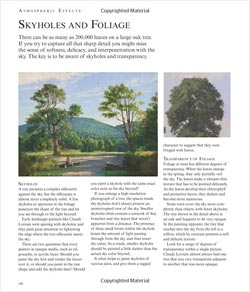
However, he goes beyond the ordinary with thoughtful excursions into topics like understanding gamuts, subsurface scattering, specular reflections, different natural and artificial light sources, and expert techniques for handling difficult problems like reflection and transparency, fog and mist, skies and foliage, nocturnes, cloud shadows, and premixing colors for a painting.
Though some of the information may be familiar, I think that most artists will find the book to be a treasure trove of small but significant revelations, as if dozens of little “Ah-ha!” lightbulbs (of varying spectrums) were appearing over your head as you read.
I consider this book, if not a “must-have”, at the very least a “must-see” for any representational painter. I urge you to pick it up and look through it in a bookstore.
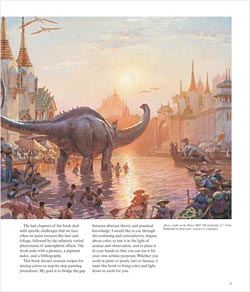 I’m a little concerned that “fine art” painters might assume from a casual leaf-through that the presence of fantasy illustrations would indicate the focus of the book is not in their direction, particularly because the fantasy illustrations often have a “jump off the page” quality to them and seem dominant. Nothing could be further off the mark, the material is exactly on target for realist painters of any background who want to get a better handle on light and color.
You can get a virtual “pick up and leaf through” from the nicely extensive preview on the Amazon.com listing (click on the “Look Inside” cover image), as well as a video flip-through from Spectrum, reposted on Gurney Journey, and another on Parka Blogs.
In addition to being available through bookstores and online booksellers, you can order directly from the the Dinotopia store and have your copy signed by the author.
Like any book from James Gurney, this one is a visual treat; in this case illustrated with works from great painters and illustrators of the past, as well as Gurney’s own illustrations, sketches, diagrams and paintings. Just like his previous instructional book, it can also be enjoyed as a coffee table art book.
Only time will tell, of course, but I think Color and Light: A Guide for the Realist Painter will take a place as a new standard text among books on color, destined to be a fixture on the bookshelves of painters and illustrators for years to come.
Categories:




Charley’s Picks
Bookshop.org
(Bookshop.org affilliate links; sales benefit independent bookshop owners; I get a small percentage to help support my work on Lines and Colors)

John Singer Sargent: Watercolors


Urban Sketching: Understanding Perspective


Charley’s Picks
Amazon
(Amazon.com affiliate links; sales go to a larger yacht for Jeff Bezos; but I get a small percentage to help support my work on Lines and Colors)
John Singer Sargent: Watercolors
Urban Sketching: Understanding Perspective