


Categories
- 3d CGI
- Amusements
- Animation
- Anime & Manga
- Art Materials
- Art Videos
- Blogroll
- Cartoons
- Color
- Comics
- Concept & Visual Dev.
- Creativity
- Digital Art
- Digital Painting
- Displaying Art on the Web
- Drawing
- Eye Candy for Today
- Gallery and Museum Art
- High-res Art Images
- Illustration
- Motion Graphics & Flash
- Museums
- Online Museums
- Outsider Art
- Painting
- Painting a Day
- Paleo Art
- Pastel, Conté & Chalk
- Pen & Ink
- Prints and Printmaking
- Reviews
- Sc-fi and Fantasy
- Sculpture & Dimensional
- Site Comments
- Sketching
- Storyboards
- Tools and Techniques
- Uncategorized
- Vector Art
- Videos & Podcasts
- Vision and Optics
- Watercolor and Gouache
- Webcomics
Archives
- October 2026
- September 2026
- August 2026
- July 2026
- June 2026
- May 2026
- April 2026
- March 2026
- February 2026
- January 2026
- December 2025
- November 2025
- October 2025
- September 2025
- August 2025
- July 2025
- June 2025
- May 2025
- January 2025
- December 2024
- November 2024
- October 2024
- September 2024
- August 2024
- June 2024
- April 2024
- March 2024
- February 2024
- January 2024
- December 2023
- November 2023
- October 2023
- September 2023
- August 2023
- July 2023
- May 2023
- April 2023
- March 2023
- February 2023
- January 2023
- December 2022
- November 2022
- September 2022
- August 2022
- July 2022
- June 2022
- May 2022
- April 2022
- March 2022
- February 2022
- January 2022
- December 2021
- November 2021
- October 2021
- September 2021
- August 2021
- July 2021
- June 2021
- May 2021
- April 2021
- March 2021
- February 2021
- January 2021
- December 2020
- November 2020
- October 2020
- September 2020
- August 2020
- July 2020
- June 2020
- May 2020
- April 2020
- March 2020
- February 2020
- January 2020
- December 2019
- November 2019
- October 2019
- September 2019
- August 2019
- July 2019
- June 2019
- May 2019
- April 2019
- March 2019
- February 2019
- January 2019
- December 2018
- November 2018
- October 2018
- September 2018
- August 2018
- July 2018
- June 2018
- May 2018
- April 2018
- March 2018
- February 2018
- January 2018
- December 2017
- November 2017
- October 2017
- September 2017
- August 2017
- July 2017
- June 2017
- May 2017
- April 2017
- March 2017
- February 2017
- January 2017
- December 2016
- November 2016
- October 2016
- September 2016
- August 2016
- July 2016
- June 2016
- May 2016
- April 2016
- March 2016
- February 2016
- January 2016
- December 2015
- November 2015
- October 2015
- September 2015
- August 2015
- July 2015
- June 2015
- May 2015
- April 2015
- March 2015
- February 2015
- January 2015
- December 2014
- November 2014
- October 2014
- September 2014
- August 2014
- July 2014
- June 2014
- May 2014
- April 2014
- March 2014
- February 2014
- January 2014
- December 2013
- November 2013
- October 2013
- September 2013
- August 2013
- July 2013
- June 2013
- May 2013
- April 2013
- March 2013
- February 2013
- January 2013
- December 2012
- November 2012
- October 2012
- September 2012
- August 2012
- July 2012
- June 2012
- May 2012
- April 2012
- March 2012
- February 2012
- January 2012
- December 2011
- November 2011
- October 2011
- September 2011
- August 2011
- July 2011
- June 2011
- May 2011
- April 2011
- March 2011
- February 2011
- January 2011
- December 2010
- November 2010
- October 2010
- September 2010
- August 2010
- July 2010
- June 2010
- May 2010
- April 2010
- March 2010
- February 2010
- January 2010
- December 2009
- November 2009
- October 2009
- September 2009
- August 2009
- July 2009
- June 2009
- May 2009
- April 2009
- March 2009
- February 2009
- January 2009
- December 2008
- November 2008
- October 2008
- September 2008
- August 2008
- July 2008
- June 2008
- May 2008
- April 2008
- March 2008
- February 2008
- January 2008
- December 2007
- November 2007
- October 2007
- September 2007
- August 2007
- July 2007
- June 2007
- May 2007
- April 2007
- March 2007
- February 2007
- January 2007
- December 2006
- November 2006
- October 2006
- September 2006
- August 2006
- July 2006
- June 2006
- May 2006
- April 2006
- March 2006
- February 2006
- January 2006
- December 2005
- November 2005
- October 2005
- September 2005
- August 2005
Relevant Blogs
Art, Painting & Sketch
- Gurney Journey
- Underpaintings
- Art and Influence
- Painting Perceptions
- Oil Painters of America
- Vasari Paint POV
- Flying Fox
- Urban Sketchers
- Bento (Smithsonian)
- Art Inconnu
- The Hidden Place
- Still Life
- Making a Mark
- The Art of the Landscape
- Exploring Color & Creativity
- Art Contrarian
- Artist A Day
- beinArt Surreal Art Collective
- Eye Level
- David Dunlop
- p.i.g.m.e.n.t.i.u.m
- CultureGrrl
- Joaquín Sorolla blog
- Artists in Pastel
“Painting a Day”
- A Painting a Day (Keiser)
- On Painting (Keiser)
- Julian Merrow-Smith
- Karen Jurick
- Jeffrey Hayes
- Carol Marine
- Abbey Ryan
- Daily Paintworks
Other Painting Blogs
- Virtual Gouache Land
- Neil Hollingsworth
- Marc Hanson
- Kevin Menck
- Marc Dalessio
- Larry Seiler
- Stapleton Kearns
- Colin Page
- Roos Schuring
- Hans Versfelt
- Titus Meeuws
- Régis Pettinari
- René Plein Air
- Belinda Del Pesco
- Robin Weiss
- Nathan Fowkes (Land Sketch)
- William Wray
- Frank Serrano
- Stephen Magsig
- Michael Chesley Johnson
- Twice a Week
- Sarah Wimperis
- Rob Adams
- Michael Cole Manley
- The Dirty Palette Club
- Mike Manley’s Draw!
Gallery Art & Illustration mix
Illustration
- Howard Pyle
- 100 Years of Illustration
- BibliOdyssey
- Illustration Art
- Today’s Inspiration
- Illustration Mundo
- Little Chimp Society
- Danny Gregory
- R D (John Martz
- Illustration Friday blog
- Monster Brains
- Illustrators & Illustrations (RU)
- Elwood H. Smith
- DaniDraws.com
- Designers Who Blog
- iSpot Blog
Sci-Fi & Fantasy
Illustration & Comics
Comics & Cartoons
- Comics Beat
- Robot 6
- Newsarama Blog
- Comic Vine
- Comics Alliance
- Forbidden Planet Int.
- Paolo Rivera
- Bolt City
- Flight
- Scott McCloud
- The Comics Journal
- Comixpedia
- Funnybook Babylon
- James Baker
- Middleton’s Sketchbook
- Boneville
- The Hotel Fred
- Paul Rivoche
- Daily Cartoonist
- Mad About Cartoons (William Wray)
- Digital Strips
Illustration & Concept
Animation & Concept
- Cartoon Brew
- Animation Blog
- Cold Hard Flash
- Concept Art World
- The CAB
- FY Concept Art
- Concept Ships
- Concept Robots
- John Nevarez
- Armand Serrano
- Marcos Mateu-Mestre
- all kinds of stuff (Kricfalusi)
- Yacin the faun (Man Arenas)
- Kelsey Mann
- Cre8tivemarks Blog
- Ice-Cream Monster Toon Cafe
- AAU Character & Creature Design
- AAU Animation Notes
- Articles and Texticles
Paleo & Scientific
Tools & Techniques
Other
Lists of Art Blogs
Art Image Resource Links
Historic Art Images
- Wikimedia Commons: Paintings
- Wikimedia Commons: Drawings
- The Athenaeum
- WikiArt (WikiPaintings)
- Google Art Project: Artists
- Google Art Project: Collections (Museums)
- ArtCyclopedia
- Web Gallery of Art
- Art Renewal Center
- Web Gallery of Impressionism
Auction Consolidation sites
Auction sites
- Sotheby’s
- Bonham’s
- Christies
- Heritage Auctions: Fine Art
- Heritage Auctions: Illustration
- Freeman’s Auctions
- Bukowskis
- Shannon’s
Image Search
Reverse Image Search (search by image)
- Tin Eye
- RevImg
- Google Image Search (camera icon)
- Bing Image Search (camera icon)
Promoting some friends and some clients of my website design business
- Twin Willows T’ai Chi studio in Wilmington DE. Taiji classes with Bryan Davis.
- Ray Hayward, Inspired Teacher of T’ai Chi ( Taiji ) in Minneapolis, Founder of Mindful Motion Tai Chi Academy
- OldHead Tattoo studio and Art Gallery in Wilmington DE. Tattoos and paintings by Bruce Gulick
- Sharon Domenico Art, pet portrait oil paintings
- Platinum Paperhanging, wallpaper hanging, Main Line and Philadelphia, PA
- Lisa Stone Design, interior designer, Main Line and Philadelphia, PA
- Studio12KPT, original art, prints, calendars and other custom printed items by Van Sickle & Rolleri
-
Dave Stevens
 Dave Stevens is a comics artist and illustrator who was most active in comics in the 80’s. He’s best known for his character The Rocketeer, which was made into a movie by Disney in 1991.
He is also know for his pin-up type drawings of women, in a style that is sometimes called “good girl art” (or “cheesecake”), an approach and attitude that are distinctly retro and not at all politically correct. Of course, that’s what makes it fun.
His approach to comics was definitely from another time as well. The Rocketeer has a deliberate 1940’s pulp sensibility, taking its cues from radio serial adventure stories and pulp characters like Doc Savage. Stevens’ approach to pen drawing also has a deliberate nostalgic feel in its attention to fine line and detail, as does much of the cover art he did for various comics titles in the 80’s and 90’s.
He seemed to have a particular fascination with Bettie Page, a famous pin-up model from the 50’s, and he used her as a model for his female lead in The Rocketeer comics stories (played by Jennifer Connelly in the movie adaptation). He has done a number of pin-up style drawings of her and started a sort of mini Betty Page revival during the time he was still active in comics. He has since moved on to work as a storyboard and production artist in Hollywood.
The story as I heard it is that Stevens had to halt publication of The Rocketeer when the legal department one of the big comics companies (which shall remain marvelously unnamed) that seemed to have a “sue whenever possible” attitude, sued Stevens over the character of The Rocketeer, claiming a trademark based on a single appearance of some minor backup characters in a single issue of an obscure title. They had the power to make life difficult for an individual artist and the small publishers who were publishing The Rocketeer, so publication had to cease and Stevens had to quit comics and do better paying advertising work to pay his legal bills.
The issue was resolved when he made the movie deal with Disney, who had a much bigger and badder legal department than the big bad comic company, so the big bad comic company had to put its tail between its legs.
I bring this up only to make a point. We may see the hard work artists put into developing and nurturing a character or property, and even be aware of some of the difficulties they face in getting published, getting acceptance and finding some way to make a living in the process, but we don’t always see the whole story.
The entertainment industry is throwing money at congress and congress is responding with laws that give large entertainment conglomerates more and more power over entertainment properties. There is a temptation to think that strict copyright laws benefit individual creators, but I believe that is largely an illusion.
It’s worth the attention of all illustrators, cartoonists, comics artists and anyone involved in creative endeavors to take an active interest in what’s happening to the control of entertainment properties and the means of distribution, including the publishing industry and the Internet.
But I digress. Dave Stevens’ story has (I presume) a happy ending and his art from the 80’s is still a treat, particularly if you get lucky enough to find a copy of the out-of-print Rocketeer collections: “The Rocketeer special edition” and “The Rocketeer: Cliff’s New York Adventure”.
The official Dave Stevens site is run by Tom Ranheim. There is also an unofficial gallery here, and several of Steven’s Betty Page images on the Betty Page site.
Note: The sites linked here contain sexually suggestive images and nudity. Avoid them if you’re likely to be offended.
Categories:
-
Daniel E. Greene
 Daniel E. Greene is widely recognized as one of the foremost portrait artists in the US. He has created portraits of numerous leaders in industry, government, academia, science, art, medicine and other areas, including Eleanor Roosevelt, astronaut Walter Schirra, author Ayn Rand and William Randolph Hearst. His work can be found in the collections of The Metropolitan Museum of Art, the Smithsonian Institution and the White House.
Greene works in oil for many of his portraits, but he is also a master of pastel, and many of his portraits are in that fascinating and challenging medium (images at left).
Pastel can be thought of either as a drawing medium, as in the very graphic pastels of Degas, or as a painting medium, as seen in the French pastel artists of the Rococo period. Greene works graphically at times, but his most striking work takes pastel well into the realm of painting.
Pastel is finely powdered pigment mixed with just enough gum or resin to bind it into a paste (hence the word “pastel”) and then molded into sticks. This is responsible for its brilliance, it is almost pure pigment, but also creates limitations. Because there is so little binder, at some point you run into a limit of how much pigment will adhere to the surface. To me, pastel’s limitations make work like Green’s pastel portraits even more impressive.
Greene was an instructor at the National Academy of Design and the Art Students League of New York. He is the author of two books on pastel painting: Pastel and The Art of Pastel. Both of them are unfortunately out of print, but you may have luck finding copies of the former as it was in print for over 25 years.
There are also several instructional videos available on his site for both oil and pastel technique and he gives portraiture workshops in New York State.
In addition to portraits, his site also includes a well-known series of subway paintings, galleries of still life paintings and very nice figure paintings.
There is also an excellent gallery of his portrait work on the Masters of Portrait Art site given below.
Categories:
-
Nick Pugh
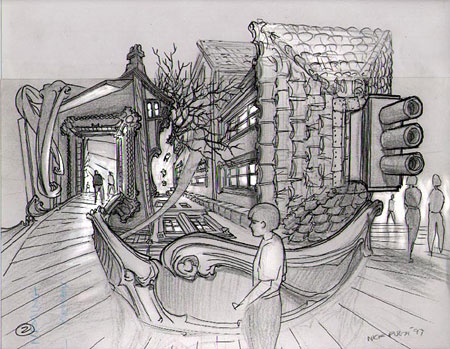
Nick Pugh is a concept artist who has done character, vehicle, prop and effects designs for movies like The Lion the Witch and the Wardrobe, The Ring 2 and Serenity.He is lead concept artist for the effects studio Rythm and Hues which also does concept design for high-end theme parks.
Pugh has a particular interest in concept vehicles and as well as pursuing his work in the entertainment industry. He designs concept cars for individuals, delivering a photo-realistic rendering in which the vehicle illustration is matched with a photo of the individual. He also designed his own concept car, the Xeno, that made it to a full-size version.
The Entertainment Design portion of his site contains pre-production illustrations in a variety of media, from sketches on vellum, mixed media, digital renderings and sculpture.
I particularly enjoy the monochromatic images in which he plays with disorienting juxtapositions of walls, streets, water and other visual elements of normal scenes in Escher-like impossibilities (image above). Unfortunately, I don’t know what project or projects they’re for. (I assume it’s a theme park installation.) If anyone knows, I’d love to find out.
In addition to his own site, I’m giving a link below to the Nick Pugh gallery on the Gnomon Workshop site, where he is an instructor. The page includes links to several of his instructional DVDs.
Categories:
-
Seth Fisher dies
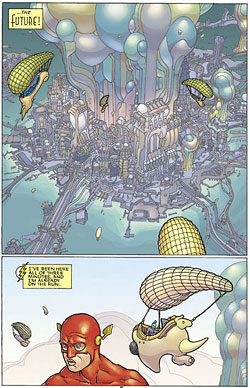 Word went around the Net today that comic artist Seth Fisher has died. Even those of us who only knew him through his art will feel a loss. His work was incredibly imaginative and wonderfully fun.
Here is a post I did about him back in November of last year. If you’re not familiar with his work, visit his site to see what we’ll be missing from now on.
Categories:
-
William Holman-Hunt
 There are more dramatic images I could have chosen to represent Holman-Hunt, The Scapegoat, for example or The Hireling Shepherd, but this painting, Isabella and the Pot of Basil , has a personal connection for me because I’ve been visiting the original in the Delaware Art Museum since I was an adolescent.
The painting was personal for Holman-Hunt in a very different way. It was based on portraits of his first wife and painted shortly after her death. The rather macabre story it depicts is from a Renaissance poem in which Isabella discovers the body of Lorenzo, who her brothers have murdered because they want her to marry another. She severs his head and buries it in a pot of basil which she waters with her tears. Holman-Hunt also painted a larger version of the same composition, which is in the Laing Gallery in Newcastle, England.
The original painting is small (15×23″, 38x58cm) and has a gem-like quality when standing in front of it. It is rich with the extraordinary detail and luminescent color that make the Pre-Raphaelite works so appealing to many (except, of course, to art critics, who seem immune to visual pleasure). You can literally spend hours working your eye through Holman-Hunt’s paintings, luxuriating in the visual feast of his attention to the texture and color of physical objects.
The composition of this work seems oddly off-kilter, but Holman-Hunt was such a masterful painter that I have to assume that is intentional. I find myself leaning into the pot of Basil with isabella and perhaps feeling additionally unsettled as if sharing her disorienting grief.
Even though Holman-Hunt professed social and religious views that valued purity and piety and often portrayed religious subjects, his paintings seem to revel in the sensuality of the physical world; you want to run your hand across the polished wood, feel the embroidered fabrics with your fingers, smell the plants and be dazzled by the light that bathes objects in glowing warmth.
Holman-Hunt, along with Dante Gabriel Rosetti and John Everett Millais, who he met while they were students at the Royal Academy, was a founder of the Pre-Raphaelite Brotherhood. The Pre-Raphaelites were a group of English painters and writers who rejected the idealized academic painting of the day, as exemplified by Sir Joshua Reynolds, then head of the Royal Academy, and embraced a return to the rich color and detail of the early Renaissance (before Raphael and his contemporaries started their own kind of idealized painting).
They desired to be faithful to nature in their paintings an also infused them with romanticism, pulling their subject matter from Keats, Shakespeare and classical literature. They were aided by critic John Ruskin, one of the few art critics who actually seems to have made a contribution to the history of art, if only because he defended the Pre-Raphaelites against the harsh treatment they received from other critics (a practice that still seems necessary today.)
There is a good selection of Holman-Hunt’s paintings on the Art Renewal Center and the ARTchive (ad warning).
Categories:
-
Drawing on the Right Side of the Brain (Betty Edwards)
 I have long been a firm believer in the idea that drawing is a skill that can be taught and not a magical gift bestowed on some individuals and denied others.
We live in a culture (at least in America) that doesn’t value drawing as a worthwhile skill in the general sense. “Everybody can’t be an artist, why teach them drawing?” But everyone can’t be a writer, why teach them writing? Just like writing, drawing has applications and benefits that go beyond its use by professionals. Drawing is a method of understanding and dealing with information about the world around us, a means of solving problems and changing perceptions. Because we don’t value drawing in that way, most of us (who haven’t been told that we have “talent”) stop drawing at about age 9 or 10 and our drawing skills freeze at that level.
Not that I don’t believe in “talent”, I think I have just enough “talent” to know what it is and what it isn’t. I learned to play the guitar, but I will never play like Eric Clapton. I can write an essay, but I will never write like Tom Wolfe. My drawing skills, though, are probably beyond what they might be if I hadn’t always had an innate tendency to explore that avenue. I understand the difference between learning a skill in a creative area and having the “talent” to carry that skill further than you might otherwise.
So when someone admires my drawing ability and says “I wish I could draw…”, I’m quick to say “You can learn if you really want to.” and back it up by recommending Drawing on the Right Side of the Brain by Dr. Betty Edwards.
Edwards is professor emeritus of art at California State University. She was teaching drawing in the late 60’s, and struggling to convey what she also saw as a skill that should be teachable, when she had an impulse to have the students copy a drawing by Picasso up-side down. To her and the students’ surprise they did much better when drawing something they couldn’t recognize consciously.
Over the next few years she expanded on that idea and combined it with her fascination with a theory of brain usage that was popular at the time to create her signature method for teaching drawing. The fact that the right-brain/left-brain model is in dispute as a theory of brain physiology doesn’t devalue it as a useful metaphor for two different modes of thinking and perceiving. The “left brain” specializes in logic, speech, analytical thought and critical evaluation and is emphasized in our society largely to the exclusion of the “right brain”, which is intuitive, holistic and concerned with spatial perception and the creative process.
Edwards assumption is that the logical left brain, which is dominant, perceives in symbols and “recognizes” objects in the visual world as belonging to classes of those symbols; so it interferes with the right brain’s ability to simply see what things really look like when trying to draw them. Your left brain says “An eye is just an oval with two pointed ends.” and prevents your right brain from seeing that an eye is a much more complex and asymmetrical shape.
Her teaching system consists largely of methods of getting the left brain to shut up and let the right brain really see what the eyes receive. She uses exercises she’s developed as well as traditional drawing techniques that fit into her approach, like pure contour drawing (drawing without taking your eyes off the subject to look at the paper) and drawing the shape of a negative space instead of an object’s outlines.
The pairs of drawings above left (and more on the site for the book) testify to the effectiveness of her approach. They are “before” and “after” self-portrait drawings from students enrolled in her intensive course, a workshop consisting of 5 days, eight hours a day.
The process is also of great value to experienced artists and well worth the time it takes to do the exercises. (Obviously you can do them at a slower pace over a longer period.) The book has enlightening chapters on portrait drawings (and the common problem of perceiving the face as larger than it is in relation to the size of the head), perspective, shading and color.
My only caveat is that Edwards only really covers half of what drawing is, albeit the more important half when starting out. The book has long been lacking in the aspects of drawing that lift it into the realm of art: the nuances of line, tone, composition, and handling of the materials that make a drawing really come alive. She’s added more of this to recent editions, but I would still recommend a serious student supplement the book with one of the traditional drawing texts like Mendelowitz’s Guide to Drawing (expensive, look for it on Half.com or eBay). (If you’re really serious, also look for a copy of Kimon Nicolaides’ The Natural Way to Draw : A Working Plan for Art Study.)
Edwards also wrote a somewhat less successful (but worthwhile) book on enhancing creativity, Drawing on the Artist Within, and more recently created a companion workbook for for her original book: “New Drawing on the Right Side of the Brain Workbook: Guided Practice in the Five Basic Skills of Drawing”. The web site also has begun to milk the whole thing a bit by selling pre-packaged “Portfolios” of basic art materials. The original book, though, is well worth checking out for anyone interested in drawing at any level. You can usually find older editions in most libraries.
Categories:



Charley’s Picks
Bookshop.org
(Bookshop.org affilliate links; sales benefit independent bookshop owners; I get a small percentage to help support my work on Lines and Colors)
Carlson’s Guide to Landscape Painting
Drawing and Sketching in Pencil
Bridgman’s Complete Guide to Drawing from Life
Charley’s Picks
Amazon
(Amazon.com affiliate links; sales go to a larger yacht for Jeff Bezos; but I get a small percentage to help support my work on Lines and Colors)
Carlson’s Guide to Landscape Painting
Drawing and Sketching in Pencil
Bridgman’s Complete Guide to Drawing from Life