


Categories
- 3d CGI
- Amusements
- Animation
- Anime & Manga
- Art Materials
- Art Videos
- Blogroll
- Cartoons
- Color
- Comics
- Concept & Visual Dev.
- Creativity
- Digital Art
- Digital Painting
- Displaying Art on the Web
- Drawing
- Eye Candy for Today
- Gallery and Museum Art
- High-res Art Images
- Illustration
- Motion Graphics & Flash
- Museums
- Online Museums
- Outsider Art
- Painting
- Painting a Day
- Paleo Art
- Pastel, Conté & Chalk
- Pen & Ink
- Prints and Printmaking
- Reviews
- Sc-fi and Fantasy
- Sculpture & Dimensional
- Site Comments
- Sketching
- Storyboards
- Tools and Techniques
- Uncategorized
- Vector Art
- Videos & Podcasts
- Vision and Optics
- Watercolor and Gouache
- Webcomics
Archives
- May 2026
- April 2026
- March 2026
- February 2026
- January 2026
- December 2025
- November 2025
- October 2025
- September 2025
- August 2025
- July 2025
- June 2025
- May 2025
- January 2025
- December 2024
- November 2024
- October 2024
- September 2024
- August 2024
- June 2024
- April 2024
- March 2024
- February 2024
- January 2024
- December 2023
- November 2023
- October 2023
- September 2023
- August 2023
- July 2023
- May 2023
- April 2023
- March 2023
- February 2023
- January 2023
- December 2022
- November 2022
- September 2022
- August 2022
- July 2022
- June 2022
- May 2022
- April 2022
- March 2022
- February 2022
- January 2022
- December 2021
- November 2021
- October 2021
- September 2021
- August 2021
- July 2021
- June 2021
- May 2021
- April 2021
- March 2021
- February 2021
- January 2021
- December 2020
- November 2020
- October 2020
- September 2020
- August 2020
- July 2020
- June 2020
- May 2020
- April 2020
- March 2020
- February 2020
- January 2020
- December 2019
- November 2019
- October 2019
- September 2019
- August 2019
- July 2019
- June 2019
- May 2019
- April 2019
- March 2019
- February 2019
- January 2019
- December 2018
- November 2018
- October 2018
- September 2018
- August 2018
- July 2018
- June 2018
- May 2018
- April 2018
- March 2018
- February 2018
- January 2018
- December 2017
- November 2017
- October 2017
- September 2017
- August 2017
- July 2017
- June 2017
- May 2017
- April 2017
- March 2017
- February 2017
- January 2017
- December 2016
- November 2016
- October 2016
- September 2016
- August 2016
- July 2016
- June 2016
- May 2016
- April 2016
- March 2016
- February 2016
- January 2016
- December 2015
- November 2015
- October 2015
- September 2015
- August 2015
- July 2015
- June 2015
- May 2015
- April 2015
- March 2015
- February 2015
- January 2015
- December 2014
- November 2014
- October 2014
- September 2014
- August 2014
- July 2014
- June 2014
- May 2014
- April 2014
- March 2014
- February 2014
- January 2014
- December 2013
- November 2013
- October 2013
- September 2013
- August 2013
- July 2013
- June 2013
- May 2013
- April 2013
- March 2013
- February 2013
- January 2013
- December 2012
- November 2012
- October 2012
- September 2012
- August 2012
- July 2012
- June 2012
- May 2012
- April 2012
- March 2012
- February 2012
- January 2012
- December 2011
- November 2011
- October 2011
- September 2011
- August 2011
- July 2011
- June 2011
- May 2011
- April 2011
- March 2011
- February 2011
- January 2011
- December 2010
- November 2010
- October 2010
- September 2010
- August 2010
- July 2010
- June 2010
- May 2010
- April 2010
- March 2010
- February 2010
- January 2010
- December 2009
- November 2009
- October 2009
- September 2009
- August 2009
- July 2009
- June 2009
- May 2009
- April 2009
- March 2009
- February 2009
- January 2009
- December 2008
- November 2008
- October 2008
- September 2008
- August 2008
- July 2008
- June 2008
- May 2008
- April 2008
- March 2008
- February 2008
- January 2008
- December 2007
- November 2007
- October 2007
- September 2007
- August 2007
- July 2007
- June 2007
- May 2007
- April 2007
- March 2007
- February 2007
- January 2007
- December 2006
- November 2006
- October 2006
- September 2006
- August 2006
- July 2006
- June 2006
- May 2006
- April 2006
- March 2006
- February 2006
- January 2006
- December 2005
- November 2005
- October 2005
- September 2005
- August 2005
Relevant Blogs
Art, Painting & Sketch
- Gurney Journey
- Underpaintings
- Art and Influence
- Painting Perceptions
- Oil Painters of America
- Vasari Paint POV
- Flying Fox
- Urban Sketchers
- Bento (Smithsonian)
- Art Inconnu
- The Hidden Place
- Still Life
- Making a Mark
- The Art of the Landscape
- Exploring Color & Creativity
- Art Contrarian
- Artist A Day
- beinArt Surreal Art Collective
- Eye Level
- David Dunlop
- p.i.g.m.e.n.t.i.u.m
- CultureGrrl
- Joaquín Sorolla blog
- Artists in Pastel
“Painting a Day”
- A Painting a Day (Keiser)
- On Painting (Keiser)
- Julian Merrow-Smith
- Karen Jurick
- Jeffrey Hayes
- Carol Marine
- Abbey Ryan
- Daily Paintworks
Other Painting Blogs
- Virtual Gouache Land
- Neil Hollingsworth
- Marc Hanson
- Kevin Menck
- Marc Dalessio
- Larry Seiler
- Stapleton Kearns
- Colin Page
- Roos Schuring
- Hans Versfelt
- Titus Meeuws
- Régis Pettinari
- René Plein Air
- Belinda Del Pesco
- Robin Weiss
- Nathan Fowkes (Land Sketch)
- William Wray
- Frank Serrano
- Stephen Magsig
- Michael Chesley Johnson
- Twice a Week
- Sarah Wimperis
- Rob Adams
- Michael Cole Manley
- The Dirty Palette Club
- Mike Manley’s Draw!
Gallery Art & Illustration mix
Illustration
- Howard Pyle
- 100 Years of Illustration
- BibliOdyssey
- Illustration Art
- Today’s Inspiration
- Illustration Mundo
- Little Chimp Society
- Danny Gregory
- R D (John Martz
- Illustration Friday blog
- Monster Brains
- Illustrators & Illustrations (RU)
- Elwood H. Smith
- DaniDraws.com
- Designers Who Blog
- iSpot Blog
Sci-Fi & Fantasy
Illustration & Comics
Comics & Cartoons
- Comics Beat
- Robot 6
- Newsarama Blog
- Comic Vine
- Comics Alliance
- Forbidden Planet Int.
- Paolo Rivera
- Bolt City
- Flight
- Scott McCloud
- The Comics Journal
- Comixpedia
- Funnybook Babylon
- James Baker
- Middleton’s Sketchbook
- Boneville
- The Hotel Fred
- Paul Rivoche
- Daily Cartoonist
- Mad About Cartoons (William Wray)
- Digital Strips
Illustration & Concept
Animation & Concept
- Cartoon Brew
- Animation Blog
- Cold Hard Flash
- Concept Art World
- The CAB
- FY Concept Art
- Concept Ships
- Concept Robots
- John Nevarez
- Armand Serrano
- Marcos Mateu-Mestre
- all kinds of stuff (Kricfalusi)
- Yacin the faun (Man Arenas)
- Kelsey Mann
- Cre8tivemarks Blog
- Ice-Cream Monster Toon Cafe
- AAU Character & Creature Design
- AAU Animation Notes
- Articles and Texticles
Paleo & Scientific
Tools & Techniques
Other
Lists of Art Blogs
Art Image Resource Links
Historic Art Images
- Wikimedia Commons: Paintings
- Wikimedia Commons: Drawings
- The Athenaeum
- WikiArt (WikiPaintings)
- Google Art Project: Artists
- Google Art Project: Collections (Museums)
- ArtCyclopedia
- Web Gallery of Art
- Art Renewal Center
- Web Gallery of Impressionism
Auction Consolidation sites
Auction sites
- Sotheby’s
- Bonham’s
- Christies
- Heritage Auctions: Fine Art
- Heritage Auctions: Illustration
- Freeman’s Auctions
- Bukowskis
- Shannon’s
Image Search
Reverse Image Search (search by image)
- Tin Eye
- RevImg
- Google Image Search (camera icon)
- Bing Image Search (camera icon)
Promoting some friends and some clients of my website design business
- Twin Willows T’ai Chi studio in Wilmington DE. Taiji classes with Bryan Davis.
- Ray Hayward, Inspired Teacher of T’ai Chi ( Taiji ) in Minneapolis, Founder of Mindful Motion Tai Chi Academy
- OldHead Tattoo studio and Art Gallery in Wilmington DE. Tattoos and paintings by Bruce Gulick
- Sharon Domenico Art, pet portrait oil paintings
- Platinum Paperhanging, wallpaper hanging, Main Line and Philadelphia, PA
- Lisa Stone Design, interior designer, Main Line and Philadelphia, PA
- Studio12KPT, original art, prints, calendars and other custom printed items by Van Sickle & Rolleri
-
Wilmington, Delaware gets an art store!
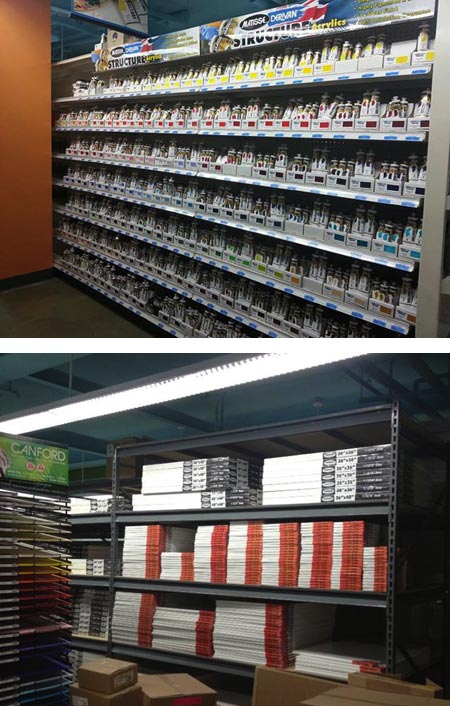
I’m happy to report that Jerry’s Artarama, an art supplier familiar to many from their online presence and a chain of retail stores across the U.S., has opened a store in Wilmington, Delaware.And why, you ask, should this be of interest to the wider national and international audience of Lines and Colors? Well, it’s relevant in that it prompts me to bring up the general state of online art suppliers and the availability of brick and mortar art supply stores in smaller cities.
Wilmington, Delaware is a relatively small city (population: 70,000) in the shadow of a large one — Philadelphia; it’s also near where I grew up, and still not far from where I live.
In years past, Wilmington had an art supply store called Audio Visual Arts, which everyone simply called “A.V.A.” It was one of those stores that seemed like a fixture when I was younger; as far as I knew it was always there, and I expected it to always be there. For a time, Wilmington supported two art stores — on the same block — after disgruntled A.V.A. employees started a rival store just a few doors down.
All of that changed when commercial art went digital at the end of the last century, as it did for so many art stores that depended on commercial artists as their primary customers and carried supplies for painters and students as a sideline. Brick and mortar art stores took another hit from the increasing prevalence of online art suppliers in the first decade of the new century.
Wilmington went from two art stores to less then one, when what remained of A.V.A. was moved to a small space adjoining the company’s related blueprint service, and the rival store went out of business. The small demi-store, left to cater to students and Sunday painters, eventually went under as well, leaving those who wanted to shop locally for art supplies to drive to a small shop in a nearby college town (Finley’s – a nice little shop, but with limited stock); or travel to Philadelphia, negotiate city traffic and fight for parking; or just be at the mercy of the suburban big-box arts and crafts stores. Any serious painter who has shopped at the latter (at least judging by the stores in this area) knows what a disappointing experience that can be.
Even though Wilmington has had a relatively small but growing art school, the Delaware College of Art and Design (where I teach a class in Web Animation with HTML5 and Adobe Flash) on it’s main shopping street since 1996, it has been without a real art supply store for a long long time. That changed last week, when Jerry’s Artarama opened its newest retail store in a building owned by the school, due in good measure to efforts on the part of DCAD’s president, Stuart Baron, and with cooperation from the city.
To me, and I’ll warrant a number of other artists in the region, a real brick and mortar art supply store opening in Wilmington was like flowers blooming in an long empty lot — a hopeful sign that things are changing for the better.
I certainly understand the appeal of online art suppliers. It’s difficult for brick and mortar stores to match the selection available from a large online supplier (similar to the difficulty faced by brick and mortar bookstores). For example, I recently ordered a jar of Red Ochre acrylic primer and a bag of marble dust to mix into it for texture — not items in high demand in local art stores. Also, my personal preference in oil paints is a brand of handmade paint from a small company that is only available online (see my post on Vasari Classic Artists’ Oil Colors).
However, when possible, I like to buy my other art supplies locally. There is something to be said about being able to see and feel the items you’re buying — the stiffness of a brush, texture of a canvas, thickness of a drawing paper or color of a marker — and the ability to pick up what you need today, when you need something for what you’re working on, not in a few days when FedEx trundles by with a shipment. (Plus, much like bookstores, I just love the way art stores smell.) So I like both online and local shopping for art supplies — for different reasons.
Philadelphia, about 30 miles from Wilmington, is a large city — with, I am told, more art schools per capita than any other American city. It has long supported multiple art supply stores in the downtown area (called Center City by locals), though individual stores have come and gone over the years. (When I was an art student, there was a cramped, cluttered, quirky and wonderful store called Zinni’s that was reminiscent of the bizarre little “we have it in the back” shops for magical paraphernalia in the Harry Potter movies — but I digress.)
The situation in Philadelphia has changed over time as well, both when the commercial art shift to digital media closed some of the stores that depended on commercial art customers, and more recently when Dick Blick, the largest online art supply company and chain of associated retail stores, opened a large store pretty much halfway between the city’s two largest art schools, the University of the Arts (formerly the Philadelphia College of Art) and the Pennsylvania Academy of the Fine Arts (where I spent my time as an art student years ago).
When the Blick store opened, a new large scale art store seemed a plus, and the store was welcomed by both students and the larger arts community (if not by its competitors, like Utrecht, the previous dominant presence). The other stores in Center City seemed to fare well enough in the following few years, leading to the thought that the city could support one more art store without losing the others.
That changed, however, when the Blick company bought Utrecht earlier this year (reportedly for their proprietary line of paints and canvas) and promptly closed the two Philadelphia Utrecht stores, undoubtedly with the idea of forcing everyone who had shopped at Utrecht to go to the single Blick store, raising that store’s profit per square foot. While this has likely been accomplished to the satisfaction of the company’s bean counters, I and many other local artists thought of it as regressive and a sorry event. At one time there were five art supply stores in the central part of the Philadelphia; there are now two — the big Blick store and a smaller (but quite good) Artist & Craftsman Supply store, part of a less extensive national chain.
So I’m happy that the unfortunate loss of the Utrecht stores (one of which was much more convenient for me reach than the Blick store) now seems offset by the new Jerry’s store in nearby Wilmington. Though I can bemoan the fact that all of these stores are part of national chains, and most (but not all) of the independent art supply stores in the wider metropolitan area are gone, I still feel encouraged when physical art supply stores open up, rather than closing down.
I was also encouraged that the new Jerry’s Artarama store in Wilmington is reasonably large and well stocked, comparable to the Utrecht stores we lost in Philadelphia — a serious art store and welcome antidote to the painfully meager offerings of the big-box craft stores. Artists and students in Wilmington have long had to travel to Philadelphia to buy art supplies, but the new Jerry’s store may well pull in the other direction, drawing students and others from out of state to the Wilmington store with the lure of easier parking and Delaware’s famous lack of sales tax.
A larger question posed here, however, and one I don’t have an answer for yet, is whether any of this is indicative of national trends, or is simply a local reshuffling of pieces on the board.
I’ll have to wait and see, but at least in the meanwhile, I’m happy I have another place to go when I need a painting panel, a #2 filbert, tube of gouache, a brush marker or a bottle of stand oil — or when I just want to walk into a store that smells like art supplies.
(Images above borrowed from the Jerry’s Artarama of Wilmington Facebook page)
Categories:
-
Eye Candy for Today: Alma-Tadema's Moses

The Finding of Moses, Sir Lawrence Alma-Tadema.The link above is to the file on Wikimedia Commons (click on their image for large version) though the image at top is from a version on WikiPaintings (click “Show Sizes” for larger versions). I think the latter image has better color, though it has been inexplicably flopped left to right (I’ve corrected it here).
The original is in a private collection. It was sold at auction today for a record price for 19th century European paintings (through Sotheby’s, though I can’t find the sale record on their new, poorly arranged website.)
Alma-Tadema worked on the painting for two years. The slaves do not look happy.
Categories:
-
My new post on Tor.com on concept art and the real U.S. space program in the 1950's
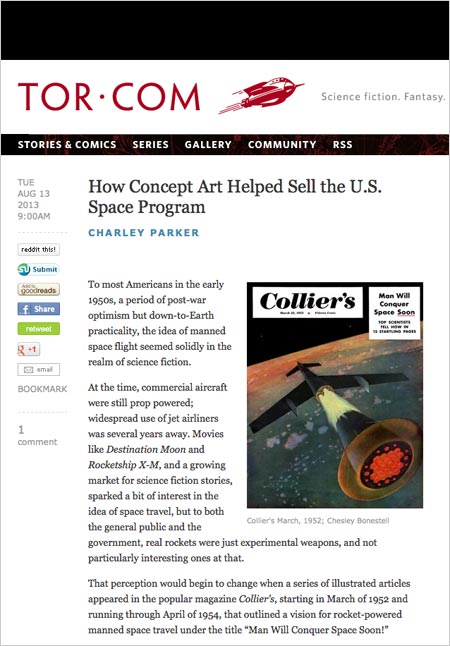
I’ve written new article for Tor.com titled “How Concept Art Helped Sell the U.S. Space Program“.
In it, I of course explain what I mean by the title, showcase some terrific space art by Chesley Bonestell, Fred Freeman and Rolf Klep, and link to a source for more.
You can see my previous articles for Tor.com here.
Categories:
-
Eric Spray

Eric Spray is a concept artist for the Gaming industry who has worked on projects like
worked on projects like X-Men Origins: Wolverine, Singularity, Black Ops and Modern Warfare 3.Though he is prevented by non-disclosure agreements from posting his most recent work, his blog features an array of past work, along with personal projects, sketches from life and other images.
You can also find a selection of his work on an alternate blog and his gallery on CGHub.
I particularly like his use of controlled color ranges, the painterly effects he achieves in faces in his digital paintings, and the way he has extended his range of techniques with digital studies of paintings by masters like Rembrandt and Sargent.
[Via Concept Ships]
Categories:
-
Lidia Luna

Though I’ve never had much of an eye for fashion, I do have an appreciation for fashion illustration, which sometimes shares some characteristics with comic book illustration, in that it has often been done in line or line filled with tone or color.Unfortunately, advances in newspaper printing technology, which permitted improved reproduction of photography, largely displaced the most common uses for fashion drawing in newspaper advertising over the last 20 years or so. It’s always good to see that the art is still alive in certain quarters, often with a more modern take on the venerable forms of rendering.
Lidia Luna has an approach that uses a fine or disappearing line, in fine point pen or pencil, with subtle rendering in watercolor.
Her renderings of models wearing haute couture take a minimalist approach to the presentation of faces, with forms suggested by soft gradations at key edges, and focus the detail on the clothing, as is expected in fashion illustration.
She has a website with a selection of renderings (arranged by project, note the “Next Project” links at the top of the pages), and a blog with more images, as well as sketches and other subjects.
There is a brief interview with Luna on Couture Troopers, but it doesn’t delve into technique.
[Via Illustration Mondo]
Categories:
-
Eye Candy for Today: John Hamilton Mortimer etching

Comedy (from Fifteen Etchings Dedicated to Sir Joshua Reynolds), John Hamilton MortimerIn the metropolitan Museum of Art. Use “Fullscreen” link and Download arrow. The outside dimentions of the sheet on which the etching is printed are roughly 12 1/2 x 7 1/2 inches (29 x 19 cm).
Another example of that wonderful quality of line that only seems possible with an etching needle. Here, Mortimer has supplemented traditional hatching with dense wavering cross hatching in the darkest areas and areas of stipple in the (weirdly demonic) faces.
Categories:




Charley’s Picks
Bookshop.org
(Bookshop.org affilliate links; sales benefit independent bookshop owners; I get a small percentage to help support my work on Lines and Colors)

John Singer Sargent: Watercolors


Urban Sketching: Understanding Perspective


Charley’s Picks
Amazon
(Amazon.com affiliate links; sales go to a larger yacht for Jeff Bezos; but I get a small percentage to help support my work on Lines and Colors)
John Singer Sargent: Watercolors
Urban Sketching: Understanding Perspective