


Categories
- 3d CGI
- Amusements
- Animation
- Anime & Manga
- Art Materials
- Art Videos
- Blogroll
- Cartoons
- Color
- Comics
- Concept & Visual Dev.
- Creativity
- Digital Art
- Digital Painting
- Displaying Art on the Web
- Drawing
- Eye Candy for Today
- Gallery and Museum Art
- High-res Art Images
- Illustration
- Motion Graphics & Flash
- Museums
- Online Museums
- Outsider Art
- Painting
- Painting a Day
- Paleo Art
- Pastel, Conté & Chalk
- Pen & Ink
- Prints and Printmaking
- Reviews
- Sc-fi and Fantasy
- Sculpture & Dimensional
- Site Comments
- Sketching
- Storyboards
- Tools and Techniques
- Uncategorized
- Vector Art
- Videos & Podcasts
- Vision and Optics
- Watercolor and Gouache
- Webcomics
Archives
- May 2026
- April 2026
- March 2026
- February 2026
- January 2026
- December 2025
- November 2025
- October 2025
- September 2025
- August 2025
- July 2025
- June 2025
- May 2025
- January 2025
- December 2024
- November 2024
- October 2024
- September 2024
- August 2024
- June 2024
- April 2024
- March 2024
- February 2024
- January 2024
- December 2023
- November 2023
- October 2023
- September 2023
- August 2023
- July 2023
- May 2023
- April 2023
- March 2023
- February 2023
- January 2023
- December 2022
- November 2022
- September 2022
- August 2022
- July 2022
- June 2022
- May 2022
- April 2022
- March 2022
- February 2022
- January 2022
- December 2021
- November 2021
- October 2021
- September 2021
- August 2021
- July 2021
- June 2021
- May 2021
- April 2021
- March 2021
- February 2021
- January 2021
- December 2020
- November 2020
- October 2020
- September 2020
- August 2020
- July 2020
- June 2020
- May 2020
- April 2020
- March 2020
- February 2020
- January 2020
- December 2019
- November 2019
- October 2019
- September 2019
- August 2019
- July 2019
- June 2019
- May 2019
- April 2019
- March 2019
- February 2019
- January 2019
- December 2018
- November 2018
- October 2018
- September 2018
- August 2018
- July 2018
- June 2018
- May 2018
- April 2018
- March 2018
- February 2018
- January 2018
- December 2017
- November 2017
- October 2017
- September 2017
- August 2017
- July 2017
- June 2017
- May 2017
- April 2017
- March 2017
- February 2017
- January 2017
- December 2016
- November 2016
- October 2016
- September 2016
- August 2016
- July 2016
- June 2016
- May 2016
- April 2016
- March 2016
- February 2016
- January 2016
- December 2015
- November 2015
- October 2015
- September 2015
- August 2015
- July 2015
- June 2015
- May 2015
- April 2015
- March 2015
- February 2015
- January 2015
- December 2014
- November 2014
- October 2014
- September 2014
- August 2014
- July 2014
- June 2014
- May 2014
- April 2014
- March 2014
- February 2014
- January 2014
- December 2013
- November 2013
- October 2013
- September 2013
- August 2013
- July 2013
- June 2013
- May 2013
- April 2013
- March 2013
- February 2013
- January 2013
- December 2012
- November 2012
- October 2012
- September 2012
- August 2012
- July 2012
- June 2012
- May 2012
- April 2012
- March 2012
- February 2012
- January 2012
- December 2011
- November 2011
- October 2011
- September 2011
- August 2011
- July 2011
- June 2011
- May 2011
- April 2011
- March 2011
- February 2011
- January 2011
- December 2010
- November 2010
- October 2010
- September 2010
- August 2010
- July 2010
- June 2010
- May 2010
- April 2010
- March 2010
- February 2010
- January 2010
- December 2009
- November 2009
- October 2009
- September 2009
- August 2009
- July 2009
- June 2009
- May 2009
- April 2009
- March 2009
- February 2009
- January 2009
- December 2008
- November 2008
- October 2008
- September 2008
- August 2008
- July 2008
- June 2008
- May 2008
- April 2008
- March 2008
- February 2008
- January 2008
- December 2007
- November 2007
- October 2007
- September 2007
- August 2007
- July 2007
- June 2007
- May 2007
- April 2007
- March 2007
- February 2007
- January 2007
- December 2006
- November 2006
- October 2006
- September 2006
- August 2006
- July 2006
- June 2006
- May 2006
- April 2006
- March 2006
- February 2006
- January 2006
- December 2005
- November 2005
- October 2005
- September 2005
- August 2005
Relevant Blogs
Art, Painting & Sketch
- Gurney Journey
- Underpaintings
- Art and Influence
- Painting Perceptions
- Oil Painters of America
- Vasari Paint POV
- Flying Fox
- Urban Sketchers
- Bento (Smithsonian)
- Art Inconnu
- The Hidden Place
- Still Life
- Making a Mark
- The Art of the Landscape
- Exploring Color & Creativity
- Art Contrarian
- Artist A Day
- beinArt Surreal Art Collective
- Eye Level
- David Dunlop
- p.i.g.m.e.n.t.i.u.m
- CultureGrrl
- Joaquín Sorolla blog
- Artists in Pastel
“Painting a Day”
- A Painting a Day (Keiser)
- On Painting (Keiser)
- Julian Merrow-Smith
- Karen Jurick
- Jeffrey Hayes
- Carol Marine
- Abbey Ryan
- Daily Paintworks
Other Painting Blogs
- Virtual Gouache Land
- Neil Hollingsworth
- Marc Hanson
- Kevin Menck
- Marc Dalessio
- Larry Seiler
- Stapleton Kearns
- Colin Page
- Roos Schuring
- Hans Versfelt
- Titus Meeuws
- Régis Pettinari
- René Plein Air
- Belinda Del Pesco
- Robin Weiss
- Nathan Fowkes (Land Sketch)
- William Wray
- Frank Serrano
- Stephen Magsig
- Michael Chesley Johnson
- Twice a Week
- Sarah Wimperis
- Rob Adams
- Michael Cole Manley
- The Dirty Palette Club
- Mike Manley’s Draw!
Gallery Art & Illustration mix
Illustration
- Howard Pyle
- 100 Years of Illustration
- BibliOdyssey
- Illustration Art
- Today’s Inspiration
- Illustration Mundo
- Little Chimp Society
- Danny Gregory
- R D (John Martz
- Illustration Friday blog
- Monster Brains
- Illustrators & Illustrations (RU)
- Elwood H. Smith
- DaniDraws.com
- Designers Who Blog
- iSpot Blog
Sci-Fi & Fantasy
Illustration & Comics
Comics & Cartoons
- Comics Beat
- Robot 6
- Newsarama Blog
- Comic Vine
- Comics Alliance
- Forbidden Planet Int.
- Paolo Rivera
- Bolt City
- Flight
- Scott McCloud
- The Comics Journal
- Comixpedia
- Funnybook Babylon
- James Baker
- Middleton’s Sketchbook
- Boneville
- The Hotel Fred
- Paul Rivoche
- Daily Cartoonist
- Mad About Cartoons (William Wray)
- Digital Strips
Illustration & Concept
Animation & Concept
- Cartoon Brew
- Animation Blog
- Cold Hard Flash
- Concept Art World
- The CAB
- FY Concept Art
- Concept Ships
- Concept Robots
- John Nevarez
- Armand Serrano
- Marcos Mateu-Mestre
- all kinds of stuff (Kricfalusi)
- Yacin the faun (Man Arenas)
- Kelsey Mann
- Cre8tivemarks Blog
- Ice-Cream Monster Toon Cafe
- AAU Character & Creature Design
- AAU Animation Notes
- Articles and Texticles
Paleo & Scientific
Tools & Techniques
Other
Lists of Art Blogs
Art Image Resource Links
Historic Art Images
- Wikimedia Commons: Paintings
- Wikimedia Commons: Drawings
- The Athenaeum
- WikiArt (WikiPaintings)
- Google Art Project: Artists
- Google Art Project: Collections (Museums)
- ArtCyclopedia
- Web Gallery of Art
- Art Renewal Center
- Web Gallery of Impressionism
Auction Consolidation sites
Auction sites
- Sotheby’s
- Bonham’s
- Christies
- Heritage Auctions: Fine Art
- Heritage Auctions: Illustration
- Freeman’s Auctions
- Bukowskis
- Shannon’s
Image Search
Reverse Image Search (search by image)
- Tin Eye
- RevImg
- Google Image Search (camera icon)
- Bing Image Search (camera icon)
Promoting some friends and some clients of my website design business
- Twin Willows T’ai Chi studio in Wilmington DE. Taiji classes with Bryan Davis.
- Ray Hayward, Inspired Teacher of T’ai Chi ( Taiji ) in Minneapolis, Founder of Mindful Motion Tai Chi Academy
- OldHead Tattoo studio and Art Gallery in Wilmington DE. Tattoos and paintings by Bruce Gulick
- Sharon Domenico Art, pet portrait oil paintings
- Platinum Paperhanging, wallpaper hanging, Main Line and Philadelphia, PA
- Lisa Stone Design, interior designer, Main Line and Philadelphia, PA
- Studio12KPT, original art, prints, calendars and other custom printed items by Van Sickle & Rolleri
-
Hudson River Landscapes at Peabody Essex
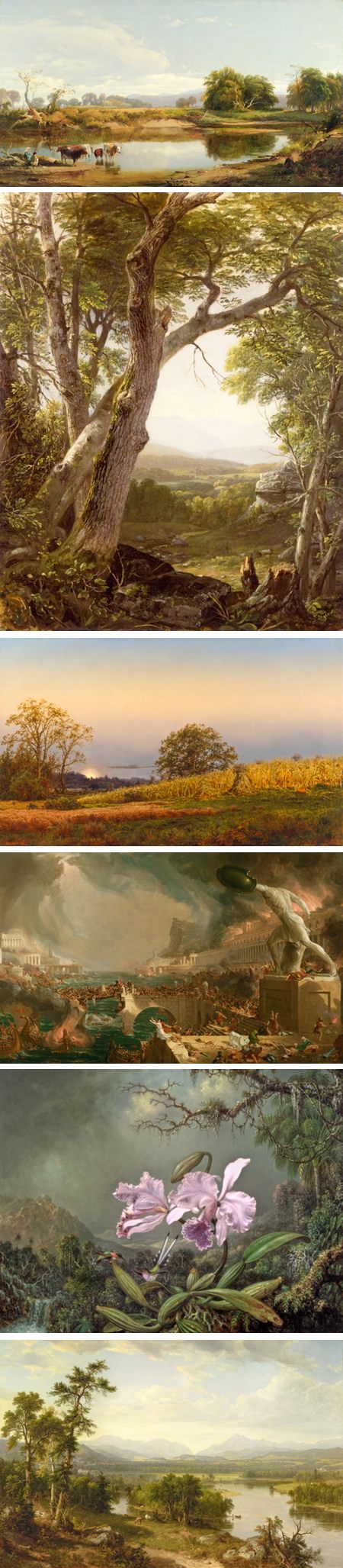
The Hudson River School is a collective name for two generations of painters working in the areas in and around the Hudson River Valley in New York who transformed American Art, and landscape painting in general, in the early part of the 19th Century.Painting the American Vision is the title of a new exhibition at the Peabody Essex Museum in Salem, MA that showcases these artists with 45 of their works drawn from the collection of the New York Historical Society.
The show includes works by Thomas Cole, Albert Biersadt, Frederic Edwin Church, Asher B. Durand and others, both familiar and less well known.
The museum’s page for the exhibition includes a slideshow of 12 paintings from the show, and there is a press release that goes into more detail about some of the artists and paintings.
You can also see a slideshow and description of the exhibit on the website of the Carter Museum of Art in Texas, where it was on display last year.
You can also visit the site of the New York Historical Society and view their extensive collection of Hudson River School paintings.
Painting the American Vision is on display at the Peabody Essex Museum until November 6, 2011.
(Images above: William hart, Asher B. Durand, Louis Rémy Mignot, Thomas Cole, George Peter Alexander Healy, Asher B. Durand)
Categories:
-
Caricatures and facial recognition on Wired
I’ve long held that the most challenging subject for representational drawing and painting is the human figure, and in particular, the face. This is because we recognize, and can detect small inaccuracies in faces and the human form more easily than in any other part of the natural world.If you draw a tree, and keep to a general approximation of that tree’s shape, smaller branches extending from larger, ect., few individuals who are not trained botanists would call you on minor inaccuracies relative to that species or the depiction of that individual tree. Draw an arm, hand, leg, or in particular a face incorrectly, and almost anyone will immediately recognize it as wrong.
Humans are hard wired for recognizing other humans, especially faces. We can look at photographs of a person as a child, adolescent and adult, stages in which major features like the relative size of the eyes and face to the size of the head can change dramatically, and still recognize it as the same person. Likewise, we can easily identify family resemblances among different individuals. Our ability to discriminate minute differences in facial features is remarkable.
Computer algorithms are getting better at it, as in the face recognition features in photo management software, but are still lacking.
Enter caricaturists, artists who, even more than portrait painters, must identify those characteristics that set one face apart from another. (Portrait painters can focus on accuracy and a sense of the sitter’s personality, caricaturists must find the identifying characteristics and exaggerate them.)
Writer Ben Austen has a article in the August Wired magazine, What Caricatures Can Teach Us About Facial Recognition in which he explores these ideas. He also describes a project at MIT analyzing hundreds of caricatures from dozens of caricature artists in an attempt to codify how they see facial differences into machine algorithms. It’s called the “Hirschfeld Project”, after noted caricaturist Al Hirschfeld.
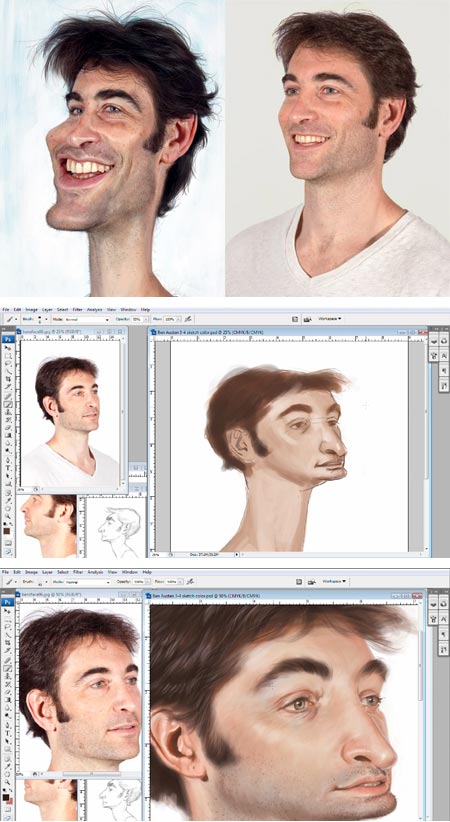
To accompany the article, Wired had four noted caricaturists create caricatures of the article’s author — Court Jones, Daniel Almariei, Glenn Ferguson and Jason Seiler (image above, top) .
For those interested in the process, and in digital painting technique, one of the most interesting features is a video at the end of the article showing Court Jones working through several preliminary sketches and a finished digital painting of his caricature of Austen in Photoshop, while discussing his process (images above, middle and bottom).
Categories:
-
LOST: The Animated Series character designs (Michael Myers)

Illustrator and animator Michael B. Myers has given us his vision of what the characters from the LOST television series would look like if they were designed for an animated series.As unlikely as that possibility may be (except perhaps in alternate reality timeline limbo) it’s fun to have his nicely stylized treatment of some of the major characters from the series — even the smoke monster. (What, no Juliet?).
You can also find more of Myers’ digital painting, studies, sketches, posters and T-shirt designs on his website and on Behance Network.
Categories:
-
Retro Future Space Art on Dark Roasted Blend

I just love these. Not only do I take great delight in past visions of the future, I’m particularly fond of retro space art.The blog Dark Roasted Blend, which posts items that are odd, amusing, visually interesting — or all three, has posted a fine addition to their wonderful series of posts collecting visions of future space tech from the past, notably the 1930’s through the 1960’s.
The posts are a cornucopia of art deco streamlined spaceships, giant wheeled space stations, beautifully clunky spacesuits and rocketships with fins that would make a 1959 Cadillac turn green with envy.
Is it the future yet?
(Please see the original articles for links to the image credits.)
[Via BibliOdyssey]
Categories:
-
LeConte Stewart

LeConte Stewart was an American painter active in the 20th Century who spent most of his life portraying the landscape of his native state of Utah.Stewart studied art at the University of Utah, but also traveled to the East Coast to study with established artists there, notably John Fabian Carlson.
I also see other influences in his work, of the California landscape painters like Hanson Puthuff and other American Impressionists, as well as Edward Hopper and John Sloan. Mostly, however, Stewart’s vision was his own and, a dedicated plein air painter, he spent countless hours painting in the fields, farms, deserts and small towns of his beloved Utah.
In addition to painting in oil, Stewart worked in pastel and watercolor, sketched in pencil and ink and was an accomplished etcher. Stewart joined the faculty of the Art Department of the University of Utah, and served as chair for over 20 years.
Some of his early work documents the trials of the nation and of individuals through the Great Depression, which is the theme of one of two new exhibitions on the painter.
The Utah Museum of Fine Arts and the LDS Church History Museum are presenting joint exhibitions, LeConte Stewart: Depression Era Art at the UMFA and LeConte Stewart: The Soul of Rural Utah at the Church History Museum. The exhibitions are on display until January 15, 2012; together they include over 200 works by the artist.
The UMFA has created an online resource for Stewart. The museum’s own holdings of Stewart’s work are extensive and the online section of their permanent collection is the best resource I’ve found. Note the arrows at bottom to subsequent pages of thumbnails, of which there are several. Most images are zoomable (the zoom controls take some getting used to, the icons don’t produce actions themselves, but change the action of your cursor).
There is a video of LeConte Stewart by Claudia Sisemore that includes a brief introduction to Stewart and his work and features footage of him working on location and audio of him discussing his approach.
Categories:
-
Art-o-Mat (update)

So you’re standing in front of a beautifully refurbished vending machine; you put in your golden token, make your selection, pull the selection knob, listen to the delightful “clunkity-clunk” that means your selection has arrived in the vending tray; you reach down and pick up your… art?Yes, if the vending machine is one of the over 90 classic vending machines around the US and Canada that have been converted to Art-o-Mats, vending machines that dispense original works of art.
I first wrote about Art-o-Mat in 2006; the idea was started in 1997 by artist Clark Whittington. There are now over 400 participating artists, creating small cigarette-pack size works in various media, and selling them inexpensively (usually $5 US) in Art-o-Mats.
On the Art-o-mat website there is a list of machines by location, as well as a selection of images of various Art-o-Mat machines and a list of sample works by various artists, linked to pop-up images of some of their Art-o-Mat works.
There are also guidelines for artists who would like to participate.
For those who wish to purchase Art-o-Mat art, but can’t get to a machine, you can now order an Art-o-Carton of 10 works online for $99.
There is also now a Flickr gallery of Art-o-Mat related photos.
Hey, can I bum five bucks? I need to get a pack of art.
(Images above, below the machines: Lindsay Matthews, Paula Griffin, Lee Fenyves, Julie Armbruster, Asya Soloian, Janie Reavis-Cox, Carrie Price, Jessica Guptill)
Categories:




Charley’s Picks
Bookshop.org
(Bookshop.org affilliate links; sales benefit independent bookshop owners; I get a small percentage to help support my work on Lines and Colors)

John Singer Sargent: Watercolors


Urban Sketching: Understanding Perspective


Charley’s Picks
Amazon
(Amazon.com affiliate links; sales go to a larger yacht for Jeff Bezos; but I get a small percentage to help support my work on Lines and Colors)
John Singer Sargent: Watercolors
Urban Sketching: Understanding Perspective