


Categories
- 3d CGI
- Amusements
- Animation
- Anime & Manga
- Art Materials
- Art Videos
- Blogroll
- Cartoons
- Color
- Comics
- Concept & Visual Dev.
- Creativity
- Digital Art
- Digital Painting
- Displaying Art on the Web
- Drawing
- Eye Candy for Today
- Gallery and Museum Art
- High-res Art Images
- Illustration
- Motion Graphics & Flash
- Museums
- Online Museums
- Outsider Art
- Painting
- Painting a Day
- Paleo Art
- Pastel, Conté & Chalk
- Pen & Ink
- Prints and Printmaking
- Reviews
- Sc-fi and Fantasy
- Sculpture & Dimensional
- Site Comments
- Sketching
- Storyboards
- Tools and Techniques
- Uncategorized
- Vector Art
- Videos & Podcasts
- Vision and Optics
- Watercolor and Gouache
- Webcomics
Archives
- May 2026
- April 2026
- March 2026
- February 2026
- January 2026
- December 2025
- November 2025
- October 2025
- September 2025
- August 2025
- July 2025
- June 2025
- May 2025
- January 2025
- December 2024
- November 2024
- October 2024
- September 2024
- August 2024
- June 2024
- April 2024
- March 2024
- February 2024
- January 2024
- December 2023
- November 2023
- October 2023
- September 2023
- August 2023
- July 2023
- May 2023
- April 2023
- March 2023
- February 2023
- January 2023
- December 2022
- November 2022
- September 2022
- August 2022
- July 2022
- June 2022
- May 2022
- April 2022
- March 2022
- February 2022
- January 2022
- December 2021
- November 2021
- October 2021
- September 2021
- August 2021
- July 2021
- June 2021
- May 2021
- April 2021
- March 2021
- February 2021
- January 2021
- December 2020
- November 2020
- October 2020
- September 2020
- August 2020
- July 2020
- June 2020
- May 2020
- April 2020
- March 2020
- February 2020
- January 2020
- December 2019
- November 2019
- October 2019
- September 2019
- August 2019
- July 2019
- June 2019
- May 2019
- April 2019
- March 2019
- February 2019
- January 2019
- December 2018
- November 2018
- October 2018
- September 2018
- August 2018
- July 2018
- June 2018
- May 2018
- April 2018
- March 2018
- February 2018
- January 2018
- December 2017
- November 2017
- October 2017
- September 2017
- August 2017
- July 2017
- June 2017
- May 2017
- April 2017
- March 2017
- February 2017
- January 2017
- December 2016
- November 2016
- October 2016
- September 2016
- August 2016
- July 2016
- June 2016
- May 2016
- April 2016
- March 2016
- February 2016
- January 2016
- December 2015
- November 2015
- October 2015
- September 2015
- August 2015
- July 2015
- June 2015
- May 2015
- April 2015
- March 2015
- February 2015
- January 2015
- December 2014
- November 2014
- October 2014
- September 2014
- August 2014
- July 2014
- June 2014
- May 2014
- April 2014
- March 2014
- February 2014
- January 2014
- December 2013
- November 2013
- October 2013
- September 2013
- August 2013
- July 2013
- June 2013
- May 2013
- April 2013
- March 2013
- February 2013
- January 2013
- December 2012
- November 2012
- October 2012
- September 2012
- August 2012
- July 2012
- June 2012
- May 2012
- April 2012
- March 2012
- February 2012
- January 2012
- December 2011
- November 2011
- October 2011
- September 2011
- August 2011
- July 2011
- June 2011
- May 2011
- April 2011
- March 2011
- February 2011
- January 2011
- December 2010
- November 2010
- October 2010
- September 2010
- August 2010
- July 2010
- June 2010
- May 2010
- April 2010
- March 2010
- February 2010
- January 2010
- December 2009
- November 2009
- October 2009
- September 2009
- August 2009
- July 2009
- June 2009
- May 2009
- April 2009
- March 2009
- February 2009
- January 2009
- December 2008
- November 2008
- October 2008
- September 2008
- August 2008
- July 2008
- June 2008
- May 2008
- April 2008
- March 2008
- February 2008
- January 2008
- December 2007
- November 2007
- October 2007
- September 2007
- August 2007
- July 2007
- June 2007
- May 2007
- April 2007
- March 2007
- February 2007
- January 2007
- December 2006
- November 2006
- October 2006
- September 2006
- August 2006
- July 2006
- June 2006
- May 2006
- April 2006
- March 2006
- February 2006
- January 2006
- December 2005
- November 2005
- October 2005
- September 2005
- August 2005
Relevant Blogs
Art, Painting & Sketch
- Gurney Journey
- Underpaintings
- Art and Influence
- Painting Perceptions
- Oil Painters of America
- Vasari Paint POV
- Flying Fox
- Urban Sketchers
- Bento (Smithsonian)
- Art Inconnu
- The Hidden Place
- Still Life
- Making a Mark
- The Art of the Landscape
- Exploring Color & Creativity
- Art Contrarian
- Artist A Day
- beinArt Surreal Art Collective
- Eye Level
- David Dunlop
- p.i.g.m.e.n.t.i.u.m
- CultureGrrl
- Joaquín Sorolla blog
- Artists in Pastel
“Painting a Day”
- A Painting a Day (Keiser)
- On Painting (Keiser)
- Julian Merrow-Smith
- Karen Jurick
- Jeffrey Hayes
- Carol Marine
- Abbey Ryan
- Daily Paintworks
Other Painting Blogs
- Virtual Gouache Land
- Neil Hollingsworth
- Marc Hanson
- Kevin Menck
- Marc Dalessio
- Larry Seiler
- Stapleton Kearns
- Colin Page
- Roos Schuring
- Hans Versfelt
- Titus Meeuws
- Régis Pettinari
- René Plein Air
- Belinda Del Pesco
- Robin Weiss
- Nathan Fowkes (Land Sketch)
- William Wray
- Frank Serrano
- Stephen Magsig
- Michael Chesley Johnson
- Twice a Week
- Sarah Wimperis
- Rob Adams
- Michael Cole Manley
- The Dirty Palette Club
- Mike Manley’s Draw!
Gallery Art & Illustration mix
Illustration
- Howard Pyle
- 100 Years of Illustration
- BibliOdyssey
- Illustration Art
- Today’s Inspiration
- Illustration Mundo
- Little Chimp Society
- Danny Gregory
- R D (John Martz
- Illustration Friday blog
- Monster Brains
- Illustrators & Illustrations (RU)
- Elwood H. Smith
- DaniDraws.com
- Designers Who Blog
- iSpot Blog
Sci-Fi & Fantasy
Illustration & Comics
Comics & Cartoons
- Comics Beat
- Robot 6
- Newsarama Blog
- Comic Vine
- Comics Alliance
- Forbidden Planet Int.
- Paolo Rivera
- Bolt City
- Flight
- Scott McCloud
- The Comics Journal
- Comixpedia
- Funnybook Babylon
- James Baker
- Middleton’s Sketchbook
- Boneville
- The Hotel Fred
- Paul Rivoche
- Daily Cartoonist
- Mad About Cartoons (William Wray)
- Digital Strips
Illustration & Concept
Animation & Concept
- Cartoon Brew
- Animation Blog
- Cold Hard Flash
- Concept Art World
- The CAB
- FY Concept Art
- Concept Ships
- Concept Robots
- John Nevarez
- Armand Serrano
- Marcos Mateu-Mestre
- all kinds of stuff (Kricfalusi)
- Yacin the faun (Man Arenas)
- Kelsey Mann
- Cre8tivemarks Blog
- Ice-Cream Monster Toon Cafe
- AAU Character & Creature Design
- AAU Animation Notes
- Articles and Texticles
Paleo & Scientific
Tools & Techniques
Other
Lists of Art Blogs
Art Image Resource Links
Historic Art Images
- Wikimedia Commons: Paintings
- Wikimedia Commons: Drawings
- The Athenaeum
- WikiArt (WikiPaintings)
- Google Art Project: Artists
- Google Art Project: Collections (Museums)
- ArtCyclopedia
- Web Gallery of Art
- Art Renewal Center
- Web Gallery of Impressionism
Auction Consolidation sites
Auction sites
- Sotheby’s
- Bonham’s
- Christies
- Heritage Auctions: Fine Art
- Heritage Auctions: Illustration
- Freeman’s Auctions
- Bukowskis
- Shannon’s
Image Search
Reverse Image Search (search by image)
- Tin Eye
- RevImg
- Google Image Search (camera icon)
- Bing Image Search (camera icon)
Promoting some friends and some clients of my website design business
- Twin Willows T’ai Chi studio in Wilmington DE. Taiji classes with Bryan Davis.
- Ray Hayward, Inspired Teacher of T’ai Chi ( Taiji ) in Minneapolis, Founder of Mindful Motion Tai Chi Academy
- OldHead Tattoo studio and Art Gallery in Wilmington DE. Tattoos and paintings by Bruce Gulick
- Sharon Domenico Art, pet portrait oil paintings
- Platinum Paperhanging, wallpaper hanging, Main Line and Philadelphia, PA
- Lisa Stone Design, interior designer, Main Line and Philadelphia, PA
- Studio12KPT, original art, prints, calendars and other custom printed items by Van Sickle & Rolleri
-
Terry Miura (update)
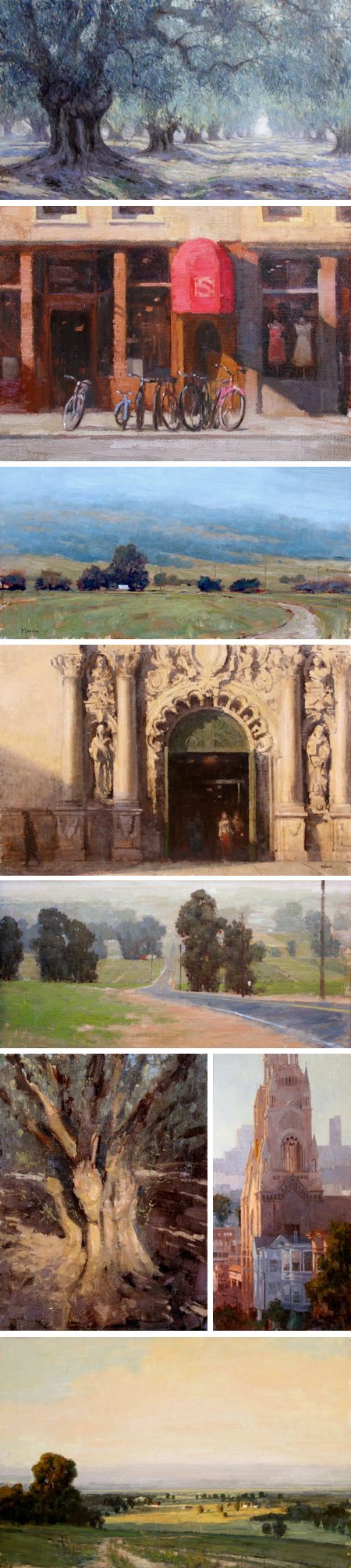
Since I wrote about California painter Terry Miura in 2007, his website has been redone and updated with new paintings, divided into sections for Landscapes, Cityscapes, Figurative and Small Works.Miura’s softly geometric, atmospheric paintings emphasize color harmony and composition and have an emotional resonance for those brief, almost unnoticed moments when we are struck by time of day, slanting light, passing shadows and hints of change.
While light plays an important part of many of his compositions, particularly the cityscapes, it is more often the role of atmosphere that defines the work, not just in the sense of muted colors and decreased value contrasts, but in a palpable feeling of being surrounded by air of a certain kind, of warm sun or cool mist.
Miura teaches figure painting at the School of Light and Color in Fair Oaks, CA, as well as teaching occasional workshops. He has recently published a painting demo booklet from his plein air painting workshops.
Miura also maintains a blog, Studio Notes. A recent post mentions that one of his paintings has just been acquired as part of the permanent collection of the Crocker Art Museum.
Categories:
-
Mukesh Singh
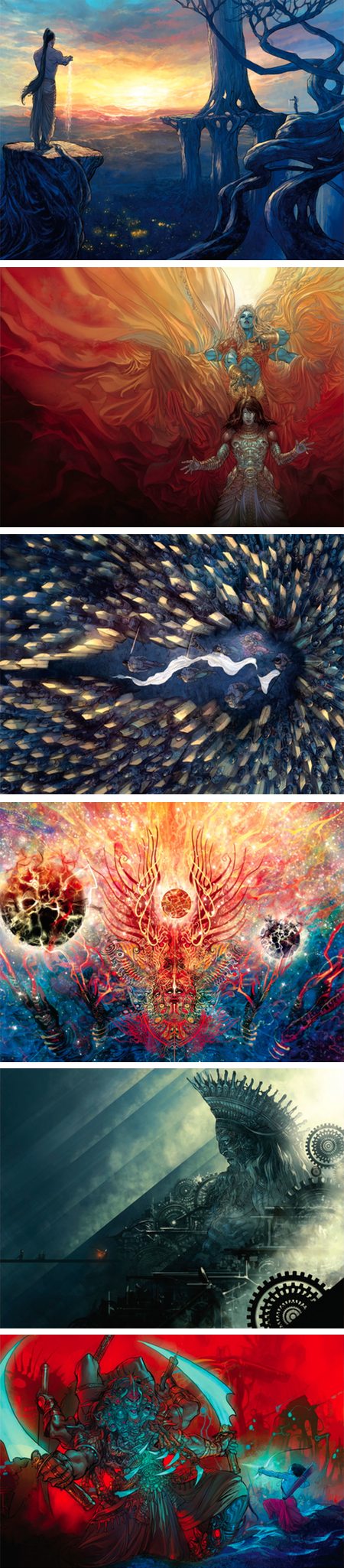
Mukesh Singh moved from working with a gaming company as a 3D artist and concept designer into drawing comics, working for the then new Virgin Comics publishing house.He moved from his base in Mumbai to new quarters in Bangalore and took on comics full time. He has worked on titles like Devi, Guy Ritchie’s Gamekeeper and Jenna Jameson’s Shadow, but first came to my attention with I saw his striking work for Grant Morrison’s 18 Days (images above), an adaptation of the ancient Sanskrit epic Mahabharata.
The latter title isn’t comics format but an illustrated book with story and art on facing pages, apparently from scripts Morrison has been working on for an animated version of the story. There is a great preview of some of the images, and the best example I can find of Singh’s work, on Parka Blogs.
Beyond that, I can find little information about Singh; he doesn’t appear to currently have a web site or blog. What little I know about his background comes from an interview conducted by Saurav Mohapatra on Comics Waiting Room.
[Addendum: Siju Thomas (see this post’s comments) was kind enough to let us know that Mukesh currently lives and works in Mumbai, is working with Liquid comics and is on LinkedIn.]
Categories:
-
About Face (Chris James)

About Face is a short (4 minute) hand drawn animation featuring a series of nicely imaginative morphing sequences, with animals, faces, even caricatures of figures from history and pop culture, like Picasso and Dal&iacite; (above).Written and drawn in 1977 by Chris James, with camera work by Julian Holdaway and music by Claude Jouvin, the short demonstrates that imagination, not CGI, is the necessary element for this kind of clever and amusing image dance.
[Via Cartoon Brew]
Categories:
-
Paintmap
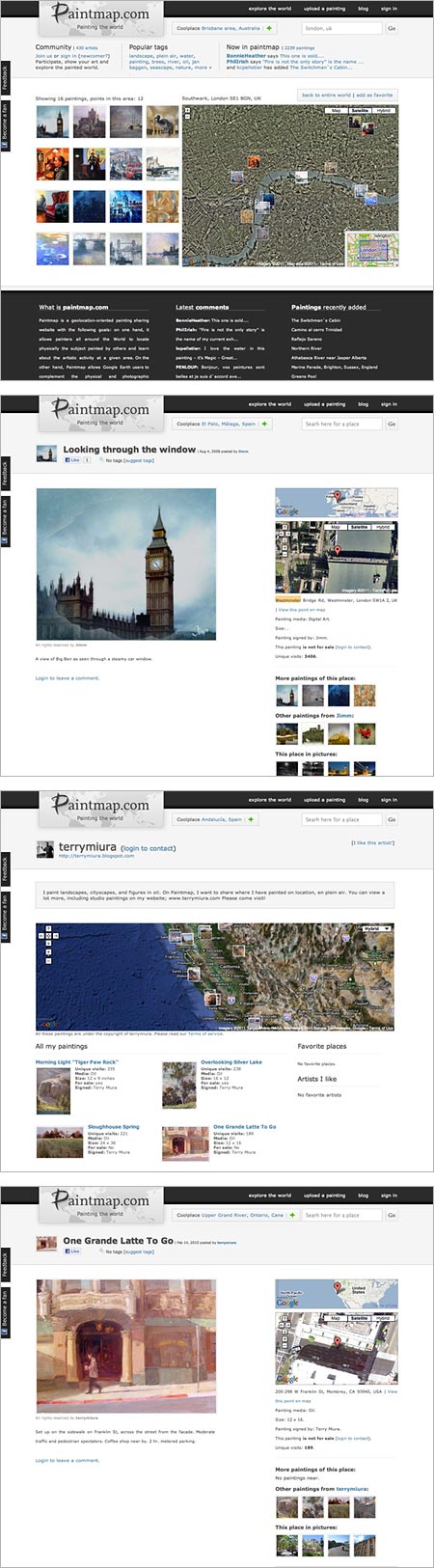
Like The Arts Map, that I wrote about last spring, Paintmap is a location based mapping feature based on the Google Maps API.In the case of The Arts Map, the application allows artists and arts related institutions to locate themselves on a global map, with a virtual pin tied to a pop-up with more detailed information for those browsing or searching.
Paintmap is focused on pinpointing the location of individual paintings, allowing the user to select a location, view thumbnails of paintings painted of or in that location and see them in more detail, along with information about the artist. It’s a nice idea, reasonably well executed in many respects, though a bit awkward in others.
You can search for a particular location (or artist) or browse from the page of an existing location or work through thumbnails that link to more works from that location, more works by that artist, or links from an artist’s page to other artists they like.
Pages for individual works also show show thumbnail images of photographs from the same location when available. In addition you can search by tags, like “river”, field”, etc. There is a Paintmap blog that describes some of the site’s evolving features.
You can use the main map window much like any Google Maps window, zoom and scroll around and look for points of interest in various locations, highlighted by thumbnails, or stacks of thumbnails.
Some things could be implemented batter. On the detail page for individual paintings, for example, there is a smaller map window the pinpoints the location assigned to the painting, but it seems to default to satellite view, and the most zoomed in view available; often leaving you with a zoomed in view of a nondescript piece of road until you take the trouble to zoom out and adjust the view — not as useful as it might be.
The system does encourage casual browsing, though finding artists you like is also not as easy as it might be. I get the impression that one of the intended uses is for artists to create and link to the Paintmap listings for their works from their own sites, adding a “here’s where I painted this” feature to their online galleries.
In a few minutes of browsing, I did find some artists I like, and with whom I was already familiar, for example Terry Miura (images above, bottom two panels, see my post on Terry Miura).
I assume that the ability for users get an account, sigh in and mark artists that they like, and then recommend them to others, will help in terms of sorting the wheat from the chaff.
Both Paintmap and the Arts Map face the same “Catch-22”; in that these kinds of resources are most valuable when well-attended and well used, but need to already be popular to attract the kind of attention necessary to get large numbers of artists to participate.
So far, in both cases, adoption seems to be relatively slow, leaving the maps pretty thin in most places. It’s a promising idea, however, and I hope that Paintmap grows into its potential.
Categories:
-
James Hart Dyke, artist who spied on the spies
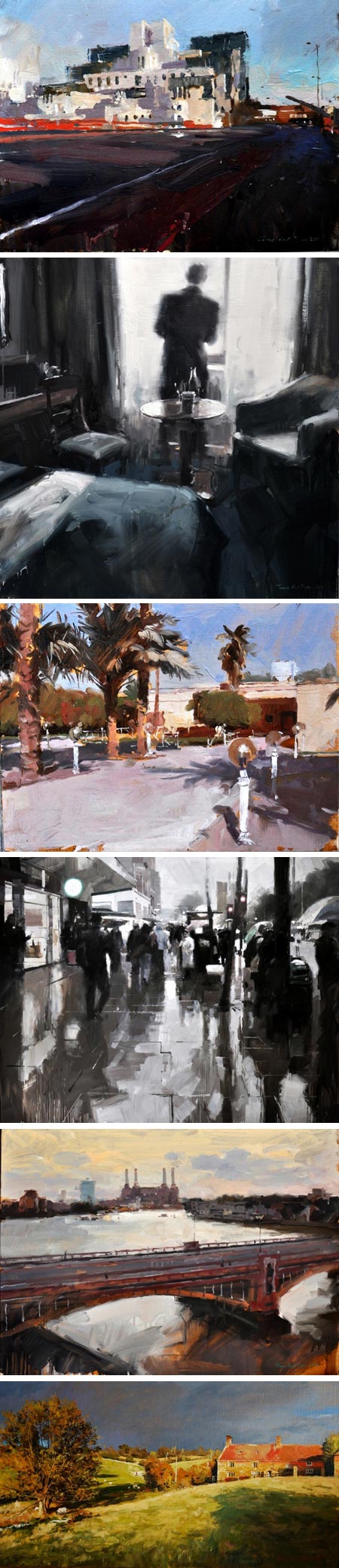
Hart Dyke, James Hart Dyke, was offered a mission by Her Majesty’s Government: to go undercover with MI6, the Secret Intelligence Service, and report on the life of undercover agents in paintings and drawings.Hart Dyke has been official artist on four royal tours with Prince Charles and has been embedded as a war artist in Iraq and Afghanistan, but was surprised by the request “go undercover” for several months, travel with MI6 agents to places like Iraq (image above, 3rd down), visit their headquarters (above, top) and convey in paintings the day to day life of agents in the British foreign intelligence service.
The agency had decided this was a way for the public to get a better understanding of this often misunderstood part of their government.
Hart Dyke found the actual experiences of the field agents not very James Bond like, but became fascinated with the way the unexpected (and potentially dangerous) lurked beneath the ordinary. As a result many of his paintings portray ordinary scenes, in which agents wait, or look for significant events or information.
The show of the work consists of 40 paintings, 25 drawings and a number of prints. Some of them can be seen on Hart Dyke’s site (along with his landscapes, image above, bottom; and other work) as well as in a slideshow accompanying an article about his experience on The Guardian.
Hart Dyke’s color palette ranges from rich and brilliant to softly atmospheric and almost monochromatic. All of his work, his painting particularly, carries a strong feeling of geometry, both underlying his forms and in the bold, textural chunks of color in which he applies his paint.
Categories:
-
Robert Fawcett: The Illustrator’s Illustrator

Robert Fawcett, though quite successful and in demand, was not the most popular illustrator of his time or the highest paid. He was, however, probably the most respected (and perhaps envied), by his peers.Fawcett earned the appellation “the illustrator’s illustrator” from that admiration. Highly skilled, independently minded, and committed to quality and mastery in his work to a degree rarely encountered, Fawcett earned a place at the pinnacle of early 20th Century illustration.
At a time when modernist faddism and stylistic meanderings in the name of popularity were strong undercurrents in the field, which was facing increasing pressures from a publishing industry that was turning to photography for more and more of its illustration needs, Fawcett remained steadfast in his ideals. Those same ideals are likely what propelled him into the field originally.
Encouraged by his father from an early age (or even “over-encouraged”, as Fawcett himself puts it, by a father who was himself a frustrated artist), Fawcett traveled back to his native England, from which his parents had emigrated to Canada when Fawcett was a teenager, to attend the well respected Slade School of Art. I don’t know if the curriculum there was strictly academic, but the school had a reputation for unstintingly rigorous training in the traditional fundamentals of art.
It was this training that formed the foundation for Fawcett’s art, which was always grounded in traditional draftsmanship. Fawcett found his original intention to be a gallery artist frustrated, in kinship with many classically trained artists who were facing an art market increasingly dominated by the anti-academic forces of modernism.
Fawcett’s emphasis on draftsmanship, and his command of drawing skills, were the underpinning of all of his work, emphasized and extended by his mastery of value and composition.
Throughout all of his illustrations, paintings and drawings is an underlying strength that is often not found in the work of his contemporaries, perhaps part of the source of their admiration, coupled with his insistence on doing work to his own high standards, even if it meant turning down more lucrative jobs.
Much of the kind of admiration other artists felt for Fawcett and his work is brimming from the covers of a wonderful new book, Robert Fawcett: The Illustrator’s Illustrator from Auad Publications.
Auad is a small specialty art publisher, whose titles I have long admired and written about previously (see my posts on Frank Brangwyn, R.A.: The Way of the Cross, Franklin Booth, Alex Toth and Alex Niño).
I was delighted to receive a review copy from Manual Auad, the publisher, who has for years wanted to do this particular book.
Working from his own deeply held regard and affection for Fawcett and his work, Auad has enlisted the cooperation of David Apatoff, author of the superb blog, Illustration Art, who wrote the text. Auad selected the images, edited and arranged the book. The reulting volume is what must now be considered the definitive work on this great American illustrator.
That the book is a labor of love, I think, shows in every page. Sharply written, wonderfully designed and printed with great attention to production values, the book shines, a fitting tribute to an artist whose own standards were so high.
It gives a broad overview of Fawcett’s career and is filled to overflowing (profusely illustrated, as I love to say) with over 100 of Fawcett’s beautiful color illustrations, and numerous black and white plates. Many of the images have been photographed from the original artwork.
Fawcett was one of the founding faculty of the Famous Artist School, and the introduction to the volume is by Walt Reed, our foremost authority on American illustration, who worked alongside Fawcett as a member of the faculty and speaks glowingly of Fawcett and his skills.
Fawcett was also the author of a highly regarded instructional book, The Art of Drawing, which is still in print and available from Dover Books.
Robert Fawcett: The Illustrator’s Illustrator, though obviously enjoyable as a coffee table book of superb illustrations, might also serve as a master class in illustration, just from the power of Fawcett’s skill, aided by Auad’s selections of rare life drawings and a number of preliminary sketches. The stylistic influence Fawcett exerted on mid-20th Century illustrators (not to mention great comics artists like Alex Raymond and Al Williamson, to name just two) is obvious in the style that emerges as you move through Fawcett’s career.
Auad has made an unusual, and I think brilliant, choice in the way the work is arranged and presented. Though the initial chapters on Fawcett’s life, drawing style and approach to composition and painting are accompanied by specifically appropriate illustrations (as well as an interview with Fawcett), in the second half of the book, more or less the “gallery” section, instead of arranging the work chronologically or by subject matter, Auad has presented the work by series, like the famous series of Sherlock Holmes illustrations that cemented his reputation, his stint as the premiere illustrator for Agatha Christie’s stories as they were originally published in Colliers and a selection of his advertising work. He then has arranged the other selections by publication. These gather and highlight work for Colliers, The Saturday Evening Post, This Week Magazine and Cosmopolitan.
Apatoff nicely gives us a picture of Fawcett’s (sometimes difficult) relationship with the magazines, the demands of doing illustration for each particular publication and in the process provides a context that I think is much more instructive about the nature of Fawcett’s devotion to his work, and refusal to bend to the vagaries of popular taste, than could be provided any other way.
The Auad Publishing page has a slideshow of images from the book (accessed by clicking on the cover image) but they are too small and brief to do the book, or Fawcett’s work, justice. (The same should be said for my too-small images above.)
For more, see David Apatoff’s post on the book and on The Training of Robert Fawcett. For a good selection of Fawcett’s work, see Leif Peng’s Flickr collection, as well as his blog post with an excerpt from the book, another with an overview and some additional images, and another titled “Robert Fawcett, Abstract Artist“.
Also see my previous post on Robert Fawcett, which includes additional resources.
Categories:




Charley’s Picks
Bookshop.org
(Bookshop.org affilliate links; sales benefit independent bookshop owners; I get a small percentage to help support my work on Lines and Colors)

John Singer Sargent: Watercolors


Urban Sketching: Understanding Perspective


Charley’s Picks
Amazon
(Amazon.com affiliate links; sales go to a larger yacht for Jeff Bezos; but I get a small percentage to help support my work on Lines and Colors)
John Singer Sargent: Watercolors
Urban Sketching: Understanding Perspective