


Categories
- 3d CGI
- Amusements
- Animation
- Anime & Manga
- Art Materials
- Art Videos
- Blogroll
- Cartoons
- Color
- Comics
- Concept & Visual Dev.
- Creativity
- Digital Art
- Digital Painting
- Displaying Art on the Web
- Drawing
- Eye Candy for Today
- Gallery and Museum Art
- High-res Art Images
- Illustration
- Motion Graphics & Flash
- Museums
- Online Museums
- Outsider Art
- Painting
- Painting a Day
- Paleo Art
- Pastel, Conté & Chalk
- Pen & Ink
- Prints and Printmaking
- Reviews
- Sc-fi and Fantasy
- Sculpture & Dimensional
- Site Comments
- Sketching
- Storyboards
- Tools and Techniques
- Uncategorized
- Vector Art
- Videos & Podcasts
- Vision and Optics
- Watercolor and Gouache
- Webcomics
Archives
- April 2026
- March 2026
- February 2026
- January 2026
- December 2025
- November 2025
- October 2025
- September 2025
- August 2025
- July 2025
- June 2025
- May 2025
- January 2025
- December 2024
- November 2024
- October 2024
- September 2024
- August 2024
- June 2024
- April 2024
- March 2024
- February 2024
- January 2024
- December 2023
- November 2023
- October 2023
- September 2023
- August 2023
- July 2023
- May 2023
- April 2023
- March 2023
- February 2023
- January 2023
- December 2022
- November 2022
- September 2022
- August 2022
- July 2022
- June 2022
- May 2022
- April 2022
- March 2022
- February 2022
- January 2022
- December 2021
- November 2021
- October 2021
- September 2021
- August 2021
- July 2021
- June 2021
- May 2021
- April 2021
- March 2021
- February 2021
- January 2021
- December 2020
- November 2020
- October 2020
- September 2020
- August 2020
- July 2020
- June 2020
- May 2020
- April 2020
- March 2020
- February 2020
- January 2020
- December 2019
- November 2019
- October 2019
- September 2019
- August 2019
- July 2019
- June 2019
- May 2019
- April 2019
- March 2019
- February 2019
- January 2019
- December 2018
- November 2018
- October 2018
- September 2018
- August 2018
- July 2018
- June 2018
- May 2018
- April 2018
- March 2018
- February 2018
- January 2018
- December 2017
- November 2017
- October 2017
- September 2017
- August 2017
- July 2017
- June 2017
- May 2017
- April 2017
- March 2017
- February 2017
- January 2017
- December 2016
- November 2016
- October 2016
- September 2016
- August 2016
- July 2016
- June 2016
- May 2016
- April 2016
- March 2016
- February 2016
- January 2016
- December 2015
- November 2015
- October 2015
- September 2015
- August 2015
- July 2015
- June 2015
- May 2015
- April 2015
- March 2015
- February 2015
- January 2015
- December 2014
- November 2014
- October 2014
- September 2014
- August 2014
- July 2014
- June 2014
- May 2014
- April 2014
- March 2014
- February 2014
- January 2014
- December 2013
- November 2013
- October 2013
- September 2013
- August 2013
- July 2013
- June 2013
- May 2013
- April 2013
- March 2013
- February 2013
- January 2013
- December 2012
- November 2012
- October 2012
- September 2012
- August 2012
- July 2012
- June 2012
- May 2012
- April 2012
- March 2012
- February 2012
- January 2012
- December 2011
- November 2011
- October 2011
- September 2011
- August 2011
- July 2011
- June 2011
- May 2011
- April 2011
- March 2011
- February 2011
- January 2011
- December 2010
- November 2010
- October 2010
- September 2010
- August 2010
- July 2010
- June 2010
- May 2010
- April 2010
- March 2010
- February 2010
- January 2010
- December 2009
- November 2009
- October 2009
- September 2009
- August 2009
- July 2009
- June 2009
- May 2009
- April 2009
- March 2009
- February 2009
- January 2009
- December 2008
- November 2008
- October 2008
- September 2008
- August 2008
- July 2008
- June 2008
- May 2008
- April 2008
- March 2008
- February 2008
- January 2008
- December 2007
- November 2007
- October 2007
- September 2007
- August 2007
- July 2007
- June 2007
- May 2007
- April 2007
- March 2007
- February 2007
- January 2007
- December 2006
- November 2006
- October 2006
- September 2006
- August 2006
- July 2006
- June 2006
- May 2006
- April 2006
- March 2006
- February 2006
- January 2006
- December 2005
- November 2005
- October 2005
- September 2005
- August 2005
Relevant Blogs
Art, Painting & Sketch
- Gurney Journey
- Underpaintings
- Art and Influence
- Painting Perceptions
- Oil Painters of America
- Vasari Paint POV
- Flying Fox
- Urban Sketchers
- Bento (Smithsonian)
- Art Inconnu
- The Hidden Place
- Still Life
- Making a Mark
- The Art of the Landscape
- Exploring Color & Creativity
- Art Contrarian
- Artist A Day
- beinArt Surreal Art Collective
- Eye Level
- David Dunlop
- p.i.g.m.e.n.t.i.u.m
- CultureGrrl
- Joaquín Sorolla blog
- Artists in Pastel
“Painting a Day”
- A Painting a Day (Keiser)
- On Painting (Keiser)
- Julian Merrow-Smith
- Karen Jurick
- Jeffrey Hayes
- Carol Marine
- Abbey Ryan
- Daily Paintworks
Other Painting Blogs
- Virtual Gouache Land
- Neil Hollingsworth
- Marc Hanson
- Kevin Menck
- Marc Dalessio
- Larry Seiler
- Stapleton Kearns
- Colin Page
- Roos Schuring
- Hans Versfelt
- Titus Meeuws
- Régis Pettinari
- René Plein Air
- Belinda Del Pesco
- Robin Weiss
- Nathan Fowkes (Land Sketch)
- William Wray
- Frank Serrano
- Stephen Magsig
- Michael Chesley Johnson
- Twice a Week
- Sarah Wimperis
- Rob Adams
- Michael Cole Manley
- The Dirty Palette Club
- Mike Manley’s Draw!
Gallery Art & Illustration mix
Illustration
- Howard Pyle
- 100 Years of Illustration
- BibliOdyssey
- Illustration Art
- Today’s Inspiration
- Illustration Mundo
- Little Chimp Society
- Danny Gregory
- R D (John Martz
- Illustration Friday blog
- Monster Brains
- Illustrators & Illustrations (RU)
- Elwood H. Smith
- DaniDraws.com
- Designers Who Blog
- iSpot Blog
Sci-Fi & Fantasy
Illustration & Comics
Comics & Cartoons
- Comics Beat
- Robot 6
- Newsarama Blog
- Comic Vine
- Comics Alliance
- Forbidden Planet Int.
- Paolo Rivera
- Bolt City
- Flight
- Scott McCloud
- The Comics Journal
- Comixpedia
- Funnybook Babylon
- James Baker
- Middleton’s Sketchbook
- Boneville
- The Hotel Fred
- Paul Rivoche
- Daily Cartoonist
- Mad About Cartoons (William Wray)
- Digital Strips
Illustration & Concept
Animation & Concept
- Cartoon Brew
- Animation Blog
- Cold Hard Flash
- Concept Art World
- The CAB
- FY Concept Art
- Concept Ships
- Concept Robots
- John Nevarez
- Armand Serrano
- Marcos Mateu-Mestre
- all kinds of stuff (Kricfalusi)
- Yacin the faun (Man Arenas)
- Kelsey Mann
- Cre8tivemarks Blog
- Ice-Cream Monster Toon Cafe
- AAU Character & Creature Design
- AAU Animation Notes
- Articles and Texticles
Paleo & Scientific
Tools & Techniques
Other
Lists of Art Blogs
Art Image Resource Links
Historic Art Images
- Wikimedia Commons: Paintings
- Wikimedia Commons: Drawings
- The Athenaeum
- WikiArt (WikiPaintings)
- Google Art Project: Artists
- Google Art Project: Collections (Museums)
- ArtCyclopedia
- Web Gallery of Art
- Art Renewal Center
- Web Gallery of Impressionism
Auction Consolidation sites
Auction sites
- Sotheby’s
- Bonham’s
- Christies
- Heritage Auctions: Fine Art
- Heritage Auctions: Illustration
- Freeman’s Auctions
- Bukowskis
- Shannon’s
Image Search
Reverse Image Search (search by image)
- Tin Eye
- RevImg
- Google Image Search (camera icon)
- Bing Image Search (camera icon)
Promoting some friends and some clients of my website design business
- Twin Willows T’ai Chi studio in Wilmington DE. Taiji classes with Bryan Davis.
- Ray Hayward, Inspired Teacher of T’ai Chi ( Taiji ) in Minneapolis, Founder of Mindful Motion Tai Chi Academy
- OldHead Tattoo studio and Art Gallery in Wilmington DE. Tattoos and paintings by Bruce Gulick
- Sharon Domenico Art, pet portrait oil paintings
- Platinum Paperhanging, wallpaper hanging, Main Line and Philadelphia, PA
- Lisa Stone Design, interior designer, Main Line and Philadelphia, PA
- Studio12KPT, original art, prints, calendars and other custom printed items by Van Sickle & Rolleri
-
Dan P. Carr
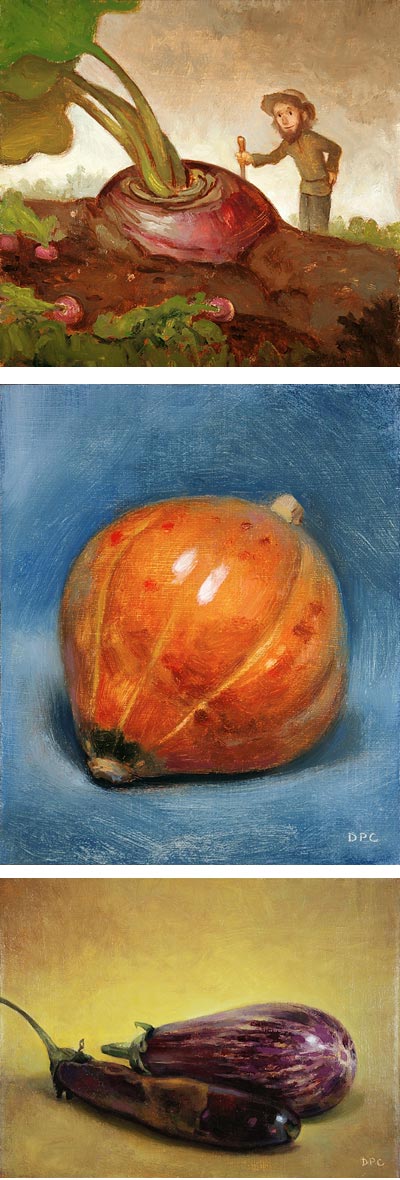
Dan P. Carr is a Virginia based illustrator whose online illustration portfolio, as far as I can tell, consists of a Flickr set, and whose blog covers a number of delightfully rambling topics, from posts on choosing colors for palettes, to the names of colors in Old English, to vintage Cream videos, to Yeats poems, to Chicken recipes, all interspersed with reproduction of his very nice small still life paintings.These, usually of fruit and vegetable subjects, are vibrantly colored, richly textured and have a painterly immediacy that is very appealing. Oddly, they are often linked to Flickr versions of the image that are essentially no larger than they are shown in the blog post.
His blog hasn’t been updated for a while, but past posts indicate that he has lapsed before and then returned with new posts. In the meanwhile there are plenty of idiosyncratic musings and delightful still lifes to keep you browsing through past posts for a while.
Categories:
-
Heilbrunn Timeline of Art History

The website of New York’s Metropolitan Museum of Art is large and sprawling and full of amazing stuff, much like the museum itself. Also like the physical museum, wandering around and exploring is often rewarded with unexpected delights and treasures.One of the treasures on the Met’s website is the Heilbrunn Timeline of Art History. Essentially a site of its own within the larger museum site, the Timeline is an ongoing project, sponsored by three foundations and created and maintained by the museum’s curatorial, conservation and education staff, that currently catalogues 6,000 works and places them within the contexts of time, place and thematic essays.
The Timeline’s features can be explored from any of these directions, as well by links to world religions, and directly searched via search box or index. You can search for artists or works of art, and many are featured in pages devoted specifically to the artist or work, as well as within the larger thematic essays.
Most of the articles have images that can be enlarged or zoomed, and are linked to further images and information within the museum’s larger object database.
From the Timeline’s front page you can flip through panels of works, timelines or thematic essays, or use the drop-down menus at top for access to dedicated pages for same, across geographic areas via world maps, or find works of art through a detailed search box.
Once drilled down to a topic, you can also follow the links in the “Related” section to any number of additional lines of browsing.
A major time sink as well as a tremendous resource.
Categories:
-
Frank Frazetta

Frank Frazetta was one of the best and most renowned fantasy illustrators in the history of the genre. Frazetta died yesterday, May 10, 2010 at the age of 82.Frazetta began his career as a comics artist, starting as a teenager as an assistant to other artists. He worked for smaller comic book publishers, producing a number of memorable “funny animal” comics (see my previous post on Frank Frazetta’s Funny Animal Comics), and a number of adventure titles.
He was eventually given the opportunity to crate his own comic title, Thun’da, King of the Congo, but his run on the comic was only two issues. He then went to work in newspaper comics, doing “ghost work” (uncredited assistance) on Dan Barry’s Flash Gordon. He continued to work for comic book companies, including EC Comics and DC Comics, and contributed covers to the Buck Rogers comic books.
In 1954 Frazetta went to work for Al Capp, assisting on his extremely popular Li’l Abner strip, he also continued to work on his own newspaper strip, Johnny Comet. On leaving Capp’s studio he did work for the Warren horror comic magazines, Creepy and Eerie, contributing many of those publications’ most memorable covers. At the same time he contributed to Harvey Kurtzman and Will Elder’s Little Annie Fanny strip for Playboy (see my post on Will Elder).
From there, Frazetta moved into paperback cover illustration and achieved his greatest renown for his lushly painted covers for novels by Edgar Rice Burroughs, and in particular, Robert E. Howard’s Conan the Barbarian books.
In addition to the influences of his colleges at E.C., like Al Williamson, Roy Krenkel and Wally Wood, Frazetta picked up on the techniques of the great 19th century pen and ink illustrators like Joseph Clement Coll and became a first rate pen and ink draftsman.
In his painting, Frazetta carried forward the traditions of the great swashbuckling adventure illustrators like Howard Pyle, N.C. Wyeth and Frank Schoonover, bringing them into the modern era with a touch more menace, implied violence and sex. In the process Frazetta became tremendously influential on a new generation of adventure fantasy artists, many of whom are working today.
Frazetta’s figures, beasts and monsters seem to inhabit a world in which gravity exerts more force than normal; and that great sensation of weight translated into a suggestion of immense power, either heroic or menacing.
Frazetta’s color palette, again with a direct lineage to Pyle and Wyeth, was often dark and moody, punctuated by bright passages for emphasis. His use of theatrical lighting for dramatic effect gave his compositions an immediate visceral impact.
To my mind, it is in the bridge he forms between those Golden Age illustrators and the newer generation that grew up in awe of his barbarian images that Frazetta is most notable, carrying forward traditions of great adventure illustration in a lineage he happily acknowledged in illustrations like Galleon (image above, bottom), a direct homage to Pyle’s Attack on a Galleon (see my post on Howard Pyle).
Frazetta remains extremely popular and there are a number of books that collect or feature his work, and there is a video interview with the artist on DVD, Frazetta: Painting With Fire.
There is a museum devoted to his work that was run by the family. I don’t know what its status will be going forward. The museum site doesn’t have much information, but it does have a selection of Frazetta’s work in the form of prints.
I’ve listed some other resources below.
[Note: Some images are NSFW.]
Categories:
-
Dan Seagrave

Born in the U.K. and now residing in Canada, Dan Seagrave began his career with an album cover for a local band. That expanded into a series of notable covers for other bands, though within a specific genre.Seagrave has continued to produce art for music groups, but his intricate, intensely detailed and highly imaginative art has spawned a market for posters, reproductions and appearances in books and magazines. He is also in demand for painting murals, including a 20 x 20 foot (6 x 6 m) ceiling painting for the Hard Rock Cafe in Ottawa.
He normally works in acrylic on panels, for the pieces shown above at a size of 24 x 36 inches (61 x 91 cm). The images on his website are frustratingly small, given the size and level of detail in his work, though he does provide a detail view feature for many pieces that allows you to scroll around a larger image in a small window, as for the detail images above. Be sure to check out the Temple Series, as well as the Posters and Store sections.
(Note: when visiting Seagrave’s website, if the site doesn’t automatically open a secondary pop-up window with the actual content, click on the “Dan Seagrave” heading.)
There are also images on the the beinArt Surreal Art Collective, but the best are probably the images on the Tor.com site,. These are a bit larger and give you a somewhat better taste of what the full images look like.
Seagrave uses curved perspective, freeform distortions, atmospheric perspective, a refined command of texture, and judicious applications of bright color within otherwise controlled palettes to create his beautifully rendered whirls of controlled chaos.
In an interview on Voices From the Dark Side, Seagrave indicates that his Temple series paintings are part of an ongoing series, and may even be the basis for a film; though I’m hoping that in the interim some of his work finds its way into a print collection.
Categories:
-
Art Inconnu
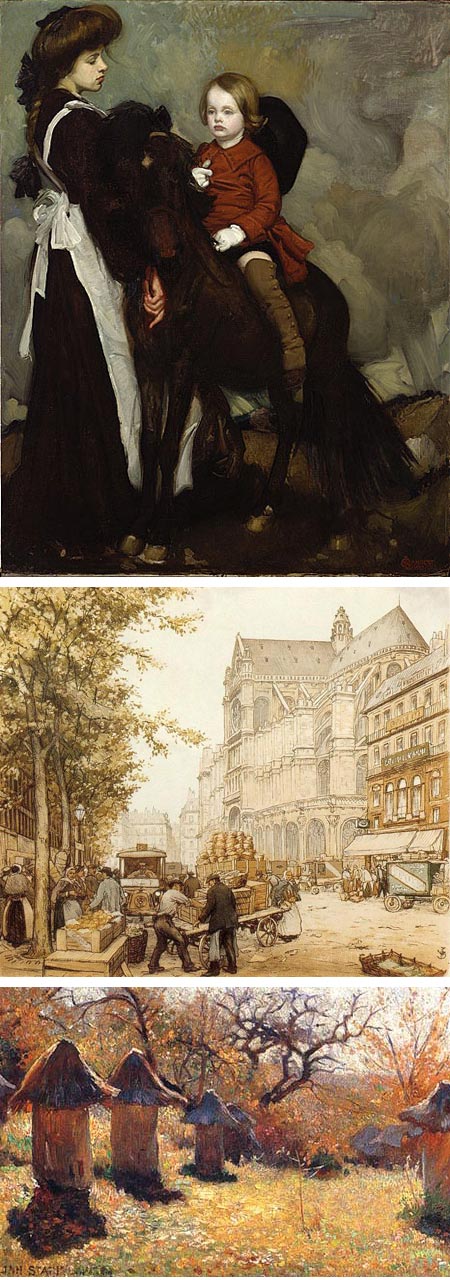
Art Inconnu is a terrific blog that has been going since January of 2008, but one that I have been unaware of until recently.“Inconnu” is a word meaning a stranger or unknown person. Maintained by an anonymous “Curator”, Art Inconnu is devoted to “little-known and under-appreciated art”, sometimes obscure, sometimes just artists who seldom receive the spotlight.
The blog focuses primarily on 19th and 20th Century European paintings, but occasionally ventures further back. There is a nice mix of styles. Though the Curator’s tastes lean further into 20th Century modernism than mine, there were many artists of interest as I thumbed through a few pages.
There are occasionally articles accompanying the posts, though many are simply a collection of images by the artist, but most include titles of the individual works and dates of the artist’s life.
There are also collections available from the right sidebar, in which the Curator has assembled works by several lesser-known artists on a particular theme.
(Images above, with links to the Art Inconnu posts: George Lambert, Tavik Frantisek Simon and Stanislaw Kamocki)
Categories:
-
Tyler Jacobson

California illustrator Tyler Jacobson recently graduated from Academy of Art University in San Francisco, and has embarked on a career as an illustrator, with an eye to working as a concept artist for the film and gaming industries.His clients include Wizards of the Coast, Dungeons and Dragons, NBC, Texas Monthly and Simon and Schuster.
Jacobson works in both traditional and digital media, sometimes mixing the two where appropriate for the desired result. There is a brief description of his process, featuring a step-through of the image above, top, on the Richard Solomon site.
He recently was awarded the Jack Gaughan Award for Best Emerging Artist, and some of his work has been selected for the upcoming Spectrum 17.
His website portfolio is divided into three sections for illustration, sketches and fine art. Both illustration and sketches feature work from a Moby Dick project, though I don’t know if it’s commissioned or personal, and the fine art section includes both portraits (above, lower right) and figurative work.
Both his illustrations and gallery paintings show his attention to value and chiaroscuro in creating drama, along with the use of carefully controlled color ranges punctuated with more intense areas of high chroma color.
On Jacobson’s blog you will often find many of the images in his portfolios, but often reproduced a bit larger and with commentary about their creation.
Categories:




Charley’s Picks
Bookshop.org
(Bookshop.org affilliate links; sales benefit independent bookshop owners; I get a small percentage to help support my work on Lines and Colors)

John Singer Sargent: Watercolors


Urban Sketching: Understanding Perspective


Charley’s Picks
Amazon
(Amazon.com affiliate links; sales go to a larger yacht for Jeff Bezos; but I get a small percentage to help support my work on Lines and Colors)
John Singer Sargent: Watercolors
Urban Sketching: Understanding Perspective