


Categories
- 3d CGI
- Amusements
- Animation
- Anime & Manga
- Art Materials
- Art Videos
- Blogroll
- Cartoons
- Color
- Comics
- Concept & Visual Dev.
- Creativity
- Digital Art
- Digital Painting
- Displaying Art on the Web
- Drawing
- Eye Candy for Today
- Gallery and Museum Art
- High-res Art Images
- Illustration
- Motion Graphics & Flash
- Museums
- Online Museums
- Outsider Art
- Painting
- Painting a Day
- Paleo Art
- Pastel, Conté & Chalk
- Pen & Ink
- Prints and Printmaking
- Reviews
- Sc-fi and Fantasy
- Sculpture & Dimensional
- Site Comments
- Sketching
- Storyboards
- Tools and Techniques
- Uncategorized
- Vector Art
- Videos & Podcasts
- Vision and Optics
- Watercolor and Gouache
- Webcomics
Archives
- April 2026
- March 2026
- February 2026
- January 2026
- December 2025
- November 2025
- October 2025
- September 2025
- August 2025
- July 2025
- June 2025
- May 2025
- January 2025
- December 2024
- November 2024
- October 2024
- September 2024
- August 2024
- June 2024
- April 2024
- March 2024
- February 2024
- January 2024
- December 2023
- November 2023
- October 2023
- September 2023
- August 2023
- July 2023
- May 2023
- April 2023
- March 2023
- February 2023
- January 2023
- December 2022
- November 2022
- September 2022
- August 2022
- July 2022
- June 2022
- May 2022
- April 2022
- March 2022
- February 2022
- January 2022
- December 2021
- November 2021
- October 2021
- September 2021
- August 2021
- July 2021
- June 2021
- May 2021
- April 2021
- March 2021
- February 2021
- January 2021
- December 2020
- November 2020
- October 2020
- September 2020
- August 2020
- July 2020
- June 2020
- May 2020
- April 2020
- March 2020
- February 2020
- January 2020
- December 2019
- November 2019
- October 2019
- September 2019
- August 2019
- July 2019
- June 2019
- May 2019
- April 2019
- March 2019
- February 2019
- January 2019
- December 2018
- November 2018
- October 2018
- September 2018
- August 2018
- July 2018
- June 2018
- May 2018
- April 2018
- March 2018
- February 2018
- January 2018
- December 2017
- November 2017
- October 2017
- September 2017
- August 2017
- July 2017
- June 2017
- May 2017
- April 2017
- March 2017
- February 2017
- January 2017
- December 2016
- November 2016
- October 2016
- September 2016
- August 2016
- July 2016
- June 2016
- May 2016
- April 2016
- March 2016
- February 2016
- January 2016
- December 2015
- November 2015
- October 2015
- September 2015
- August 2015
- July 2015
- June 2015
- May 2015
- April 2015
- March 2015
- February 2015
- January 2015
- December 2014
- November 2014
- October 2014
- September 2014
- August 2014
- July 2014
- June 2014
- May 2014
- April 2014
- March 2014
- February 2014
- January 2014
- December 2013
- November 2013
- October 2013
- September 2013
- August 2013
- July 2013
- June 2013
- May 2013
- April 2013
- March 2013
- February 2013
- January 2013
- December 2012
- November 2012
- October 2012
- September 2012
- August 2012
- July 2012
- June 2012
- May 2012
- April 2012
- March 2012
- February 2012
- January 2012
- December 2011
- November 2011
- October 2011
- September 2011
- August 2011
- July 2011
- June 2011
- May 2011
- April 2011
- March 2011
- February 2011
- January 2011
- December 2010
- November 2010
- October 2010
- September 2010
- August 2010
- July 2010
- June 2010
- May 2010
- April 2010
- March 2010
- February 2010
- January 2010
- December 2009
- November 2009
- October 2009
- September 2009
- August 2009
- July 2009
- June 2009
- May 2009
- April 2009
- March 2009
- February 2009
- January 2009
- December 2008
- November 2008
- October 2008
- September 2008
- August 2008
- July 2008
- June 2008
- May 2008
- April 2008
- March 2008
- February 2008
- January 2008
- December 2007
- November 2007
- October 2007
- September 2007
- August 2007
- July 2007
- June 2007
- May 2007
- April 2007
- March 2007
- February 2007
- January 2007
- December 2006
- November 2006
- October 2006
- September 2006
- August 2006
- July 2006
- June 2006
- May 2006
- April 2006
- March 2006
- February 2006
- January 2006
- December 2005
- November 2005
- October 2005
- September 2005
- August 2005
Relevant Blogs
Art, Painting & Sketch
- Gurney Journey
- Underpaintings
- Art and Influence
- Painting Perceptions
- Oil Painters of America
- Vasari Paint POV
- Flying Fox
- Urban Sketchers
- Bento (Smithsonian)
- Art Inconnu
- The Hidden Place
- Still Life
- Making a Mark
- The Art of the Landscape
- Exploring Color & Creativity
- Art Contrarian
- Artist A Day
- beinArt Surreal Art Collective
- Eye Level
- David Dunlop
- p.i.g.m.e.n.t.i.u.m
- CultureGrrl
- Joaquín Sorolla blog
- Artists in Pastel
“Painting a Day”
- A Painting a Day (Keiser)
- On Painting (Keiser)
- Julian Merrow-Smith
- Karen Jurick
- Jeffrey Hayes
- Carol Marine
- Abbey Ryan
- Daily Paintworks
Other Painting Blogs
- Virtual Gouache Land
- Neil Hollingsworth
- Marc Hanson
- Kevin Menck
- Marc Dalessio
- Larry Seiler
- Stapleton Kearns
- Colin Page
- Roos Schuring
- Hans Versfelt
- Titus Meeuws
- Régis Pettinari
- René Plein Air
- Belinda Del Pesco
- Robin Weiss
- Nathan Fowkes (Land Sketch)
- William Wray
- Frank Serrano
- Stephen Magsig
- Michael Chesley Johnson
- Twice a Week
- Sarah Wimperis
- Rob Adams
- Michael Cole Manley
- The Dirty Palette Club
- Mike Manley’s Draw!
Gallery Art & Illustration mix
Illustration
- Howard Pyle
- 100 Years of Illustration
- BibliOdyssey
- Illustration Art
- Today’s Inspiration
- Illustration Mundo
- Little Chimp Society
- Danny Gregory
- R D (John Martz
- Illustration Friday blog
- Monster Brains
- Illustrators & Illustrations (RU)
- Elwood H. Smith
- DaniDraws.com
- Designers Who Blog
- iSpot Blog
Sci-Fi & Fantasy
Illustration & Comics
Comics & Cartoons
- Comics Beat
- Robot 6
- Newsarama Blog
- Comic Vine
- Comics Alliance
- Forbidden Planet Int.
- Paolo Rivera
- Bolt City
- Flight
- Scott McCloud
- The Comics Journal
- Comixpedia
- Funnybook Babylon
- James Baker
- Middleton’s Sketchbook
- Boneville
- The Hotel Fred
- Paul Rivoche
- Daily Cartoonist
- Mad About Cartoons (William Wray)
- Digital Strips
Illustration & Concept
Animation & Concept
- Cartoon Brew
- Animation Blog
- Cold Hard Flash
- Concept Art World
- The CAB
- FY Concept Art
- Concept Ships
- Concept Robots
- John Nevarez
- Armand Serrano
- Marcos Mateu-Mestre
- all kinds of stuff (Kricfalusi)
- Yacin the faun (Man Arenas)
- Kelsey Mann
- Cre8tivemarks Blog
- Ice-Cream Monster Toon Cafe
- AAU Character & Creature Design
- AAU Animation Notes
- Articles and Texticles
Paleo & Scientific
Tools & Techniques
Other
Lists of Art Blogs
Art Image Resource Links
Historic Art Images
- Wikimedia Commons: Paintings
- Wikimedia Commons: Drawings
- The Athenaeum
- WikiArt (WikiPaintings)
- Google Art Project: Artists
- Google Art Project: Collections (Museums)
- ArtCyclopedia
- Web Gallery of Art
- Art Renewal Center
- Web Gallery of Impressionism
Auction Consolidation sites
Auction sites
- Sotheby’s
- Bonham’s
- Christies
- Heritage Auctions: Fine Art
- Heritage Auctions: Illustration
- Freeman’s Auctions
- Bukowskis
- Shannon’s
Image Search
Reverse Image Search (search by image)
- Tin Eye
- RevImg
- Google Image Search (camera icon)
- Bing Image Search (camera icon)
Promoting some friends and some clients of my website design business
- Twin Willows T’ai Chi studio in Wilmington DE. Taiji classes with Bryan Davis.
- Ray Hayward, Inspired Teacher of T’ai Chi ( Taiji ) in Minneapolis, Founder of Mindful Motion Tai Chi Academy
- OldHead Tattoo studio and Art Gallery in Wilmington DE. Tattoos and paintings by Bruce Gulick
- Sharon Domenico Art, pet portrait oil paintings
- Platinum Paperhanging, wallpaper hanging, Main Line and Philadelphia, PA
- Lisa Stone Design, interior designer, Main Line and Philadelphia, PA
- Studio12KPT, original art, prints, calendars and other custom printed items by Van Sickle & Rolleri
-
Bill Carman

Bill Carman has an approach that combines stylish exaggeration, line, painted rendering, texture, design and a variety of applications of color to achieve an entertaining and eye-catching range of illustrations, paintings and drawings.Carman studied at De Anze College and Brigham Young University and is currently a professor of illustration and drawing at Boise State University.
In addition to his work for clients like Lucas Arts Entertainment, TSR, Opera Idaho, Ford Aerospace, UTNE Reader, and a number of other editorial and commercial accounts, his work has been featured in publications like the Society of Illustrators Annuals, American Illustration and the Spectrum collections of contemporary fantastic art. He is the author and illustrator of the children’s book What’s That Noise?, from random House.
The gallery on his own site is essentially just a shopping cart for giclee prints; of more interest is the wider range of work shown on his gallery on Boise State University, which is divided into sections like illustration, children’s books, paint stuff and draw stuff. I particularly like the pieces in the painted stuff section. Don’t miss the Altoids icon at the bottom of the pop-up that leads to a selection of painted Altoid tins, and the sketchbook link to the right of that.
There are also larger images of some of his paintings in the Tor.com gallery.
Categories:
-
Erin Kelso

When I discovered Erin Kelso’s work on conceptart.org, I did my usual dig to see what else I could find about the artist, who was listed only as “bluefooted”.I eventually found out that she also has a presence on deviantART, where she is also listed only as “bluefooted”, but no actual website or blog.
I eventually contacted her, found that she does have an actual name, and that she a PhD in evolutionary biology and a Master’s in zoology and is working for a university; and her art is done in her off hours.
Kelso is largely self taught as an artist (though I think I saw in a post that she is taking a class of some kind currently), and takes her inspiration from numerous sources. When I contacted her, she confirmed my thoughts that she was influenced by artists like Arthur Rackham, Edmund Dulac, Gustav Tenggren and Gustav Klimt; and mentioned contemporary artists like James Jean, Jon Foster, Yoshitaka Amano, Michael Kaluta in addition.
Kelso does her drawings in pen and ink, and sometimes pencil, scans them and applies color and textures in Photoshop and Painter. (She has a brief Fake Watercolor Tutorial on her sketchbook post on the conceptart.org forums – about halfway down.)
It is the strong design elements and artful use of texture that make her work particularly appealing for me. I also enjoy the pen and ink and watercolor approach that carries some of the flavor of both drawing and painting; and her nice combination of Rackham-inspired line work with areas of Klimt-like textures and patterns.
Categories:
-
Peder Mork Mønsted
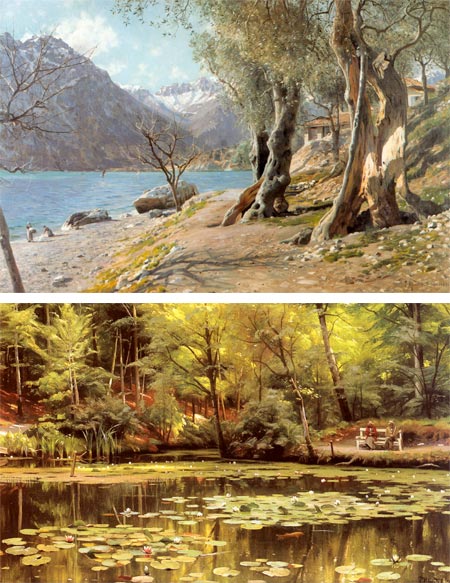
Peder Mork Mønsted was a Danish painter active in the late 19th and early 20th Century.Looking through his work you will find lush, color saturated paintings of his native Denmark, where Mønstead studied at the Copenhagen Academy, as well as landscapes from lands where he traveled, including Norway, Sweden, Switzerland, North Africa and Italy.
His paintings ring with a crisp, vibrant naturalism, emphasized by passages of sharp detail and strong value contrasts. The detail doesn’t keep them from being painterly, and lively with the feeling of the artist’s hand.
His subjects ranged from shade darkened streams, dappled with sunlight, to snow covered Nordic fields and the warm sun of the Italian coast.
Mønsted’s fascination with water and small streams remind me of Norwegian painter Frits Thaulow (also here).
Overall Mønsted’s style is a wonderful blend of intense, almost impressionistic color with strong academic underpinnings.
Categories:
-
Hethe Srodawa

Hethe Srodawa is an entertainment industry concept artist currently working for Rockstar Games.Like many in his field, Srodawa paints digitally in Photoshop. I came across his work, specifically the image above, “Enchanted“, on the CGSociety site.
Srodawa has a blog called The Pirate’s Cave, Illustrated Memoirs of a Dead Pirate, in which he posts sketches, finished work , flights of fancy, and in the case of the piece shown here, step by step progress and preliminary alternative layouts for some of his digital paintings. (He says that this image is about and inspired by his wife, and that he’s going to tell his children when they’re older that this is how he met their mother and that they come from royal fairy blood.)
He also has a web site in which the portfolio is pretty much as informal as the blog, a mix of drawings, painted sketches and more finished works.
His drawings and painted sketches have a nice, comfortable looseness about them, and his more finished works carry some of that forward at times with a feeling of gestural fluidity and brusquely applied textures.
Categories:
-
One1more2time3’s Weblog: Animation Treasures
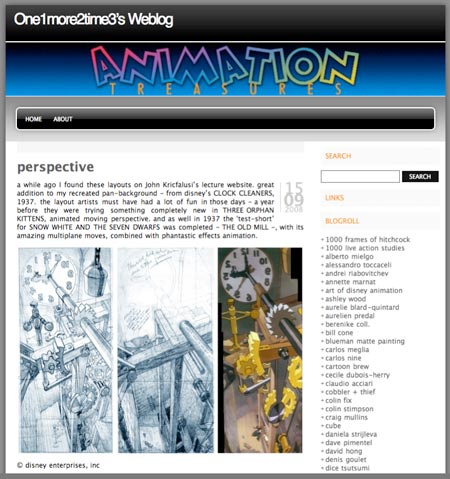
One1more2time3’s Weblog is a blog written by animated film industry production designer Hans Bacher.Formerly based in Europe, the U.S. and Tokyo, Bacher is now in Manila, Philippines and writes about a number of animation and production art topics.
According to Michael Hirsh’s Articles & Texticles, Bacher had been blogging previously on a different platform, stopped for a time and has recently relaunched his blog on WordPress.
I don’t know if he will eventually bring his archives from the older iteration of the blog over to the new one. I hope so, because the current crop is fascinating, informative, insightful and crammed full of great illustrations (what more could you want from an animation blog?).
The most recent article (as of this writing) is about 4 masters, production artists who Bacher has had the opportunity to work with, one of whom is Alex Niño, who I recently profiled.
Of particular interest in the articles currently available are several on the nature and production of backgrounds for Disney’s classic Bambi. One of them discusses the range of greens in the background paintings, displays them as a palette, and talks about the predominance of saturated, intense colors in modern animation backgrounds vs. the more subtle and naturalistic backgrounds in the older classics. There is a related article about the rendering of rocks. (This discussion would be of interest to contemporary landscape painters as well.)
The image shown above is a screen capture of Bacher’s article about perspective, referencing a blog post by John Krikfalusi on the topic and showing backgrounds from Disney’s Clock Cleaners.
This looks to be a blog worth watching.
[Link via Articles & Texticles]
Categories:
-
Van Gogh and the Colors of the Night

I will wander off topic for a little personal background (“local color”, so to speak) and then come back.The town of Arles is in Provence, a region of France that borders the Mediterreanean Sea and Northern Italy, where the Romans established their first province (provincia) outside their borders (hence the name). Arles was one of the major Roman cities in France, still has a largely intact Roman theater and arena and a good bit of the city wall. Today it’s a charming and visually rich town, popular with tourists.
Provence has long had a draw for artists, who find a particular appeal in the warm light and beautiful countryside. In 1888 and 1889 Arles was home to Vincent van Gogh for two of his most productive and most troubled years.
There are none of Van Gogh’s paintings in collections in Arles, the closest is in Avignon, about 20 miles (35km) away, but there are signs of him in many places. When my wife and I traveled to Arles on our first trip to France in 2002 (and I came to the immediate conclusion that the sunlight is indeed wonderful in Provence), Van Gogh’s presence kind of snuck up on us several times.
When we arrived in Arles, after two flights, a bus and train ride and a considerable walk, we were exhausted; and soon discovered that the locals don’t seem to eat between lunchtime and 6 or 7 PM. After spending some time searching for a cafe serving food in the mid-afternoon, we were finally relieved to find a small place that happened to have outdoor seating out its back door at the edge of a courtyard with a pleasant garden.
As we were eating and unwinding, I kept looking at the garden and courtyard, which was backed by a building faced with rows of arches. I found myself fascinated with it, partly because it was attractive, but partly, I gradually realized, because there was something oddly familiar about the place, which was impossible, of course, as I had never been to France before, let alone to this courtyard in Arles.
I finally noticed there was a plaque at one corner of the courtyard and as I approached it, and the view changed slightly, I suddenly realized we were in the garden portrayed in Van Gogh’s The Courtyard of the Hospital at Arles (image above, bottom right, larger version here); which, the plaque confirmed, is intentionally maintained in a pretty good approximation of the way it looked when he painted it (photo here).
Later, after unpacking and settling in a bit, we were out for a drink in a cafe that I had chosen primarily because it had internet access, and I was sitting at the table sketching when I got a similar feeling of odd familiarity from a cafe a few steps away with a yellow front and awning; and I realized that it was the subject of van Gogh’s Cafe Terrace at Night (image above, bottom left). The cafe is currently a tourist spot, named “Cafe Van Gogh” (also here), though we didn’t notice it at first.
We had chosen to sit not in the cafe that was the subject of his painting; but, by sheer chance, in another cafe in almost the exact position Van Gogh must have been sitting while composing his well known work. The effect was even more dramatic in the night, when the awning was lit from below by the glow of lamps, and the colors were uncannily similar to the painting.
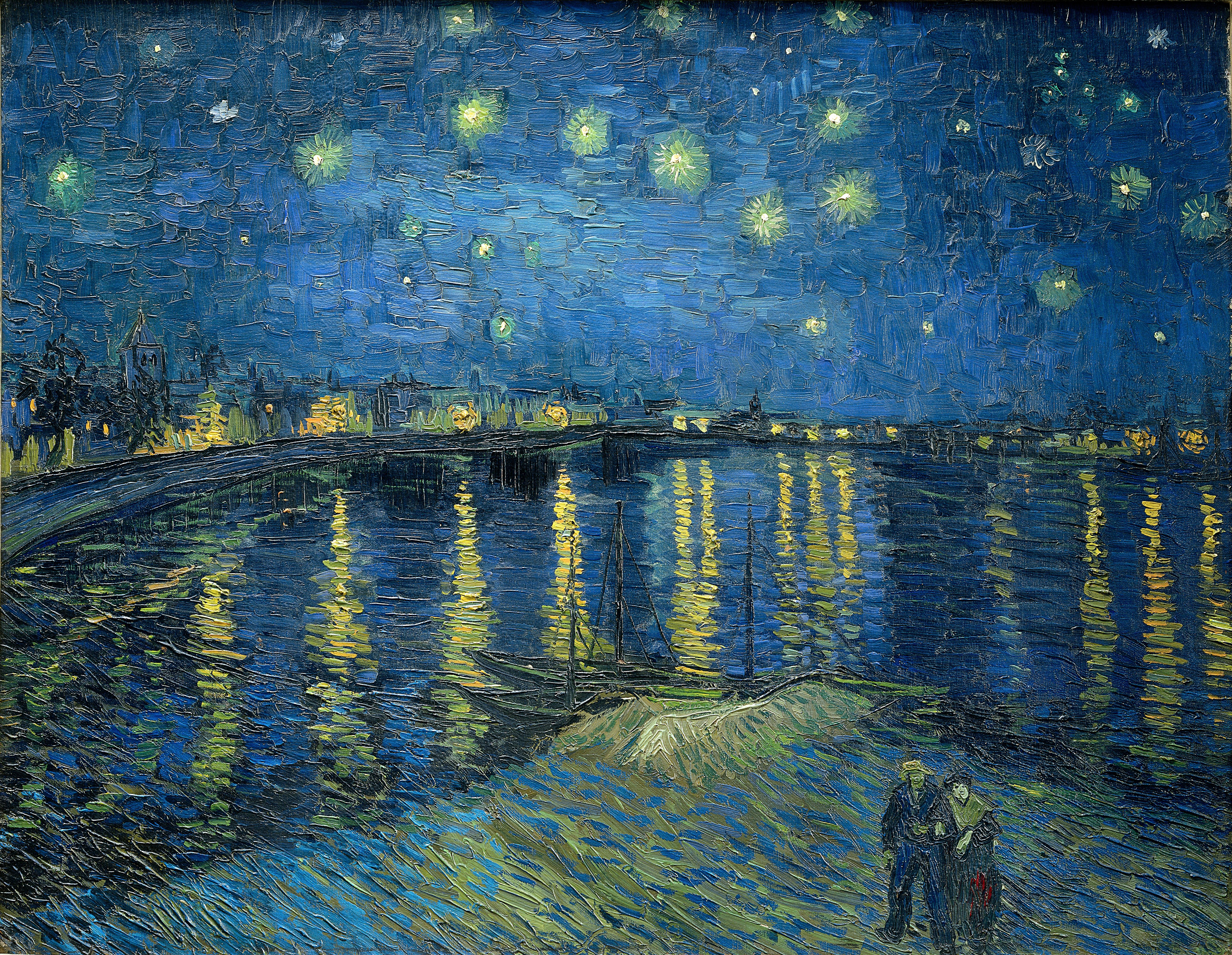
We felt the artist’s presence again when walking by “The Yellow House” and in the fields surrounding the town. In particular, when looking out over the Rhone River at night, I imagined him painting Starry Night Over the Rhone (image above, top, larger version here).
Most people are more familiar with the other “Starry Night”, the famous one, The Starry Night; but both paintings, along with The Night Cafe (the lamplit interior) and a number of other works, remind us that as much as van Gogh was a painter of brilliant fields ablaze with the Provence sun, he was also a painter of the night; more specifically, the colors of the night.
Van Gogh and the Colors of the Night is the title of a new exhibition at the Museum of Modern Art in New York. The exhibition promises to be a small (23 paintings, 9 drawings and some letters) but insightful look into Van Gogh’s interpretation of the night, of which he said: “I often think that the night is more alive and more richly colored than the day.”
The exhibition should prove that with some of his most renowned works, including The Night Cafe, The Dance Hall in Arles, The Potato Eaters, Gauguin’s Chair, Starry Night Over the Rhone and the iconic The Starry Night, which is in the MoMA’s permanent collection, along with several less well known works. (The Courtyard of the Hospital at Arles and Cafe Terrace at Night are not in the show, I just included them here to illustrate my story.) There is a catalog accompanying the exhibition.
Van Gogh and the Colors of the Night runs until January 5, 2009 at the Museum of Modern Art in New York and then will be on display at the Van Gogh Museum in Amsterdam from February 13 to June 17, 2009 (English link here). Advance tickets are suggested.
The exhibit should demonstrate that even though the light for artists is indeed special in places like Provence, it is even more special in the eyes of the artist, day or night.
Categories:




Charley’s Picks
Bookshop.org
(Bookshop.org affilliate links; sales benefit independent bookshop owners; I get a small percentage to help support my work on Lines and Colors)

John Singer Sargent: Watercolors


Urban Sketching: Understanding Perspective





Charley’s Picks
Amazon
(Amazon.com affiliate links; sales go to a larger yacht for Jeff Bezos; but I get a small percentage to help support my work on Lines and Colors)
John Singer Sargent: Watercolors
Urban Sketching: Understanding Perspective