


Categories
- 3d CGI
- Amusements
- Animation
- Anime & Manga
- Art Materials
- Art Videos
- Blogroll
- Cartoons
- Color
- Comics
- Concept & Visual Dev.
- Creativity
- Digital Art
- Digital Painting
- Displaying Art on the Web
- Drawing
- Eye Candy for Today
- Gallery and Museum Art
- High-res Art Images
- Illustration
- Motion Graphics & Flash
- Museums
- Online Museums
- Outsider Art
- Painting
- Painting a Day
- Paleo Art
- Pastel, Conté & Chalk
- Pen & Ink
- Prints and Printmaking
- Reviews
- Sc-fi and Fantasy
- Sculpture & Dimensional
- Site Comments
- Sketching
- Storyboards
- Tools and Techniques
- Uncategorized
- Vector Art
- Videos & Podcasts
- Vision and Optics
- Watercolor and Gouache
- Webcomics
Archives
- April 2026
- March 2026
- February 2026
- January 2026
- December 2025
- November 2025
- October 2025
- September 2025
- August 2025
- July 2025
- June 2025
- May 2025
- January 2025
- December 2024
- November 2024
- October 2024
- September 2024
- August 2024
- June 2024
- April 2024
- March 2024
- February 2024
- January 2024
- December 2023
- November 2023
- October 2023
- September 2023
- August 2023
- July 2023
- May 2023
- April 2023
- March 2023
- February 2023
- January 2023
- December 2022
- November 2022
- September 2022
- August 2022
- July 2022
- June 2022
- May 2022
- April 2022
- March 2022
- February 2022
- January 2022
- December 2021
- November 2021
- October 2021
- September 2021
- August 2021
- July 2021
- June 2021
- May 2021
- April 2021
- March 2021
- February 2021
- January 2021
- December 2020
- November 2020
- October 2020
- September 2020
- August 2020
- July 2020
- June 2020
- May 2020
- April 2020
- March 2020
- February 2020
- January 2020
- December 2019
- November 2019
- October 2019
- September 2019
- August 2019
- July 2019
- June 2019
- May 2019
- April 2019
- March 2019
- February 2019
- January 2019
- December 2018
- November 2018
- October 2018
- September 2018
- August 2018
- July 2018
- June 2018
- May 2018
- April 2018
- March 2018
- February 2018
- January 2018
- December 2017
- November 2017
- October 2017
- September 2017
- August 2017
- July 2017
- June 2017
- May 2017
- April 2017
- March 2017
- February 2017
- January 2017
- December 2016
- November 2016
- October 2016
- September 2016
- August 2016
- July 2016
- June 2016
- May 2016
- April 2016
- March 2016
- February 2016
- January 2016
- December 2015
- November 2015
- October 2015
- September 2015
- August 2015
- July 2015
- June 2015
- May 2015
- April 2015
- March 2015
- February 2015
- January 2015
- December 2014
- November 2014
- October 2014
- September 2014
- August 2014
- July 2014
- June 2014
- May 2014
- April 2014
- March 2014
- February 2014
- January 2014
- December 2013
- November 2013
- October 2013
- September 2013
- August 2013
- July 2013
- June 2013
- May 2013
- April 2013
- March 2013
- February 2013
- January 2013
- December 2012
- November 2012
- October 2012
- September 2012
- August 2012
- July 2012
- June 2012
- May 2012
- April 2012
- March 2012
- February 2012
- January 2012
- December 2011
- November 2011
- October 2011
- September 2011
- August 2011
- July 2011
- June 2011
- May 2011
- April 2011
- March 2011
- February 2011
- January 2011
- December 2010
- November 2010
- October 2010
- September 2010
- August 2010
- July 2010
- June 2010
- May 2010
- April 2010
- March 2010
- February 2010
- January 2010
- December 2009
- November 2009
- October 2009
- September 2009
- August 2009
- July 2009
- June 2009
- May 2009
- April 2009
- March 2009
- February 2009
- January 2009
- December 2008
- November 2008
- October 2008
- September 2008
- August 2008
- July 2008
- June 2008
- May 2008
- April 2008
- March 2008
- February 2008
- January 2008
- December 2007
- November 2007
- October 2007
- September 2007
- August 2007
- July 2007
- June 2007
- May 2007
- April 2007
- March 2007
- February 2007
- January 2007
- December 2006
- November 2006
- October 2006
- September 2006
- August 2006
- July 2006
- June 2006
- May 2006
- April 2006
- March 2006
- February 2006
- January 2006
- December 2005
- November 2005
- October 2005
- September 2005
- August 2005
Relevant Blogs
Art, Painting & Sketch
- Gurney Journey
- Underpaintings
- Art and Influence
- Painting Perceptions
- Oil Painters of America
- Vasari Paint POV
- Flying Fox
- Urban Sketchers
- Bento (Smithsonian)
- Art Inconnu
- The Hidden Place
- Still Life
- Making a Mark
- The Art of the Landscape
- Exploring Color & Creativity
- Art Contrarian
- Artist A Day
- beinArt Surreal Art Collective
- Eye Level
- David Dunlop
- p.i.g.m.e.n.t.i.u.m
- CultureGrrl
- Joaquín Sorolla blog
- Artists in Pastel
“Painting a Day”
- A Painting a Day (Keiser)
- On Painting (Keiser)
- Julian Merrow-Smith
- Karen Jurick
- Jeffrey Hayes
- Carol Marine
- Abbey Ryan
- Daily Paintworks
Other Painting Blogs
- Virtual Gouache Land
- Neil Hollingsworth
- Marc Hanson
- Kevin Menck
- Marc Dalessio
- Larry Seiler
- Stapleton Kearns
- Colin Page
- Roos Schuring
- Hans Versfelt
- Titus Meeuws
- Régis Pettinari
- René Plein Air
- Belinda Del Pesco
- Robin Weiss
- Nathan Fowkes (Land Sketch)
- William Wray
- Frank Serrano
- Stephen Magsig
- Michael Chesley Johnson
- Twice a Week
- Sarah Wimperis
- Rob Adams
- Michael Cole Manley
- The Dirty Palette Club
- Mike Manley’s Draw!
Gallery Art & Illustration mix
Illustration
- Howard Pyle
- 100 Years of Illustration
- BibliOdyssey
- Illustration Art
- Today’s Inspiration
- Illustration Mundo
- Little Chimp Society
- Danny Gregory
- R D (John Martz
- Illustration Friday blog
- Monster Brains
- Illustrators & Illustrations (RU)
- Elwood H. Smith
- DaniDraws.com
- Designers Who Blog
- iSpot Blog
Sci-Fi & Fantasy
Illustration & Comics
Comics & Cartoons
- Comics Beat
- Robot 6
- Newsarama Blog
- Comic Vine
- Comics Alliance
- Forbidden Planet Int.
- Paolo Rivera
- Bolt City
- Flight
- Scott McCloud
- The Comics Journal
- Comixpedia
- Funnybook Babylon
- James Baker
- Middleton’s Sketchbook
- Boneville
- The Hotel Fred
- Paul Rivoche
- Daily Cartoonist
- Mad About Cartoons (William Wray)
- Digital Strips
Illustration & Concept
Animation & Concept
- Cartoon Brew
- Animation Blog
- Cold Hard Flash
- Concept Art World
- The CAB
- FY Concept Art
- Concept Ships
- Concept Robots
- John Nevarez
- Armand Serrano
- Marcos Mateu-Mestre
- all kinds of stuff (Kricfalusi)
- Yacin the faun (Man Arenas)
- Kelsey Mann
- Cre8tivemarks Blog
- Ice-Cream Monster Toon Cafe
- AAU Character & Creature Design
- AAU Animation Notes
- Articles and Texticles
Paleo & Scientific
Tools & Techniques
Other
Lists of Art Blogs
Art Image Resource Links
Historic Art Images
- Wikimedia Commons: Paintings
- Wikimedia Commons: Drawings
- The Athenaeum
- WikiArt (WikiPaintings)
- Google Art Project: Artists
- Google Art Project: Collections (Museums)
- ArtCyclopedia
- Web Gallery of Art
- Art Renewal Center
- Web Gallery of Impressionism
Auction Consolidation sites
Auction sites
- Sotheby’s
- Bonham’s
- Christies
- Heritage Auctions: Fine Art
- Heritage Auctions: Illustration
- Freeman’s Auctions
- Bukowskis
- Shannon’s
Image Search
Reverse Image Search (search by image)
- Tin Eye
- RevImg
- Google Image Search (camera icon)
- Bing Image Search (camera icon)
Promoting some friends and some clients of my website design business
- Twin Willows T’ai Chi studio in Wilmington DE. Taiji classes with Bryan Davis.
- Ray Hayward, Inspired Teacher of T’ai Chi ( Taiji ) in Minneapolis, Founder of Mindful Motion Tai Chi Academy
- OldHead Tattoo studio and Art Gallery in Wilmington DE. Tattoos and paintings by Bruce Gulick
- Sharon Domenico Art, pet portrait oil paintings
- Platinum Paperhanging, wallpaper hanging, Main Line and Philadelphia, PA
- Lisa Stone Design, interior designer, Main Line and Philadelphia, PA
- Studio12KPT, original art, prints, calendars and other custom printed items by Van Sickle & Rolleri
-
Little Sammy Sneeze

It is sometimes pointed out that Americans have contributed two original art forms to the culture of the world, jazz and comic strips. Though both have precedents, they achieved the state for which they are identified here in the U.S.One of the earliest pioneers of the latter is still one of its all time masters — Winsor McCay.
Most people who recognize his name (a name which, if there were any justice, should be as familiar as Disney or Picasso) associate him with his pioneering animated film Gertie the Dinosaur and his comic strip masterpiece Little Nemo in Slumberland.
Less well known are strips that ran prior to or concurrently with Little Nemo. The most familiar of these was Dream of the Rarebit Fiend, which presaged Little Nemo in its fancifully imagined dreams (brought on by gastronomic distress from eating Welsh rarebit) that ended with the dreamer waking and falling out of bed. A collection of Dream of the Rarebit Fiend was published this year by Ulrich Merkl in an edition limited to 1,000. (You can see a DotRF strip here from a Library of Congress online feature, Cartoon America.)
This is a good year for Winsor McCay fans, as Sunday Press Books, who previously published the deliriously wonderful collection Little Nemo in Slumberland: So Many Splendid Sundays, in which 100 of those classic strips were printed as they were meant to be seen, at the size of a full newspaper broadsheet; and followed up with Sundays with Walt and Skeezix, reprinting Frank King’s beautiful Gasoline Alley strips in a similar format; is back again with a collection of Little Sammy Sneeze, another of McCay’s less frequently seen comic strips.
Little Sammy Sneeze was based on a simple minded concept, a child who honks off a monumental sneeze at the most inopportune moments and in the midst of some delicately balanced undertaking or social setting, the participants of which are left dumbfounded by the result of the sneeze. Simple minded or not, McCay can’t help but elevate the idea several notches with his inevitably beautiful execution.
This volume collects the complete two year run of the Sunday strip, again printed at original size, in this case a newspaper half-page; as well as the complete run of another rarely seen McCay strip, Hungry Henrietta, a black and white Sunday feature that ran on the back of the color pages in the New York Herald.
See also my previous post on Winsor McCay, in which I go into more detail about Little Nemo in Slumberland: So Many Splendid Sundays; and my post on Frank King’s Sundays with Walt and Skeezix from Sunday Press Books.
You can also find other printings and books on McCay and his work, but the Sunday Press volumes are superb. I haven’t seen the Merkl volume of Dream of the Rarebit Fiend, but it has gotten good notice. The example of Little Sammy Sneeze shown above has been rearranged form it’s horizontal format into a vertical one, and is in black and white, where the new volume is true to the original format and in color.
If you’re uncertain about McCay suiting your taste, try your library. See if you can find some examples (preferably printed large) from the man who was perhaps the Duke Ellington of the comic strip.
Categories:
-
Camille Pissarro: Impressions of City and Country
 It has been suggested that the Impressionists painted as they did partly because they deliberately abandoned their academic training before it was complete, and were therefore incapable of painting “realistically”; as though they were the punk rockers of their day, eschewing the facile technique of their predecessors for the “honesty” of making art without the “creative restrictions” of training.
I beg to differ.
As a case in point I present the early landscapes of Camille Pissarro, who, as much if not more than Monet, was responsible for the techniques of French Impressionism and the tenants of their philosophical approach to painting.
Pissarro actually did have little academic training, and that weakness shows when viewing the rather weak and stiff figures in his early work; but his command of the techniques of landscape, learned from his study with Jean-Babtiste Camille Corot, is visibly solid, if not particularly exciting, in his early landscapes (image at left, top).
Pissarro’s progression into the short, broken strokes we associate with French Impressionism, as seen in his painting of a haystack at left, was a gradual one. There is a sweet spot for me, in between his Corot and Courbet inspired naturalism and full-on Impressionism, where his early experimentation led him to use broad painterly strokes of color in a manner similar to later work by the “American impressionists” and others.
These paintings are fresh, open, lively, and rich with the sense of light and atmosphere that is evident in Impressionist work, but less overwhelmed with the staccato of individual brushstrokes; and drawing is not yet being sacrificed on the altar of color. For more, see my previous post on Pissarro.
Camille Pissarro was restless and relentless in his pursuit of the Impressionist ideals, which led him, ironically, to “Neo-Impressionism” and the Pointillism of Seurat, in which almost everything is sacrificed to the ideal of “pure” color. In Pointillism the individual daubs of unblended color were to be mixed in the viewer’s eye rather than on the artist’s palette or the canvas.
These, for me, are Pissarro’s least successful works (image at left, bottom); and presage modernism not only in their distance from academic realism, but in the reliance on theory over direct interpretation of the artist’s vision.
There is a new exhibit of Pissarro’s work that offers a broad view of his work over his entire career, a rare treat, as most exhibitions of Impressionist paintings concentrate only on the high period from which their most recognizable works are taken.
The exhibit, Camille Pissarro: Impressions of City and Country, is at the Jewish Museum in New York from November 4, 2007 to March 16, 2008.
There is an online feature on the museum’s website that, despite a poorly implemented system for scrolling text, offers a nice glimpse of the evolution of Pissarros’ work over time.
If you can, however, try to see the actual exhibit. The run is longer that most, which will hopefully give more people the chance to see this aspect of Pissarro’s artistic legacy. It may change your impression of how a major art movement arose and developed over the lifetime of one its most important figures.
Categories:
-
Zip and Li’l Bit (update)

I found myself in a sour mood the other day and in need of some distraction and entertainment that didn’t involve gunshots, car chases, fist fights, explosions, betrayal, murder, infidelity, gratuitous nudity, scandal, deceit, lies and horror.So I turned off Fox News and looked to the list of web comics that I like to check in on periodically.
Much to my delight I realized that Zip and Li’l Bit, a lighthearted online comic by Trade Loeffler, had progressed well into a new story since I had last visited.
If you haven’t encountered Zip and Li’l Bit, I’ll refer you to my previous post and suggest that you start at the beginning of the first story, The Upside-down Me. If, like me, you’ve read the first, but not the new story, start at the beginning of that story, The Sky Kayak.
The site is well arranged except that the home page always opens to the most recent page. This is a fairly common paradigm in web comics, but one of which I’m not fond. It’s convenient for current readers who are following along as new pages are added (in the case of Zip and Li’l Bit, Thursdays and Sundays), but can be disconcerting for first time visitors, who are presented with a “walked into the middle of a movie” situation.
The new story is up to page 19 as of yesterday, and the young brother and sister protagonists are accompanied this time by a couple of new characters, notably Zip’s shadow and Willoughby, a talking stone lion on a cornice of their house.
In describing these gentle, well crafted adventures, the word “charming” springs to mind, both in terms of being charmed by the characters, setting and unhurried pace of the stories, but also in terms of being charmed by Loeffler’s drawings, which are deceptively simple, but reward closer inspection.
Closer inspection is conveniently provided using one of the site’s great “only on the web” features. Clicking on any of the panels produces a pop-up enlargement of the panel in which you can see it in detail. This works particularly well in Loeffler’s chosen format of uniform panel shape.
You can click through the enlarged panels with a hidden arrow at the upper right of the panel, until the end of the page. Notice, in the enlarged drawings, the loose but restrained linework in the backgrounds, accented with a bit of texture and a carefully controlled color palette.
Notice particularly, though, Loeffler’s nicely varied and beautifully controlled ink lines on the figures and foreground objects.
Zip and Li’l Bit was originally planned as a print project, and I hope it makes it’s way to print at some point. The strip would charm children at bedtime just as much as adults at their computers.
Categories:
-
Sketchtravel
 I don’t know about you, but I can sometimes be a little intimidated by my own sketchbooks, specifically in cases where I’ve made some drawings that I feel were particularly successful, and become reluctant to add to them, either from worry about carrying a sketchbook with drawings I like in it around and losing it, or simply feeling like I have to be confident I’m going to make a comparably good drawing with my next entry.
This is completely silly, of course, and counter-productive for an artist, but I venture to think some of you can identify.
How much more intimidating would it be, though, if the sketchbook in which you were drawing were full of wonderful drawings by other artists? Daunting? Perhaps, but how inspiring might it be as well? This is the situation facing the artists participating in Sketchtravel.
Sketchtravel is a project jointly managed by Daisuke Tsutsumi, a multifaceted artist who I profiled on lines and colors last May, and Gérald Guerlais, a French illustrator and background designer, who informed me about the project.
Sketchtravel revolves around a single sketchbook to which 50 artists will make contributions at it travels around the world.
Each artist contributes a single page of art, be it drawing or painting, though the rules suggest that care must be taken not to damage previous or subsequent pages with invasive tools or techniques. The drawings are scanned, both as a precaution in the event of the worst case scenario of the book being lost or stolen, and also so the virtual version of the physical sketchbook can be updated on the project’s web site.
The theme of the works varies widely, though it often focuses on the book itself and its travels.
One of the more interesting aspects of the process is that the sketchbook is making its zig-zag journey around the curve of the horizon not by post or package service, but carried by hand. It travels in a custom made, felt lined, oak case with brass hardware.
Each invited artist receives the sketchbook from the previous contributor in person, adds their contribution, and, in turn, hands it off to the next artist; though I found no mention of how the artists are selected or how the logistics of travel were determined. The site has a map marking the book’s recent travels and current location (as of this writing, the west coast of the U.S.).
The project was started in 2006 and the sketchbook currently has 24 artists represented in the virtual version on the site. You can view the contributions to date, along with photos of the book and pictures of the hand-offs from artist to artist. There is also a list of the participating artists with links to their individual web sites or blogs.
Guerlais also maintains a blog for the project, with more details about the sketchbook’s travels, the hand-offs and related news. The blog and the web site have content in both French and English.
As each artist adds to the book, presumably more inspired than intimidated by the work of those who have added their drawings before them, the book will grow organically into its final state as a collaborative artwork. When finished, the original sketchbook will be exhibited at the Arludik Gallery in Paris, after which it will be auctioned off to a charity association selected by the artists.
(Images at left, from top: Gérald Guerlais, Dominique Louis, Claude William Trebutien, Ronnie Del Carmen, Nash Dunnigan, Benoit le Pennec.)
Categories:
-
Craig Elliott
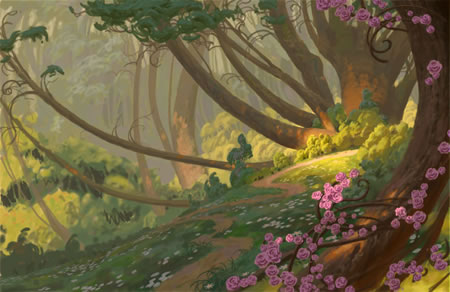 (Image above © Disney)
Craig Elliott is an illustrator, visual development artist and layout artist who works in the film industry. He has worked on numerous films for Disney Feature Animation, Dreamworks and other studios. His credits include titles like Bee Movie, Shark Tale, Flushed Away, Mulan, The Emporor’s New Groove and Treasure Planet. He has also done work for the new Disney Feature Film Enchanted (image above).
In his online portfolio you’ll find a a variety of images of location design, creature and character design, color keys, 3-D models and sets, as well as fantasy illustration.
A number of the most interesting and imaginative images are from Disney’s animated feature Treasure Planet, for which Elliott’s contributions were extensive. He is featured prominently in Treasure Planet: A Voyage of Discovery (more info here), a collection of art done for the movie that also includes artists like Peter Clarke, Peter De Seve, Ian Gooding and Christophe Vacher.
Some of my favorite pieces in Elliott’s portfolio are black and white location design images for Treasure Planet that have a wonderfully imaginative, otherworldly quality, rendered with grainy textures and atmospheric tones. Objects that might be plants, rock formations, or both, extend into the sky over oddly surfaced plains, or form gigantic rippled walls against which tiny figures are silhouetted. Wonderful stuff.
Note: The site contains some NSFW material.
Categories:
-
Dr. Sketchy’s Anti Art Show
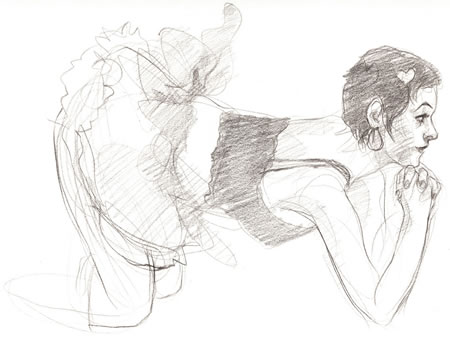
I’ve long maintained that both men and women have only one erogenous zone. (Got your attention, didn’t I?)I’ll further maintain that this single erogenous zone is located in the same physical location for both sexes, directly between… the ears. Nothing is sexy unless you think it’s sexy.
Which is why life drawing sessions are set up to maintain a professional or academic atmosphere and the sexual element is almost non-existant. This is generally a Good Thing, but it’s nice to know that there are exceptions to every rule.
Dr. Sketchy’s Anti Art School is a series of drawing sessions that looks to put the “arrrrrr” back into art classes, with racy costumes, provocative poses and a generally anti-academic atmosphere.
For more background, see my previous post on Dr. Sketchy’s.
At the time, I mentioned that submissions were being taken for the first Dr. Sketchy’s Anti Art Show.
Dr. Sketchy’s founder, illustrator Molly Crabapple, has written to say that the show is now assembled and will hang at Rapture, 200 Avenue A in NYC, from November 21 to December 20, 2007. The opening party will be November 27th.
There is a gallery online for those of us not in the area, that features work by some of the participants, as well as photographs from the sessions.
Note: The Dr. Sketchy’s site should be considered delightfully NSFW and politically incorrect.
(Image above: Jim Hoover)
Categories:




Charley’s Picks
Bookshop.org
(Bookshop.org affilliate links; sales benefit independent bookshop owners; I get a small percentage to help support my work on Lines and Colors)

John Singer Sargent: Watercolors


Urban Sketching: Understanding Perspective


Charley’s Picks
Amazon
(Amazon.com affiliate links; sales go to a larger yacht for Jeff Bezos; but I get a small percentage to help support my work on Lines and Colors)
John Singer Sargent: Watercolors
Urban Sketching: Understanding Perspective