


Categories
- 3d CGI
- Amusements
- Animation
- Anime & Manga
- Art Materials
- Art Videos
- Blogroll
- Cartoons
- Color
- Comics
- Concept & Visual Dev.
- Creativity
- Digital Art
- Digital Painting
- Displaying Art on the Web
- Drawing
- Eye Candy for Today
- Gallery and Museum Art
- High-res Art Images
- Illustration
- Motion Graphics & Flash
- Museums
- Online Museums
- Outsider Art
- Painting
- Painting a Day
- Paleo Art
- Pastel, Conté & Chalk
- Pen & Ink
- Prints and Printmaking
- Reviews
- Sc-fi and Fantasy
- Sculpture & Dimensional
- Site Comments
- Sketching
- Storyboards
- Tools and Techniques
- Uncategorized
- Vector Art
- Videos & Podcasts
- Vision and Optics
- Watercolor and Gouache
- Webcomics
Archives
- April 2026
- March 2026
- February 2026
- January 2026
- December 2025
- November 2025
- October 2025
- September 2025
- August 2025
- July 2025
- June 2025
- May 2025
- January 2025
- December 2024
- November 2024
- October 2024
- September 2024
- August 2024
- June 2024
- April 2024
- March 2024
- February 2024
- January 2024
- December 2023
- November 2023
- October 2023
- September 2023
- August 2023
- July 2023
- May 2023
- April 2023
- March 2023
- February 2023
- January 2023
- December 2022
- November 2022
- September 2022
- August 2022
- July 2022
- June 2022
- May 2022
- April 2022
- March 2022
- February 2022
- January 2022
- December 2021
- November 2021
- October 2021
- September 2021
- August 2021
- July 2021
- June 2021
- May 2021
- April 2021
- March 2021
- February 2021
- January 2021
- December 2020
- November 2020
- October 2020
- September 2020
- August 2020
- July 2020
- June 2020
- May 2020
- April 2020
- March 2020
- February 2020
- January 2020
- December 2019
- November 2019
- October 2019
- September 2019
- August 2019
- July 2019
- June 2019
- May 2019
- April 2019
- March 2019
- February 2019
- January 2019
- December 2018
- November 2018
- October 2018
- September 2018
- August 2018
- July 2018
- June 2018
- May 2018
- April 2018
- March 2018
- February 2018
- January 2018
- December 2017
- November 2017
- October 2017
- September 2017
- August 2017
- July 2017
- June 2017
- May 2017
- April 2017
- March 2017
- February 2017
- January 2017
- December 2016
- November 2016
- October 2016
- September 2016
- August 2016
- July 2016
- June 2016
- May 2016
- April 2016
- March 2016
- February 2016
- January 2016
- December 2015
- November 2015
- October 2015
- September 2015
- August 2015
- July 2015
- June 2015
- May 2015
- April 2015
- March 2015
- February 2015
- January 2015
- December 2014
- November 2014
- October 2014
- September 2014
- August 2014
- July 2014
- June 2014
- May 2014
- April 2014
- March 2014
- February 2014
- January 2014
- December 2013
- November 2013
- October 2013
- September 2013
- August 2013
- July 2013
- June 2013
- May 2013
- April 2013
- March 2013
- February 2013
- January 2013
- December 2012
- November 2012
- October 2012
- September 2012
- August 2012
- July 2012
- June 2012
- May 2012
- April 2012
- March 2012
- February 2012
- January 2012
- December 2011
- November 2011
- October 2011
- September 2011
- August 2011
- July 2011
- June 2011
- May 2011
- April 2011
- March 2011
- February 2011
- January 2011
- December 2010
- November 2010
- October 2010
- September 2010
- August 2010
- July 2010
- June 2010
- May 2010
- April 2010
- March 2010
- February 2010
- January 2010
- December 2009
- November 2009
- October 2009
- September 2009
- August 2009
- July 2009
- June 2009
- May 2009
- April 2009
- March 2009
- February 2009
- January 2009
- December 2008
- November 2008
- October 2008
- September 2008
- August 2008
- July 2008
- June 2008
- May 2008
- April 2008
- March 2008
- February 2008
- January 2008
- December 2007
- November 2007
- October 2007
- September 2007
- August 2007
- July 2007
- June 2007
- May 2007
- April 2007
- March 2007
- February 2007
- January 2007
- December 2006
- November 2006
- October 2006
- September 2006
- August 2006
- July 2006
- June 2006
- May 2006
- April 2006
- March 2006
- February 2006
- January 2006
- December 2005
- November 2005
- October 2005
- September 2005
- August 2005
Relevant Blogs
Art, Painting & Sketch
- Gurney Journey
- Underpaintings
- Art and Influence
- Painting Perceptions
- Oil Painters of America
- Vasari Paint POV
- Flying Fox
- Urban Sketchers
- Bento (Smithsonian)
- Art Inconnu
- The Hidden Place
- Still Life
- Making a Mark
- The Art of the Landscape
- Exploring Color & Creativity
- Art Contrarian
- Artist A Day
- beinArt Surreal Art Collective
- Eye Level
- David Dunlop
- p.i.g.m.e.n.t.i.u.m
- CultureGrrl
- Joaquín Sorolla blog
- Artists in Pastel
“Painting a Day”
- A Painting a Day (Keiser)
- On Painting (Keiser)
- Julian Merrow-Smith
- Karen Jurick
- Jeffrey Hayes
- Carol Marine
- Abbey Ryan
- Daily Paintworks
Other Painting Blogs
- Virtual Gouache Land
- Neil Hollingsworth
- Marc Hanson
- Kevin Menck
- Marc Dalessio
- Larry Seiler
- Stapleton Kearns
- Colin Page
- Roos Schuring
- Hans Versfelt
- Titus Meeuws
- Régis Pettinari
- René Plein Air
- Belinda Del Pesco
- Robin Weiss
- Nathan Fowkes (Land Sketch)
- William Wray
- Frank Serrano
- Stephen Magsig
- Michael Chesley Johnson
- Twice a Week
- Sarah Wimperis
- Rob Adams
- Michael Cole Manley
- The Dirty Palette Club
- Mike Manley’s Draw!
Gallery Art & Illustration mix
Illustration
- Howard Pyle
- 100 Years of Illustration
- BibliOdyssey
- Illustration Art
- Today’s Inspiration
- Illustration Mundo
- Little Chimp Society
- Danny Gregory
- R D (John Martz
- Illustration Friday blog
- Monster Brains
- Illustrators & Illustrations (RU)
- Elwood H. Smith
- DaniDraws.com
- Designers Who Blog
- iSpot Blog
Sci-Fi & Fantasy
Illustration & Comics
Comics & Cartoons
- Comics Beat
- Robot 6
- Newsarama Blog
- Comic Vine
- Comics Alliance
- Forbidden Planet Int.
- Paolo Rivera
- Bolt City
- Flight
- Scott McCloud
- The Comics Journal
- Comixpedia
- Funnybook Babylon
- James Baker
- Middleton’s Sketchbook
- Boneville
- The Hotel Fred
- Paul Rivoche
- Daily Cartoonist
- Mad About Cartoons (William Wray)
- Digital Strips
Illustration & Concept
Animation & Concept
- Cartoon Brew
- Animation Blog
- Cold Hard Flash
- Concept Art World
- The CAB
- FY Concept Art
- Concept Ships
- Concept Robots
- John Nevarez
- Armand Serrano
- Marcos Mateu-Mestre
- all kinds of stuff (Kricfalusi)
- Yacin the faun (Man Arenas)
- Kelsey Mann
- Cre8tivemarks Blog
- Ice-Cream Monster Toon Cafe
- AAU Character & Creature Design
- AAU Animation Notes
- Articles and Texticles
Paleo & Scientific
Tools & Techniques
Other
Lists of Art Blogs
Art Image Resource Links
Historic Art Images
- Wikimedia Commons: Paintings
- Wikimedia Commons: Drawings
- The Athenaeum
- WikiArt (WikiPaintings)
- Google Art Project: Artists
- Google Art Project: Collections (Museums)
- ArtCyclopedia
- Web Gallery of Art
- Art Renewal Center
- Web Gallery of Impressionism
Auction Consolidation sites
Auction sites
- Sotheby’s
- Bonham’s
- Christies
- Heritage Auctions: Fine Art
- Heritage Auctions: Illustration
- Freeman’s Auctions
- Bukowskis
- Shannon’s
Image Search
Reverse Image Search (search by image)
- Tin Eye
- RevImg
- Google Image Search (camera icon)
- Bing Image Search (camera icon)
Promoting some friends and some clients of my website design business
- Twin Willows T’ai Chi studio in Wilmington DE. Taiji classes with Bryan Davis.
- Ray Hayward, Inspired Teacher of T’ai Chi ( Taiji ) in Minneapolis, Founder of Mindful Motion Tai Chi Academy
- OldHead Tattoo studio and Art Gallery in Wilmington DE. Tattoos and paintings by Bruce Gulick
- Sharon Domenico Art, pet portrait oil paintings
- Platinum Paperhanging, wallpaper hanging, Main Line and Philadelphia, PA
- Lisa Stone Design, interior designer, Main Line and Philadelphia, PA
- Studio12KPT, original art, prints, calendars and other custom printed items by Van Sickle & Rolleri
-
Reto Kaul

Reto Kaul is a young (20 yr old) freelance concept artist and illustrator from Switzerland. His web site lists his work experience as concept design, book illustration, covers and fashion design, but doesn’t list specific credits. His portfolio, however, has some nicely atmospheric pieces that show off his talent for dealing with muted light in particular.His imaginative landscapes and imaginary cityscapes are often cast in compositions with analogous color schemes, largely blues and greens. He likes to punctuate his thick atmospheres with sharp pinpoints of light, and loves to play with the idea of faintly visible shafts of light, fanning out at they emerge through the canopies of trees, break through layers of clouds or splash around a prominence of rock.
He has a nicely balanced command of his digital tools and his pieces have suggestions of texture and detail without being overworked.
His online gallery is a little shy on information about the pieces, but if you hover your mouse over the thumbnails you’ll get a “tool tip” style pop-up with the name of the piece.
You can also find more info about the images (and some larger images) on some of the various concept art sites where he has a presence under the handle “gizmodus”.
Mirandopolis: Museum of Modern Art (image above, with detail, bottom, larger image here) is part of a series in which the museums of the imaginary city (no relation, I assume, to the actual municipality of Mirandópolis in Brazil) are pictured as built in a gigantic cave.
He also has images of an airport and cathedral for the city, and you can see a step by step for his image of the cathedral here.
Categories:
-
Tom Hale
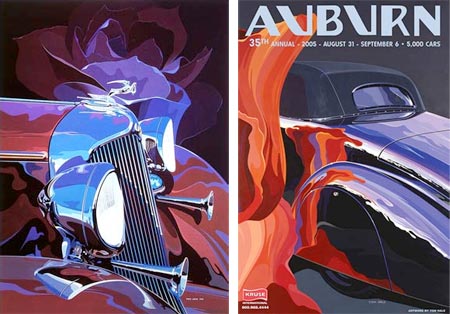 I’ve written before about concept artists and designers who create drawings and paintings of vehicles, and touched on the idea of customized car bodies as modern sculpture (in my post on “Big Daddy” Roth), but Tom Hale, who started his career as an automotive designer, has chosen cars, or more accurately, car forms, as the subject for his paintings.
Unlike many who might say they have chosen cars as the subject for paintings, Hale’s intent isn’t to illustrate the look of a particular model of automobile, though he certainly captures the flavor of individual models in terms of accuracy and detail; rather he sees the forms of vintage cars as objects of beauty.
This particularly applies to older, 30’s and 40’s cars, in which the curve of fenders, the rounded forms of headlight bezels, the dignified rise of grills and the sweeping curves of the bodies are inherently more beautiful and interesting, to my mind, than the designs of the 50’s and beyond. (Cars of the late 30’s, in particular, seem to have a kind of Art Deco grace.) Not that Hale doesn’t also see beauty in later models, particularly the chrome plated cruisers of the 50’s with the bulleted punch of enormous chrome bumpers and the cherry red gleam of the new paints.
Hale makes the forms stand out as forms, isolates them into small selected areas that make it easier to see them as something other than “a car” and renders them in sweeping graphic shapes of brilliant color.
He revels in the reflective surfaces of hand rubbed lacquer and polished chrome and his colors swirl and flow across the forms like the liquid rainbows on a film of oil. His compositions become very graphic, and work very well as posters.
His web site doesn’t mention anything about technique. The work looks like acrylic to me, though his bio mentions an award from the American Watercolor Society.
The gallery on his site kind of bypasses showing the art as art, however, and divides the work into posters and limited edition prints. You will find him portraying entire cars at times, particularly in the posters, but with the same dazzling ribbons of color playing off of reflective surfaces and curvilinear forms.
Categories:
-
Rogier van der Weyden
 Just as an individual artist struggles to learn the basics of drawing and painting, and works to progress into more sophisticated mastery of perspective, proportion, composition, and the ability to convincingly portray any desired subject, so too has Western art in general struggled to pass through those same stages.
Representational art started out as decoration and progressively moved toward less iconic and more “realistic” portrayals of people and other aspects of nature. The heights reached in Greece and Rome were lost in the “dark ages” and reclaimed or relearned in the time leading up to the Renaissance. Occasionally you see flashes of more naturalistic handling of subjects, particularly people, that presage later levels of accomplishment and understanding.
I think that Rogier van der Weyden (who changed his name from Roglet de la Pasture when he moved to Brussels) was one of those bright flashes.
Van der Weyden is presumed by scholars to have been a student of Robert Campin, and profoundly influenced by his silghtly older contemporary Jan van Eyck. Like Van Eyck he took up the new medium of oil painting and ran with it, realizing its potential to convey the world with more precision, detail and depth than the established medium of egg tempera.
He introduced some of the stylistic and compositional characteristics of Italian painting to the north and was instrumental in introducing the new technique of oil painting to the Italians (talk about picking it up and running with it).
He became, by the time of his death, the one of the most popular and influential painters in Europe, though he was afterward almost forgotten for hundreds of years, and much of what we know about him is through the research of scholars in the last century or so.
Unlike Van Eyck, Van der Weyden strayed from attempting to represent the world as accurately as possible and choose to infuse his work with more emotion, usually in the service of religious works. Occasionally he painted secular portraits, like the image shown here, usually simply called Portrait of a Young Woman or Lady wearing a Gauze Headdress. I’ve always found this painting in particular striking, standing out amid other work of the time like a red poppy in a green lawn.
It’s a beautiful face, rendered with confident draftsmanship and tonal subtlety, from the faint under-lighting of the folds of white fabric under her chin to the delicate Leonardoesque corners of her mouth. Wonderful. (And when I say “Leonardoesque”, bear in mind that Da Vinci wouldn’t be born for another 6 or 7 years.)
Here is where I may get a bit presumptuous in second guessing a great master, as something strikes me as a bit odd about her eyes. Yes, they too are beautiful, luminous green, holding our gaze with unwavering equanimity, with slight traces of lashes beneath absent brows (not uncommon in paintings of the time).
Look at her left eye, though (to our right), also delicately modeled, also beautiful; but isn’t it essentially the same beautifully modeled shape as her right eye? An eye in that position should be more rounded to reflect it’s position on the spherical axis of the head. Also the shape of the eyes seems oversimplified, almost iconic. I think you can see the artist appear to have some difficulty with the shape of eyes in other paintings and drawings as well.
Though he may have been free in his interpretation, intentionally giving the eyes in this portrait an artificial symmetry, I think Van der Weyden is painting partly what he sees and partly what he knows, struggling a bit with the accurate representation of reality as is actually is, and, in a way, representing the whole of Western art as it worked to improve its grasp of this process of capturing the world with brushes and paints.
Categories:
-
Making Comics: Storytelling Secrets of Comics, Manga and Graphic Novels

It’s often mentioned that comics, or “graphic storytelling” is the only art form in which words and pictures are blended together in an integral way to tell a story. I also like to point out that comics is the only visual medium (compared, for example, to film or video) in which the reader/viewer can choose to alter the element of time. Yes authors in both prose and comics can exert control over how quickly the flow of a story progresses, but readers can choose to read more or less slowly, or whether to linger over a particular passage, which is very unlike film or video.As such, comics represents a unique nexus of various story-telling techniques, sharing much in common with both film and prose. Comics is not just a unique medium of expression, it is essentially a different kind of language (regardless of the cultural language of any incorporated test), and has its own system of visual grammar.
This is a rarely explored topic, and most comics artists learn it through emulation or study of existing work, advice from more seasoned comics artists, and occasionally through formal classes.
Most how-to books on the subject creating comics concentrate on how to draw dramatic superheroes, watery-eyed manga babes or cool bots, and/or on drawing tools, pencils, inks, coloring and reproduction, or how to “break into the biz” of professional comics. Little thought is given to the real objective of telling a story in words and pictures.
Who better to fill that gap that Scott McCloud, who has probably given more thought to the nature of comics and comics storytelling than anyone, with the possible exception of Will Eisner.
McCloud’s latest book Making Comics: Storytelling Secrets of Comics, Manga and Graphic Novels is part how-to manual on understanding and using that language; and part continuation of his series of treatises on the nature of comics as a medium. These started with the classic Understanding Comics: The Invisible Art, followed by the less well received (and possibly misunderstood) Reinventing Comics: How Imagination and Technology Are Revolutionizing an Art Form.
Though it covers some of the more familiar territory of tools and techniques, drawing expressions and composing dramatic panels, the majority of Making Comics is about the actual language of comics, and how to use it effectively. A good alternate title for Making Comics might be Comics, the Missing Manual.
McCloud covers a range of topics that anyone involved in creating comics needs to know, and anyone who enjoys reading comics would find interesting and enlightening.
He explains the logic behind establishing shots, medium shots and close ups (so similar to film, see the image above), choice of words and flow of the story (so similar to prose) and things unique to comics like choosing panel arrangements, placing word balloons, using sound effects, balancing the marriage of words and text (in terms of which is used to convey what); as well as skill in the placement of figures in a panel to convey relationships and keep the reader/viewer correctly oriented in the imaginary physical space in which the story unfolds.
All of this extraordinarily well though out analysis of the medium, which amounts to a definitive St. Martin’s Handbook for comics, is imparted in a breezy, informal style, peppered with humor and conveyed through the medium of comics itself.
The book is set up to some extent as if intended to be used as a textbook, and well it should be. Anyone interested in creating comics would do well to study this book.
If you are serious, supplement it with Understanding Comics and two books by Will Eisner, one of the all time masters of the medium, Graphic Storytelling and Comics & Sequential Art. (Having books on comics storytelling by Eisner is a bit like having painting manuals from Rembrandt or Sargent.)
There is a Making Comics page on McCloud’s site devoted to the book, but it is oddly lacking in the description, excerpts, and promotional material expected of a web site presence for a book. It concentrates more on the fascinating promotional tour McCloud and his family undertook of all 50 US states (which I wrote about in December of 2006), including a dedicated blog and podcasts from the road, as well as “Winterviews”, in which McCloud’s young daughter interviews comics creators they encounterd on the tour. There is, however, an “online chapter” of the book, Chapter 5 ½, in which McCloud discusses webcomics in their natural environment and in color.
For better descriptions of the book itself, I’ll have to send you to some of the other reviews I’ve listed below. The best thing, of course, is to stop by the bookstore and take a look for yourself. You don’t get a feeling for a book like this without seeing it (sorry, no audio books commute for this one).
For those just interested in the medium, McCloud continues to surprise and delight with his keen observations and inventive expositions. For those creating comics, particularly those who are just learning their craft, Making Comics is an essential read.
I don’t even think McCloud himself is aware of something else he has accomplished with the three books in this series (forest for the trees and all that). In using his own considerable skills as a comics storyteller to explain the complexities and subtleties of this unique art form, McCloud has refined the language of comics as an informational medium to a previously unknown level.
This may seem a smaller thing than it is, but, just as in the best comics stories, the combination of words and pictures that is comics can convey ideas in ways that words or pictures alone, or words simply illustrated with pictures, could not. All three of these graphic expositions (can’t call ’em novels) demonstrate that potential like nothing I’ve ever seen.
McCloud has refined this skill to the point where it is simultaneously as subtle as an essay, as informative as an illustrated book and as entertaining as, well, comics.
Categories:
-
Irving Norman
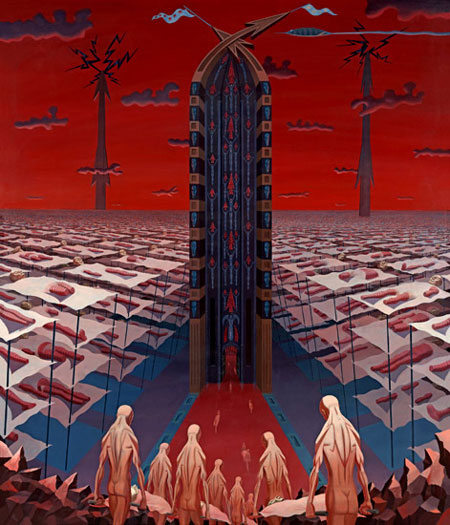
Irving Norman may be the most important “ignored” artist of the 20th Century.His work is striking, powerful, visually and intellectually rich and complex, masterfully painted and emotionally haunting. He painted dramatic, large scale canvasses exploding with color and detail, in which dozens, even hundreds of figures dance the dances of humanity in the throes of being at their most vulnerable, their most cruel, their most fragile, their most cursed and most noble in suffering. The image above, War Wounded (70 x 60 in, 178x 152 cm), was painted in 1960.
Why haven’t the majority of people, even those conversant in 20th Century art, heard of him?
His art was suppressed because the postwar modernist art establishment suppressed everything but Abstract Expressionism, and its sterile, flat-headed children, for more than half a century.
His art was suppressed because it intentionally makes us uncomfortable, both with jarringly visceral images of pain and violence and with disconcerting reminders of the horrors of war, racism, poverty and inequality; and does so with a raw power, emotional rage and technical facility that makes most “social commentary” art look genteel.
His art was suppressed because his horrifically elegant tableaux of the landscape of suffering humanity, that expose how those with power dominate, manipulate, control and use those without, make those same powerful individuals uncomfortable and angry.
His art was suppressed because he was on the US government’s list of “potential subversives” during the years when F.B.I. Director J. Edgar Hoover and Senator Joseph McCarthy were doing their best to restrict the freedoms and success of anyone who didn’t fit their narrow, ultra-conservative picture of what was acceptably “American”.
Even now, I have to wonder if interest in his work is enough to land you on a “suspected terrorist” no-fly list (and I’m only half joking).
Mark Vallen, on his “Art for a Change” blog, gives a better overview of Norman and his struggle against these forces than I can provide here.
There is a web site devoted to Norman’s work that contains biographical information and images. Unfortunately, the focus of the galleries seems to be on quantity and a historical record of his work through different periods. Few of the images are large enough to convey the power and detail of his large scale paintings. There are a few slightly larger ones on TFAOI along with an essay on the artist and his work.
There is a traveling museum exhibit called Dark Metropolis: Irving Norman’s Social Surrealism, that originated at the Crocker Art Museum and then moved to the Pasadena Museum of California Art. It is now at the Nora Eccles Harrison Museum of Art, Utah State University until October 20, 2007, and will then go to the Katzen Art Center, at American University in Washington, D.C, where I hope to see it, from November 6, 2007 to January 27, 2008.
There is a book, created to accompany the exhibit, by the same title: Dark Metropolis: Irving Norman’s Social Surrealism (Amazon link, more detail here).
Don’t let my descriptions of Norman’s powerful art give you the impression that it is about hopelessness, far from it. No matter how horrific his images, those facing the forces of oppression do so with a strength and inherent dignity that cannot be extinguished by the crushing injustices of war and the oppressive forces of modern society.
Much like Norman’s own determined resilience through his personal experience of the horrors and cruelty of the Spanish Civil War and, on returning the US, in the face of 20 years of government surveillance and artistic repression.
[Note: the site linked here contains images of violence and should be considered NSFW.]
Categories:
-
Louis Comfort Tiffany

Most people who are aware of Louis Comfort Tiffany as a designer and creator of elegant Art Nouveau artifacts and, in particular, stained glass, are unaware that he started as a painter, training under George Inness and Samuel Coleman.The metropolitan Museum of Art in NY expanded the galleries in its American Wing to allow for more space devoted to Tiffany’s works, and has a nice online feature that includes some of his rarely noticed paintings and drawings, as well as work from other artists in the employ of Tiffany’s studio. Included is Tiffany’s painting Snake Charmer at Tangier (image above, top, large version here). In the tradition of “Orientalist” painters like Jean-Léon Gérôme, Tiffany traveled to Egypt and North Africa and found inspiration in the exotic architecture, dress and customs.
There also a selection of Tiffany paintings and drawings on the Art Renewal Center.
From October 7, 207 to January 6, 2008 the Allentown Art Museum will feature Tiffany by Design, an exhibition of Tiffany’s famous lamps and other artifacts from the Neustadt Collection of Tiffany Glass in Long island City, NY. The Allentown Art Museum is concurrently showing Alphonse Mucha: Art Nouveau Extraordinaire (see my post on Mucha).
My favorite piece by Tiffany is a collaboration with another artist, Maxfield Parrish, in which Tiffany interpreted Parrish’s painting for Dream Garden, a 15′ x 50′ (4.5m x 15m glass mosaic mural installed in the Curtis Center (formerly Curtis Publishing) here in Philadelphia.
In city with its fair share of art scandal (Barnes, Eakins), this too was the center of controversy a few years ago when the new owners of the building saw it as stained glass dollar signs and wanted to dismantle it from the lobby of the historic building across from Independence Hall in which Tiffany and Parrish had installed it, and sell it to a collector from another city. Fortunately the city was able to prevent that; and I can say from a recent visit that it looks as glorious as ever (image, above, bottom; my photo in which I’ve left a visitor in for scale and couldn’t avoid the plant; there’s a better image here from Philadelphia Scenes by Dave Thomas).
[Allentown Museum exhibit link via Art Knowledge News]
Categories:



Charley’s Picks
Bookshop.org
(Bookshop.org affilliate links; sales benefit independent bookshop owners; I get a small percentage to help support my work on Lines and Colors)

John Singer Sargent: Watercolors


Urban Sketching: Understanding Perspective


Charley’s Picks
Amazon
(Amazon.com affiliate links; sales go to a larger yacht for Jeff Bezos; but I get a small percentage to help support my work on Lines and Colors)
John Singer Sargent: Watercolors
Urban Sketching: Understanding Perspective