


Categories
- 3d CGI
- Amusements
- Animation
- Anime & Manga
- Art Materials
- Art Videos
- Blogroll
- Cartoons
- Color
- Comics
- Concept & Visual Dev.
- Creativity
- Digital Art
- Digital Painting
- Displaying Art on the Web
- Drawing
- Eye Candy for Today
- Gallery and Museum Art
- High-res Art Images
- Illustration
- Motion Graphics & Flash
- Museums
- Online Museums
- Outsider Art
- Painting
- Painting a Day
- Paleo Art
- Pastel, Conté & Chalk
- Pen & Ink
- Prints and Printmaking
- Reviews
- Sc-fi and Fantasy
- Sculpture & Dimensional
- Site Comments
- Sketching
- Storyboards
- Tools and Techniques
- Uncategorized
- Vector Art
- Videos & Podcasts
- Vision and Optics
- Watercolor and Gouache
- Webcomics
Archives
- April 2026
- March 2026
- February 2026
- January 2026
- December 2025
- November 2025
- October 2025
- September 2025
- August 2025
- July 2025
- June 2025
- May 2025
- January 2025
- December 2024
- November 2024
- October 2024
- September 2024
- August 2024
- June 2024
- April 2024
- March 2024
- February 2024
- January 2024
- December 2023
- November 2023
- October 2023
- September 2023
- August 2023
- July 2023
- May 2023
- April 2023
- March 2023
- February 2023
- January 2023
- December 2022
- November 2022
- September 2022
- August 2022
- July 2022
- June 2022
- May 2022
- April 2022
- March 2022
- February 2022
- January 2022
- December 2021
- November 2021
- October 2021
- September 2021
- August 2021
- July 2021
- June 2021
- May 2021
- April 2021
- March 2021
- February 2021
- January 2021
- December 2020
- November 2020
- October 2020
- September 2020
- August 2020
- July 2020
- June 2020
- May 2020
- April 2020
- March 2020
- February 2020
- January 2020
- December 2019
- November 2019
- October 2019
- September 2019
- August 2019
- July 2019
- June 2019
- May 2019
- April 2019
- March 2019
- February 2019
- January 2019
- December 2018
- November 2018
- October 2018
- September 2018
- August 2018
- July 2018
- June 2018
- May 2018
- April 2018
- March 2018
- February 2018
- January 2018
- December 2017
- November 2017
- October 2017
- September 2017
- August 2017
- July 2017
- June 2017
- May 2017
- April 2017
- March 2017
- February 2017
- January 2017
- December 2016
- November 2016
- October 2016
- September 2016
- August 2016
- July 2016
- June 2016
- May 2016
- April 2016
- March 2016
- February 2016
- January 2016
- December 2015
- November 2015
- October 2015
- September 2015
- August 2015
- July 2015
- June 2015
- May 2015
- April 2015
- March 2015
- February 2015
- January 2015
- December 2014
- November 2014
- October 2014
- September 2014
- August 2014
- July 2014
- June 2014
- May 2014
- April 2014
- March 2014
- February 2014
- January 2014
- December 2013
- November 2013
- October 2013
- September 2013
- August 2013
- July 2013
- June 2013
- May 2013
- April 2013
- March 2013
- February 2013
- January 2013
- December 2012
- November 2012
- October 2012
- September 2012
- August 2012
- July 2012
- June 2012
- May 2012
- April 2012
- March 2012
- February 2012
- January 2012
- December 2011
- November 2011
- October 2011
- September 2011
- August 2011
- July 2011
- June 2011
- May 2011
- April 2011
- March 2011
- February 2011
- January 2011
- December 2010
- November 2010
- October 2010
- September 2010
- August 2010
- July 2010
- June 2010
- May 2010
- April 2010
- March 2010
- February 2010
- January 2010
- December 2009
- November 2009
- October 2009
- September 2009
- August 2009
- July 2009
- June 2009
- May 2009
- April 2009
- March 2009
- February 2009
- January 2009
- December 2008
- November 2008
- October 2008
- September 2008
- August 2008
- July 2008
- June 2008
- May 2008
- April 2008
- March 2008
- February 2008
- January 2008
- December 2007
- November 2007
- October 2007
- September 2007
- August 2007
- July 2007
- June 2007
- May 2007
- April 2007
- March 2007
- February 2007
- January 2007
- December 2006
- November 2006
- October 2006
- September 2006
- August 2006
- July 2006
- June 2006
- May 2006
- April 2006
- March 2006
- February 2006
- January 2006
- December 2005
- November 2005
- October 2005
- September 2005
- August 2005
Relevant Blogs
Art, Painting & Sketch
- Gurney Journey
- Underpaintings
- Art and Influence
- Painting Perceptions
- Oil Painters of America
- Vasari Paint POV
- Flying Fox
- Urban Sketchers
- Bento (Smithsonian)
- Art Inconnu
- The Hidden Place
- Still Life
- Making a Mark
- The Art of the Landscape
- Exploring Color & Creativity
- Art Contrarian
- Artist A Day
- beinArt Surreal Art Collective
- Eye Level
- David Dunlop
- p.i.g.m.e.n.t.i.u.m
- CultureGrrl
- Joaquín Sorolla blog
- Artists in Pastel
“Painting a Day”
- A Painting a Day (Keiser)
- On Painting (Keiser)
- Julian Merrow-Smith
- Karen Jurick
- Jeffrey Hayes
- Carol Marine
- Abbey Ryan
- Daily Paintworks
Other Painting Blogs
- Virtual Gouache Land
- Neil Hollingsworth
- Marc Hanson
- Kevin Menck
- Marc Dalessio
- Larry Seiler
- Stapleton Kearns
- Colin Page
- Roos Schuring
- Hans Versfelt
- Titus Meeuws
- Régis Pettinari
- René Plein Air
- Belinda Del Pesco
- Robin Weiss
- Nathan Fowkes (Land Sketch)
- William Wray
- Frank Serrano
- Stephen Magsig
- Michael Chesley Johnson
- Twice a Week
- Sarah Wimperis
- Rob Adams
- Michael Cole Manley
- The Dirty Palette Club
- Mike Manley’s Draw!
Gallery Art & Illustration mix
Illustration
- Howard Pyle
- 100 Years of Illustration
- BibliOdyssey
- Illustration Art
- Today’s Inspiration
- Illustration Mundo
- Little Chimp Society
- Danny Gregory
- R D (John Martz
- Illustration Friday blog
- Monster Brains
- Illustrators & Illustrations (RU)
- Elwood H. Smith
- DaniDraws.com
- Designers Who Blog
- iSpot Blog
Sci-Fi & Fantasy
Illustration & Comics
Comics & Cartoons
- Comics Beat
- Robot 6
- Newsarama Blog
- Comic Vine
- Comics Alliance
- Forbidden Planet Int.
- Paolo Rivera
- Bolt City
- Flight
- Scott McCloud
- The Comics Journal
- Comixpedia
- Funnybook Babylon
- James Baker
- Middleton’s Sketchbook
- Boneville
- The Hotel Fred
- Paul Rivoche
- Daily Cartoonist
- Mad About Cartoons (William Wray)
- Digital Strips
Illustration & Concept
Animation & Concept
- Cartoon Brew
- Animation Blog
- Cold Hard Flash
- Concept Art World
- The CAB
- FY Concept Art
- Concept Ships
- Concept Robots
- John Nevarez
- Armand Serrano
- Marcos Mateu-Mestre
- all kinds of stuff (Kricfalusi)
- Yacin the faun (Man Arenas)
- Kelsey Mann
- Cre8tivemarks Blog
- Ice-Cream Monster Toon Cafe
- AAU Character & Creature Design
- AAU Animation Notes
- Articles and Texticles
Paleo & Scientific
Tools & Techniques
Other
Lists of Art Blogs
Art Image Resource Links
Historic Art Images
- Wikimedia Commons: Paintings
- Wikimedia Commons: Drawings
- The Athenaeum
- WikiArt (WikiPaintings)
- Google Art Project: Artists
- Google Art Project: Collections (Museums)
- ArtCyclopedia
- Web Gallery of Art
- Art Renewal Center
- Web Gallery of Impressionism
Auction Consolidation sites
Auction sites
- Sotheby’s
- Bonham’s
- Christies
- Heritage Auctions: Fine Art
- Heritage Auctions: Illustration
- Freeman’s Auctions
- Bukowskis
- Shannon’s
Image Search
Reverse Image Search (search by image)
- Tin Eye
- RevImg
- Google Image Search (camera icon)
- Bing Image Search (camera icon)
Promoting some friends and some clients of my website design business
- Twin Willows T’ai Chi studio in Wilmington DE. Taiji classes with Bryan Davis.
- Ray Hayward, Inspired Teacher of T’ai Chi ( Taiji ) in Minneapolis, Founder of Mindful Motion Tai Chi Academy
- OldHead Tattoo studio and Art Gallery in Wilmington DE. Tattoos and paintings by Bruce Gulick
- Sharon Domenico Art, pet portrait oil paintings
- Platinum Paperhanging, wallpaper hanging, Main Line and Philadelphia, PA
- Lisa Stone Design, interior designer, Main Line and Philadelphia, PA
- Studio12KPT, original art, prints, calendars and other custom printed items by Van Sickle & Rolleri
-
The New Creative Artist by Nita Leland
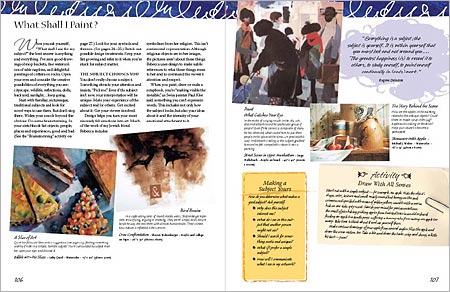
I received a review copy of The New Creative Artist: A Guide to Developing Your Creative Spirit by Nita Leland from North Light Books. Leland is the author of several popular books including Exploring Color, Creative Collage Techniques, and The Creative Artist, her first book, of which The New Creative Artist is a considerably revised and expanded version.Leland has long had a presence on the web. Her blog Exploring Color and Creativity, which is one of the oldest links on the lines and colors blogroll, covers a variety of art related topics, as does her web site, which contains an extensive, if loosely arranged, array of resources, from a succinct description of split-primary color mixing, to an extensive list of art related books and mini book reviews. (Her site is perhaps best navigated through the site map.)
Leland often brings her resources to bear in service of those who need some help or guidance getting started down an artistic path. She has been teaching workshops since the ’70s, and her books, in particular The New Creative Artist, work hard at building a bridge onto that path, either for beginners or even seasoned artists who are struggling with being “blocked” or are in need of a recharge for their artistic confidence.
The New Creative Artist is a compendium of suggestions, exercises, and short articles on various ways to jump start the creative process. Like Bert Dodson’s Keys to Drawing with Imagination, also from North Light Books, which I reviewed a few weeks ago, Leland’s creativity enhancement principles are not new, the value is in her choice and presentation of them.
Like Keys to Drawing With Imagination, The New Creative Artist makes those techniques specific to artistic creation, as opposed to the many creativity enhancement books that try to cover all bases and include business and office creativity in the mix. Also like that book, this one is bound as a spiral/hardback hybrid meant to lay open flat on your drawing table while you work. Unlike Keys, which is specifically related to drawing, Leland’s book is more generally oriented to a variety of artistic endeavors, including painting, drawing, collage, and even crafts like fiber arts, papermaking and decorative painting.
In the process, The New Creative Artist serves as a brief introduction to a multitude of artistic techniques. Various mediums and working methods are mentioned briefly, but with enough detail to engage in them. Her section on Drawing Methods, for example, gives you short but workable descriptions of contour drawing, gesture drawing, portraiture, figure drawing and even the Surrealists’ specialty of automatic drawing. She also talks about design in relation to composing works, and the importance of elements like shape, value, rhythm, contrast and balance.
Design is perhaps an issue in the appreciation of the book, The book itself is an intense exercise in book design (by Wendy Dunning, possibly in collaboration with Leland). It is full of colors, patterns, textures and graphic elements meant to look like notes or scraps of paper, with exercises and quotes written on them, scattered about as if lying on top of the pages. It’s illustrated with works from a number of artists, in addition to Leland’s own, that generally use a bright palette. While sure to be delightful to some, The overall effect is, to my eye, a bit feminine, and may be off-putting to hard bitten concept artists, comic book artists and dyed-in-the-wool starving-in-a-garret bohemian painters. If you can get past that initial impression, and the cheery, informal, hand-holding tone of the text, you may find that the techniques are just as valid as if printed in plain Garamond on stark white pages.
There is an online preview of the book, which allows you to thumb through small but legible examples of over 30 pages.
Though of potential benefit to almost any artist who wants a source of techniques for unblocking and reviving artistic confidence, (one the best of which, I feel, is to break from what you are used to doing and explore another approach, medium or set of tools, as this book suggests), the The New Creative Artist is more directly aimed at those who are working to get started, and who will find it full of gentle encouragement and a wide array of approaches to creative exploration.
Categories:
-
Jonny Duddle
 Jonny Duddle is, as far as I can determine, a concept artist for the gaming industry who lives in the UK. The “Who” section of his website just has a “More info soon” line above a row of photos that look a bit like a criminal line up; but we’ll ignore that in light of the fact that the “How” section, right next door, has nice step-by-step breakdowns of the creation of three of his wonderfully silly and exaggerated images, including the image shown here.
Duddle’s images have the feeling of highly rendered cartoons, brushed out with plenty of texture, lots of color and a good dose of flippant attitude. Monkeys and/or apes feature prominently in many of them, including a series of astronaut chimp images and a series he calls “Monkey Girl” of which the image at left is a part.
Some of the work on the site, notably in the “Games” section, is from his professional work on games like Milo and the Rainbow Nasties, Looney Tunes: Back in Action, and E.T.: Return to the Green Planet. The brief bit of text in that section tells us we can’t expect to see more games images from him for a some time for contractual reasons; but we’ll ignore that in light of the “Stories” and “Gumph” sections, which are chock-full of fun stuff, apparently done for his own amusement. The former featuring work done around story-like themes, if not for actual stories, and the latter a place to fit things that don’t fit the former.
In addition to the detail images you can find in the course of the step-by-step breakdowns in the “How” section, you will occasionally see icons next to images that say “Big?”, and link to some genuinely large close-ups of the images.
For reasons that elude me, Duddle’s site opens in a pop-up window, uses frames and is too big for its window at times; but we’ll ignore that in light of the fact that his opening page indicates that his site is due for a major overhaul.
Duddle paints digitally. Only one of his step-by-step sequences includes any commentary at all, and it’s pretty breezy; but we’ll ignore that in light of the fact that Duddle is now a regular contributor to ImagineFX, a UK magazine devoted to digital fantasy and science fiction art, and the magazine’s web site includes several of his workshops, including Go Berserk in Photoshop and Perfect Brushes in Photoshop, followed, ironically, by Defecting to Painter, and Painter related posts like Getting Messy with Oils and Mixed Media Experiments (part 3), in which he uses both apps together.
In the course of this post, I’ve probably told you less about Duddle’s work than I have about the structure of his web site; but we’ll ignore that.
Categories:
-
David M. Bowers
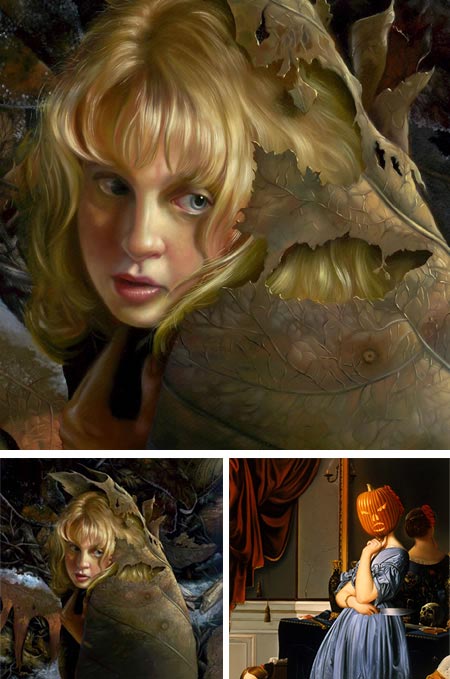
David M. Bowers started his career as a studio staff artist, transitioned into illustration and then into gallery painting. He has been splitting his time between illustration and his personal work and is now concentrating more on the later.Over the course of his successful illustration career he has received a number of awards from the Society of Illustrators, including a Gold Medal, several Silver Medals and a “Best of Show”, and has been featured in Communication Arts and the Spectrum fantastic art collections (for which the image above, left and detail, top, was chosen as the cover for last year’s Spectrum 12).
Two of his paintings for Time magazine covers are in the permanent collection of the National Portrait Gallery.
His beautifully refined oil paintings carry the feeling of Renaissance and Baroque masters, imbued with layers of implied meaning and spiced with imaginative imagery characteristic of the symbolists and surrealists.
His carefully composed and subtly lighted images can appear almost starkly realistic at times, but there always seems to be an undercurrent of meaning, or a suggestion that something is not as it seems, like his scene of normal looking patrons at an apparently ordinary bar, that just happens to have Vermeer’s Girl with a Pearl Earring hanging on the wall between the beer signs. At other times Bowers’ images can be overtly fantastic, and are sometimes wickedly funny, like his wonderful pumpkin headed version of Ingres’ portrait of Comtesse d’Haussonville (image above, right).
Bowers’ painting technique is very much in the classical tradition. He devotes a page on his site to describing of his painstaking painting process, which I’ll attempt to summarize here because it makes a nice brief account of the traditional academic painting techniques that have been handed down since the Renaissance.
He starts with a ground of real gesso, prepared with rabbit skin glue, chalk and zinc (as opposed to acrylic “gesso” which should more properly be called acrylic primer and is not actually the best surface for oil based paint). Rabbit skin glue smells terrible, has to be heated up in a double-boiler pan, takes a lot of time an effort and is a PITA to work with, but it actually sizes the canvas, and, properly primed, makes a superior surface for painting.
He then paints a monochromatic underpainting, which separates the painting of value from color, as has been tradition since oil painting was first in common use (see my post on Jan van Eyck). Bowers paints his underpainting in earth colors. The greenish cast of the burnt umber in the skin areas is reinforced with a transparent layer of green. This is a traditional Renaissance technique that gives the final reddish skin tones variation, depth and strength. Similarly, a green tree will have a reddish undercolor.
He then layers in the final colors, working carefully from background to foreground, finally applying layers of translucent glazes, sanding the layers as they dry with pumice stone powder. The final painting is sanded again and varnished to bring out the luster and depth of the glazes. This meticulous process has yielded results for generations of painters and it serves Bowers well.
When viewing the paintings in the galleries and Exhibitions sections of his site, don’t miss the Prints section, which includes detail images.
Link suggestion courtesy of Jack Harris
Categories:
-
Leah Palmer Preiss
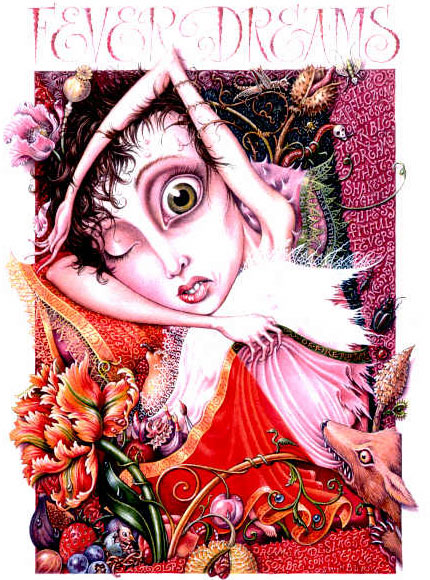
Illustrator, calligrapher and puzzle maven Leah Palmer Preiss lists her influences as “medieval manuscripts, Mad magazine, art nouveau, Alice in Wonderland, Morse code, Persian miniatures, Monty Python, scientific illustration, 17th Century poetry, Flemish Renaissance paintings and the art of the insane”.If that sounds like an insane combination, it’s wonderfully so, and her quirky, funny, highly textured, obsessively detailed, lovingly rendered and richly imaginative illustrations bear that out.
Her client list includes HarperCollins, Macmillan, Viking, the Utne Reader, New York Life, Woman’s Day and a list of advertising agencies and greeting card companies.
In addition to her mainstream editorial illustration an children’s book illustration, she has something of a specialty in the form of illustrations that are also visual puzzles. Done primarily for children’s periodicals, these are detailed images that combine her illustration and calligraphy skills with her fascination with brain teasers to create one-stop entertainments for the brain and eye.
You will also find “messages” in her other editorial work, like the “Fever Dreams” piece shown above. Included in the Illustration section of her site, she lists “Maniatures”, though she doesn’t include indications of the size of these, presumably small, expressions of visual mania.
The images on the site are just big enough to get some feeling for the intricacy and detail in her work, but can be a little small for appreciating the puzzles. Unfortunately, there isn’t a collection of her work yet that would allow us to see them together in print.
Also unfortunately, her web site is a bit of an unintentional puzzle at the moment. The imagemaps that provide the links for the main navigation elements on the left side of her site are flawed, and you can sometimes click on part of the section title and not get a response (and I can’t give you direct links because the site is in frames). Just move your mouse and try again, it’s worth the trouble.
Preiss has taken “curiouser and curiouser” as her motto, and her fascinating images can leave you curiouser for more.
Categories:
-
DrawerGeeks
 Now here’s a great idea from a group of artists for an informal series of creative projects that also translates into a fun web site.
I can’t sum it up any more succinctly than they do themselves in the first paragraph of their FAQ: “DrawerGeeks is a fun thing we do every other Friday, where professional artists (mostly from the animation, comic book, illustration and design fields) all draw their own version of a chosen fictional character.”
The result is a delightful amalgam of divers styles, techniques and artistic approaches that is pulled together with a common theme. The characters are often drawn (if you’ll excuse the expression) from mainstream comics, e.g. Thor, Captain America, Wonder Woman and Bizarro; but you’ll also find characters from movies, literature, fairy tales and other areas of pop culture, like King Kong, King Authur, Little Red Riding Hood and Cereal Mascots.
The artists sometimes make the themes bit broader than they seem by giving them an open-minded interpretation; Iron Man, for example, can be the Iron Man, the Marvel Comics character, or an iron man. Keeping to the chosen character is one of only two rules the artists apply to themselves, the other being to “keep it clean”.
There’s no requirement or limit on the amount of time devoted to the piece, and you will see examples from both ends of the spectrum, though most tend to be quite finished and some are very elaborate.
This seems a tremendous way for these artists to have fun and encourage themselves to indulge in playful creation, unrestrained by the demands of art directors and deadlines, but within a framework of a collegial atmosphere and perhaps a bit of friendly competition.
I’ve chosen a few images from the Cavemen topic to show here (from top: Cedric Hohnstadt, Mike Maihack, Jim Bradshaw, Sarah Mensinga, Jeremy Vanhoozer).
Before you run off looking for how to join, DrawerGeeks is more or less a closed circle. In order to try to keep this as a fun thing for the original participants, and not burden someone with administering a giant web site, participation is limited to invitation only.
The idea to take from this, beyond enjoying the fruits of their project by following the site every other week, would be to initiate a similar project among your own circle of artist friends.
Or, if you want an already established framework for creating a themed illustration on a regular basis and sharing it with a large group, check out Illustration Friday.
The other thing to take from DrawerGeeks is to check out the page that lists the participating artists and visit their individual web sites — something I’m just starting to do. Enjoy.
Suggestion courtesy of Meg Levitt
Categories:
-
Gilbert Stuart
 In addition to his famous portraits of our first president, George “father of his country but not exactly the handsomest guy” Washington, Gilbert Stuart, who has been rightly called the father of American portraiture, did less-well-known portraits of the next four presidents, First Ladies Dolley Madison and Abigail Adams, artists Benjamin West, Joshua Reynolds, John Trumbull and John Singleton Copley, as well as numerous members of high society in American and England.
After initial study with the Scottish painter Cosmo Alexander, he became a student of Benjamin West, an American painter who had become very successful in England and was eventually elected president of the Royal Academy there. Stuart studied with West for five years, returned to the States and set up shop in Germantown, a suburb of Philadelphia (later incorporated into the city). He later settled in Boston, and museums in that city, as well as Philadelphia and New York, hold much of his work.
Stuart painted three portraits of Washington from life, but then, due to great demand, turned out over 100 replicas of them, starting a successful cottage industry in presidential portraits (and perhaps laying the groundwork for Presidents Day sales).
The most renowned of these portrait series is the “Lansdowne” type, based on a full length portrait painted in Philadelphia, the most famous version of which was painted for the White House, and the original version of which hangs here in Philadelphia at the Pennsylvania Academy of the Fine Arts (image at left, top). It’s interesting to look at the differences in the handling of the draperies, the faces, and the rainbow arcing across the sky in these two versions.
Many other copies of this painting hang in state houses in other states. The White House version of the painting was rescued from the White House by Dolley Madison, when that structure was burned during the War of 1812.
The most famous of Stuart’s Washington portraits is the “Athenaeum Head“, the unfinished portrait of Washington facing to his right that was commissioned by Martha Washington, an engraved version of which faces the other direction as he stares out at us from the front of the one dollar bill (talk about painting money). The other major Washington portrait type is the “Vaughn” type, with washington facing to his left, which was actually the first painted and of which there are at least 15 of his replicas known. (You can see couple of them on the ARC site.)
Stuart’s style, though directly influenced by West, carried a lot of the feeling of Joshua Reynolds and Thomas Gainsborough, who were very influential at the time. Some of Stuart’s society portraits feel stiff, showing pasty-faced rich folk with dour expressions that look a bit like the portraits, and their subjects, have been gathering dust for some time. Others, however, are bright and engaging, showing a remarkable flair for color, lively brushwork and a forceful sense of the sitter’s personality, like his portrait of Rachel Harvey Montgomery, or his beautiful dual portrait of Mrs. Samuel Gratliff and her Daughter (image at left, middle and detail, bottom). These paintings are also here in Philadelphia at the Pennsylvania Academy of the Fine Arts.
There is also a nice online feature on the site for The Metropolitan Museum of Art, based on an exhibition from 2004, that gives a good overview of Stuart’s work.
Stuart was well-liked by his patrons, very popular and quite successful in his career, with the slight exception of the fact that he tended to live beyond his means, neglected his financial affairs and was often under threat of being sent to debtor’s prison. Since he didn’t actually have the ability to paint money, he moved to Ireland to avoid his creditors, and wound up in financial trouble there as well.
I guess he just couldn’t wait for credit cards and Presidents Day sales.
Categories:




Charley’s Picks
Bookshop.org
(Bookshop.org affilliate links; sales benefit independent bookshop owners; I get a small percentage to help support my work on Lines and Colors)

John Singer Sargent: Watercolors


Urban Sketching: Understanding Perspective


Charley’s Picks
Amazon
(Amazon.com affiliate links; sales go to a larger yacht for Jeff Bezos; but I get a small percentage to help support my work on Lines and Colors)
John Singer Sargent: Watercolors
Urban Sketching: Understanding Perspective