


Categories
- 3d CGI
- Amusements
- Animation
- Anime & Manga
- Art Materials
- Art Videos
- Blogroll
- Cartoons
- Color
- Comics
- Concept & Visual Dev.
- Creativity
- Digital Art
- Digital Painting
- Displaying Art on the Web
- Drawing
- Eye Candy for Today
- Gallery and Museum Art
- High-res Art Images
- Illustration
- Motion Graphics & Flash
- Museums
- Online Museums
- Outsider Art
- Painting
- Painting a Day
- Paleo Art
- Pastel, Conté & Chalk
- Pen & Ink
- Prints and Printmaking
- Reviews
- Sc-fi and Fantasy
- Sculpture & Dimensional
- Site Comments
- Sketching
- Storyboards
- Tools and Techniques
- Uncategorized
- Vector Art
- Videos & Podcasts
- Vision and Optics
- Watercolor and Gouache
- Webcomics
Archives
- April 2026
- March 2026
- February 2026
- January 2026
- December 2025
- November 2025
- October 2025
- September 2025
- August 2025
- July 2025
- June 2025
- May 2025
- January 2025
- December 2024
- November 2024
- October 2024
- September 2024
- August 2024
- June 2024
- April 2024
- March 2024
- February 2024
- January 2024
- December 2023
- November 2023
- October 2023
- September 2023
- August 2023
- July 2023
- May 2023
- April 2023
- March 2023
- February 2023
- January 2023
- December 2022
- November 2022
- September 2022
- August 2022
- July 2022
- June 2022
- May 2022
- April 2022
- March 2022
- February 2022
- January 2022
- December 2021
- November 2021
- October 2021
- September 2021
- August 2021
- July 2021
- June 2021
- May 2021
- April 2021
- March 2021
- February 2021
- January 2021
- December 2020
- November 2020
- October 2020
- September 2020
- August 2020
- July 2020
- June 2020
- May 2020
- April 2020
- March 2020
- February 2020
- January 2020
- December 2019
- November 2019
- October 2019
- September 2019
- August 2019
- July 2019
- June 2019
- May 2019
- April 2019
- March 2019
- February 2019
- January 2019
- December 2018
- November 2018
- October 2018
- September 2018
- August 2018
- July 2018
- June 2018
- May 2018
- April 2018
- March 2018
- February 2018
- January 2018
- December 2017
- November 2017
- October 2017
- September 2017
- August 2017
- July 2017
- June 2017
- May 2017
- April 2017
- March 2017
- February 2017
- January 2017
- December 2016
- November 2016
- October 2016
- September 2016
- August 2016
- July 2016
- June 2016
- May 2016
- April 2016
- March 2016
- February 2016
- January 2016
- December 2015
- November 2015
- October 2015
- September 2015
- August 2015
- July 2015
- June 2015
- May 2015
- April 2015
- March 2015
- February 2015
- January 2015
- December 2014
- November 2014
- October 2014
- September 2014
- August 2014
- July 2014
- June 2014
- May 2014
- April 2014
- March 2014
- February 2014
- January 2014
- December 2013
- November 2013
- October 2013
- September 2013
- August 2013
- July 2013
- June 2013
- May 2013
- April 2013
- March 2013
- February 2013
- January 2013
- December 2012
- November 2012
- October 2012
- September 2012
- August 2012
- July 2012
- June 2012
- May 2012
- April 2012
- March 2012
- February 2012
- January 2012
- December 2011
- November 2011
- October 2011
- September 2011
- August 2011
- July 2011
- June 2011
- May 2011
- April 2011
- March 2011
- February 2011
- January 2011
- December 2010
- November 2010
- October 2010
- September 2010
- August 2010
- July 2010
- June 2010
- May 2010
- April 2010
- March 2010
- February 2010
- January 2010
- December 2009
- November 2009
- October 2009
- September 2009
- August 2009
- July 2009
- June 2009
- May 2009
- April 2009
- March 2009
- February 2009
- January 2009
- December 2008
- November 2008
- October 2008
- September 2008
- August 2008
- July 2008
- June 2008
- May 2008
- April 2008
- March 2008
- February 2008
- January 2008
- December 2007
- November 2007
- October 2007
- September 2007
- August 2007
- July 2007
- June 2007
- May 2007
- April 2007
- March 2007
- February 2007
- January 2007
- December 2006
- November 2006
- October 2006
- September 2006
- August 2006
- July 2006
- June 2006
- May 2006
- April 2006
- March 2006
- February 2006
- January 2006
- December 2005
- November 2005
- October 2005
- September 2005
- August 2005
Relevant Blogs
Art, Painting & Sketch
- Gurney Journey
- Underpaintings
- Art and Influence
- Painting Perceptions
- Oil Painters of America
- Vasari Paint POV
- Flying Fox
- Urban Sketchers
- Bento (Smithsonian)
- Art Inconnu
- The Hidden Place
- Still Life
- Making a Mark
- The Art of the Landscape
- Exploring Color & Creativity
- Art Contrarian
- Artist A Day
- beinArt Surreal Art Collective
- Eye Level
- David Dunlop
- p.i.g.m.e.n.t.i.u.m
- CultureGrrl
- Joaquín Sorolla blog
- Artists in Pastel
“Painting a Day”
- A Painting a Day (Keiser)
- On Painting (Keiser)
- Julian Merrow-Smith
- Karen Jurick
- Jeffrey Hayes
- Carol Marine
- Abbey Ryan
- Daily Paintworks
Other Painting Blogs
- Virtual Gouache Land
- Neil Hollingsworth
- Marc Hanson
- Kevin Menck
- Marc Dalessio
- Larry Seiler
- Stapleton Kearns
- Colin Page
- Roos Schuring
- Hans Versfelt
- Titus Meeuws
- Régis Pettinari
- René Plein Air
- Belinda Del Pesco
- Robin Weiss
- Nathan Fowkes (Land Sketch)
- William Wray
- Frank Serrano
- Stephen Magsig
- Michael Chesley Johnson
- Twice a Week
- Sarah Wimperis
- Rob Adams
- Michael Cole Manley
- The Dirty Palette Club
- Mike Manley’s Draw!
Gallery Art & Illustration mix
Illustration
- Howard Pyle
- 100 Years of Illustration
- BibliOdyssey
- Illustration Art
- Today’s Inspiration
- Illustration Mundo
- Little Chimp Society
- Danny Gregory
- R D (John Martz
- Illustration Friday blog
- Monster Brains
- Illustrators & Illustrations (RU)
- Elwood H. Smith
- DaniDraws.com
- Designers Who Blog
- iSpot Blog
Sci-Fi & Fantasy
Illustration & Comics
Comics & Cartoons
- Comics Beat
- Robot 6
- Newsarama Blog
- Comic Vine
- Comics Alliance
- Forbidden Planet Int.
- Paolo Rivera
- Bolt City
- Flight
- Scott McCloud
- The Comics Journal
- Comixpedia
- Funnybook Babylon
- James Baker
- Middleton’s Sketchbook
- Boneville
- The Hotel Fred
- Paul Rivoche
- Daily Cartoonist
- Mad About Cartoons (William Wray)
- Digital Strips
Illustration & Concept
Animation & Concept
- Cartoon Brew
- Animation Blog
- Cold Hard Flash
- Concept Art World
- The CAB
- FY Concept Art
- Concept Ships
- Concept Robots
- John Nevarez
- Armand Serrano
- Marcos Mateu-Mestre
- all kinds of stuff (Kricfalusi)
- Yacin the faun (Man Arenas)
- Kelsey Mann
- Cre8tivemarks Blog
- Ice-Cream Monster Toon Cafe
- AAU Character & Creature Design
- AAU Animation Notes
- Articles and Texticles
Paleo & Scientific
Tools & Techniques
Other
Lists of Art Blogs
Art Image Resource Links
Historic Art Images
- Wikimedia Commons: Paintings
- Wikimedia Commons: Drawings
- The Athenaeum
- WikiArt (WikiPaintings)
- Google Art Project: Artists
- Google Art Project: Collections (Museums)
- ArtCyclopedia
- Web Gallery of Art
- Art Renewal Center
- Web Gallery of Impressionism
Auction Consolidation sites
Auction sites
- Sotheby’s
- Bonham’s
- Christies
- Heritage Auctions: Fine Art
- Heritage Auctions: Illustration
- Freeman’s Auctions
- Bukowskis
- Shannon’s
Image Search
Reverse Image Search (search by image)
- Tin Eye
- RevImg
- Google Image Search (camera icon)
- Bing Image Search (camera icon)
Promoting some friends and some clients of my website design business
- Twin Willows T’ai Chi studio in Wilmington DE. Taiji classes with Bryan Davis.
- Ray Hayward, Inspired Teacher of T’ai Chi ( Taiji ) in Minneapolis, Founder of Mindful Motion Tai Chi Academy
- OldHead Tattoo studio and Art Gallery in Wilmington DE. Tattoos and paintings by Bruce Gulick
- Sharon Domenico Art, pet portrait oil paintings
- Platinum Paperhanging, wallpaper hanging, Main Line and Philadelphia, PA
- Lisa Stone Design, interior designer, Main Line and Philadelphia, PA
- Studio12KPT, original art, prints, calendars and other custom printed items by Van Sickle & Rolleri
-
Daryl Mandryk

I don’t know why, exactly, but it seems like most adolescent boys, including the ones that remain in charge of some part of us as adults, love a good monster. A lot of girls like monsters too, of course, but it seems much more ingrained in boys.Perhaps it’s some primal urge to slay the demons threatening our family/village/tribe/species that compels our fascination with monsters, or maybe it’s just the gee-whiz wow cool factor. Regardless, most of us, even as “responsible adults” have to admit that we like to see a good monster now and then.
Daryl Mandryk paints good monsters, as well as nasty zombies, giant ice warriors, menacing mecha, rampaging bots, evil aliens and all manner of deliciously threatening beasties. All of which, of course, make for the ideal stock in trade of today’s gaming market.
Mandryk is a concept artist for the gaming industry, and has worked on games like Def Jam Fight, SSX on Tour, Need for Speed Underground 2, and Def Jam Vendetta for EA Games. He is currently a senior concept artist for Propaganda Games where he is working on a new game listed under the working title of Turok, which I hope means it is a version of those great old Turok, Son of Stone Indians and Dinosaurs comic books.
Mandryk has also done illustrations for fantasy and gaming publications and his work was the subject of a recent feature article and tutorial in Imagine FX Magazine.
Mandryk started out working with 3-D modeling, but has shifted into direct digital painting in Painter and Photoshop, as well as working in traditional media.
The galleries on his site are arranged by date, and include sections of older work, sketches and figure drawings from life. The highlights, though, are the nicely scary monsters, demons, and otherworldly nasties that crawl out of his electronic paintbrush.
Categories:
-
Arthur Radenbaugh

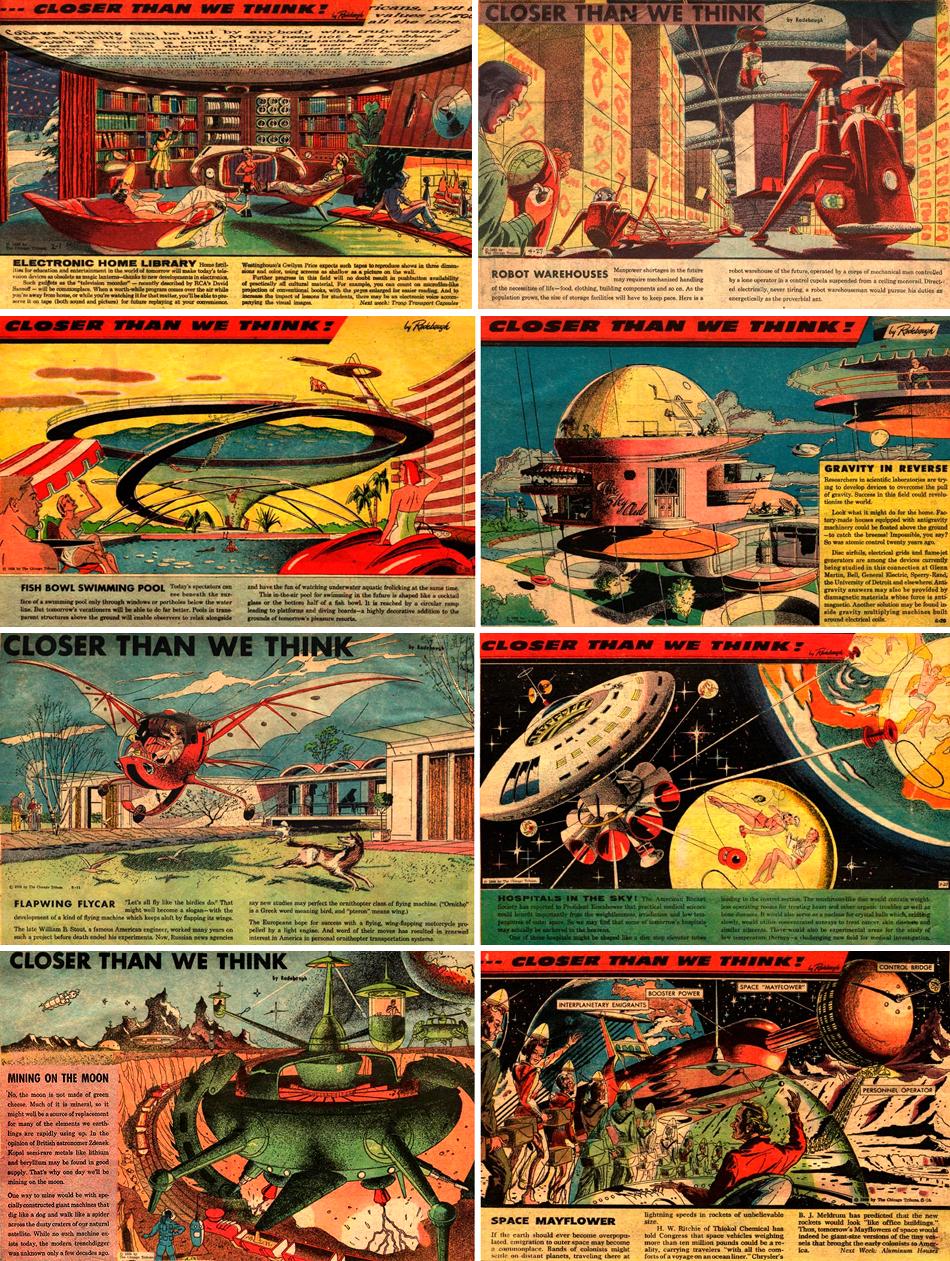
Are we there yet? Is this the future?Apparently not, judging by the lack of seed-shaped aerodynamic three-wheeled cars and art deco skyscrapers (Chrysler Building notwithstanding), but the future as depicted by futurist illustrator Arthur Radenbaugh in the 1930’s would have been very cool indeed.
Radenbaugh did his futuristic renderings of cars for Motor magazine, and his advertising and editorial illustrations for magazines like Esquire, Fortune and Advertising Agency with an eye to the future, and rendered them with a futuristic tool, the airbrush, which was coming into broader use at the time.
The ability of the airbrush to lay down remarkably smooth, even tones and gradations (today being replaced by digital tools that do the same thing more easily), made it the tool of choice for rendering a future that would obviously be seemlessly smooth, shiny and sleekly modern (just like today!)
There is a virtual exhibition of Radenbaugh’s work, Radenbaugh, The Future We Were Promised online as part of The Palace of Culture Museum.
Hey, I still want to know why we don’t all have a gyrocopter in our driveway. Must not be the future yet.
Categories:
-
Gustave Courbet
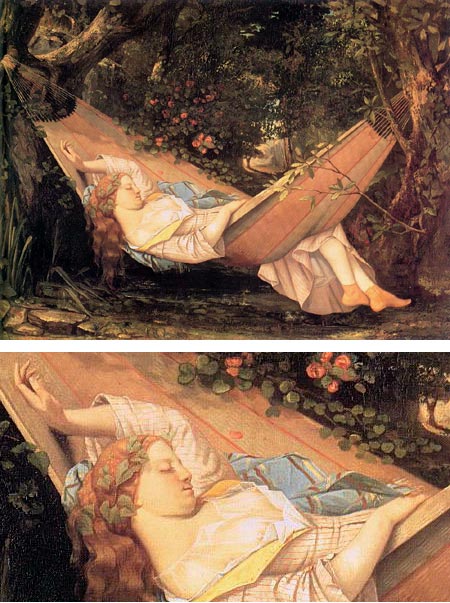
Because we live in a Post-Modern age (I love that term, “post-modern”!), we tend to think that everything prior to Modernism was “Realism”. Actually with a few exceptions, most representational art is far from being realism. Most of it is romantic or fantastic or devotional or in some manner represents life in a way that is far from “realistic”.The Dutch genre painters brushed with realism when they painted their scenes of everyday life, but “Realism” was an actual style of painting, initiated by French painter Gustave Courbet, who is also credited with coining the term. And, far from being the prosaic, “ordinary” art that Modernism would “liberate” us from, Realism was a revolutionary style, born out of political revolution and running counter the accepted art standards of the day, which were firmly entrenched in Romantic and Neo-Classical art.
Courbet painted peasants as peasants, as they actually looked. He painted genre scenes, depictions of everyday life that were ordinarily done on a small scale, on the kind of grand canvasses normally reserved for the depiction of royalty, implying, of course, that one was as important as the other.
Courbet’s insistence on painting life as is is, rather than an idealized fantasy of how is should be, made him an outcast of the art establishment at the time, the Paris Salon, but eventually made him popular with those who rejected the established order, something that was happening all around him because he was in the middle of the Paris Commune during the collapse of the revolutionary government in the 1870’s.
Courbet also changed the way paint was handled, eschewing smooth, refined and blended finish for rough handling of the paint and leaving visible brushstrokes. This, along with his devotion to truth in representing nature, made him very influential with the Impressionists, who would carry on with their own revolution in painting. Courbet would also create his own exhibition spaces when refused entry in the official Salons, again setting the stage for the Impressionists’ participation in the Salon de Refusés. The Impressionists didn’t spring up without precedent, they walked on trails blazed by Courbet (particularly in his seascapes), Corot and Manet.
Courbet also painted erotic images, which gained him more notoriety, and became directly involved in the political turmoil of his times. He helped preserve the art in the museums in Paris from being damaged or looted during the shifts in power, but was also held responsible for the destruction of a monument, and fled to Switzerland to avoid the levy of an enormous fine.
Meanwhile, here in the post-modern world, those on the East Coast of the US have an opportunity to see an exhibition called Courbet and the Modern Landscape at Walters Art Museum in Baltimore from now until January 7, 2007.
Because of Courbet’s rejection of romanticized images, the art establishment accused him of deliberately cultivating “ugliness”. I’ve had the pleasure of standing in front of his large works in the Musée d’Orsay, and the idea of Courbet depicting “ugliness” brings a smile to my face as easily as the phrase “post-modern”.
Categories:
-
Robh Ruppel
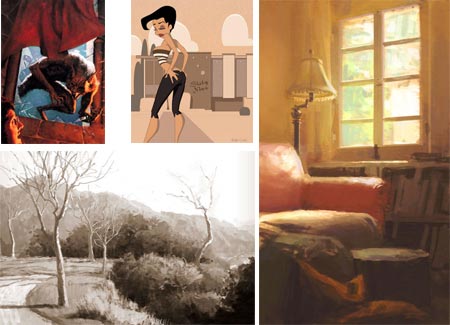
Robh Ruppel is a visual development artist and art director for Disney Feature Animation, and has worked on movies like Mulan, The Emporer’s New Groove, Treasure Planet, Atlantis, Tarzan, and Brother Bear, for which he was Art Director. He has also done gaming art and worked on gaming worlds like Ravenloft and Planescape for TSR . His latest project for Disney is Meet the The Robinsons.Ruppel also has a sideline interest in retro-60’s-modern style poster and cartoon art associated with pulp stye detective stories and film noir detectives, for which he has a site called BroadviewGraphics. This usually involves a lot of “good girl” art and fun pastiches of paperback covers and film posters.
On his regular site you will find professional and personal work, including a variety of movie concept art in color and monochromatic renderings, character designs, backgrounds, monsters and fantasy and horror illustrations as well as traditional landscapes.
His regular site doesn’t appear to be updated as often as his newer Broadview site and blog. I find the blog the most interesting because of its focus on digital painting from life, (If someone has a better term for this, let me know.) i.e. painting from life using digital painting tools like Photoshop and Painter, usually on a laptop computer.
Digital painting is usually associated with concept and production art for films and games, and editorial illustration, where the speed with which color images can be painted is a distinct advantage. A number of artists, usually from that background professionally, have taken to using the digital tools to sketch and paint from life and often post their paintings on blogs. (See my post on Sparth, for example.) Digital painting not only lets you work quickly, but eliminates the need to carry around and set up paints and and other liquids, and allows you to paint in low-light level conditions that would be difficult with traditional media.
Ruppel has been doing this for a while now, and not only does good digital paintings from life and posts them to his Broadview Blog, but often talks about the process and techniques involved. He also does something most painters can benefit from but don’t often do when they get out of school – value studies. Making monochromatic paintings is a great way to separate the understanding and appreciation of value from the distractions of color, and work with them independently.
Ruppel teaches classes at Art Center College of Design and Entertainment Art Academy, and apparently takes his students out for digital (and/or traditional) painting excursions.
His work is included in the book Drawing and Painting Fantasy Landscapes and Cityscapes by Rob Alexander and a number of gaming publications from TSR.
Note: links contain some NSFW material.
Categories:
-
Josh McKible
 I love those hazy areas where one type of imagery blurs into another, where comics fade into illustration and illustration blends into easel painting and so on.
Josh McKible is an illustrator who is often called on to either explain concepts or processes or to conceptualize an idea. In service of this he utilizes a style that brings together the bold simplicity of infographics with the richer colors and patterns of editorial illustration, producing a hybrid you might call “infostration”. (Hey, how often do I get to make up new words, even dumb ones?)
McKible uses a bold outline style with thiner detail lines and areas of flat color or gradations, which he often accents with patterns, making otherwise flat areas more lively. His focus is always on the information conveyed by the image, though, and he never allows the illustration to lose that focus.
He sometimes combines illustration with photographs of actual items (usually consumer products), producing an illustration that serves as a kind of enhanced photograph.
McKible also brings a good bit of imagination and clever choice of images to the task, making for an entertaining as well as informative visual experience.
His clients include The New York Times, Newsweek, Rolling Stone, Esquire, Popular Science, National Geographic Adventure and others. His gallery section details where each illustration was used and the kind of story or article it was illustrating.
Categories:
-
Hanson Puthuff
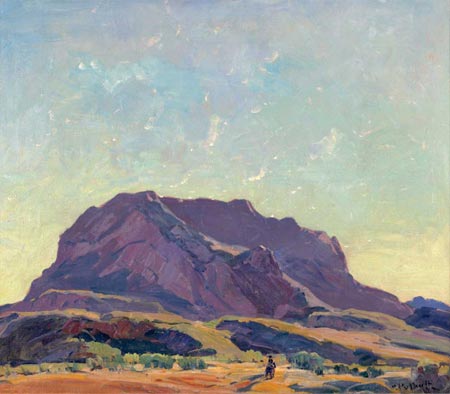
Hanson Puthuff was a commercial artist from Missouri, working in Denver and then Los Angeles at the turn of the 20th Century. While producing signs and posters for advertising, he continued to paint on his own time. He eventually abandoned commercial work to pursue his interest in plein air painting and became one of the preeminent California painters working in the Impressionist style.He was in demand as a muralist, including a set of dioramas for the Natural History Museum of Los Angeles County, and also painted a series of views of the Grand Canyon for the Sante Fe Railroad.
He painted the rolling hills, mountains, plains and valleys of California with an open, broad-stroked style, combining vibrant colors and subtle atmospheric perspective. He remains one of the most popular and widely collected of the California plein air painters from the 20th Century.
There is an exhibit of his work at the Pasdena Museum of California Art from today, October 15, 2006 to January 7, 2007.
Link via Art Knowledge News
Categories:




Charley’s Picks
Bookshop.org
(Bookshop.org affilliate links; sales benefit independent bookshop owners; I get a small percentage to help support my work on Lines and Colors)

John Singer Sargent: Watercolors


Urban Sketching: Understanding Perspective


Charley’s Picks
Amazon
(Amazon.com affiliate links; sales go to a larger yacht for Jeff Bezos; but I get a small percentage to help support my work on Lines and Colors)
John Singer Sargent: Watercolors
Urban Sketching: Understanding Perspective