


Categories
- 3d CGI
- Amusements
- Animation
- Anime & Manga
- Art Materials
- Art Videos
- Blogroll
- Cartoons
- Color
- Comics
- Concept & Visual Dev.
- Creativity
- Digital Art
- Digital Painting
- Displaying Art on the Web
- Drawing
- Eye Candy for Today
- Gallery and Museum Art
- High-res Art Images
- Illustration
- Motion Graphics & Flash
- Museums
- Online Museums
- Outsider Art
- Painting
- Painting a Day
- Paleo Art
- Pastel, Conté & Chalk
- Pen & Ink
- Prints and Printmaking
- Reviews
- Sc-fi and Fantasy
- Sculpture & Dimensional
- Site Comments
- Sketching
- Storyboards
- Tools and Techniques
- Uncategorized
- Vector Art
- Videos & Podcasts
- Vision and Optics
- Watercolor and Gouache
- Webcomics
Archives
- April 2026
- March 2026
- February 2026
- January 2026
- December 2025
- November 2025
- October 2025
- September 2025
- August 2025
- July 2025
- June 2025
- May 2025
- January 2025
- December 2024
- November 2024
- October 2024
- September 2024
- August 2024
- June 2024
- April 2024
- March 2024
- February 2024
- January 2024
- December 2023
- November 2023
- October 2023
- September 2023
- August 2023
- July 2023
- May 2023
- April 2023
- March 2023
- February 2023
- January 2023
- December 2022
- November 2022
- September 2022
- August 2022
- July 2022
- June 2022
- May 2022
- April 2022
- March 2022
- February 2022
- January 2022
- December 2021
- November 2021
- October 2021
- September 2021
- August 2021
- July 2021
- June 2021
- May 2021
- April 2021
- March 2021
- February 2021
- January 2021
- December 2020
- November 2020
- October 2020
- September 2020
- August 2020
- July 2020
- June 2020
- May 2020
- April 2020
- March 2020
- February 2020
- January 2020
- December 2019
- November 2019
- October 2019
- September 2019
- August 2019
- July 2019
- June 2019
- May 2019
- April 2019
- March 2019
- February 2019
- January 2019
- December 2018
- November 2018
- October 2018
- September 2018
- August 2018
- July 2018
- June 2018
- May 2018
- April 2018
- March 2018
- February 2018
- January 2018
- December 2017
- November 2017
- October 2017
- September 2017
- August 2017
- July 2017
- June 2017
- May 2017
- April 2017
- March 2017
- February 2017
- January 2017
- December 2016
- November 2016
- October 2016
- September 2016
- August 2016
- July 2016
- June 2016
- May 2016
- April 2016
- March 2016
- February 2016
- January 2016
- December 2015
- November 2015
- October 2015
- September 2015
- August 2015
- July 2015
- June 2015
- May 2015
- April 2015
- March 2015
- February 2015
- January 2015
- December 2014
- November 2014
- October 2014
- September 2014
- August 2014
- July 2014
- June 2014
- May 2014
- April 2014
- March 2014
- February 2014
- January 2014
- December 2013
- November 2013
- October 2013
- September 2013
- August 2013
- July 2013
- June 2013
- May 2013
- April 2013
- March 2013
- February 2013
- January 2013
- December 2012
- November 2012
- October 2012
- September 2012
- August 2012
- July 2012
- June 2012
- May 2012
- April 2012
- March 2012
- February 2012
- January 2012
- December 2011
- November 2011
- October 2011
- September 2011
- August 2011
- July 2011
- June 2011
- May 2011
- April 2011
- March 2011
- February 2011
- January 2011
- December 2010
- November 2010
- October 2010
- September 2010
- August 2010
- July 2010
- June 2010
- May 2010
- April 2010
- March 2010
- February 2010
- January 2010
- December 2009
- November 2009
- October 2009
- September 2009
- August 2009
- July 2009
- June 2009
- May 2009
- April 2009
- March 2009
- February 2009
- January 2009
- December 2008
- November 2008
- October 2008
- September 2008
- August 2008
- July 2008
- June 2008
- May 2008
- April 2008
- March 2008
- February 2008
- January 2008
- December 2007
- November 2007
- October 2007
- September 2007
- August 2007
- July 2007
- June 2007
- May 2007
- April 2007
- March 2007
- February 2007
- January 2007
- December 2006
- November 2006
- October 2006
- September 2006
- August 2006
- July 2006
- June 2006
- May 2006
- April 2006
- March 2006
- February 2006
- January 2006
- December 2005
- November 2005
- October 2005
- September 2005
- August 2005
Relevant Blogs
Art, Painting & Sketch
- Gurney Journey
- Underpaintings
- Art and Influence
- Painting Perceptions
- Oil Painters of America
- Vasari Paint POV
- Flying Fox
- Urban Sketchers
- Bento (Smithsonian)
- Art Inconnu
- The Hidden Place
- Still Life
- Making a Mark
- The Art of the Landscape
- Exploring Color & Creativity
- Art Contrarian
- Artist A Day
- beinArt Surreal Art Collective
- Eye Level
- David Dunlop
- p.i.g.m.e.n.t.i.u.m
- CultureGrrl
- Joaquín Sorolla blog
- Artists in Pastel
“Painting a Day”
- A Painting a Day (Keiser)
- On Painting (Keiser)
- Julian Merrow-Smith
- Karen Jurick
- Jeffrey Hayes
- Carol Marine
- Abbey Ryan
- Daily Paintworks
Other Painting Blogs
- Virtual Gouache Land
- Neil Hollingsworth
- Marc Hanson
- Kevin Menck
- Marc Dalessio
- Larry Seiler
- Stapleton Kearns
- Colin Page
- Roos Schuring
- Hans Versfelt
- Titus Meeuws
- Régis Pettinari
- René Plein Air
- Belinda Del Pesco
- Robin Weiss
- Nathan Fowkes (Land Sketch)
- William Wray
- Frank Serrano
- Stephen Magsig
- Michael Chesley Johnson
- Twice a Week
- Sarah Wimperis
- Rob Adams
- Michael Cole Manley
- The Dirty Palette Club
- Mike Manley’s Draw!
Gallery Art & Illustration mix
Illustration
- Howard Pyle
- 100 Years of Illustration
- BibliOdyssey
- Illustration Art
- Today’s Inspiration
- Illustration Mundo
- Little Chimp Society
- Danny Gregory
- R D (John Martz
- Illustration Friday blog
- Monster Brains
- Illustrators & Illustrations (RU)
- Elwood H. Smith
- DaniDraws.com
- Designers Who Blog
- iSpot Blog
Sci-Fi & Fantasy
Illustration & Comics
Comics & Cartoons
- Comics Beat
- Robot 6
- Newsarama Blog
- Comic Vine
- Comics Alliance
- Forbidden Planet Int.
- Paolo Rivera
- Bolt City
- Flight
- Scott McCloud
- The Comics Journal
- Comixpedia
- Funnybook Babylon
- James Baker
- Middleton’s Sketchbook
- Boneville
- The Hotel Fred
- Paul Rivoche
- Daily Cartoonist
- Mad About Cartoons (William Wray)
- Digital Strips
Illustration & Concept
Animation & Concept
- Cartoon Brew
- Animation Blog
- Cold Hard Flash
- Concept Art World
- The CAB
- FY Concept Art
- Concept Ships
- Concept Robots
- John Nevarez
- Armand Serrano
- Marcos Mateu-Mestre
- all kinds of stuff (Kricfalusi)
- Yacin the faun (Man Arenas)
- Kelsey Mann
- Cre8tivemarks Blog
- Ice-Cream Monster Toon Cafe
- AAU Character & Creature Design
- AAU Animation Notes
- Articles and Texticles
Paleo & Scientific
Tools & Techniques
Other
Lists of Art Blogs
Art Image Resource Links
Historic Art Images
- Wikimedia Commons: Paintings
- Wikimedia Commons: Drawings
- The Athenaeum
- WikiArt (WikiPaintings)
- Google Art Project: Artists
- Google Art Project: Collections (Museums)
- ArtCyclopedia
- Web Gallery of Art
- Art Renewal Center
- Web Gallery of Impressionism
Auction Consolidation sites
Auction sites
- Sotheby’s
- Bonham’s
- Christies
- Heritage Auctions: Fine Art
- Heritage Auctions: Illustration
- Freeman’s Auctions
- Bukowskis
- Shannon’s
Image Search
Reverse Image Search (search by image)
- Tin Eye
- RevImg
- Google Image Search (camera icon)
- Bing Image Search (camera icon)
Promoting some friends and some clients of my website design business
- Twin Willows T’ai Chi studio in Wilmington DE. Taiji classes with Bryan Davis.
- Ray Hayward, Inspired Teacher of T’ai Chi ( Taiji ) in Minneapolis, Founder of Mindful Motion Tai Chi Academy
- OldHead Tattoo studio and Art Gallery in Wilmington DE. Tattoos and paintings by Bruce Gulick
- Sharon Domenico Art, pet portrait oil paintings
- Platinum Paperhanging, wallpaper hanging, Main Line and Philadelphia, PA
- Lisa Stone Design, interior designer, Main Line and Philadelphia, PA
- Studio12KPT, original art, prints, calendars and other custom printed items by Van Sickle & Rolleri
-
Olduvai George (Carl Buell)

Olduvai George is a blog title and online identity for natural history illustrator Carl Buell. (The name is a play on Olduvai Gorge, a large ravine in Tanzania where some of the earliest human remains have been found.)Buell has a passionate fascination with animals, living and extinct, although his work has him most often illustrating animals that lived in the last 65 million years (after the disappearance of the dinosaurs). His robust, colorful illustration style uses texture and color relationships to give the animals a real sense of physical presence.
He works in both traditional media and digital painting, working primarily in Photoshop for the latter. You’ll also find work in acrylic posted on the site (image above). Here is his step-by-step walk through of his digital illustration of a mammoth, and a more abbreviated look at the drawings for a color image of a bird.
The links that say “Click here for a larger, more detailed image” link to Buell’s Photostream on Flickr. While it’s nice to be able to leaf through the images that way, and I think there are a few on Flickr not on the blog, the images are disappointingly not much (or any) bigger then the images on the blog. They’re good sized on the blog postings, I would just enjoy seeing more of the details because the images seem rich in detail and texture.
There are both color and black and white illustrations posted on the site. Some of the black and white ones are preparatory drawings for color pieces, some are finished (and nicely rendered) black and white illustrations.
Check out this wonderful black and white landscape, inspired in part by Ansel Adams’ photographic techniques.
Link via John Nack on Adobe and Drawn!.
[Addendum: As of June, 2010 — Buell seems to have abandoned the Olduvai George blog, it’s gone. He has a largely incomplete website that appears to be in the early stages of construction, I don’t know how current it is. In the meanwhile, his Flickr account looks like it’s been updated recently.]
Categories:
-
Kurt Wenner
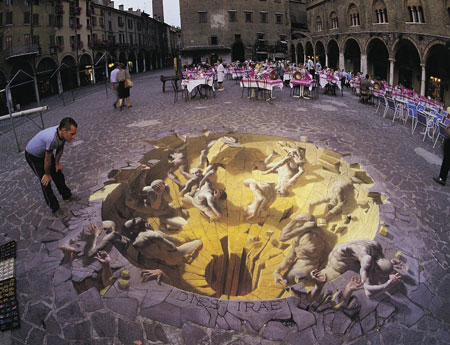 Among his other talents, Kurt Wenner is a “street painter”, an artist who does highly rendered “paintings” in colored chalk on public sidewalks, usually with a fairly high degree of draughtsmanship and most often in European cities. (American cities are usually too up-tight to allow “art” on the sidewalk, even temporarily; advertising maybe, but not art.)
For more on this fascinating practice, see my post from last fall on its other notable proponent, Julian Beever.
As with Beever, Wenner’s street paintings sometimes take the form of straightforward classical or original images rendered on the pavement. The most intriguing sidewalk images, however, are anamorphic; distorted in a way that, when viewed from a certain angle, produces a dramatic illusion of 3-dimensionality.
Wenner’s site doesn’t demonstrate it, but you can see an excellent example of how this works on these two pages from Beever’s site: the illusionistic view, and the anamorphic image from another angle.
With Beever, (who plays the pop art counterpart to Wenner’s classical approach), it is often the illusion of a 3-dimensional object on or above the plane of the pavement. Occasionally he projects depth below.
Wenner, however, prefers the illusion of depth below the pavement and creates spectacular images of ornately decorated structures that appear to be sunken into the sidewalk. Many of his painting sessions also take on the flavor of public events.
Wenner is certainly the more classically proficient draughtsman of the two and his images often carry the feeling of the classical trompe l’oeil techniques, used to add the illusion of ornate decoration to plain architectural elements, that were popular in the Baroque period. In fact, Wenner himself does this for clients and you can see a rather striking example of it here.
Wenner also does traditional painting, sculpture and decorative relief, as well as designing fanciful architecture. He used to be a scientific space illustrator for NASA(!). There is also a gallery of his street painting at Snopes.com.
Link via John Nack on Adobe.
Categories:
-
Arnold Böcklin
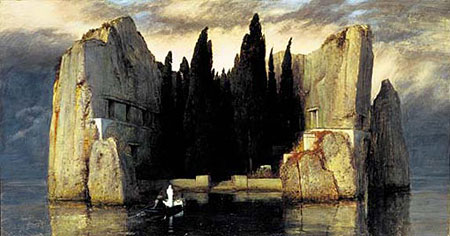
We assume to a certain extent that most artists’ work is influenced by their life. Arnold Böcklin is known for his famous image The Isle of the Dead, a composition of which he actually did five different versions. The one shown here is in Berlin, there is also one in the Metropolitan Museum in New York and you’ll encounter a couple of the others in the links I’ve provided.Böcklin also did a painting called Self Portrait with Death. The seemingly macabre fascination with death can be better understood when you learn that the painter’s life was impacted by it again and again. Five of his eleven children died in infancy and his family had to flee two different cholera epidemics.
Böcklin was one of the best known of the Symbolist painters. Symbolism was a loosely defined movement in art and literature in the late 19th century. The symbolists’ images were often dreamlike, mystical and filled with mythological subject matter, but the “symbols” were likely to be arcane and personal, not the universal symbols you might expect from the term. The Symbolists had a distinct impact on Art Nouveau (see my post on Alfonse Mucha) and were predecessors of the Surrealists in their exploration of dream-inspired imagery.
Böcklin actually called The Isle of the Dead “a tranquil place”. It supposedly was inspired in part by the “English Cemetery” in Florence, near where Böcklin had his studio and where one of his children was buried. I have to wonder, though, if it was also inspired by Isola di San Michele, the island cemetery of Venice. I saw it from a boat and, while it lacks the dramatic landscapes of Böcklin’s compositions, it has the cypress trees and the strange quality of actually being an “island of the dead”.
Categories:
-
Stephen Wiltshire – memory drawing
 Here’s a question for those of you who draw from life: How often and how long do you look at your subject when drawing?
Do you look up at the model or scene frequently, grabbing a fresh impression for each tiny bit of drawing, or do you take in as much as you can in a long hard look, trying to impress a good bit of what’s in front of you on your memory before working on the drawing for several minutes?
Chances are that you glance at the subject frequently, as I do, particularly if you’re tying to be faithful to nature rather than just taking hints from reality with which to be expressive.
Occasionally, I’ve tried to draw a scene or subject from memory (as opposed to making up something from my imagination). I’ve found my ability to do this limited, but our brains may be capable of much more than we give them credit for. People talk about this in the areas of science and mathematics, but it’s relevant in drawing as much as in other areas.
Sometimes people with unusual abilities will make us look at our assumptions about what is or isn’t possible in a new light. Stephen Wiltshire is a autistic savant with a seemingly innate skill for drawing. For background, see my previous post on him.
In the past few years Wiltshire has done a few public demonstrations of his astonishing ability to draw images in detail from memory. In May of 2005 he was in Tokyo. After a half-hour helicopter tour and some additional time viewing the city’s skyline form the roof of a skyscraper (top-left), Wiltshire spent seven days drawing a 10 meter (30 ft.) panorama of Tokyo on the inside of a 360 degree curved surface, without the aid of reference or sketched notes.
You can view a video of the process on the site, from which the screen captures at left are taken. (I apologize for the terrible image quality, but they only offer the videos in Windows Media and Real Media formats, no MPEG or Quicktime. C’mon, people, get a clue.)
There are also similar but less dramatic videos from demonstrations in other cities in the Television section of Wiltshire’s site, in which he demonstrates a similar reliable ability to retain and draw large amounts of visual information with great detail.
I’ve long felt that there is a particular state of mind involved when drawing, in which we see things differently. (See my post on Drawing on the Right Side of the Brain.) When I was young, I used to think of it as looking at things with my “regular eyes” or my “artist eyes”. Some of you may have experienced it as something similar. How many of us have explored the possibilities of expanding on that state of mind, culturing and developing it, in addition to working on our drawing technique?
Savants often express abilities beyond what is considered normal, but how much of what is considered “normal” is the result of assumed or acculturated limitations? At the very least, the abilities of someone like Stephen Wiltshire should give us a hint that we may all be able to train ourselves to see just a little bit more when we’re drawing, or even when we’re just walking down the street.
Categories:
-
Jamie Baker

Sometimes I have trouble finding the right words to describe someone’s artwork, but in Jamie Baker’s case a word just jumps right out. His stuff is just plain fun.Click through his Folio and you’ll find dozens of loopy, over-the-top characters, creatures and scenes drawn in a breezy, confident style and laced with liberal doses of humor.
Baker is a freelance storyboard artist and character designer. He has worked on productions like Finding Nemo and Cars for Pixar, Hubert’s Brain for Wild Brain, and Frankenstein for ILM. He is also the the creator/directror/designer of the Koala Lumpur CD-ROM game and was the art director and character designer for the Back to the Future animated TV series. The Folio section of the site contains some of his model sheets for those productions (unfortunately reproduced rather small).
When Baker finishes a hard day of working on storyboards and such, he takes off his artist’s hat and put on his er…, um, artist’s hat. Well, he takes off his storyboard artist’s hat an put on his comic artist hat, and draws comics with titles like Nerve Bomb Comix, Babes in Space, Gourmet Gruel Sketchbook, and in particular, Rocket Rabbit and The Professor (images above). You can see preivews of some of his comics in the Store section.
Baker also keeps a blog called JaMiE BaKeR: FALLOUT (which has been running since 2001), and maintains separate sites for Nerve Bomb Comix and Rocket Rabbit. You might actually want to go through those before diving into the Folio section of the main site as they put many of the characters in context.
Categories:
-
Douglas Henderson
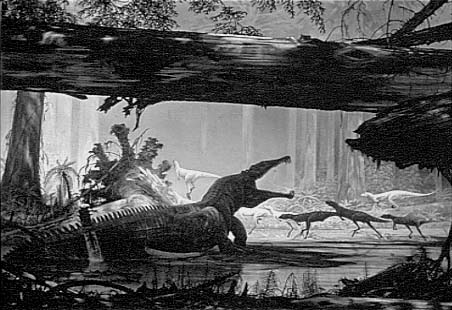
Dinosaurs get all the attention in paleo art, and not surprisingly so. What else is so dramatic and visually arresting? But paleontological artists deal with many other aspects of recreating the appearance of prehistoric life.There are numerous other prehistoric animals that preceded, followed or co-existed with the dinosaurs. (The main animal in the image above, rutidon lithodendrorum, is not a dinosaur but a phytosaur, a group of animals that shared a common ancestor with modern crocodiles.) In addition, most prehistoric animals that are recreated in scientific illustrations need to be portrayed in relationship to their environment. That requires a painstaking recreation of prehistoric landscapes and ancient plants.
On top of scientific accuracy and the challenge of representing the animals and plants in a way that makes their unique characteristics clear to the viewer, scientific and nature artists face the same challenges as other other artists: creating a successful composition, issues of draughtsmanship and rendering, controlling light and shade and blending the disparate elements into a unified whole.
Paleo artist Douglas Henderson is so good at this that I often think of his illustrations as beautifully rendered landscapes that happen to have prehistoric animals in them. I think Henderson himself must feel somewhat that way. He started out drawing landscapes and his scientific illustrations have compositions that emphasize putting the animals in relationship with their surroundings, often portraying them as relatively small in the landscape. This is actually a more realistic view than the artificial compositions that focus on the animals and feature a little bit of the environment as background.
Henderson does beautiful color work, but what I find particularly appealing are his black and white illustrations. There is no information about techniques on the site, (“The art of Paleo Illustration” section has been “under construction” for several years.), but I assume the black and white illustrations are done in charcoal because of their rich, deep blacks and soft gray tones. His compositions often feature silhouetted foreground elements, like tree trunks or fallen logs, as a framing device for the animals and primary landscape area, further emphasizing that the animals are in the landscape, not just in front of it. This approach also allows him to utilize a very broad range of tones in the drawings.
Henderson’s work appears in museums across the country and he has illustrated or contributed to numerous books on prehistoric life.
Categories:




Charley’s Picks
Bookshop.org
(Bookshop.org affilliate links; sales benefit independent bookshop owners; I get a small percentage to help support my work on Lines and Colors)

John Singer Sargent: Watercolors


Urban Sketching: Understanding Perspective


Charley’s Picks
Amazon
(Amazon.com affiliate links; sales go to a larger yacht for Jeff Bezos; but I get a small percentage to help support my work on Lines and Colors)
John Singer Sargent: Watercolors
Urban Sketching: Understanding Perspective