


Categories
- 3d CGI
- Amusements
- Animation
- Anime & Manga
- Art Materials
- Art Videos
- Blogroll
- Cartoons
- Color
- Comics
- Concept & Visual Dev.
- Creativity
- Digital Art
- Digital Painting
- Displaying Art on the Web
- Drawing
- Eye Candy for Today
- Gallery and Museum Art
- High-res Art Images
- Illustration
- Motion Graphics & Flash
- Museums
- Online Museums
- Outsider Art
- Painting
- Painting a Day
- Paleo Art
- Pastel, Conté & Chalk
- Pen & Ink
- Prints and Printmaking
- Reviews
- Sc-fi and Fantasy
- Sculpture & Dimensional
- Site Comments
- Sketching
- Storyboards
- Tools and Techniques
- Uncategorized
- Vector Art
- Videos & Podcasts
- Vision and Optics
- Watercolor and Gouache
- Webcomics
Archives
- April 2026
- March 2026
- February 2026
- January 2026
- December 2025
- November 2025
- October 2025
- September 2025
- August 2025
- July 2025
- June 2025
- May 2025
- January 2025
- December 2024
- November 2024
- October 2024
- September 2024
- August 2024
- June 2024
- April 2024
- March 2024
- February 2024
- January 2024
- December 2023
- November 2023
- October 2023
- September 2023
- August 2023
- July 2023
- May 2023
- April 2023
- March 2023
- February 2023
- January 2023
- December 2022
- November 2022
- September 2022
- August 2022
- July 2022
- June 2022
- May 2022
- April 2022
- March 2022
- February 2022
- January 2022
- December 2021
- November 2021
- October 2021
- September 2021
- August 2021
- July 2021
- June 2021
- May 2021
- April 2021
- March 2021
- February 2021
- January 2021
- December 2020
- November 2020
- October 2020
- September 2020
- August 2020
- July 2020
- June 2020
- May 2020
- April 2020
- March 2020
- February 2020
- January 2020
- December 2019
- November 2019
- October 2019
- September 2019
- August 2019
- July 2019
- June 2019
- May 2019
- April 2019
- March 2019
- February 2019
- January 2019
- December 2018
- November 2018
- October 2018
- September 2018
- August 2018
- July 2018
- June 2018
- May 2018
- April 2018
- March 2018
- February 2018
- January 2018
- December 2017
- November 2017
- October 2017
- September 2017
- August 2017
- July 2017
- June 2017
- May 2017
- April 2017
- March 2017
- February 2017
- January 2017
- December 2016
- November 2016
- October 2016
- September 2016
- August 2016
- July 2016
- June 2016
- May 2016
- April 2016
- March 2016
- February 2016
- January 2016
- December 2015
- November 2015
- October 2015
- September 2015
- August 2015
- July 2015
- June 2015
- May 2015
- April 2015
- March 2015
- February 2015
- January 2015
- December 2014
- November 2014
- October 2014
- September 2014
- August 2014
- July 2014
- June 2014
- May 2014
- April 2014
- March 2014
- February 2014
- January 2014
- December 2013
- November 2013
- October 2013
- September 2013
- August 2013
- July 2013
- June 2013
- May 2013
- April 2013
- March 2013
- February 2013
- January 2013
- December 2012
- November 2012
- October 2012
- September 2012
- August 2012
- July 2012
- June 2012
- May 2012
- April 2012
- March 2012
- February 2012
- January 2012
- December 2011
- November 2011
- October 2011
- September 2011
- August 2011
- July 2011
- June 2011
- May 2011
- April 2011
- March 2011
- February 2011
- January 2011
- December 2010
- November 2010
- October 2010
- September 2010
- August 2010
- July 2010
- June 2010
- May 2010
- April 2010
- March 2010
- February 2010
- January 2010
- December 2009
- November 2009
- October 2009
- September 2009
- August 2009
- July 2009
- June 2009
- May 2009
- April 2009
- March 2009
- February 2009
- January 2009
- December 2008
- November 2008
- October 2008
- September 2008
- August 2008
- July 2008
- June 2008
- May 2008
- April 2008
- March 2008
- February 2008
- January 2008
- December 2007
- November 2007
- October 2007
- September 2007
- August 2007
- July 2007
- June 2007
- May 2007
- April 2007
- March 2007
- February 2007
- January 2007
- December 2006
- November 2006
- October 2006
- September 2006
- August 2006
- July 2006
- June 2006
- May 2006
- April 2006
- March 2006
- February 2006
- January 2006
- December 2005
- November 2005
- October 2005
- September 2005
- August 2005
Relevant Blogs
Art, Painting & Sketch
- Gurney Journey
- Underpaintings
- Art and Influence
- Painting Perceptions
- Oil Painters of America
- Vasari Paint POV
- Flying Fox
- Urban Sketchers
- Bento (Smithsonian)
- Art Inconnu
- The Hidden Place
- Still Life
- Making a Mark
- The Art of the Landscape
- Exploring Color & Creativity
- Art Contrarian
- Artist A Day
- beinArt Surreal Art Collective
- Eye Level
- David Dunlop
- p.i.g.m.e.n.t.i.u.m
- CultureGrrl
- Joaquín Sorolla blog
- Artists in Pastel
“Painting a Day”
- A Painting a Day (Keiser)
- On Painting (Keiser)
- Julian Merrow-Smith
- Karen Jurick
- Jeffrey Hayes
- Carol Marine
- Abbey Ryan
- Daily Paintworks
Other Painting Blogs
- Virtual Gouache Land
- Neil Hollingsworth
- Marc Hanson
- Kevin Menck
- Marc Dalessio
- Larry Seiler
- Stapleton Kearns
- Colin Page
- Roos Schuring
- Hans Versfelt
- Titus Meeuws
- Régis Pettinari
- René Plein Air
- Belinda Del Pesco
- Robin Weiss
- Nathan Fowkes (Land Sketch)
- William Wray
- Frank Serrano
- Stephen Magsig
- Michael Chesley Johnson
- Twice a Week
- Sarah Wimperis
- Rob Adams
- Michael Cole Manley
- The Dirty Palette Club
- Mike Manley’s Draw!
Gallery Art & Illustration mix
Illustration
- Howard Pyle
- 100 Years of Illustration
- BibliOdyssey
- Illustration Art
- Today’s Inspiration
- Illustration Mundo
- Little Chimp Society
- Danny Gregory
- R D (John Martz
- Illustration Friday blog
- Monster Brains
- Illustrators & Illustrations (RU)
- Elwood H. Smith
- DaniDraws.com
- Designers Who Blog
- iSpot Blog
Sci-Fi & Fantasy
Illustration & Comics
Comics & Cartoons
- Comics Beat
- Robot 6
- Newsarama Blog
- Comic Vine
- Comics Alliance
- Forbidden Planet Int.
- Paolo Rivera
- Bolt City
- Flight
- Scott McCloud
- The Comics Journal
- Comixpedia
- Funnybook Babylon
- James Baker
- Middleton’s Sketchbook
- Boneville
- The Hotel Fred
- Paul Rivoche
- Daily Cartoonist
- Mad About Cartoons (William Wray)
- Digital Strips
Illustration & Concept
Animation & Concept
- Cartoon Brew
- Animation Blog
- Cold Hard Flash
- Concept Art World
- The CAB
- FY Concept Art
- Concept Ships
- Concept Robots
- John Nevarez
- Armand Serrano
- Marcos Mateu-Mestre
- all kinds of stuff (Kricfalusi)
- Yacin the faun (Man Arenas)
- Kelsey Mann
- Cre8tivemarks Blog
- Ice-Cream Monster Toon Cafe
- AAU Character & Creature Design
- AAU Animation Notes
- Articles and Texticles
Paleo & Scientific
Tools & Techniques
Other
Lists of Art Blogs
Art Image Resource Links
Historic Art Images
- Wikimedia Commons: Paintings
- Wikimedia Commons: Drawings
- The Athenaeum
- WikiArt (WikiPaintings)
- Google Art Project: Artists
- Google Art Project: Collections (Museums)
- ArtCyclopedia
- Web Gallery of Art
- Art Renewal Center
- Web Gallery of Impressionism
Auction Consolidation sites
Auction sites
- Sotheby’s
- Bonham’s
- Christies
- Heritage Auctions: Fine Art
- Heritage Auctions: Illustration
- Freeman’s Auctions
- Bukowskis
- Shannon’s
Image Search
Reverse Image Search (search by image)
- Tin Eye
- RevImg
- Google Image Search (camera icon)
- Bing Image Search (camera icon)
Promoting some friends and some clients of my website design business
- Twin Willows T’ai Chi studio in Wilmington DE. Taiji classes with Bryan Davis.
- Ray Hayward, Inspired Teacher of T’ai Chi ( Taiji ) in Minneapolis, Founder of Mindful Motion Tai Chi Academy
- OldHead Tattoo studio and Art Gallery in Wilmington DE. Tattoos and paintings by Bruce Gulick
- Sharon Domenico Art, pet portrait oil paintings
- Platinum Paperhanging, wallpaper hanging, Main Line and Philadelphia, PA
- Lisa Stone Design, interior designer, Main Line and Philadelphia, PA
- Studio12KPT, original art, prints, calendars and other custom printed items by Van Sickle & Rolleri
-
Thomas Paquette: Defined by Water
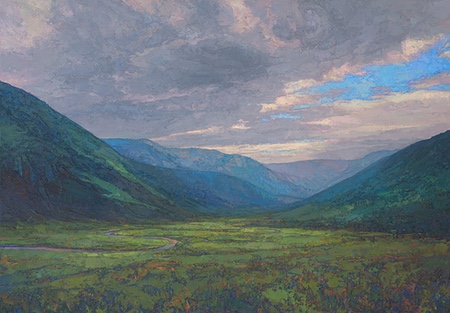

Thomas Paquette is a painter from Western Pennsylvania, whose work I have featured several times before and who I continue to follow, as I am delighted and fascinated by his approach.
Paquette breaks up his compositions in areas of color that are often edged with contrasting or complementary colors. The color areas and edges are in rough patterns that have a fractal appearance, but blend to make a naturalistic whole from a distance.
The result is part naturalistic, part graphic and part textural, with energetic paint marks providing surface qualities that move the eye, even within images that are essentially tranquil.
Many of his oils are fairly large in scale, in contrast to his wonderful gouache paintings that are essentially miniatures, often in the range of three or four inches on a side.
You can find examples of both oil and gouache paintings on his website, as well as printed collections of his work. (I found the book of Gouaches to be particularly a treat, as most are reproduced at their actual size.)
Thomas Paquette’s work will be on display here in Philadelphia in a solo show at the Gross McCleaf Gallery: “Thomas Paquette: Defined by Water“, that runs from September 6th to 28th, 2019. The reception is Friday, September 6th from 5:00 to 7:00 pm.
Categories:
-
Eye Candy for Today: Cornelis Visscher, The Large Cat


The Large Cat (Cat Sleeping), Cornelis Visscher, engraving, roughly 5 x 7 inches (14 x 18 cm)
I admire the way Visscher has varied the direction of his lines to indicate the natural texture of the cat’s fur, and the density of the lines to achieve his subtle variations in value.
The foreground foliage and background wall, indentation and daring little mouse give the composition depth, offsetting the dominance of the large figure of the animal within the frame of the image.
Categories:
-
N. C. Wyeth
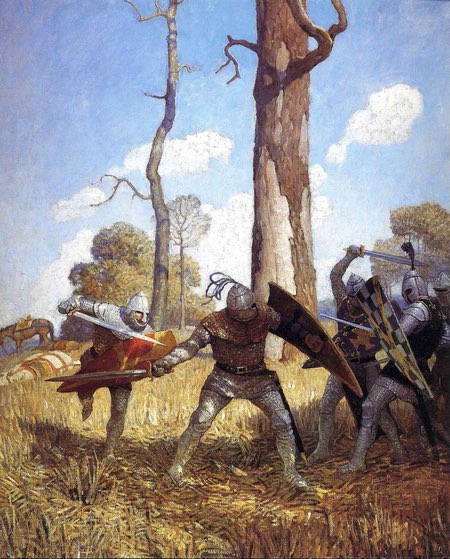

When I first started Lines and Colors back in 2005, I actually wondered if I might run out of artists I admire to write about. Some fourteen years and several thousand posts later, my list of potential subjects is longer than the list of those I’ve covered.
There are some artists, however, who are among my very favorites, that I have not yet covered. In the case of N. C. Wyeth, I’ve allowed myself to be intimidated by the task of conveying my respect and and enthusiasm for his work, and I’m remiss in not getting to this post sooner.
Along with his teacher, Howard Pyle, Newell Convers Wyeth was both one of America’s best and most beloved illustrators, and one of America’s great painters in any sense.
Given Pyle’s stature, influence and level of accomplishment, it’s no mean feat that — in my opinion, at least — the student surpassed the master in many respects.
While Pyle brought a new level of dynamics and drama to previously staid and theatrical approaches to illustration, Wyeth took his teacher’s mastery of drama and cranked it up to 11, placing the viewer on the edge of impending action or danger.
In the process, Wyeth developed a dramatic and remarkable use of light and strong value contrasts, often setting a foreground character in deep shadow against a brightly lit background.
Wyeth was also a master of texture, and many of his settings and backgrounds resound with a beautiful naturalism that owes much to his secondary practice of landscape painting.
If you search, you will find many references to N. C. Wyeth’s career as an illustrator, both in collections and reproductions of the classic books he illustrated, titles like The Black Arrow, Robin Hood, Treasure Island, Kidnapped, The Mysterious Island, The Boy’s King Arthur, The White Company, The Last of the Mohicans and many others.
What you will see less often, but can find with some digging, are examples of Wyeth’s landscapes, both of the area around Chadds Ford, Pennsylvania — where he settled after moving to the area from his home in Massachusets in order to study with Pyle — and of the area around his eventual summer home in Maine.
In his landscapes in particular, but also in his illustrations, Wyeth was a restless experimenter. He was familiar with Daniel Garber and other artists of the nearby New hope school of Pennsylvania Impressionists, and many of his paintings draw on Impressionist technique. You can also see the influence of regionalist painters like Thomas Hart Benton and Grant Wood.
Wyeth taught all of his children art, most notably, his son, Andrew Wyeth. N. C. was an imposing figure, both in personality and in his ability, and I have to wonder if his overwhelming command of drama and bold color led Andrew to choose his path of muted colors, textural paint application and contemplative subject matter.
N. C. Wyeth also did commercial illustration, murals, still life and other subjects. There are significant collections of his work in the Farnsworth Art Museum and the Portland Museum of art in Maine, and in particular, in the Brandywine River Museum in Chadds Ford, PA.
I grew up in the area around Wilmington, Delaware and the Brandywine Valley, and I’ve been going to the Brandywine River Museum since it opened while I was in my early 20s. N. C. Wyeth has been a big influence on my appreciation of art in general and illustration in particular.
The museum ordinarily has an extensive exhibit of N. C. Wyeth’s work — as well at the work of his son, Andrew Wyeth, and his grandson Jamie Wyeth — but at the moment there is a special exhibition, N. C. Wyeth: New Perspectives, that features work drawn from the permanent collection, as well as many pieces borrowed from other museums and private collections, and includes a number of his rarely seen landscape paintings.
The exhibit runs until September 15, 2019.
There is a catalog accompanying the exhibit, and there are a number of other books with Wyeth’s work, including beautiful hardbound reproduction editions of many of the classics he illustrated as well as collections, like Visions of Adventure: N. C. Wyeth and the Brandywine Artists, that offers and introduction to some of his contemporaries and other students of Howard Pyle.
There is also a Catalogue Raisonné of his work, expensive as a two volume boxed set, but accessible in an online version courtesy of the Brandywine River Museum that is one of the best places to see some of N. C. Wyeth’s landscapes, even if reproduced smaller than we might like.
Categories:
-
Ambrogio Alciati


Ambrogio Antonio Alciati was an Italian painter active in the late 19th and early 20th centuries.
He was primarily a society portrait painter, but many of his other canvasses were subjects of romance, courtship and passion.
His style evolved over time, a darker more classical approach giving way to painterly splashes of color.
Categories:
-
Martin Lewis
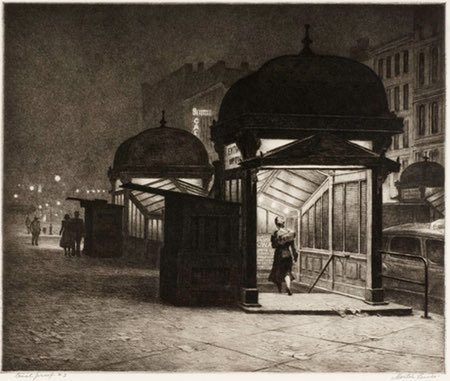

Martin Lewis was an Australian/American printmaker, illustrator and painter active in the first half of the 20th century.
He is known primarily for his etchings of wonderfully evocative scenes of urban life, often focusing on the effects of artificial light in nighttime scenes.
In much of his work, shadows and areas absent of light play a role as important as objects and areas of light. The balance and play between them give his compositions a dynamic and visceral feeling of atmosphere and place.
Among his friends was Edward Hopper, who asked Lewis to teach him the fundamentals of etching.
[Via William Wray]
Categories:
-
Eye Candy for Today: Rembrandt Peale’s portrait of Rubens Peale


Rubens Peale with a Geranium, Rembrandt Peale, oil on Canvas, roughly 28 x 24 inches (71 x 61 cm); in the collection of the National Gallery of Art, DC.
Link is to the NGA page, which has both a zoomable and downloadable version of the image. There is also a zoomable version on the Google Art Project, and a downloadable version on Wikimedia Commons.
The American painter and naturalist Charles Willson Peale named most of his children after noted artists or scientists. Some of them took up the interests of their father, Rembrandt became a noted portrait painter, and Rubens a botanist and later in life a still life painter.
Here, a young Rembrandt Peale paints a portrait of his 17 year old brother Rubens holding his prize specimen of a geranium — at the time an exotic plant, not native to the Americas — supposedly the first grown on the continent. Rembrandt has given the plant a careful and portrait-like treatment to honor his brother’s accomplishment.
Categories:




Charley’s Picks
Bookshop.org
(Bookshop.org affilliate links; sales benefit independent bookshop owners; I get a small percentage to help support my work on Lines and Colors)

John Singer Sargent: Watercolors


Urban Sketching: Understanding Perspective


.jpg)

Charley’s Picks
Amazon
(Amazon.com affiliate links; sales go to a larger yacht for Jeff Bezos; but I get a small percentage to help support my work on Lines and Colors)
John Singer Sargent: Watercolors
Urban Sketching: Understanding Perspective