


Categories
- 3d CGI
- Amusements
- Animation
- Anime & Manga
- Art Materials
- Art Videos
- Blogroll
- Cartoons
- Color
- Comics
- Concept & Visual Dev.
- Creativity
- Digital Art
- Digital Painting
- Displaying Art on the Web
- Drawing
- Eye Candy for Today
- Gallery and Museum Art
- High-res Art Images
- Illustration
- Motion Graphics & Flash
- Museums
- Online Museums
- Outsider Art
- Painting
- Painting a Day
- Paleo Art
- Pastel, Conté & Chalk
- Pen & Ink
- Prints and Printmaking
- Reviews
- Sc-fi and Fantasy
- Sculpture & Dimensional
- Site Comments
- Sketching
- Storyboards
- Tools and Techniques
- Uncategorized
- Vector Art
- Videos & Podcasts
- Vision and Optics
- Watercolor and Gouache
- Webcomics
Archives
- April 2026
- March 2026
- February 2026
- January 2026
- December 2025
- November 2025
- October 2025
- September 2025
- August 2025
- July 2025
- June 2025
- May 2025
- January 2025
- December 2024
- November 2024
- October 2024
- September 2024
- August 2024
- June 2024
- April 2024
- March 2024
- February 2024
- January 2024
- December 2023
- November 2023
- October 2023
- September 2023
- August 2023
- July 2023
- May 2023
- April 2023
- March 2023
- February 2023
- January 2023
- December 2022
- November 2022
- September 2022
- August 2022
- July 2022
- June 2022
- May 2022
- April 2022
- March 2022
- February 2022
- January 2022
- December 2021
- November 2021
- October 2021
- September 2021
- August 2021
- July 2021
- June 2021
- May 2021
- April 2021
- March 2021
- February 2021
- January 2021
- December 2020
- November 2020
- October 2020
- September 2020
- August 2020
- July 2020
- June 2020
- May 2020
- April 2020
- March 2020
- February 2020
- January 2020
- December 2019
- November 2019
- October 2019
- September 2019
- August 2019
- July 2019
- June 2019
- May 2019
- April 2019
- March 2019
- February 2019
- January 2019
- December 2018
- November 2018
- October 2018
- September 2018
- August 2018
- July 2018
- June 2018
- May 2018
- April 2018
- March 2018
- February 2018
- January 2018
- December 2017
- November 2017
- October 2017
- September 2017
- August 2017
- July 2017
- June 2017
- May 2017
- April 2017
- March 2017
- February 2017
- January 2017
- December 2016
- November 2016
- October 2016
- September 2016
- August 2016
- July 2016
- June 2016
- May 2016
- April 2016
- March 2016
- February 2016
- January 2016
- December 2015
- November 2015
- October 2015
- September 2015
- August 2015
- July 2015
- June 2015
- May 2015
- April 2015
- March 2015
- February 2015
- January 2015
- December 2014
- November 2014
- October 2014
- September 2014
- August 2014
- July 2014
- June 2014
- May 2014
- April 2014
- March 2014
- February 2014
- January 2014
- December 2013
- November 2013
- October 2013
- September 2013
- August 2013
- July 2013
- June 2013
- May 2013
- April 2013
- March 2013
- February 2013
- January 2013
- December 2012
- November 2012
- October 2012
- September 2012
- August 2012
- July 2012
- June 2012
- May 2012
- April 2012
- March 2012
- February 2012
- January 2012
- December 2011
- November 2011
- October 2011
- September 2011
- August 2011
- July 2011
- June 2011
- May 2011
- April 2011
- March 2011
- February 2011
- January 2011
- December 2010
- November 2010
- October 2010
- September 2010
- August 2010
- July 2010
- June 2010
- May 2010
- April 2010
- March 2010
- February 2010
- January 2010
- December 2009
- November 2009
- October 2009
- September 2009
- August 2009
- July 2009
- June 2009
- May 2009
- April 2009
- March 2009
- February 2009
- January 2009
- December 2008
- November 2008
- October 2008
- September 2008
- August 2008
- July 2008
- June 2008
- May 2008
- April 2008
- March 2008
- February 2008
- January 2008
- December 2007
- November 2007
- October 2007
- September 2007
- August 2007
- July 2007
- June 2007
- May 2007
- April 2007
- March 2007
- February 2007
- January 2007
- December 2006
- November 2006
- October 2006
- September 2006
- August 2006
- July 2006
- June 2006
- May 2006
- April 2006
- March 2006
- February 2006
- January 2006
- December 2005
- November 2005
- October 2005
- September 2005
- August 2005
Relevant Blogs
Art, Painting & Sketch
- Gurney Journey
- Underpaintings
- Art and Influence
- Painting Perceptions
- Oil Painters of America
- Vasari Paint POV
- Flying Fox
- Urban Sketchers
- Bento (Smithsonian)
- Art Inconnu
- The Hidden Place
- Still Life
- Making a Mark
- The Art of the Landscape
- Exploring Color & Creativity
- Art Contrarian
- Artist A Day
- beinArt Surreal Art Collective
- Eye Level
- David Dunlop
- p.i.g.m.e.n.t.i.u.m
- CultureGrrl
- Joaquín Sorolla blog
- Artists in Pastel
“Painting a Day”
- A Painting a Day (Keiser)
- On Painting (Keiser)
- Julian Merrow-Smith
- Karen Jurick
- Jeffrey Hayes
- Carol Marine
- Abbey Ryan
- Daily Paintworks
Other Painting Blogs
- Virtual Gouache Land
- Neil Hollingsworth
- Marc Hanson
- Kevin Menck
- Marc Dalessio
- Larry Seiler
- Stapleton Kearns
- Colin Page
- Roos Schuring
- Hans Versfelt
- Titus Meeuws
- Régis Pettinari
- René Plein Air
- Belinda Del Pesco
- Robin Weiss
- Nathan Fowkes (Land Sketch)
- William Wray
- Frank Serrano
- Stephen Magsig
- Michael Chesley Johnson
- Twice a Week
- Sarah Wimperis
- Rob Adams
- Michael Cole Manley
- The Dirty Palette Club
- Mike Manley’s Draw!
Gallery Art & Illustration mix
Illustration
- Howard Pyle
- 100 Years of Illustration
- BibliOdyssey
- Illustration Art
- Today’s Inspiration
- Illustration Mundo
- Little Chimp Society
- Danny Gregory
- R D (John Martz
- Illustration Friday blog
- Monster Brains
- Illustrators & Illustrations (RU)
- Elwood H. Smith
- DaniDraws.com
- Designers Who Blog
- iSpot Blog
Sci-Fi & Fantasy
Illustration & Comics
Comics & Cartoons
- Comics Beat
- Robot 6
- Newsarama Blog
- Comic Vine
- Comics Alliance
- Forbidden Planet Int.
- Paolo Rivera
- Bolt City
- Flight
- Scott McCloud
- The Comics Journal
- Comixpedia
- Funnybook Babylon
- James Baker
- Middleton’s Sketchbook
- Boneville
- The Hotel Fred
- Paul Rivoche
- Daily Cartoonist
- Mad About Cartoons (William Wray)
- Digital Strips
Illustration & Concept
Animation & Concept
- Cartoon Brew
- Animation Blog
- Cold Hard Flash
- Concept Art World
- The CAB
- FY Concept Art
- Concept Ships
- Concept Robots
- John Nevarez
- Armand Serrano
- Marcos Mateu-Mestre
- all kinds of stuff (Kricfalusi)
- Yacin the faun (Man Arenas)
- Kelsey Mann
- Cre8tivemarks Blog
- Ice-Cream Monster Toon Cafe
- AAU Character & Creature Design
- AAU Animation Notes
- Articles and Texticles
Paleo & Scientific
Tools & Techniques
Other
Lists of Art Blogs
Art Image Resource Links
Historic Art Images
- Wikimedia Commons: Paintings
- Wikimedia Commons: Drawings
- The Athenaeum
- WikiArt (WikiPaintings)
- Google Art Project: Artists
- Google Art Project: Collections (Museums)
- ArtCyclopedia
- Web Gallery of Art
- Art Renewal Center
- Web Gallery of Impressionism
Auction Consolidation sites
Auction sites
- Sotheby’s
- Bonham’s
- Christies
- Heritage Auctions: Fine Art
- Heritage Auctions: Illustration
- Freeman’s Auctions
- Bukowskis
- Shannon’s
Image Search
Reverse Image Search (search by image)
- Tin Eye
- RevImg
- Google Image Search (camera icon)
- Bing Image Search (camera icon)
Promoting some friends and some clients of my website design business
- Twin Willows T’ai Chi studio in Wilmington DE. Taiji classes with Bryan Davis.
- Ray Hayward, Inspired Teacher of T’ai Chi ( Taiji ) in Minneapolis, Founder of Mindful Motion Tai Chi Academy
- OldHead Tattoo studio and Art Gallery in Wilmington DE. Tattoos and paintings by Bruce Gulick
- Sharon Domenico Art, pet portrait oil paintings
- Platinum Paperhanging, wallpaper hanging, Main Line and Philadelphia, PA
- Lisa Stone Design, interior designer, Main Line and Philadelphia, PA
- Studio12KPT, original art, prints, calendars and other custom printed items by Van Sickle & Rolleri
-
J.M.W. Turner: Sketchbooks, Drawings and Watercolours


English painter and printmaker J.M.W. Turner, who was active in the late 18th and early 19th centuries, was astonishingly prolific. On his death, he left over 550 oil paintings, 2,000 watercolors and more than 30,000 works on paper.
Many of the latter are pages from his sketchbooks, and many of those are in the collection of the Tate Britain as part of the extraordinary Turner Bequest, which brought the museum’s holding of Turner’s works to over 37,000.
The Tate has put a number of these online, in a special section of their website: J.M.W. Turner: Sketchbooks, Drawings, Watercolours.
The resource is divided into 5 chronologically arranged sections from different points in the artist’s career, and within that, the works are arranged in subsections by location or other theme. Exploring is a matter of drilling down through the categories to subcategories.
Eventually, you will come to pages in which an individual sketchbook or thematic group of works is available in a slideshow. In the initial window of that slideshow there are usually two tabs, allowing you to choose between “Entry” (the slideshow) and “At a glance” or “Artworks”. Choosing the latter will open up thumbnails of the images arrayed directly on the page, making them much easier to browse.
For example, in the section “1819-29 Italy and After“, there is a subsection for “Rivers of England c. 1822-4” and a subsequent subsection for “‘Rivers of England’ Watercolours“.
From there you can click on a thumbnail to go to the detail page for an artwork, and there click on the image for an enlarged view. Most of the images are available in a nicely large size.
A number of the sections contain sketchbook pages that are so light or barely notated that they may be of less interest, but if you patiently dig around, you will be rewarded with many extraordinarily accomplished works in watercolor and gouache.
The sections for “Loose Studies of Paris and the Seine” and “Meuse-Moselle Gouache and Watercolour” (among others) are particularly of interest to those who are interested in Turner’s masterful handling of gouache as a sketching medium.
This project is so extensive, so wonderful and so engrossing, that I will issue a Time Sink Warning.
Categories:
-
Eye Candy for Today: Emilio Sanchez-Perrier river landscape
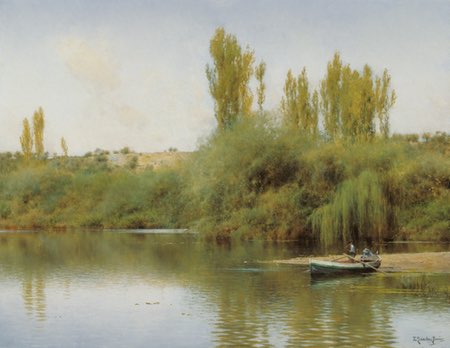

On the Banks of the Guadaíra with a boat, Emilio Sánchez-Perrier; oil on panel, roughly 12 x 16 inches (32 x 40 cm); in the collection of the Museo CarmenTyssen Málaga. Click on the image on their page for access to zoomable and downloadable versions. There is also a downloadable file of the same image on Wikimedia Commons.
Sánchez-Perrier’s apparent realism is surprisingly painterly when viewed in detail; much of the visually soft quality of the foliage appears to be produced with stipple effects, perhaps by pouncing with the end of a stiff brush.
Categories:
-
Algernon Newton


Algernon Cecil Newton was a British painter active in the early to mid 20th century. Newton is known for his cityscapes with canal fronting buildings and landscapes of open hills and isolated trees.
Newton’s approach, with stark contrasts of value and texture, evokes stillness and perhaps even a suspension of time, giving his paintings a magic realist quality. A number of his cityscapes feature canals with reflections of buildings in them; and he was sometimes referred to as the “Canaletto of the canals”.
Algernon Newton’s grandfather, Henry Newton, was the founding “Newton” of the art materials manufacturer Winsor & Newton. Algernon Newton found little success until late in his career, though he is now considered a significant figure in 20th century British art.
Categories:
-
Eye Candy for Today: Circe Offering the Cup to Ulysses, John William Waterhouse
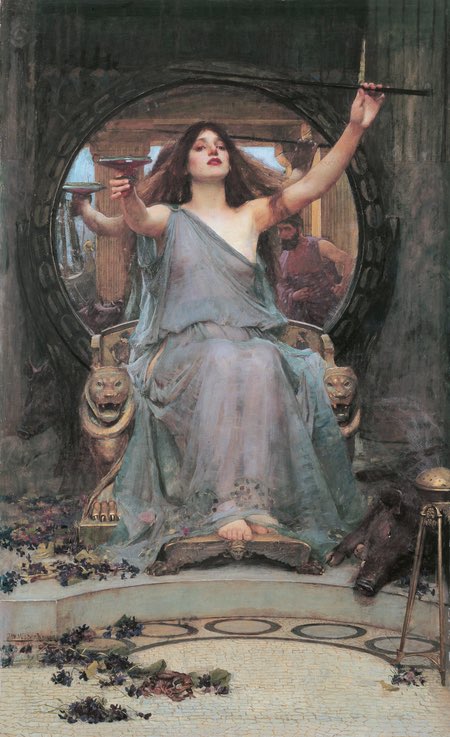

Circe Offering the Cup to Ulysses, John William Waterhouse, oil on canvas, roughly 70 x 36 inches ( 175 x 92 cm); with preliminary sketch, both images on Wikimedia Commons; the original painting is in Gallery Oldham, but their website doesn’t offer details about the painting. The sketch is in the Victoria and Albert Museum.
English painter John William Waterhouse — whose later work was much influenced by the Pre-Raphaelite painters — took the mythological character of Circe as his subject for three paintings.
In this one, inspired by the account in Homer’s Odyssey, the sorceress has used her knowledge of herbs and potions to turn Ulysses’ crew into swine, one of whom can be seen at her feet.
A regal Circe, seated on a lions head throne and clad in a diaphanous gown, holds a wand and a cup of the potion, both enticing and daring Ulysses to take what is offered. A wary Ulysses (Odysseus) can be seen in the mirror to our right, his ship to our left.
Categories:
-
Ivan Pokhitonov


Active in the late 19th and early 20th centuries, Ivan Pavlovitch Pokhitonov was a Russian/Ukrainian painter who spent the greater part of his career living and working in France and Belgium.
Though he also painted portraits and still life, he is noted for his landscapes. Influenced by the French and Belgian painters around him, Pokhitonov’s landscapes took on qualities that had critics referring to him as the “Russian Barbizon painter”.
Aside from some classes in drawing and watercolor during studies of other subjects at Odessa University, and a stint working for French Symbolist painter Eugène Carriè, Pokhitonov was largely self-taught.
Most remarkable, perhaps, after seeing reproductions of Pokhitonov’s paintings, is the realization that they are essentially miniatures. Rather than being 30 x 40 inches or larger, as I might have assumed, it appears that most of them are in the range of 6 x 10 inches (15 x 25 cm).
Pokhitonov worked on his small paintings with unorthodox tools, reportedly using magnifiers, scalpels, fishbones and other objects to enable small marks and textural effects. A number of his works are “cinematic” in aspect ratio, and many feature prominent horizons that might threaten to divide the canvas in two vertically, but are always kept in check in the context of his artfully balanced compositions.
Many of his contemporaries were impressed with his naturalism and painting skill, some even referring to him as a “sorcerer” or “magician”.
Russian great Ilya Repin, after slogging disappointedly through the 1894 Paris Salon, remarked that his only pleasure after “all this torture and wandering through endless exhibition rooms was the opportunity to have a rest in front of the miniature gems of our I.P. Pokhitonov”.
Categories:
-
Thomas Mostyn


Thomas Edwin Mostyn was a British painter active in the late 19th and early 20th centuries.
Though he also painted portraits, figures and landscapes of specific locations, he is known primarily for his invented landscapes of idyllic gardens.
These were often painted with high chroma passages, broken color and short brush stokes in the Impressionist manner.
Categories:




Charley’s Picks
Bookshop.org
(Bookshop.org affilliate links; sales benefit independent bookshop owners; I get a small percentage to help support my work on Lines and Colors)

John Singer Sargent: Watercolors


Urban Sketching: Understanding Perspective


Charley’s Picks
Amazon
(Amazon.com affiliate links; sales go to a larger yacht for Jeff Bezos; but I get a small percentage to help support my work on Lines and Colors)
John Singer Sargent: Watercolors
Urban Sketching: Understanding Perspective