


Categories
- 3d CGI
- Amusements
- Animation
- Anime & Manga
- Art Materials
- Art Videos
- Blogroll
- Cartoons
- Color
- Comics
- Concept & Visual Dev.
- Creativity
- Digital Art
- Digital Painting
- Displaying Art on the Web
- Drawing
- Eye Candy for Today
- Gallery and Museum Art
- High-res Art Images
- Illustration
- Motion Graphics & Flash
- Museums
- Online Museums
- Outsider Art
- Painting
- Painting a Day
- Paleo Art
- Pastel, Conté & Chalk
- Pen & Ink
- Prints and Printmaking
- Reviews
- Sc-fi and Fantasy
- Sculpture & Dimensional
- Site Comments
- Sketching
- Storyboards
- Tools and Techniques
- Uncategorized
- Vector Art
- Videos & Podcasts
- Vision and Optics
- Watercolor and Gouache
- Webcomics
Archives
- May 2026
- April 2026
- March 2026
- February 2026
- January 2026
- December 2025
- November 2025
- October 2025
- September 2025
- August 2025
- July 2025
- June 2025
- May 2025
- January 2025
- December 2024
- November 2024
- October 2024
- September 2024
- August 2024
- June 2024
- April 2024
- March 2024
- February 2024
- January 2024
- December 2023
- November 2023
- October 2023
- September 2023
- August 2023
- July 2023
- May 2023
- April 2023
- March 2023
- February 2023
- January 2023
- December 2022
- November 2022
- September 2022
- August 2022
- July 2022
- June 2022
- May 2022
- April 2022
- March 2022
- February 2022
- January 2022
- December 2021
- November 2021
- October 2021
- September 2021
- August 2021
- July 2021
- June 2021
- May 2021
- April 2021
- March 2021
- February 2021
- January 2021
- December 2020
- November 2020
- October 2020
- September 2020
- August 2020
- July 2020
- June 2020
- May 2020
- April 2020
- March 2020
- February 2020
- January 2020
- December 2019
- November 2019
- October 2019
- September 2019
- August 2019
- July 2019
- June 2019
- May 2019
- April 2019
- March 2019
- February 2019
- January 2019
- December 2018
- November 2018
- October 2018
- September 2018
- August 2018
- July 2018
- June 2018
- May 2018
- April 2018
- March 2018
- February 2018
- January 2018
- December 2017
- November 2017
- October 2017
- September 2017
- August 2017
- July 2017
- June 2017
- May 2017
- April 2017
- March 2017
- February 2017
- January 2017
- December 2016
- November 2016
- October 2016
- September 2016
- August 2016
- July 2016
- June 2016
- May 2016
- April 2016
- March 2016
- February 2016
- January 2016
- December 2015
- November 2015
- October 2015
- September 2015
- August 2015
- July 2015
- June 2015
- May 2015
- April 2015
- March 2015
- February 2015
- January 2015
- December 2014
- November 2014
- October 2014
- September 2014
- August 2014
- July 2014
- June 2014
- May 2014
- April 2014
- March 2014
- February 2014
- January 2014
- December 2013
- November 2013
- October 2013
- September 2013
- August 2013
- July 2013
- June 2013
- May 2013
- April 2013
- March 2013
- February 2013
- January 2013
- December 2012
- November 2012
- October 2012
- September 2012
- August 2012
- July 2012
- June 2012
- May 2012
- April 2012
- March 2012
- February 2012
- January 2012
- December 2011
- November 2011
- October 2011
- September 2011
- August 2011
- July 2011
- June 2011
- May 2011
- April 2011
- March 2011
- February 2011
- January 2011
- December 2010
- November 2010
- October 2010
- September 2010
- August 2010
- July 2010
- June 2010
- May 2010
- April 2010
- March 2010
- February 2010
- January 2010
- December 2009
- November 2009
- October 2009
- September 2009
- August 2009
- July 2009
- June 2009
- May 2009
- April 2009
- March 2009
- February 2009
- January 2009
- December 2008
- November 2008
- October 2008
- September 2008
- August 2008
- July 2008
- June 2008
- May 2008
- April 2008
- March 2008
- February 2008
- January 2008
- December 2007
- November 2007
- October 2007
- September 2007
- August 2007
- July 2007
- June 2007
- May 2007
- April 2007
- March 2007
- February 2007
- January 2007
- December 2006
- November 2006
- October 2006
- September 2006
- August 2006
- July 2006
- June 2006
- May 2006
- April 2006
- March 2006
- February 2006
- January 2006
- December 2005
- November 2005
- October 2005
- September 2005
- August 2005
Relevant Blogs
Art, Painting & Sketch
- Gurney Journey
- Underpaintings
- Art and Influence
- Painting Perceptions
- Oil Painters of America
- Vasari Paint POV
- Flying Fox
- Urban Sketchers
- Bento (Smithsonian)
- Art Inconnu
- The Hidden Place
- Still Life
- Making a Mark
- The Art of the Landscape
- Exploring Color & Creativity
- Art Contrarian
- Artist A Day
- beinArt Surreal Art Collective
- Eye Level
- David Dunlop
- p.i.g.m.e.n.t.i.u.m
- CultureGrrl
- Joaquín Sorolla blog
- Artists in Pastel
“Painting a Day”
- A Painting a Day (Keiser)
- On Painting (Keiser)
- Julian Merrow-Smith
- Karen Jurick
- Jeffrey Hayes
- Carol Marine
- Abbey Ryan
- Daily Paintworks
Other Painting Blogs
- Virtual Gouache Land
- Neil Hollingsworth
- Marc Hanson
- Kevin Menck
- Marc Dalessio
- Larry Seiler
- Stapleton Kearns
- Colin Page
- Roos Schuring
- Hans Versfelt
- Titus Meeuws
- Régis Pettinari
- René Plein Air
- Belinda Del Pesco
- Robin Weiss
- Nathan Fowkes (Land Sketch)
- William Wray
- Frank Serrano
- Stephen Magsig
- Michael Chesley Johnson
- Twice a Week
- Sarah Wimperis
- Rob Adams
- Michael Cole Manley
- The Dirty Palette Club
- Mike Manley’s Draw!
Gallery Art & Illustration mix
Illustration
- Howard Pyle
- 100 Years of Illustration
- BibliOdyssey
- Illustration Art
- Today’s Inspiration
- Illustration Mundo
- Little Chimp Society
- Danny Gregory
- R D (John Martz
- Illustration Friday blog
- Monster Brains
- Illustrators & Illustrations (RU)
- Elwood H. Smith
- DaniDraws.com
- Designers Who Blog
- iSpot Blog
Sci-Fi & Fantasy
Illustration & Comics
Comics & Cartoons
- Comics Beat
- Robot 6
- Newsarama Blog
- Comic Vine
- Comics Alliance
- Forbidden Planet Int.
- Paolo Rivera
- Bolt City
- Flight
- Scott McCloud
- The Comics Journal
- Comixpedia
- Funnybook Babylon
- James Baker
- Middleton’s Sketchbook
- Boneville
- The Hotel Fred
- Paul Rivoche
- Daily Cartoonist
- Mad About Cartoons (William Wray)
- Digital Strips
Illustration & Concept
Animation & Concept
- Cartoon Brew
- Animation Blog
- Cold Hard Flash
- Concept Art World
- The CAB
- FY Concept Art
- Concept Ships
- Concept Robots
- John Nevarez
- Armand Serrano
- Marcos Mateu-Mestre
- all kinds of stuff (Kricfalusi)
- Yacin the faun (Man Arenas)
- Kelsey Mann
- Cre8tivemarks Blog
- Ice-Cream Monster Toon Cafe
- AAU Character & Creature Design
- AAU Animation Notes
- Articles and Texticles
Paleo & Scientific
Tools & Techniques
Other
Lists of Art Blogs
Art Image Resource Links
Historic Art Images
- Wikimedia Commons: Paintings
- Wikimedia Commons: Drawings
- The Athenaeum
- WikiArt (WikiPaintings)
- Google Art Project: Artists
- Google Art Project: Collections (Museums)
- ArtCyclopedia
- Web Gallery of Art
- Art Renewal Center
- Web Gallery of Impressionism
Auction Consolidation sites
Auction sites
- Sotheby’s
- Bonham’s
- Christies
- Heritage Auctions: Fine Art
- Heritage Auctions: Illustration
- Freeman’s Auctions
- Bukowskis
- Shannon’s
Image Search
Reverse Image Search (search by image)
- Tin Eye
- RevImg
- Google Image Search (camera icon)
- Bing Image Search (camera icon)
Promoting some friends and some clients of my website design business
- Twin Willows T’ai Chi studio in Wilmington DE. Taiji classes with Bryan Davis.
- Ray Hayward, Inspired Teacher of T’ai Chi ( Taiji ) in Minneapolis, Founder of Mindful Motion Tai Chi Academy
- OldHead Tattoo studio and Art Gallery in Wilmington DE. Tattoos and paintings by Bruce Gulick
- Sharon Domenico Art, pet portrait oil paintings
- Platinum Paperhanging, wallpaper hanging, Main Line and Philadelphia, PA
- Lisa Stone Design, interior designer, Main Line and Philadelphia, PA
- Studio12KPT, original art, prints, calendars and other custom printed items by Van Sickle & Rolleri
-
Jean-Léon Gérôme

Anyone who is interested in concept art for films or games, particularly if it involves near-eastern themes in games like Prince of Persia, should be aware of 19th Century painter Jean-Léon Gérôme, if you aren’t already.Likewise, anyone with in interest in Victorian art, the Pre-Raphaelites or 19th Century academic art in general would enjoy Gérôme’s beautifully painted scenes of mosques, minarets and Eqyptian rooftops, as well as his depictions of Imperial Rome.
The Victorian era fascination with the exotic cultures of Asia inspired a number of painters and became known as Orientalism. This was the artistic end of a European view of the near east, and Islamic cultures in particular, as strange, romantic and sensual. The accuracy of such views, and of the scholarly interest in the middle east, was of less importance than the appeal of the foreign and strange to the art buying elite.
Plus, it was a great way to fill canvases with the eye candy of exotic costume, strange customs, and of languorous odalisques and harem concubines, smoking hookahs by reflective pools, or being proffered at slave auctions. There was plenty of that Victorian era titillation in the guise of history painting or allegory, or in this case, acceptance by virtue of the portrayal of other lands or cultures.
Gérôme excelled at the portrayal of these subjects, but at times exhibited an almost National Geographic style reportage of the inside of mosques and cityscapes, in contrast to his more exploitative harem scenes. Prayer in the Mosque (image above, top right), was probably painted from sketches made on one of his many trips to Egypt. The painting is in the collection of the Metropolitan Museum of Art in New York.
At his best, Gérôme was a superb painter and sculptor in the neo-classical style, a student of Paul Delaroche and a teacher of such notable painters as Odilon Redon, Thomas Eakins and J. Alden Weir. At his worst he was an influential enemy of the Impressionists, and almost succeeded in convincing the French government to refuse a gift of 65 of their controversial paintings from Gustave Caillebotte (the bulk of which now form the core of the Musee d’Orsay’s wonderful collection, and a smaller portion of which are here in Philadelphia in the collection of the Barnes Foundation).
Despite his antipathy toward the Impressionists, Gérôme is definitely worth a look for his technique as a painter, and for his interesting subject matter, including a classic scene in the Roman arena, Pollice Verso, which reportedly inspired Ridley Scott to take on the filming of Gladiator, and is generally accepted to be the origin of the “thumbs up/ thumbs down” image we have of the decision of gladiatorial combat, and by extension the use of the gesture in modern times. Another famous image by Gérôme is his two paintings of Pygmalion and Galatea, in which the sculptor’s creation comes to life (image above, lower right).
Categories:
-
Paprika
 Despite the fact that mainstream American audiences associate anime (Japanese animation) with giant robots bashing each other about while they tramp hip deep in skyscrapers, Japanese directors have long been willing to tackle sophisticated subjects that producers of American full-length animated features would never even consider.
American studios are still under the impression (perhaps unfortunately correct) that feature length animation intended for theatrical release here must be “family fare” to have a broad enough appeal to make their box office.
While I often complain about the adherence to simplistic formulas in American animation, anime is certainly locked into its own formulas at times, particularly in the area of science fiction; but from a genre whose ventures into science fiction have been largely near future and post apocalyptic adventures populated with robots, gynoids and exoskeleton mecha, comes an eye-popping exploration of the unconscious.
Renowned anime director Satoshi Kon has adapted Paprika from the science fiction novel by Yasutaka Tsusui, about a device that allows psychiatrists to immerse themselves in the dreams of a patient. In the story a reserved psychiatrist/inventor uses a prototype of this device to venture into the dreams of patients, where she is represented by a fairy-like avatar, until the machine is stolen, leaving her trapped in the psychedelic landscape of the dream state, confronted by the nightmare imaginings of the inner mind.
You can see the groundwork for Paprika in Kon’s own work and in films like Otomo’s Akira, and Miyazaki’s Spirited Away, in which the borders of reality are flexed an rippled with the push and pull of events.
Kon is best known here for Tokyo Godfathers and Perfect Blue. He also directed the less-well known Millennium Actress and the Japanese animated television series Paranoia Agent.
Kon has said that he based the imagery in Paprika on his own dreams, and the trailer and preview images promise a cornucopia of fantastic and wildly imaginative scenes.
Kon studied at Musashino Art University, majoring in Visual Art Communication Design, but his original interested in manga (Japanese comics) increasingly gave way to a fascination with animated film. He was influenced by the traditional anime classics, and Gundam style fare, but also by the hallucinatory films of American director Terry Gilliam.
Many of Kon’s previous films have a tendency to wiggle the line between dream and reality. Kon also wrote the screenplay for the Magnetic Rose segment of Memories, which was directed and animated by Koji Morimoto.
There in an offical site for Paprika, that includes a trailer and a gallery of images.
The film opened in New York yesterday and opens in Los Angeles on June 1st. The hopes for a wider theatrical distribution, as usual for adult-themed anime, seem dim; and like most American anime fans, I’ll probably have to wait for the DVD release. American theaters, even on the art house circuit, seem clueless about the appeal and potential audience for films like this, despite the proliferation of bad, second-string anime on American television.
Link via Wired
Categories:
-
Jamin LeFave
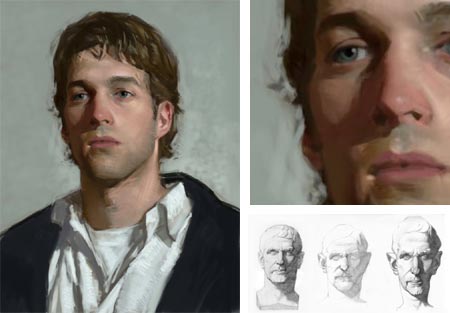
Jamin LeFave is another of those artists about whom I can find little information, but whose work is fascinating. LeFave has a blog, but apparently does not have a gallery-type web site. His brief bio paragraph indicates that he is a concept and production artist working for an independent gaming company called Wahoo studios, but I don’t think any of his professional work is available on the web.Instead, LeFave’s blog focuses on his studio painting, teaching work and experiments in oil, acrylic an digital media. When I came across his blog I was immediately struck by a self-portrait painting in progress (above, left and detail, top right), with its combination of straightforward realism, fresh handling and solid draftsmanship.
I went on to find a series of strong portrait studies, both paintings and drawings, as well as other items from his sketchbooks and classes. LeFave teaches illustration at Utah Valley State College.
One of the items I found particularly fascinating is his post about a drawing exercise he does (image above, bottom right), in which he starts with a drawing from reference, in this case from a cast drawing in a Charles Bargue Drawing Course book. He follows his original drawing in a day or two with another drawing of the same image from memory only. LeFave says the he knows the memory drawing is done when he can’t remember any thing else to draw. He then uses his memory drawing for reference, and redesigns it as a looser, more exaggerated drawing with a playful exploration of the forms. He can then go back to the original for reference and add interesting details. This is an exercise I haven’t encountered before, and it sounds like a great way to build your powers of observation and explore the drawing methods of other artists.
LeFave’s blog has only been established since last November, and he doesn’t add to it often, but I’m looking forward to seeing more of his work in the future.
Categories:
-
Illustration Magazine and illo.
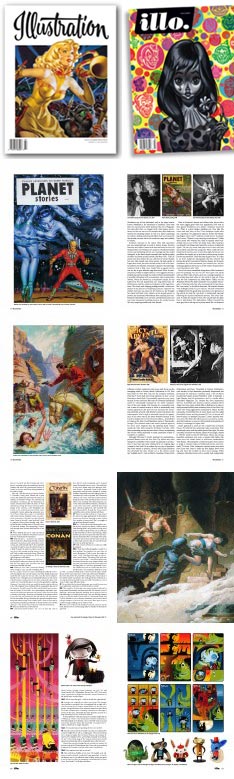 For 18 issues, Illustration Magazine has been featuring artists form the history of American illustration. Illustration is beautifully printed and full of great illustrations from the “Golden Age” through the late 20th Century.
In 2005 publisher and executive editor Daniel Zimmer launched a new title, Illustration’05, in a similar format, but devoted to contemporary illustration. Both magazines are superb and of interest to any one interested in American illustration.
The Illustration’05 title became Illustration’06 and Illustration’07, much to the confusion of readers and magazine dealers, and did not fare as well as it might have.
I’m happy to say that Zimmer has relaunched Illustraton’0whatever as Illo., starting the numbering over at issue#1, in the same beautiful format. That format is 80 pages, focusing on four in-depth articles about contemporary American illustrators, with page after glossy, high-resolution page of beautifully reproduced artwork.
The magazine is rounded out with a couple of shorter articles and reviews, features very few ads; and the ads themselves are for things like Last Gasp Publishing, Flesk Publications and shows at the Society of Illustrators, that are as much of interest to readers as the articles.
Though the web site currently says that Illo. #1 is still at the printer, it is actually out and I picked up my copy yesterday.
I’m fortunate to have an amazing independent book/comic store nearby in Delaware that makes a point of carrying magazines like Illustraton and Illo., but If you can’t convince a magazine dealer or bookstore near you to carry them (it’s worth a try), you can order them online directly from the publisher.
Illo. is published quarterly and a four issue subscription is $40 U.S.; individual issues are $10 (cover price), postpaid. In addition you can order back issues of Illustration ’05.
You can also order subscriptions and back issues of Illustration Magazine, which, like Illo., is published quarterly for $10 an issue.
The newly published issue #1 of Illo. features Mitch O’Connell, Mark Schultz, Nathan Jurevicius, Brian Taylor and an interview with Nancy Stahl. You can see thumbnail previews of the entire issue here. (The article on Mark Schultz is in the form of an extensive interview conducted by John Fleskes of Flesk Publications, which I profiled as one of the first posts on lines and colors.)
Issue 18 of Illustration features Allen Anderson, The Cooper Studio (part 2), Alberto Vargas, Jack Potter and others. Thumbnail previews here.
(Image above left, Illustration Magazine: top left, second row and third row, Illo.: top right, fourth row, bottom row.)
Categories:
-
Stéphane Halleux

Stéphane Halleux creates sculptures of characters and objects that have a feeling of Tim Burton meets Rube Goldberg by way of 1930’s animated cartoons.His tiny-wheeled cars, junk-dealer robots, Charles Adamsish characters, mechanized chairs and enigmatic “engines” are wonderful visual fun. Their textured and weathered surfaces, strange shapes, and arrangements of odd parts are imaginative and entertaining.
Halleux’s objects are appealing in a way that makes you want to pick them up, or at least be able to view them from a wide variety of angles. Though he often provides images from more than one angle, it’s unfortunate that Quicktime VR isn’t as easy as standard digital photography, it would be great to be able to rotate these images.
Halleux’s web site is apparently new, as the biography section is still “coming soon”, and some other sections are also incomplete. Though there is a section of preliminary design sketches (“croquis”) for some of his pieces, there is no information on his creations in terms of materials, technique, intention or size. Hopefully, that will be added in the near future. In the mean time, we’ll have to settle for looking through his galleries of wonderfully eccentric objects.
Categories:
-
Jessica Joslin
 Jessica Joslin makes unusual objects that are a collision of sculpture, assemblage, jewelry and perhaps taxidermy.
Seemingly displays in an unnatural history museum, Joslin’s sculptures consist of bone (real, cast or modeled), brass, sculpted and painted leather, beads, lamp fittings, wire, machine bolts, pins, feathers, pewter, glass eyes, and various antique hardware items arranged into bizarre animal forms.
The result is an eerily disconcerting menagerie of “characters” to which she has assigned names like Serafina, Callisto, Ludwig, Valeria and Cosimo (at left).
Joslin is quick to point out in her FAQ that when she does use real bone or animal skulls, she obtains them from the same suppliers that provide them ethically to natural history museums. She often uses casts or modeled pieces as well, and does her best to make it unclear which is which. When viewing her galleries, note that you can often click in the text area on links for detail images.
Her objects vary in size from one inch tall to nearly six feet, and her site arranges them according to series done in particular years. Joslin works professionally as a commercial model maker, crating prototypes for toys (perhaps for an extra-dimensional toy company).
Link courtesy of Leah Palmer Preiss
Categories:




Charley’s Picks
Bookshop.org
(Bookshop.org affilliate links; sales benefit independent bookshop owners; I get a small percentage to help support my work on Lines and Colors)

John Singer Sargent: Watercolors


Urban Sketching: Understanding Perspective


Charley’s Picks
Amazon
(Amazon.com affiliate links; sales go to a larger yacht for Jeff Bezos; but I get a small percentage to help support my work on Lines and Colors)
John Singer Sargent: Watercolors
Urban Sketching: Understanding Perspective