


Categories
- 3d CGI
- Amusements
- Animation
- Anime & Manga
- Art Materials
- Art Videos
- Blogroll
- Cartoons
- Color
- Comics
- Concept & Visual Dev.
- Creativity
- Digital Art
- Digital Painting
- Displaying Art on the Web
- Drawing
- Eye Candy for Today
- Gallery and Museum Art
- High-res Art Images
- Illustration
- Motion Graphics & Flash
- Museums
- Online Museums
- Outsider Art
- Painting
- Painting a Day
- Paleo Art
- Pastel, Conté & Chalk
- Pen & Ink
- Prints and Printmaking
- Reviews
- Sc-fi and Fantasy
- Sculpture & Dimensional
- Site Comments
- Sketching
- Storyboards
- Tools and Techniques
- Uncategorized
- Vector Art
- Videos & Podcasts
- Vision and Optics
- Watercolor and Gouache
- Webcomics
Archives
- August 2026
- July 2026
- June 2026
- May 2026
- April 2026
- March 2026
- February 2026
- January 2026
- December 2025
- November 2025
- October 2025
- September 2025
- August 2025
- July 2025
- June 2025
- May 2025
- January 2025
- December 2024
- November 2024
- October 2024
- September 2024
- August 2024
- June 2024
- April 2024
- March 2024
- February 2024
- January 2024
- December 2023
- November 2023
- October 2023
- September 2023
- August 2023
- July 2023
- May 2023
- April 2023
- March 2023
- February 2023
- January 2023
- December 2022
- November 2022
- September 2022
- August 2022
- July 2022
- June 2022
- May 2022
- April 2022
- March 2022
- February 2022
- January 2022
- December 2021
- November 2021
- October 2021
- September 2021
- August 2021
- July 2021
- June 2021
- May 2021
- April 2021
- March 2021
- February 2021
- January 2021
- December 2020
- November 2020
- October 2020
- September 2020
- August 2020
- July 2020
- June 2020
- May 2020
- April 2020
- March 2020
- February 2020
- January 2020
- December 2019
- November 2019
- October 2019
- September 2019
- August 2019
- July 2019
- June 2019
- May 2019
- April 2019
- March 2019
- February 2019
- January 2019
- December 2018
- November 2018
- October 2018
- September 2018
- August 2018
- July 2018
- June 2018
- May 2018
- April 2018
- March 2018
- February 2018
- January 2018
- December 2017
- November 2017
- October 2017
- September 2017
- August 2017
- July 2017
- June 2017
- May 2017
- April 2017
- March 2017
- February 2017
- January 2017
- December 2016
- November 2016
- October 2016
- September 2016
- August 2016
- July 2016
- June 2016
- May 2016
- April 2016
- March 2016
- February 2016
- January 2016
- December 2015
- November 2015
- October 2015
- September 2015
- August 2015
- July 2015
- June 2015
- May 2015
- April 2015
- March 2015
- February 2015
- January 2015
- December 2014
- November 2014
- October 2014
- September 2014
- August 2014
- July 2014
- June 2014
- May 2014
- April 2014
- March 2014
- February 2014
- January 2014
- December 2013
- November 2013
- October 2013
- September 2013
- August 2013
- July 2013
- June 2013
- May 2013
- April 2013
- March 2013
- February 2013
- January 2013
- December 2012
- November 2012
- October 2012
- September 2012
- August 2012
- July 2012
- June 2012
- May 2012
- April 2012
- March 2012
- February 2012
- January 2012
- December 2011
- November 2011
- October 2011
- September 2011
- August 2011
- July 2011
- June 2011
- May 2011
- April 2011
- March 2011
- February 2011
- January 2011
- December 2010
- November 2010
- October 2010
- September 2010
- August 2010
- July 2010
- June 2010
- May 2010
- April 2010
- March 2010
- February 2010
- January 2010
- December 2009
- November 2009
- October 2009
- September 2009
- August 2009
- July 2009
- June 2009
- May 2009
- April 2009
- March 2009
- February 2009
- January 2009
- December 2008
- November 2008
- October 2008
- September 2008
- August 2008
- July 2008
- June 2008
- May 2008
- April 2008
- March 2008
- February 2008
- January 2008
- December 2007
- November 2007
- October 2007
- September 2007
- August 2007
- July 2007
- June 2007
- May 2007
- April 2007
- March 2007
- February 2007
- January 2007
- December 2006
- November 2006
- October 2006
- September 2006
- August 2006
- July 2006
- June 2006
- May 2006
- April 2006
- March 2006
- February 2006
- January 2006
- December 2005
- November 2005
- October 2005
- September 2005
- August 2005
Relevant Blogs
Art, Painting & Sketch
- Gurney Journey
- Underpaintings
- Art and Influence
- Painting Perceptions
- Oil Painters of America
- Vasari Paint POV
- Flying Fox
- Urban Sketchers
- Bento (Smithsonian)
- Art Inconnu
- The Hidden Place
- Still Life
- Making a Mark
- The Art of the Landscape
- Exploring Color & Creativity
- Art Contrarian
- Artist A Day
- beinArt Surreal Art Collective
- Eye Level
- David Dunlop
- p.i.g.m.e.n.t.i.u.m
- CultureGrrl
- Joaquín Sorolla blog
- Artists in Pastel
“Painting a Day”
- A Painting a Day (Keiser)
- On Painting (Keiser)
- Julian Merrow-Smith
- Karen Jurick
- Jeffrey Hayes
- Carol Marine
- Abbey Ryan
- Daily Paintworks
Other Painting Blogs
- Virtual Gouache Land
- Neil Hollingsworth
- Marc Hanson
- Kevin Menck
- Marc Dalessio
- Larry Seiler
- Stapleton Kearns
- Colin Page
- Roos Schuring
- Hans Versfelt
- Titus Meeuws
- Régis Pettinari
- René Plein Air
- Belinda Del Pesco
- Robin Weiss
- Nathan Fowkes (Land Sketch)
- William Wray
- Frank Serrano
- Stephen Magsig
- Michael Chesley Johnson
- Twice a Week
- Sarah Wimperis
- Rob Adams
- Michael Cole Manley
- The Dirty Palette Club
- Mike Manley’s Draw!
Gallery Art & Illustration mix
Illustration
- Howard Pyle
- 100 Years of Illustration
- BibliOdyssey
- Illustration Art
- Today’s Inspiration
- Illustration Mundo
- Little Chimp Society
- Danny Gregory
- R D (John Martz
- Illustration Friday blog
- Monster Brains
- Illustrators & Illustrations (RU)
- Elwood H. Smith
- DaniDraws.com
- Designers Who Blog
- iSpot Blog
Sci-Fi & Fantasy
Illustration & Comics
Comics & Cartoons
- Comics Beat
- Robot 6
- Newsarama Blog
- Comic Vine
- Comics Alliance
- Forbidden Planet Int.
- Paolo Rivera
- Bolt City
- Flight
- Scott McCloud
- The Comics Journal
- Comixpedia
- Funnybook Babylon
- James Baker
- Middleton’s Sketchbook
- Boneville
- The Hotel Fred
- Paul Rivoche
- Daily Cartoonist
- Mad About Cartoons (William Wray)
- Digital Strips
Illustration & Concept
Animation & Concept
- Cartoon Brew
- Animation Blog
- Cold Hard Flash
- Concept Art World
- The CAB
- FY Concept Art
- Concept Ships
- Concept Robots
- John Nevarez
- Armand Serrano
- Marcos Mateu-Mestre
- all kinds of stuff (Kricfalusi)
- Yacin the faun (Man Arenas)
- Kelsey Mann
- Cre8tivemarks Blog
- Ice-Cream Monster Toon Cafe
- AAU Character & Creature Design
- AAU Animation Notes
- Articles and Texticles
Paleo & Scientific
Tools & Techniques
Other
Lists of Art Blogs
Art Image Resource Links
Historic Art Images
- Wikimedia Commons: Paintings
- Wikimedia Commons: Drawings
- The Athenaeum
- WikiArt (WikiPaintings)
- Google Art Project: Artists
- Google Art Project: Collections (Museums)
- ArtCyclopedia
- Web Gallery of Art
- Art Renewal Center
- Web Gallery of Impressionism
Auction Consolidation sites
Auction sites
- Sotheby’s
- Bonham’s
- Christies
- Heritage Auctions: Fine Art
- Heritage Auctions: Illustration
- Freeman’s Auctions
- Bukowskis
- Shannon’s
Image Search
Reverse Image Search (search by image)
- Tin Eye
- RevImg
- Google Image Search (camera icon)
- Bing Image Search (camera icon)
Promoting some friends and some clients of my website design business
- Twin Willows T’ai Chi studio in Wilmington DE. Taiji classes with Bryan Davis.
- Ray Hayward, Inspired Teacher of T’ai Chi ( Taiji ) in Minneapolis, Founder of Mindful Motion Tai Chi Academy
- OldHead Tattoo studio and Art Gallery in Wilmington DE. Tattoos and paintings by Bruce Gulick
- Sharon Domenico Art, pet portrait oil paintings
- Platinum Paperhanging, wallpaper hanging, Main Line and Philadelphia, PA
- Lisa Stone Design, interior designer, Main Line and Philadelphia, PA
- Studio12KPT, original art, prints, calendars and other custom printed items by Van Sickle & Rolleri
-
Studio Spaces
 For some reason, I just love to look at the studios and workspaces of artists, designers and other “creative” workers.
In part, I suppose there is a thought that one might get usable ideas form the way others have arranged their work area; but mostly I think it’s just curiosity and the vaguely inspirational nature of being around or in artists’ working areas.
Even art school studio and work spaces, which always seem to have a “same as it ever was” feeling to them, can feel inspirational, just because of the associations they have for those of us who attended classes at one time or another.
Parka Blogs, who I profiled here, has a post about Creative Workspaces and Home Offices, with links to a number of individual workspace articles from blogs (including Man Arenas, who I profiled here); as well as links to collections of workspace and studio photos on Flicker.
Some of them are: The Creative Workspace Pool, The Workspaces – No Computers Pool, The Art Studio Pool, The artist STUDIOS Pool, The Professional Creatives at Home Pool, and even The Inspiration Boards Pool, devoted to those collage-like amalgams of inspirational and reference images most of us have accumulating push pins above our drawing tables and computers somewhere.
(Images at left: “sweet sweet life“, “lavadera“, “the arborgeist project“, “jacanegra“)
[Via Drawn!]
Categories:
-
Paint the Parks 2009

Paint the Parks 2009 it the third installment of an annual competition sponsored by PaintAmerica, a non-profit association ‘devoted to providing opportunities for artists all across America”.They sponsor two artist competitions, PaintAmerica Top100, which happens in the fall, and Paint the Parks100, for which the call for entries deadline is May 31, 2009.
The competition is designed to highlight the U.S. National Parks, and the entries must be realistic (to some degree) representations of scenes from one of the 390 areas supervised by the National Parks Service (the inclusion of National Monuments and Historic sites expends the possibilities considerably).
The current entry form hasn’t been posted yet, so I don’t know the entry fee, but you can download a Regions Map from this page that lists the eligible National Parks, Monuments and Historic sites.
There are prizes for each of three national regions, and a grand prize, a $10,000 Purchase Award. There is also a Mini Competition with a $5,000 Grand Prize for paintings of 180 square inches or less. There are more details here.
Winning paintings will be be featured in a touring exhibition and online, providing additional exposure.
There is a PaintAmerica blog, on which you can find more information, as well as see paintings from last years winners from both competitions.
(Image above: Robert Gunn, Thomas Marcotti, Robert Highsmith)
[Via Nita Leland (whose latest book is Confident Color)]
Categories:
-
Freelancers Union
 One of the issues facing working artists is that many of us are self-employed, a state that brings with it some of the logistical difficulties faced by almost all self-employed workers.
Most notable among them are things like health insurance, which can be a make it or break it factor in the ability of artists to support themselves.
There are other factors, like retirement savings and an unfairly high tax rate on self-employed people here in the U.S., based on various government excuses, the gist of which are that the government assumes that we’re cheating in some way.
All of these are factors that the Freelancers Union is intended to deal with. The Freelancers Union is an organization started by Sara Horowitz, a labor organizer and attorney from New York, whose family has been involved in unions and labor relations for a couple of generations.
Membership is free and open to all freelancers, consultants, independent contractors, temporary and part time workers and anyone who is self-employed.
The Freelancers Union offers access to group health, dental, term life and disability insurance, and in the state of new York is acting as it’s own insurance provider. There are also seminars, workshops, networking events and a member directory and gig listing, as well as offers of discounts with Staples, Zipcar and other companies.
I learned about the Freelancers Union from a story on the NewsHour on PBS.
I can’t speak about the organization from personal experience, at least not yet; but I intend to join, even if only to learn more.
Categories:
-
Justin Gerard
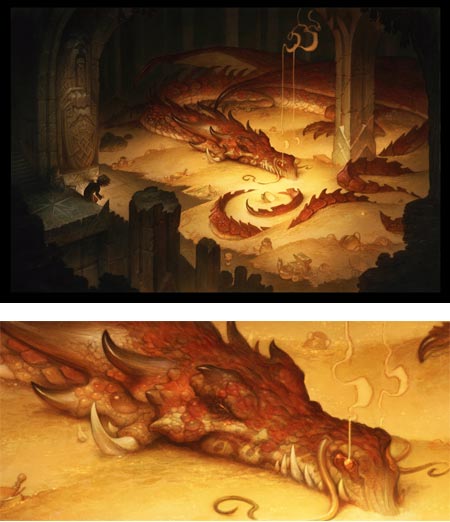
Justin Gerard is an illustrator about whom I have little background information. His web site has galleries of his beautiful fantasy themed illustrations, but lacks a simple bio.His blog has some fascinating details, like his confession about swiping a copy of a Step by Step Graphics from a college library because of an article on the art of Gregory Manchess that Gerard found dramatically influential; and his hope to somehow atone with his contribution to this year’s MicroVisions art auction in support of the Society of Illustrators scholarship fund (more the MicroVisions auction in a subsequent post).
I also found an interview with Gerard by Irene Gallo on the Tor Books site, in which Gerard discusses his project to create illustrations of his own interpretation of The Hobbit, apparently as a personal project, which I find amazing (image above with detail below, larger version here). If this work is not slated to be printed in some form it certainly should be, even if as a self-published version through Blurb or something similar (I’d certainly buy a copy).
In other sections of his web site gallery, I found wonderful fantasy illustrations of various subjects and a section devoted to illustrations of Beowulf, as well as the series from The Hobbit.
Gerard’s illustrations are intricately textured, make great use of chiaroscuro and leverage the power of a limited palette to produce drama and control focus. His style, though based on intensely observed realism in some respects, has a feeling of whimsey and charm that is ideally suited to his subject matter.
I also found a number of books that he has illustrated on Amazon, and a gallery of his work on the Tor Books site.
I finally found a brief bio on the site of Portland Studios, an illustration, animation and interactive firm of which he is a part. From it I learned that Gerard lives in South Carolina and won an IPPY Award for his interpretation of Beowulf Book One: Grendel the Ghastly. There is also an animation called The Mad Bull on the home page of the Portland Studios site for which he is listed as co-creator.
Categories:
-
Birds and Bees — Sheridan Illustration Council

The Sheridan Illustration Council (which, if I’m not mistaken, is part of Sheridan College in Ontario, Canada), is holding an exhibit themed Birds and Bees as a fundraiser for the benefit of the 4th year graduating class.From the press release:
The Sheridan Illustration Council proudly presents the Birds and the Bees Fundraiser Group show. The show features work from Sheridan alumni and faculty, consisting of well-known and emerging illustrators belonging to the fields of illustration, fine arts, comics, and much more. The hopes are to be able to raise funds to help put on a successful year-end show for the 4th year graduating class.
The show will offer collectors and new buyers the opportunity to acquire original artwork from renowned illustrators, and a chance for them to help support the next generation illustration stars.
The show is at SMASH Industrial Salvage|| Jerome Jenner Gallery, 2880 Dundas West, Toronto, ON. I’m a little late in listing the actual show, the opening was March 20, and it only runs to this Saturday, April 4, but the online version will be up until April 11th, 2009.
There is a listing of artists and an online gallery.
(Image above, left to right: Anita Kunz, Tessar Lo, Clemente Botelho, Peter Chan, Claton Hanmer, Benjamin Rivers)
[Via Nimit Malavia]
Categories:
-
Gustave Caillebotte: Impressionist Paintings from Paris to the Sea

As I pointed out in my previous post about Gustave Caillebotte, he is one of my two favorite underappreciated French Impressionist painters (along with Alfred Sisley).Though he was not the draughtsman Degas was (few were), or as facile with brush and color as Monet or Pissarro, Caillebotte nonetheless epitomized many of the characteristics we associate with French Impressionism, the bright strokes and dabs of pure color, optically blended into luxuriously beautiful images of gardens, rivers and brightly dressed members of the leisure class enjoying the sun.
It is in his differences from the other Impressionist painters, though, that he resonates most strongly for me. I think it’s in his subtle appreciation for shadow, soft light, rain, fog and snow that he displays his greatest visual poetry.
He also differs form the other French Impressionists in that his approach often leaned more toward realism; putting him, perhaps, in the company of the American Impressionists and others who adopted the Impressionist palette and free brushwork, but without abandoning the realist underpinnings from Academic painting that Monet and Pissaro rejected. He was also one of the first painters to be fascinated with and influenced by then new art of photography.
Caillebotte was an engineer by training, but also studied at the Ecole des beaux-Arts, and became acquainted with Degas, Renoir and Monet early on. He became a supporter and patron of his friends’ work, using his considerable family resources to purchase paintings for himself (often at prices well above their market value, basically to help them survive and keep painting) and to organize the Impressionist exhibitions in Paris.
It was Caillebotte’s eventual donation of his collection of Impressionist works to the French government, which at first was refused at the urging of the conservative Academy, and only later accepted in part (40 of the 60 offered), which now forms the core of the Impressionist collections in the Musée d’Orsay.
Many of the remainder (lesser in terms of quality) were sold to American physician and art collector Albert Barnes, and are here in Philadelphia in the collection of the Barnes Foundation. Others are in museums and collections around the world.
His own work received less respect after his death than the works he collected, but his reputation is being restored as public appreciation for his work gains ground.
Gustave Caillebotte: Impressionist Paintings from Paris to the Sea is an exhibition currently at the Brooklyn Museum (until July 5, 2009). It features about 40 paintings showing a range of Caillebotte’s work and subjects, though it focuses in large part on paintings of activities on and around the Yerres and Petit Gennevillers rivers near his family’s estates, like Skiffs (above, top, sometimes called The Oarsmen).
There is a catalog accompanying the exhibition (hardback only, I believe this is the same book on Amazon).
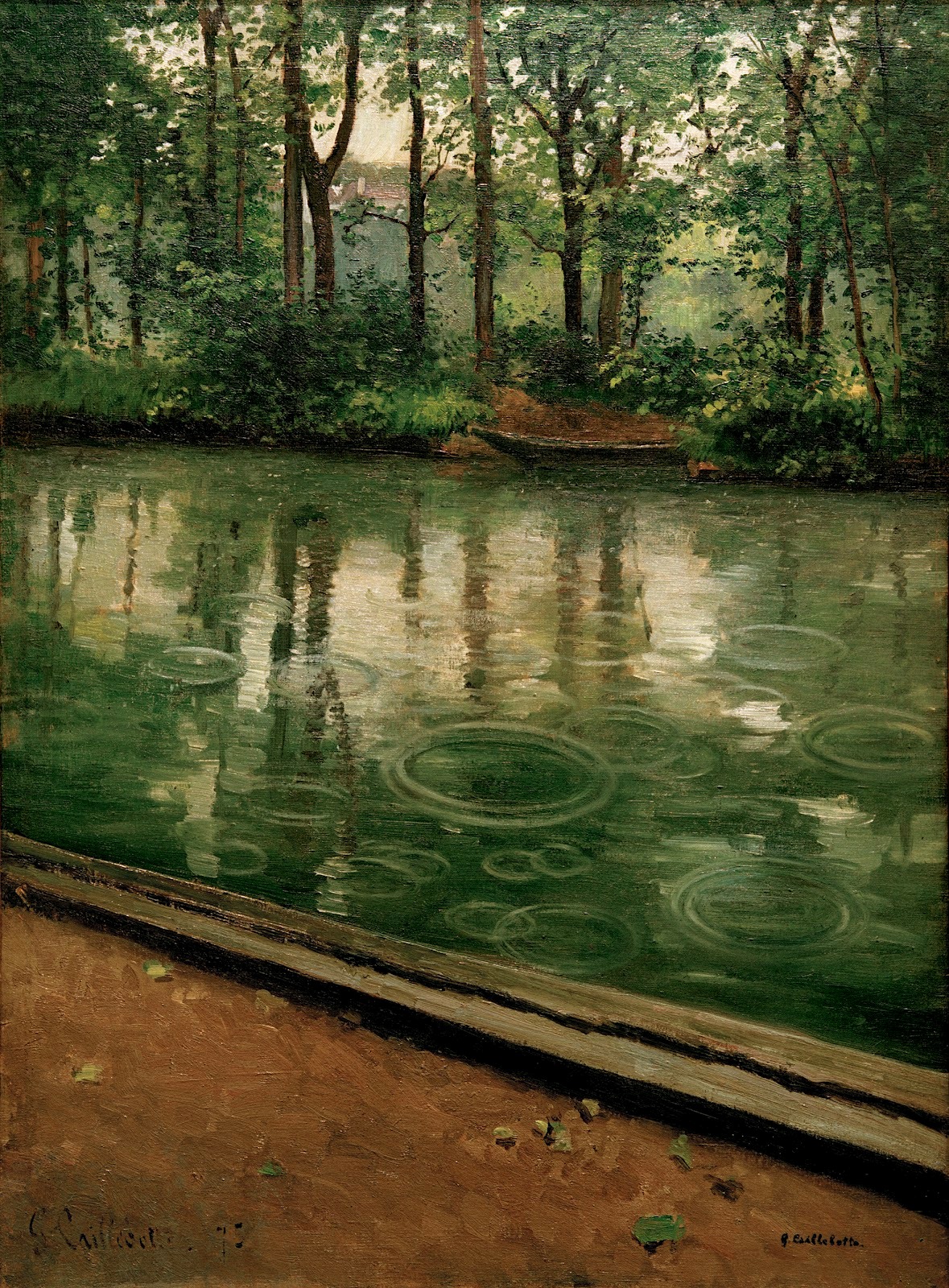
Much to my delight, the exhibit includes one of my favorite paintings, Yerres Riverbank in the Rain (above, bottom, larger version here, unfortunately not well reproduced; smaller but a little better here).
This is not a dramatic Impressionist painting, busting with sunlight and brilliant color; quite the opposite, in fact — subtle, quiet; a gentle suggestion of a painting, with the soft light and subtle colors of a summer shower, but so evocative you can smell the rain.
Categories:



Charley’s Picks
Bookshop.org
(Bookshop.org affilliate links; sales benefit independent bookshop owners; I get a small percentage to help support my work on Lines and Colors)
Carlson’s Guide to Landscape Painting
Drawing and Sketching in Pencil

Bridgman’s Complete Guide to Drawing from Life


Charley’s Picks
Amazon
(Amazon.com affiliate links; sales go to a larger yacht for Jeff Bezos; but I get a small percentage to help support my work on Lines and Colors)
Carlson’s Guide to Landscape Painting
Drawing and Sketching in Pencil
Bridgman’s Complete Guide to Drawing from Life