


Categories
- 3d CGI
- Amusements
- Animation
- Anime & Manga
- Art Materials
- Art Videos
- Blogroll
- Cartoons
- Color
- Comics
- Concept & Visual Dev.
- Creativity
- Digital Art
- Digital Painting
- Displaying Art on the Web
- Drawing
- Eye Candy for Today
- Gallery and Museum Art
- High-res Art Images
- Illustration
- Motion Graphics & Flash
- Museums
- Online Museums
- Outsider Art
- Painting
- Painting a Day
- Paleo Art
- Pastel, Conté & Chalk
- Pen & Ink
- Prints and Printmaking
- Reviews
- Sc-fi and Fantasy
- Sculpture & Dimensional
- Site Comments
- Sketching
- Storyboards
- Tools and Techniques
- Uncategorized
- Vector Art
- Videos & Podcasts
- Vision and Optics
- Watercolor and Gouache
- Webcomics
Archives
- October 2026
- September 2026
- August 2026
- July 2026
- June 2026
- May 2026
- April 2026
- March 2026
- February 2026
- January 2026
- December 2025
- November 2025
- October 2025
- September 2025
- August 2025
- July 2025
- June 2025
- May 2025
- January 2025
- December 2024
- November 2024
- October 2024
- September 2024
- August 2024
- June 2024
- April 2024
- March 2024
- February 2024
- January 2024
- December 2023
- November 2023
- October 2023
- September 2023
- August 2023
- July 2023
- May 2023
- April 2023
- March 2023
- February 2023
- January 2023
- December 2022
- November 2022
- September 2022
- August 2022
- July 2022
- June 2022
- May 2022
- April 2022
- March 2022
- February 2022
- January 2022
- December 2021
- November 2021
- October 2021
- September 2021
- August 2021
- July 2021
- June 2021
- May 2021
- April 2021
- March 2021
- February 2021
- January 2021
- December 2020
- November 2020
- October 2020
- September 2020
- August 2020
- July 2020
- June 2020
- May 2020
- April 2020
- March 2020
- February 2020
- January 2020
- December 2019
- November 2019
- October 2019
- September 2019
- August 2019
- July 2019
- June 2019
- May 2019
- April 2019
- March 2019
- February 2019
- January 2019
- December 2018
- November 2018
- October 2018
- September 2018
- August 2018
- July 2018
- June 2018
- May 2018
- April 2018
- March 2018
- February 2018
- January 2018
- December 2017
- November 2017
- October 2017
- September 2017
- August 2017
- July 2017
- June 2017
- May 2017
- April 2017
- March 2017
- February 2017
- January 2017
- December 2016
- November 2016
- October 2016
- September 2016
- August 2016
- July 2016
- June 2016
- May 2016
- April 2016
- March 2016
- February 2016
- January 2016
- December 2015
- November 2015
- October 2015
- September 2015
- August 2015
- July 2015
- June 2015
- May 2015
- April 2015
- March 2015
- February 2015
- January 2015
- December 2014
- November 2014
- October 2014
- September 2014
- August 2014
- July 2014
- June 2014
- May 2014
- April 2014
- March 2014
- February 2014
- January 2014
- December 2013
- November 2013
- October 2013
- September 2013
- August 2013
- July 2013
- June 2013
- May 2013
- April 2013
- March 2013
- February 2013
- January 2013
- December 2012
- November 2012
- October 2012
- September 2012
- August 2012
- July 2012
- June 2012
- May 2012
- April 2012
- March 2012
- February 2012
- January 2012
- December 2011
- November 2011
- October 2011
- September 2011
- August 2011
- July 2011
- June 2011
- May 2011
- April 2011
- March 2011
- February 2011
- January 2011
- December 2010
- November 2010
- October 2010
- September 2010
- August 2010
- July 2010
- June 2010
- May 2010
- April 2010
- March 2010
- February 2010
- January 2010
- December 2009
- November 2009
- October 2009
- September 2009
- August 2009
- July 2009
- June 2009
- May 2009
- April 2009
- March 2009
- February 2009
- January 2009
- December 2008
- November 2008
- October 2008
- September 2008
- August 2008
- July 2008
- June 2008
- May 2008
- April 2008
- March 2008
- February 2008
- January 2008
- December 2007
- November 2007
- October 2007
- September 2007
- August 2007
- July 2007
- June 2007
- May 2007
- April 2007
- March 2007
- February 2007
- January 2007
- December 2006
- November 2006
- October 2006
- September 2006
- August 2006
- July 2006
- June 2006
- May 2006
- April 2006
- March 2006
- February 2006
- January 2006
- December 2005
- November 2005
- October 2005
- September 2005
- August 2005
Relevant Blogs
Art, Painting & Sketch
- Gurney Journey
- Underpaintings
- Art and Influence
- Painting Perceptions
- Oil Painters of America
- Vasari Paint POV
- Flying Fox
- Urban Sketchers
- Bento (Smithsonian)
- Art Inconnu
- The Hidden Place
- Still Life
- Making a Mark
- The Art of the Landscape
- Exploring Color & Creativity
- Art Contrarian
- Artist A Day
- beinArt Surreal Art Collective
- Eye Level
- David Dunlop
- p.i.g.m.e.n.t.i.u.m
- CultureGrrl
- Joaquín Sorolla blog
- Artists in Pastel
“Painting a Day”
- A Painting a Day (Keiser)
- On Painting (Keiser)
- Julian Merrow-Smith
- Karen Jurick
- Jeffrey Hayes
- Carol Marine
- Abbey Ryan
- Daily Paintworks
Other Painting Blogs
- Virtual Gouache Land
- Neil Hollingsworth
- Marc Hanson
- Kevin Menck
- Marc Dalessio
- Larry Seiler
- Stapleton Kearns
- Colin Page
- Roos Schuring
- Hans Versfelt
- Titus Meeuws
- Régis Pettinari
- René Plein Air
- Belinda Del Pesco
- Robin Weiss
- Nathan Fowkes (Land Sketch)
- William Wray
- Frank Serrano
- Stephen Magsig
- Michael Chesley Johnson
- Twice a Week
- Sarah Wimperis
- Rob Adams
- Michael Cole Manley
- The Dirty Palette Club
- Mike Manley’s Draw!
Gallery Art & Illustration mix
Illustration
- Howard Pyle
- 100 Years of Illustration
- BibliOdyssey
- Illustration Art
- Today’s Inspiration
- Illustration Mundo
- Little Chimp Society
- Danny Gregory
- R D (John Martz
- Illustration Friday blog
- Monster Brains
- Illustrators & Illustrations (RU)
- Elwood H. Smith
- DaniDraws.com
- Designers Who Blog
- iSpot Blog
Sci-Fi & Fantasy
Illustration & Comics
Comics & Cartoons
- Comics Beat
- Robot 6
- Newsarama Blog
- Comic Vine
- Comics Alliance
- Forbidden Planet Int.
- Paolo Rivera
- Bolt City
- Flight
- Scott McCloud
- The Comics Journal
- Comixpedia
- Funnybook Babylon
- James Baker
- Middleton’s Sketchbook
- Boneville
- The Hotel Fred
- Paul Rivoche
- Daily Cartoonist
- Mad About Cartoons (William Wray)
- Digital Strips
Illustration & Concept
Animation & Concept
- Cartoon Brew
- Animation Blog
- Cold Hard Flash
- Concept Art World
- The CAB
- FY Concept Art
- Concept Ships
- Concept Robots
- John Nevarez
- Armand Serrano
- Marcos Mateu-Mestre
- all kinds of stuff (Kricfalusi)
- Yacin the faun (Man Arenas)
- Kelsey Mann
- Cre8tivemarks Blog
- Ice-Cream Monster Toon Cafe
- AAU Character & Creature Design
- AAU Animation Notes
- Articles and Texticles
Paleo & Scientific
Tools & Techniques
Other
Lists of Art Blogs
Art Image Resource Links
Historic Art Images
- Wikimedia Commons: Paintings
- Wikimedia Commons: Drawings
- The Athenaeum
- WikiArt (WikiPaintings)
- Google Art Project: Artists
- Google Art Project: Collections (Museums)
- ArtCyclopedia
- Web Gallery of Art
- Art Renewal Center
- Web Gallery of Impressionism
Auction Consolidation sites
Auction sites
- Sotheby’s
- Bonham’s
- Christies
- Heritage Auctions: Fine Art
- Heritage Auctions: Illustration
- Freeman’s Auctions
- Bukowskis
- Shannon’s
Image Search
Reverse Image Search (search by image)
- Tin Eye
- RevImg
- Google Image Search (camera icon)
- Bing Image Search (camera icon)
Promoting some friends and some clients of my website design business
- Twin Willows T’ai Chi studio in Wilmington DE. Taiji classes with Bryan Davis.
- Ray Hayward, Inspired Teacher of T’ai Chi ( Taiji ) in Minneapolis, Founder of Mindful Motion Tai Chi Academy
- OldHead Tattoo studio and Art Gallery in Wilmington DE. Tattoos and paintings by Bruce Gulick
- Sharon Domenico Art, pet portrait oil paintings
- Platinum Paperhanging, wallpaper hanging, Main Line and Philadelphia, PA
- Lisa Stone Design, interior designer, Main Line and Philadelphia, PA
- Studio12KPT, original art, prints, calendars and other custom printed items by Van Sickle & Rolleri
-
Malcolm McNeill
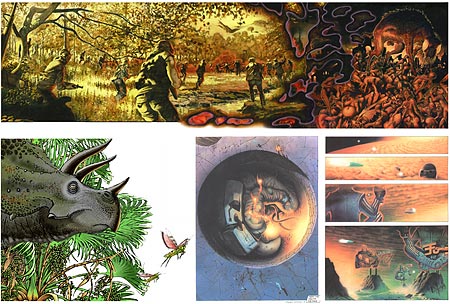
Malcolm McNeill is an illustrator, concept artist and comics artist based in New York. His work has appeared in publications like The New York Times, National Lampoon and titles for Marvel Comics.McNeill was collaborating with William S. Burroughs, before his death, on an “word/image novel” called Ah Pook is Here (image above, top), based, I believe, on a short story by the same name (which was also the inspiration for an animated short by Philip Hunt). McNeill worked on the project with Burroughs intermittently for seven years. Unfortunately the project was eventually abandoned because of insufficient funding. The glimpse of the work is tantalizing. It looks like McNeill is playing with the comics narrative form in some interesting and novel ways.
McNeill is at work on his own graphic novel, 0º, and a non-fiction graphic narrative called 1%, in which he also seems to be playing with narrative conventions. It’s too bad that the images on the site are relatively small.
He wrote and illustrated a science fiction comic series called Tetra (above, two images at bottom, right) that ran in Gallery magazine for two years.
He has also done concept design for TV, including concept, design and art direction for the Saturday Night Live opening sequence in which the cast appeared as giants among the buildings of New York, as well as a number of commercial spots.
There are some nicely done illustrations for a dinosaur-themed project in the Kids section (above, image at bottom, left), for which he lists contributions of character design and script development but doesn’t indicate the name of the project.
Addendum: Malcolm has let me know that he in now in LA, not NY, he’s just completed a book about the collaboration with Burroughs, which took place in the 70’s, and the book will include the artwork in various stages of completion. The dinosaur images are for a book/film called “Pterrence with a P”, which he storyboarded, but has left to work on 0º. He also notes that anyone interested in contacting him for professional inquiries can simply ask for larger versions of the images.
Note: Site contains NSFW images.
Addendum 2 (9/11/07): McNeill has posted a sited devoted specifically to the Burroughs project, which is now spelled Ah Puch is Here. There is now a fairly extensive interview with malcom McNeill posted on RealityStudio.org, and another on George Laughead’s Beats in Kansas, in which he talks about collaborating with Burroughs.
Categories:
-
Chris Appelhans

I chanced on Chris Appelhans from a two-month old link from John Nevarez’s blog, did a little digging and found that he is being widely mentioned at the moment. Good thing because his own site has some yummy art but very little actual biographical or background info.Chris Appelhans is a visual development artist who, among other projects, worked extensively on the new movie Monster House. His previsualization art for that movie is particularly striking (images above), and there are a number of images from the project on his site.
There are also images from an upcoming project that is an adaptation of Alice’s Adventures in Wonderland which apparently takes place in a modern urban/sci-fi setting called Underworld. Art from these and other projects can be accessed from Appelhans’ Portfolio page, along with landscape sketches, doodles and an animated Superman short.
There is also a link there to the archive of his series of short webcomics, frank and frank.
Appelhans is featured in the Art of Monster House book and is a contributor to the Flight 1 and Flight 2 comics anthologies.
There is a nice post on Stainless Steel Droppings which indicates that Appelhans is a Pixar employee and goes into more detail on his current and upcoming projects. Appelhans is also an instructor for the Gnomon School of Visual Effects.
Link via John Nevarez
Categories:
-
Ivan Bilibin
Every once in a while I stumble across something by accident that turns out to be a great find.I was in the Met in New York last weekend and they have a wonderful practice (fortunately in common with many major museums lately) of rotating works into view from their collection of drawings, prints and photographs that ordinarily can’t be on permanent display because of sensitivity to light. One of the many upsides to this is that works come to light that might not make it to the curator’s list for major displays and wouldn’t be seen under other circumstances.
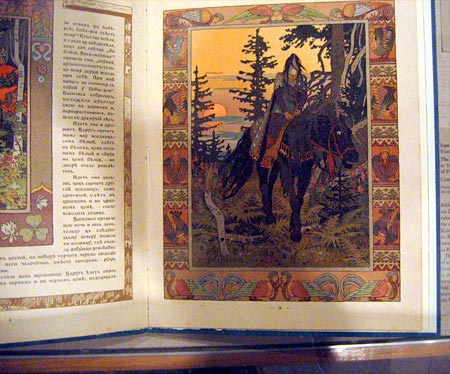
I was walking by a case in which some lushly illustrated books were on display and noticed that they were open to wonderful, brightly colored illustrations by an illustrator I was not familiar with. I took some photos (image above) and noted the artist’s name: Ivan Bilibin. On looking him up, I was pleased to find that there were a number of resources on the web, and I’ve listed what I could find for you in the links below.
Bilibin was a Russian illustrator working, more or less, during the peak times for great illustration around the turn of the 20th Century, but he seems to have been outside of the mainstream and took most of his influences from Russian folk art, Medieval and Renaissance art, Art Nouveau, and the open line and filled color style of Japanese prints. (See my posts on Hokusai, Yoshida and Hasui.)
Bilibin is most famous for his illustrations of Russian fairy tales which he illustrated with a colorful clear line style that incorporates decorative elements both within the images and at times surrounding them.
Bilibin eventually moved into stage and costume design for operas and ballets and also ventured into murals and straightforward landscape painting.
I was also delighted to find that there are books available with his illustrations, including Russian Fairy Tales, although I haven’t see them first hand yet.
Categories:
-
Laurelines (Laura Frankstone)
 All artists go through periods of difficulty, where the act of creation becomes more of a chore than a joy, or ideas dry up, or we reach those plateaus where progress seems to cease, or we are pressed with doubt or even fear about our abilities (or lack thereof).
When this happens, the logical thing to do is to look around for some way to change things, shake things up, wake up our muse (or have a fling with another) and get going again. Few of us though, will approach it so thoroughly as to draw up and dedicate ourselves to a systematic plan.
Laura Frankstone is an artist who has been posting her watercolors, drawings and sketches to her blog Laurelines since early 2005 (if not longer).
On January 1 of 2006, she embarked on a year-long plan of “self-apprenticeship” to revitalize her art life. She set aside each month of the year as a particular topic, January: interiors, February, food and dining, March: trees, etc. and devoted herself to doing a drawing a day through that period. (I mentioned that painter Jon Conkey os doing something similar with his Themeworks project in my last post on Painting a Day blogs.)
In addition she is taking classes in digital art, endeavoring to change mediums, even working in mediums she’s not comfortable with and trying to extend her reach in many directions.
She has managed to crown this program with a highlight that would be the envy of many artists, myself included, taking the month of October in Paris and dedicating her time there to travel sketches. The site also inclludes older travel sketches from other parts of Europe and the US.
I enjoy travel sketches to begin with, and particularly ones of Paris. Frankstone’s recent posts are filled with her direct, unfussy pencil and watercolor impressions of scenes around Paris and often in the Luxemborg Gardens.
You can view them in a gallery mode, but if you view them in place in the blog, you get the benefit of her description of the time and place and her approach to the sketch, which gives you even more of a feeling for being there.
It’s worth noting that even in the midst of the wonders of Paris, Frankstone finds worthwhile subjects in seedpods from trees and other simple objects.
One of the other ways to break out of an artistic slump is to ride along with another artist for a while, watching over their shoulder for inspiration, even if it’s just enough inspiration to say, “Yes, I should pick up my sketchbook and draw today”.
Categories:
-
Chris Gall
Chris Gall is an illustrator and author living in Arizona, and is also an adjunct professor at the University of Arizona.His paintings seem to have a social realist, heroic WPA mural sensibility to them, and occasionally feel a bit like Thomas Hart Benton doing illustrations for Popular Science.
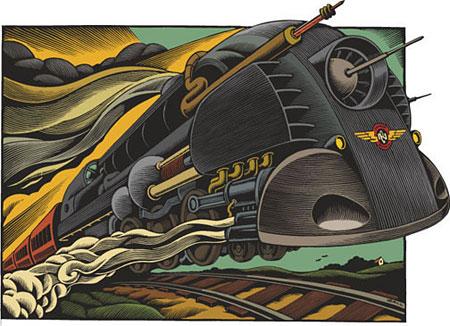
What I find most interesting, though, are his engravings, which I would have taken for colored pen and ink drawings had he not listed them that way. These have a terrific mix of strong, graphic color and controlled line work, along with a bold sense of composition that again takes cues from 30’s and 40’s posters and illustrations.
Gall doesn’t indicate on the site specifically what these illustrations were originally for, but his clients include Time, Newsweek, The Washington Post, The New York Times, Harper Collins, Nike, Ford, and many others.
Almost any of the pieces in the “engravings” section of his site would make a terrific poster. Gall does, in fact, offer Giclée prints and other items if you contact him, but doesn’t have a store per se on the site.
Gall is also the author/illustrator of three books. He spent 4 years as a professional stand-up comedian and currently gives presentations in schools in which he presumably uses some of those same skills.
Categories:
-
Garry Trudeau
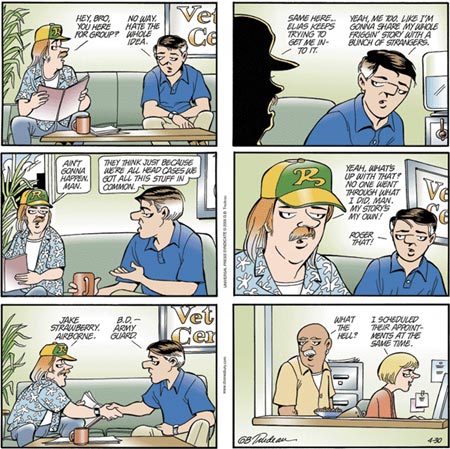
When I first came across Doonesbury I was a bit put off. I just didn’t like the drawing. The figures lacked geometry, the linework seemed weak and I just didn’t get the dark circles under the eyes thing.I was ready to toss it off as another example of the declining state of newspaper comics in the latter half of the 20th Century, but… the writing was brilliant.
So it’s not the art per se that I admire about Doonsebury, but Trudeau’s masterful use of the comics medium, which consists, of course, of both pictures and words.
Trudeau wasn’t the first to carry sophisticated political satire to the comics page, Walt Kelly’s amazing Pogo was taking on McCarthyism and other issues of the day long before Michael Doonesbury first moved into B.D.’s dorm room, but Trudeau has done it with a depth, boldness and dogged persistence that is just amazing.
A lot of time has passed since the inception of the strip, and Trudeau and Doonesbury, along with the rest of us, have gone through some changes. Over the years the quality of the strip has waxed and waned, but remained generally high, and I gave Trudeau a lot of credit simply for passing the seven year mark.
It seemed to me that, while unfunny comics like Beetle Bailey or Hagar the Horrible could go on forever, the strips that were actually funny to me, like The Far Side, Bloom County and Bill Watterson’s brilliant Calvin and Hobbes, demanded so much of their creators that they went into burn-out mode after six or seven years, went on hiatus, returned for a year or so and then retired altogether from the grind of doing a daily comic.
For a brief time, several years ago, I was in discussion with Jay Kennedy of King Features over the possibility of doing a strip, and in the process I realized that it was something I couldn’t do. I couldn’t write a funny (to me) gag comic strip every day, 365 days a year. I don’t know how the funny ones actually do it, even for seven years.
Trudeau not only passed the seven year mark, (though he did take a hiatus) he’s carried on for 35 years and shows no sign of letting up, In fact, after some years of weaker strips, Doonesbury has bounced back, revitalized and reinvigorated by a storyline in which Trudeau has attempted to tackle the complexities of the life of returning disabled veterans. He took one of his longest running characters, the college football star B.D., sent him to Iraq (again) and let the war send him home an amputee.
The storyline has evolved over the last two years in a way that is strikingly complex, richly human and funny to boot, all within the space of those four tiny panels every day.
This is so far above the warmed-over oatmeal that passes for comics writing in most newspaper strips these days that it boggles the mind.
Through it all Trudeau himself has been something of a shadow figure, shunning publicity and refusing interviews. Gene Weingarten, a writer for the Washington Post, has finally gotten to hang with Trudeau for an extended period and has produced an insightful and fascinating article called Doonesbury’s War, about Trudeau, and in particular, his involvement with the returning disabled veteran storyline to which he has become so dedicated. It’s a fascinating read, and even if you don’t agree with Trudeau’s political stance, you may find the story worthwhile and enlightening.
Weingarten hosts a regular onine chat for tha Post called Chatological Humor, and the transcript of the one on Trudeau is posted here.
In the course of the original article Weingarten talks about Trudeau’s efforts to improve his drawing, dispels the rumors that he no longer draws the strip (the strip is inked by his assistant Don Carlton, but Trudeau continues to draw it himself) and delves into his deadline anxiety and the other issues any daily cartoonist must deal with.
Over the years Trudeau’s drawing has gotten more sophisticated, improved dramatically in fact, but I have to admit I still don’t like it much, and I still don’t get the dark circles under the eyes thing, but… the writing is brilliant.
Categories:



Charley’s Picks
Bookshop.org
(Bookshop.org affilliate links; sales benefit independent bookshop owners; I get a small percentage to help support my work on Lines and Colors)
Carlson’s Guide to Landscape Painting
Drawing and Sketching in Pencil
Bridgman’s Complete Guide to Drawing from Life
Charley’s Picks
Amazon
(Amazon.com affiliate links; sales go to a larger yacht for Jeff Bezos; but I get a small percentage to help support my work on Lines and Colors)
Carlson’s Guide to Landscape Painting
Drawing and Sketching in Pencil
Bridgman’s Complete Guide to Drawing from Life