


Categories
- 3d CGI
- Amusements
- Animation
- Anime & Manga
- Art Materials
- Art Videos
- Blogroll
- Cartoons
- Color
- Comics
- Concept & Visual Dev.
- Creativity
- Digital Art
- Digital Painting
- Displaying Art on the Web
- Drawing
- Eye Candy for Today
- Gallery and Museum Art
- High-res Art Images
- Illustration
- Motion Graphics & Flash
- Museums
- Online Museums
- Outsider Art
- Painting
- Painting a Day
- Paleo Art
- Pastel, Conté & Chalk
- Pen & Ink
- Prints and Printmaking
- Reviews
- Sc-fi and Fantasy
- Sculpture & Dimensional
- Site Comments
- Sketching
- Storyboards
- Tools and Techniques
- Uncategorized
- Vector Art
- Videos & Podcasts
- Vision and Optics
- Watercolor and Gouache
- Webcomics
Archives
- October 2026
- September 2026
- August 2026
- July 2026
- June 2026
- May 2026
- April 2026
- March 2026
- February 2026
- January 2026
- December 2025
- November 2025
- October 2025
- September 2025
- August 2025
- July 2025
- June 2025
- May 2025
- January 2025
- December 2024
- November 2024
- October 2024
- September 2024
- August 2024
- June 2024
- April 2024
- March 2024
- February 2024
- January 2024
- December 2023
- November 2023
- October 2023
- September 2023
- August 2023
- July 2023
- May 2023
- April 2023
- March 2023
- February 2023
- January 2023
- December 2022
- November 2022
- September 2022
- August 2022
- July 2022
- June 2022
- May 2022
- April 2022
- March 2022
- February 2022
- January 2022
- December 2021
- November 2021
- October 2021
- September 2021
- August 2021
- July 2021
- June 2021
- May 2021
- April 2021
- March 2021
- February 2021
- January 2021
- December 2020
- November 2020
- October 2020
- September 2020
- August 2020
- July 2020
- June 2020
- May 2020
- April 2020
- March 2020
- February 2020
- January 2020
- December 2019
- November 2019
- October 2019
- September 2019
- August 2019
- July 2019
- June 2019
- May 2019
- April 2019
- March 2019
- February 2019
- January 2019
- December 2018
- November 2018
- October 2018
- September 2018
- August 2018
- July 2018
- June 2018
- May 2018
- April 2018
- March 2018
- February 2018
- January 2018
- December 2017
- November 2017
- October 2017
- September 2017
- August 2017
- July 2017
- June 2017
- May 2017
- April 2017
- March 2017
- February 2017
- January 2017
- December 2016
- November 2016
- October 2016
- September 2016
- August 2016
- July 2016
- June 2016
- May 2016
- April 2016
- March 2016
- February 2016
- January 2016
- December 2015
- November 2015
- October 2015
- September 2015
- August 2015
- July 2015
- June 2015
- May 2015
- April 2015
- March 2015
- February 2015
- January 2015
- December 2014
- November 2014
- October 2014
- September 2014
- August 2014
- July 2014
- June 2014
- May 2014
- April 2014
- March 2014
- February 2014
- January 2014
- December 2013
- November 2013
- October 2013
- September 2013
- August 2013
- July 2013
- June 2013
- May 2013
- April 2013
- March 2013
- February 2013
- January 2013
- December 2012
- November 2012
- October 2012
- September 2012
- August 2012
- July 2012
- June 2012
- May 2012
- April 2012
- March 2012
- February 2012
- January 2012
- December 2011
- November 2011
- October 2011
- September 2011
- August 2011
- July 2011
- June 2011
- May 2011
- April 2011
- March 2011
- February 2011
- January 2011
- December 2010
- November 2010
- October 2010
- September 2010
- August 2010
- July 2010
- June 2010
- May 2010
- April 2010
- March 2010
- February 2010
- January 2010
- December 2009
- November 2009
- October 2009
- September 2009
- August 2009
- July 2009
- June 2009
- May 2009
- April 2009
- March 2009
- February 2009
- January 2009
- December 2008
- November 2008
- October 2008
- September 2008
- August 2008
- July 2008
- June 2008
- May 2008
- April 2008
- March 2008
- February 2008
- January 2008
- December 2007
- November 2007
- October 2007
- September 2007
- August 2007
- July 2007
- June 2007
- May 2007
- April 2007
- March 2007
- February 2007
- January 2007
- December 2006
- November 2006
- October 2006
- September 2006
- August 2006
- July 2006
- June 2006
- May 2006
- April 2006
- March 2006
- February 2006
- January 2006
- December 2005
- November 2005
- October 2005
- September 2005
- August 2005
Relevant Blogs
Art, Painting & Sketch
- Gurney Journey
- Underpaintings
- Art and Influence
- Painting Perceptions
- Oil Painters of America
- Vasari Paint POV
- Flying Fox
- Urban Sketchers
- Bento (Smithsonian)
- Art Inconnu
- The Hidden Place
- Still Life
- Making a Mark
- The Art of the Landscape
- Exploring Color & Creativity
- Art Contrarian
- Artist A Day
- beinArt Surreal Art Collective
- Eye Level
- David Dunlop
- p.i.g.m.e.n.t.i.u.m
- CultureGrrl
- Joaquín Sorolla blog
- Artists in Pastel
“Painting a Day”
- A Painting a Day (Keiser)
- On Painting (Keiser)
- Julian Merrow-Smith
- Karen Jurick
- Jeffrey Hayes
- Carol Marine
- Abbey Ryan
- Daily Paintworks
Other Painting Blogs
- Virtual Gouache Land
- Neil Hollingsworth
- Marc Hanson
- Kevin Menck
- Marc Dalessio
- Larry Seiler
- Stapleton Kearns
- Colin Page
- Roos Schuring
- Hans Versfelt
- Titus Meeuws
- Régis Pettinari
- René Plein Air
- Belinda Del Pesco
- Robin Weiss
- Nathan Fowkes (Land Sketch)
- William Wray
- Frank Serrano
- Stephen Magsig
- Michael Chesley Johnson
- Twice a Week
- Sarah Wimperis
- Rob Adams
- Michael Cole Manley
- The Dirty Palette Club
- Mike Manley’s Draw!
Gallery Art & Illustration mix
Illustration
- Howard Pyle
- 100 Years of Illustration
- BibliOdyssey
- Illustration Art
- Today’s Inspiration
- Illustration Mundo
- Little Chimp Society
- Danny Gregory
- R D (John Martz
- Illustration Friday blog
- Monster Brains
- Illustrators & Illustrations (RU)
- Elwood H. Smith
- DaniDraws.com
- Designers Who Blog
- iSpot Blog
Sci-Fi & Fantasy
Illustration & Comics
Comics & Cartoons
- Comics Beat
- Robot 6
- Newsarama Blog
- Comic Vine
- Comics Alliance
- Forbidden Planet Int.
- Paolo Rivera
- Bolt City
- Flight
- Scott McCloud
- The Comics Journal
- Comixpedia
- Funnybook Babylon
- James Baker
- Middleton’s Sketchbook
- Boneville
- The Hotel Fred
- Paul Rivoche
- Daily Cartoonist
- Mad About Cartoons (William Wray)
- Digital Strips
Illustration & Concept
Animation & Concept
- Cartoon Brew
- Animation Blog
- Cold Hard Flash
- Concept Art World
- The CAB
- FY Concept Art
- Concept Ships
- Concept Robots
- John Nevarez
- Armand Serrano
- Marcos Mateu-Mestre
- all kinds of stuff (Kricfalusi)
- Yacin the faun (Man Arenas)
- Kelsey Mann
- Cre8tivemarks Blog
- Ice-Cream Monster Toon Cafe
- AAU Character & Creature Design
- AAU Animation Notes
- Articles and Texticles
Paleo & Scientific
Tools & Techniques
Other
Lists of Art Blogs
Art Image Resource Links
Historic Art Images
- Wikimedia Commons: Paintings
- Wikimedia Commons: Drawings
- The Athenaeum
- WikiArt (WikiPaintings)
- Google Art Project: Artists
- Google Art Project: Collections (Museums)
- ArtCyclopedia
- Web Gallery of Art
- Art Renewal Center
- Web Gallery of Impressionism
Auction Consolidation sites
Auction sites
- Sotheby’s
- Bonham’s
- Christies
- Heritage Auctions: Fine Art
- Heritage Auctions: Illustration
- Freeman’s Auctions
- Bukowskis
- Shannon’s
Image Search
Reverse Image Search (search by image)
- Tin Eye
- RevImg
- Google Image Search (camera icon)
- Bing Image Search (camera icon)
Promoting some friends and some clients of my website design business
- Twin Willows T’ai Chi studio in Wilmington DE. Taiji classes with Bryan Davis.
- Ray Hayward, Inspired Teacher of T’ai Chi ( Taiji ) in Minneapolis, Founder of Mindful Motion Tai Chi Academy
- OldHead Tattoo studio and Art Gallery in Wilmington DE. Tattoos and paintings by Bruce Gulick
- Sharon Domenico Art, pet portrait oil paintings
- Platinum Paperhanging, wallpaper hanging, Main Line and Philadelphia, PA
- Lisa Stone Design, interior designer, Main Line and Philadelphia, PA
- Studio12KPT, original art, prints, calendars and other custom printed items by Van Sickle & Rolleri
-
The Hell Creek Mural

Every field of artistic endeavor has its own limitations, but it’s often within those limitations, rather than in spite of them, that artists do their best work.In gallery art, artists who wish to survive on the sale of their art must produce work that finds an appreciative audience of buyers, and must often please gallery owners first in order to receive exposure.
Illustration has a special limitation in that the work must accompany and help express the themes, scenes or intention of a literary work, and must please editors as well as the public.
Scientific illustration brings with it the often stringent restriction that, in addition many of the challenges inherent in creating representational art, the work must adhere to scientific accuracy. This includes fields like botanical illustration, medical illustration, and that most popularly recognized branch of scientific art, paleontological illustration.
Paleo art carries even more restrictions, in that the artists are attempting to create realistic and scientifically accurate reconstructions of animals that no one has ever seen.
The importance of scientific accuracy in paleo art has led to a the creation of a special prize, awarded by the scientists themselves, for “outstanding achievement in paleontological scientific illustration and naturalistic art”. Named after, and partly supported by, noted paleo art collector John J. Lanzendorf, the Lanzendorf Paleoart Prize is awarded each year in October by the Society of Vertebrate Paleontology.
The 2-Dimensional Art category of the Lanzendorf Prize was most recently awarded to the “Hell Creek” mural at the Carnegie Museum of Natural History.
Created by Robert F. Walters, who I previously profiled here, and his partner, Tess Kissinger, with help from artist Laura Fields, the 92 ft long and 15 ft high (28 x 4.5 metre) mural depicts a scene from the end of the Cretaceous Period, just before the extinction of the non-avian dinosaurs. It is named for the Hell Creek Formation in South Dakota, where fossils of many of the species portrayed have been found.
You can read an article, Hell Creek Mural Wins Lanzendorf Prize, on Discovery News, and see the accompanying large image of the entire mural here.
You can also see images from the mural on the Walters & Kissinger DinoArt.com website.
Walters and Kissinger head one of the worlds premier dinosaur art studios, as well as the more broad-based Walters & Kissinger Museum Illustration Studio. The prize comes just two years after they were awarded the 2007 Lanzendorf prize for the Morrison Foundation mural that is part of the same exhibit, and is also, at 180 ft x 15 ft (54 x 4.5 metres) the largest dinosaur mural in the world.
I’ve known Walters and Kissinger for a number of years, so I was privy to some of the additional challenges presented by the scale and scope of the mural in much more detail than usual.
Installed in the newly redesigned Dinosaurs in their Time installation of the Carnegie Museum of Natural History, the mural was required to incorporate a number of species of animals and prehistoric plants that existed at the time in a single panoramic scene (paleo artists, in addition to the portrayal of prehistoric animals, often must serve as botanical artists as well).
The mural also had to work within the physical structure of the museum building and the layout of the exhibit design. Also, in a way perhaps analogous to the Renaissance artists who had to answer to the Church in terms of the specific and minute details of how a scene was to be portrayed, modern paleo artists answer to the rigorous analysis of the scientists who study the animals and plants to be portrayed.
The specifications of the Hell Creek mural, as outlined by the scientists working on the project, required not only specific plants and animals, but required that the animals reflect the skeleton mountings in the museum’s collection. In many cases these skeletons are mounted directly in front of the section of the mural showing that animal, and the painting must accommodate the skeleton, as well as physical models of plants, as though they were extensions of the mural, working together to create an illusionistic space for the visitor (image above, bottom).
In addition, the mural incorporates the latest scientific findings in terms of the probable physical appearance of the animals, something that is constantly changing as new discoveries are made. The triceratops (the familiar three-horned dinosaurs that are the stars of the mural) incorporate a skin texture interpreted from a fossil impression of triceratops skin discovered less than a year before. Likewise the oviraptorosaur, the animal with a beak and bony crest on it’s head in the middle image, incorporates feathers from research on an earlier oviraptorosaur find in China.
So in addition to working within the restrictions of scientific accuracy, paleo artists must also play detective, piecing together bits of knowledge from scattered sources to recreate the best possible vision of the animal.
The artists were able to incorporate some elements to surprise and delight, as well. Almost hidden in the foliage away from the more dramatic animals, are smaller creatures, like the avisaurus, a primitive bird with teeth that flies through the forest canopy just above and to the right of the triceratops, and the didelphodon, a badger-sized marsupial mammal moving through the underbrush, almost unnoticed at the right of the triceratops’ feet.
The late Cretaceous Period was a time when flowering plants came to prominence, and Walters told me that he took special delight in the portrayal of the group of edmontosaurs (the “duck-billed” dinosaurs to the left of the triceratops) in a field of flowers that resembled modern buttercups. Much of the other flora displayed is also recognizable as familiar modern plants that began to appear in that period.
Paleo artists have help, of course, in the reconstruction of extinct animals, working with the paleontologists who discover and study them, but even that has its limitations. The definition of paleontologist is one who studies ancient life, but not all paleontologists are anatomists, knowledgeable about the skeletal and muscular functioning of modern animals.
Having studied human anatomy in sessions at the medical college of Thomas Jefferson University while a student at the Pennsylvania Academy of the Fine Arts, Walters places a great deal of emphasis on accurate animal anatomy in his paleontological life reconstruction art.
The challenge, of course, was to take all of these considerations, scientific restrictions and requirements and mold them into a dynamic composition that immerses us in another time, in the orange glow of a sunset that presages the end of the reign of the dinosaurs.
So when artists think they are working within too many restrictions, they might consider the additional challenges in artistic fields where science is the salon jury.
Categories:
-
Continuous Pencil

Well, the “Liquid Pencil” turned out to be a dud, so how about a more modest bit of pencil inventiveness?Most of us who use wooden drawing pencils have experienced the stub problem; once your wooden pencil is worn down to a stub that’s too small to comfortably use, what do you do with it? (You can’t just waste all of that wonderful, not to mention expensive, graphite goodness.)
The usual tack is some kind of pencil holder or extension, but these are often awkward, a bit too thick and not as nice as the experience of drawing with a fresh, new wooden pencil.
Well the Continuous Pencil concept from Yanko Design seeks to resolve that, and looks to be a clever and quite workable solution.
The Continuous Pencil is essentially modular, each pencil has a hollow end, into which will fit the thin graphite-filled extension on the business end of the new pencil, essentially forming a new whole that can be sharpened with sharpener or knife, as would be a new single pencil.
So far it’s just a concept, but it’s nice to see even the humble pencil being rethought in imaginative ways.
“What about just using a mechanical pencil?”, you ask. Well, they’re nice for some kinds of drawing, (and there are some nice new variations on that idea, like the Uni-ball Kuru Toga Pencil that mechanically rotates the tip as you draw to keep it sharp), but they don’t do much for those of us who like to draw with a knife-sharpened, chiseled or sanded point in all of its glorious variations.
For that, try moving up from a mechanical pencil a 2mm lead holder.
[Via Wired’s Gadget Lab]
Categories:
-
ImagineFX #60
 I’ve written before about ImagineFX, a UK based magazine devoted primarily to 2D digital art (“digital painting”) for the fantasy, science fiction and concept art fields.
Almost every issue of the magazine I’ve every seen has had articles of interest to me, (and ImagineFX is one of those magazines, like Illustration magazine, in which even the ads are relevant and interesting); but I found Issue #60 (September 2010) to be of particular interest for a number of reasons.
In addition to the cornucopia of news from the field, pointers to interesting topics on the web, artist questions and answers, reviews of computer graphics software and hardware, how-to workshops, and the discovery of at least two artists new to me that I will be profiling in the future, the issue includes several feature articles about (or by) artists I’ve previously featured here on Lines and Colors.
William Stout is profiled in a several page article, illustrated with art from his beautiful new book Hallucinations (which I reviewed here) and his previous recent book Dinosaur Discoveries (which I reviewed here), along with other work from his illustrious career.
Goro Fujita, who I profiled here, contributes a three page article on Digital Painting on the iPad with the Brushes app.
James Gurney, who I have featured in several posts on Lines and Colors, highlights the Workshops section of the issue with a terrific 6 page article on The Science Behind Visual Perception, that is alone worth the cover price of the magazine. This includes material adapted from Gurney’s upcoming book, Color and Light: A Guide for the Realist Painter. There is a post about the ImagineFX article on Gurney’s always fascinating blog, Gurney Journey.
There are good-size digital files of the images from the articles by Gurney and Fujita on the DVD that accompanies the issue. This also includes a ton of resources, including images from other articles and workshops, a hi-resolution texture pack, over 700 female figure reference pose photos and trial versions of Painter 11, ZBrush 3.1 and ArtRage 3. (I’ll be reviewing ArtRage 3 in an upcoming post.)
As part of a nine page “Back to Basics” section on topics like Texture, Digital File Formats, Layers, and Figure Drawing Basics, Justin Gerard, who I profiled here, contributes a short article on Composition for Beginners,.
Oh yes, and as part of that same section, yours truly contributes a short column on Art Terms and Questions, in which I explain some commonly misunderstood art terms like “chiaroscuro”, “negative space”, “simultaneous contrast”, “chroma” and “lost and found edges” (page 61, right column).
ImagineFX #60 is currently on sale in the U.S. and Canada (in the UK, it’s last month’s issue, which can be purchased from the website as a back issue).
The ImagineFX website is also a huge resource of archived articles, galleries, workshops, forums, reviews and downloads.
Categories:
-
The Vegetable Museum, Ju Duoqi
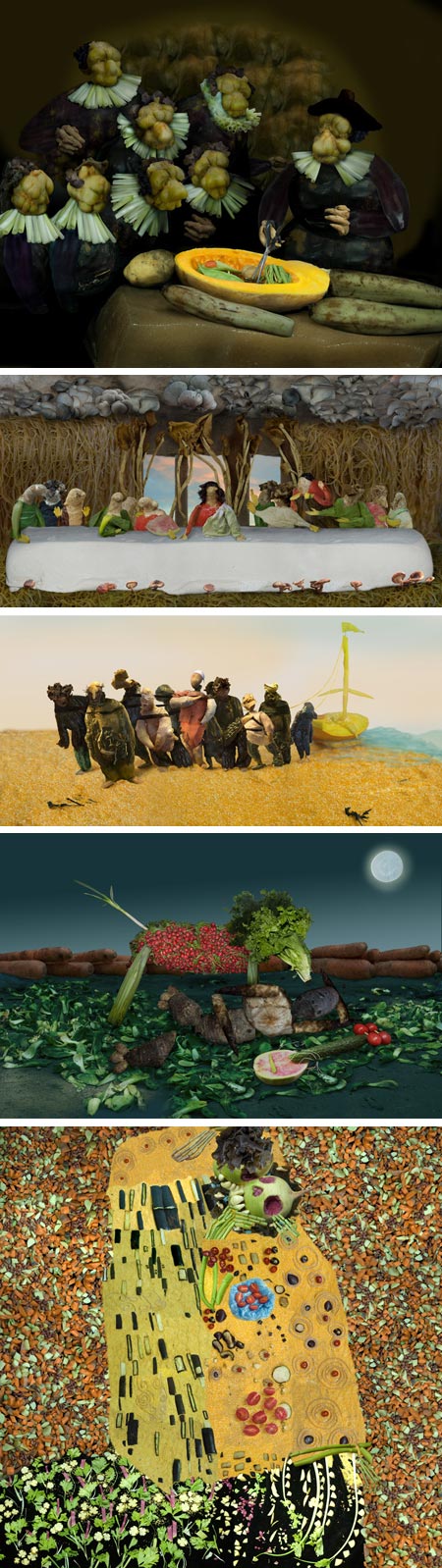
It has long been an established practice for artists to study the paintings and drawings of artists from the past by creating their own copies of the masters’ work. Ju Duoqi just happens to use vegetables as her medium.Her “Vegetable Museum” is a series in which she has arranged vegetables, fresh and otherwise, chosen for their form, textural qualities, tone and color, to recreate famous works from some of Western art’s great masters. The results, particularly if you are familiar with the original work, are amusing, often hilarious, as well as being visually yummy for their own compositional characteristics.
Duoqi, who was born in Chongqing, China and studied at the Sichuan Fine Arts Institute, found herself rearranging vegetables in the bins at market stalls, seeing in the arrangments bits of imagery.
She put some together in her first old master study by recreating Eug&eqcute;ne Delacroix’s La Liberté Guidant le Peuple (“Liberty Leading the People”) as La Liberté Guidant les Légumes (essentially,”Liberty Leading the Beans”).
Duoqi chooses from a variety of vegetables in various states, fresh, rotten, withered, dried, pickled, fried, boiled and otherwise prepared, carefully arranges them, photographs the arrangement and then digitally manipulates the results. The final pieces are printed in limited editions.
In addition to The Vegetable Museum, the Galerie Paris-Beijing, which handles her work, has an exhibit of The Fantasies of Chinese Cabbage, images of cheesecake pictures of women (including Marylyn Monroe’s iconic Playboy centerfold) created out of the aforementioned vegetable. These are particularly interesting for the way she has used the striations of the cabbage in defining the forms, plus they’re also frequently hilarious.
The Vegetable Museum series, as I pointed out, is best enjoyed in comparison to the originals. Images above: Rembrandt’s The Anatomy Lecture of Dr. Nicolaes Tulp, Da Vinci’s The Last Supper, Ilya Repin’s Barge Haulers on the Volga, Henri Rousseau’s The Sleeping Gypsy and Gustav Klimt’s The Kiss.
(Also, for more on those artists, see my posts on Rembrandt [also here], Da Vinci’s The Last Supper, Ilya Repin, Henri Rousseau and Gustav Klimt.)
So far, Duoqi has resisted the temptation to create any (possibly recursive) homages to the vegetable-as-image paintings of Guisepe Arcimboldo.
[Via Sandbox World]
Categories:
-
Barbara Kacicek
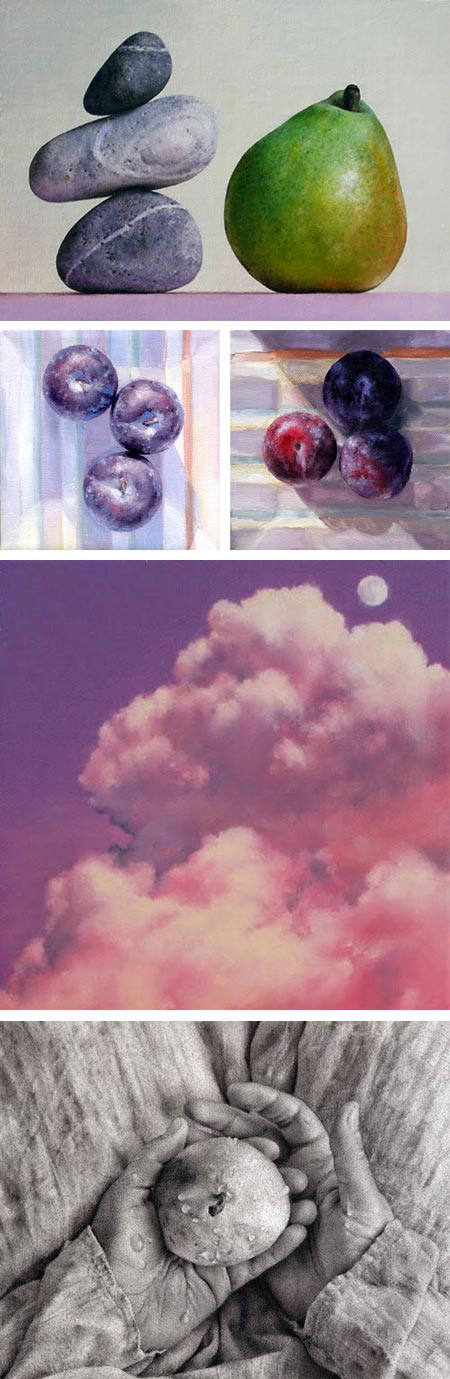
Pennsylvania artist Barbara Kacicek favors a few subjects to which she returns frequently. One is small still life subjects, particularly pears, plums and smooth river stones. Another is compositions of clouds, often mounded and towering cumulus clouds.To these she adds drawings that veer away from realism into “Imaginary Realism”, done with smooth tones of charcoal on bristol board.
Her still life paintings, though brought to a fairly high level of finish, are painted alla prima, in oil on canvas mounted on panels. She finds compositional focus in the textural surfaces of her subjects as well as their subtle colors.
I particularly enjoy her series of “31 Meditations on Three Plums“, in which she approaches the same basic subject repeatedly on small canvas (6×6 inches), with variations on composition of the plums against a striped cloth background in a variety of lighting choices.
When viewing her website, note that there are additional works in the Archive section. There is also a section of oil pastels, in which she explores the cloud theme, but with the different textural effect afforded by the medium. Kacicek also features her charcoal drawings on a separate site.
Categories:
-
Jeremy Bastian

I just came across Jeremy Bastian this morning in Cory Doctrow’s post on BoingBoing about a commissioned drawing he did: an extravagantly detailed homage to Winsor McCay’s Little Nemo (see my posts on Winsor McCay, and here).The owner of the drawing, Ben Friedman, has been kind enough to share it with us by posting images of it on ComicArtFans (images above, top, and detail, second down). You can see the full piece here and here, and details 1, 2, 3, 4 and 5.
Bastien is a contemporary comics artist with a wonderfully anachronistic style, picking up the fine line illustration styles of the late 19th Century and applying them to his own idiosynchratic vision.
In checking out Bastian’s website, I found it sadly lacking in information about his most prominent project, a comics series called Cursed Pirate Girl.
He gives a brief, colorful description of the story, a couple of prominent raves by Mike Mignola and Mouse Guard’s David Peterson, and a link to an under-construction “Booty” page, but no indication of what the comic is, who publishes it, where it might be found or even whether it exists in digital or printed form. (When amateurs make websites they frequently overlook the critical factor that other people don’t know what they know and need introductory information.)
With a bit of digging, I was able to discover that Cursed Pirate Girl is a printed comics series, published by Olympian Publishing, which apparently has issues 1 and 3 of a three part series still available.
Comixcology, which sells digital versions of comics for iPad, iPhone and iPod Touch, lists issues 1-3 as “of 6”. I don’t know if they are split up differently for digital distribution, or if three more issues are planned.
Delightfully, Comixcology has provided a 7 page online preview of Cursed Pirate Girl #1 (bottom three images, above), making up for the inexplicable lack of images on Bastian’s site.
You will find a few images on Bastian’s website, mixed in with personal travel photos in the “updates” section (I can’t give you a direct link because the site is in frames); but they are mostly sketches.
I found another image on Guy Davis’s site of a drawing Bastian did of Davis’s character The Marquis, and a portrait of Leto II from Dune on Hey Oscar Wilde! It’s Clobberin Time!! (see my post on Hey Oscar Wilde! It’s Clobberin Time!!).
There are also reviews and articles about Cursed Pirate Girl on Read About Comics, CBR’s Robot 6 and Broken Frontier; as well as an interview on Newsarama.
Bastian also contributed a short Story to David Peterson’s Mouse Guard: Legends of the Guard #1.
Olympian Publishing is producing an audio drama adaptation of Cursed Pirate Girl, with Stephanie Leonidas (Mirrormask, Dracula) as the lead.
Here’s hoping that some of the attention Basitan has been getting results in a graphic album collection of the issues to date, and broader awareness of his unique talent.
Categories:



Charley’s Picks
Bookshop.org
(Bookshop.org affilliate links; sales benefit independent bookshop owners; I get a small percentage to help support my work on Lines and Colors)
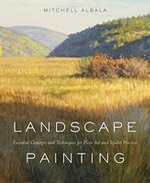
Carlson’s Guide to Landscape Painting
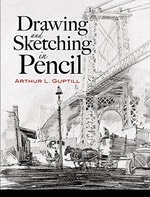
Drawing and Sketching in Pencil
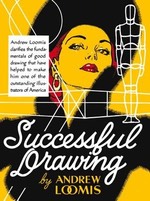
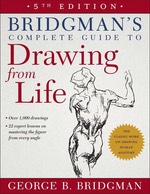
Bridgman’s Complete Guide to Drawing from Life


_-_Volga_Boatmen_(1870-1873).jpg)
Charley’s Picks
Amazon
(Amazon.com affiliate links; sales go to a larger yacht for Jeff Bezos; but I get a small percentage to help support my work on Lines and Colors)
Carlson’s Guide to Landscape Painting
Drawing and Sketching in Pencil
Bridgman’s Complete Guide to Drawing from Life