


Categories
- 3d CGI
- Amusements
- Animation
- Anime & Manga
- Art Materials
- Art Videos
- Blogroll
- Cartoons
- Color
- Comics
- Concept & Visual Dev.
- Creativity
- Digital Art
- Digital Painting
- Displaying Art on the Web
- Drawing
- Eye Candy for Today
- Gallery and Museum Art
- High-res Art Images
- Illustration
- Motion Graphics & Flash
- Museums
- Online Museums
- Outsider Art
- Painting
- Painting a Day
- Paleo Art
- Pastel, Conté & Chalk
- Pen & Ink
- Prints and Printmaking
- Reviews
- Sc-fi and Fantasy
- Sculpture & Dimensional
- Site Comments
- Sketching
- Storyboards
- Tools and Techniques
- Uncategorized
- Vector Art
- Videos & Podcasts
- Vision and Optics
- Watercolor and Gouache
- Webcomics
Archives
- October 2026
- September 2026
- August 2026
- July 2026
- June 2026
- May 2026
- April 2026
- March 2026
- February 2026
- January 2026
- December 2025
- November 2025
- October 2025
- September 2025
- August 2025
- July 2025
- June 2025
- May 2025
- January 2025
- December 2024
- November 2024
- October 2024
- September 2024
- August 2024
- June 2024
- April 2024
- March 2024
- February 2024
- January 2024
- December 2023
- November 2023
- October 2023
- September 2023
- August 2023
- July 2023
- May 2023
- April 2023
- March 2023
- February 2023
- January 2023
- December 2022
- November 2022
- September 2022
- August 2022
- July 2022
- June 2022
- May 2022
- April 2022
- March 2022
- February 2022
- January 2022
- December 2021
- November 2021
- October 2021
- September 2021
- August 2021
- July 2021
- June 2021
- May 2021
- April 2021
- March 2021
- February 2021
- January 2021
- December 2020
- November 2020
- October 2020
- September 2020
- August 2020
- July 2020
- June 2020
- May 2020
- April 2020
- March 2020
- February 2020
- January 2020
- December 2019
- November 2019
- October 2019
- September 2019
- August 2019
- July 2019
- June 2019
- May 2019
- April 2019
- March 2019
- February 2019
- January 2019
- December 2018
- November 2018
- October 2018
- September 2018
- August 2018
- July 2018
- June 2018
- May 2018
- April 2018
- March 2018
- February 2018
- January 2018
- December 2017
- November 2017
- October 2017
- September 2017
- August 2017
- July 2017
- June 2017
- May 2017
- April 2017
- March 2017
- February 2017
- January 2017
- December 2016
- November 2016
- October 2016
- September 2016
- August 2016
- July 2016
- June 2016
- May 2016
- April 2016
- March 2016
- February 2016
- January 2016
- December 2015
- November 2015
- October 2015
- September 2015
- August 2015
- July 2015
- June 2015
- May 2015
- April 2015
- March 2015
- February 2015
- January 2015
- December 2014
- November 2014
- October 2014
- September 2014
- August 2014
- July 2014
- June 2014
- May 2014
- April 2014
- March 2014
- February 2014
- January 2014
- December 2013
- November 2013
- October 2013
- September 2013
- August 2013
- July 2013
- June 2013
- May 2013
- April 2013
- March 2013
- February 2013
- January 2013
- December 2012
- November 2012
- October 2012
- September 2012
- August 2012
- July 2012
- June 2012
- May 2012
- April 2012
- March 2012
- February 2012
- January 2012
- December 2011
- November 2011
- October 2011
- September 2011
- August 2011
- July 2011
- June 2011
- May 2011
- April 2011
- March 2011
- February 2011
- January 2011
- December 2010
- November 2010
- October 2010
- September 2010
- August 2010
- July 2010
- June 2010
- May 2010
- April 2010
- March 2010
- February 2010
- January 2010
- December 2009
- November 2009
- October 2009
- September 2009
- August 2009
- July 2009
- June 2009
- May 2009
- April 2009
- March 2009
- February 2009
- January 2009
- December 2008
- November 2008
- October 2008
- September 2008
- August 2008
- July 2008
- June 2008
- May 2008
- April 2008
- March 2008
- February 2008
- January 2008
- December 2007
- November 2007
- October 2007
- September 2007
- August 2007
- July 2007
- June 2007
- May 2007
- April 2007
- March 2007
- February 2007
- January 2007
- December 2006
- November 2006
- October 2006
- September 2006
- August 2006
- July 2006
- June 2006
- May 2006
- April 2006
- March 2006
- February 2006
- January 2006
- December 2005
- November 2005
- October 2005
- September 2005
- August 2005
Relevant Blogs
Art, Painting & Sketch
- Gurney Journey
- Underpaintings
- Art and Influence
- Painting Perceptions
- Oil Painters of America
- Vasari Paint POV
- Flying Fox
- Urban Sketchers
- Bento (Smithsonian)
- Art Inconnu
- The Hidden Place
- Still Life
- Making a Mark
- The Art of the Landscape
- Exploring Color & Creativity
- Art Contrarian
- Artist A Day
- beinArt Surreal Art Collective
- Eye Level
- David Dunlop
- p.i.g.m.e.n.t.i.u.m
- CultureGrrl
- Joaquín Sorolla blog
- Artists in Pastel
“Painting a Day”
- A Painting a Day (Keiser)
- On Painting (Keiser)
- Julian Merrow-Smith
- Karen Jurick
- Jeffrey Hayes
- Carol Marine
- Abbey Ryan
- Daily Paintworks
Other Painting Blogs
- Virtual Gouache Land
- Neil Hollingsworth
- Marc Hanson
- Kevin Menck
- Marc Dalessio
- Larry Seiler
- Stapleton Kearns
- Colin Page
- Roos Schuring
- Hans Versfelt
- Titus Meeuws
- Régis Pettinari
- René Plein Air
- Belinda Del Pesco
- Robin Weiss
- Nathan Fowkes (Land Sketch)
- William Wray
- Frank Serrano
- Stephen Magsig
- Michael Chesley Johnson
- Twice a Week
- Sarah Wimperis
- Rob Adams
- Michael Cole Manley
- The Dirty Palette Club
- Mike Manley’s Draw!
Gallery Art & Illustration mix
Illustration
- Howard Pyle
- 100 Years of Illustration
- BibliOdyssey
- Illustration Art
- Today’s Inspiration
- Illustration Mundo
- Little Chimp Society
- Danny Gregory
- R D (John Martz
- Illustration Friday blog
- Monster Brains
- Illustrators & Illustrations (RU)
- Elwood H. Smith
- DaniDraws.com
- Designers Who Blog
- iSpot Blog
Sci-Fi & Fantasy
Illustration & Comics
Comics & Cartoons
- Comics Beat
- Robot 6
- Newsarama Blog
- Comic Vine
- Comics Alliance
- Forbidden Planet Int.
- Paolo Rivera
- Bolt City
- Flight
- Scott McCloud
- The Comics Journal
- Comixpedia
- Funnybook Babylon
- James Baker
- Middleton’s Sketchbook
- Boneville
- The Hotel Fred
- Paul Rivoche
- Daily Cartoonist
- Mad About Cartoons (William Wray)
- Digital Strips
Illustration & Concept
Animation & Concept
- Cartoon Brew
- Animation Blog
- Cold Hard Flash
- Concept Art World
- The CAB
- FY Concept Art
- Concept Ships
- Concept Robots
- John Nevarez
- Armand Serrano
- Marcos Mateu-Mestre
- all kinds of stuff (Kricfalusi)
- Yacin the faun (Man Arenas)
- Kelsey Mann
- Cre8tivemarks Blog
- Ice-Cream Monster Toon Cafe
- AAU Character & Creature Design
- AAU Animation Notes
- Articles and Texticles
Paleo & Scientific
Tools & Techniques
Other
Lists of Art Blogs
Art Image Resource Links
Historic Art Images
- Wikimedia Commons: Paintings
- Wikimedia Commons: Drawings
- The Athenaeum
- WikiArt (WikiPaintings)
- Google Art Project: Artists
- Google Art Project: Collections (Museums)
- ArtCyclopedia
- Web Gallery of Art
- Art Renewal Center
- Web Gallery of Impressionism
Auction Consolidation sites
Auction sites
- Sotheby’s
- Bonham’s
- Christies
- Heritage Auctions: Fine Art
- Heritage Auctions: Illustration
- Freeman’s Auctions
- Bukowskis
- Shannon’s
Image Search
Reverse Image Search (search by image)
- Tin Eye
- RevImg
- Google Image Search (camera icon)
- Bing Image Search (camera icon)
Promoting some friends and some clients of my website design business
- Twin Willows T’ai Chi studio in Wilmington DE. Taiji classes with Bryan Davis.
- Ray Hayward, Inspired Teacher of T’ai Chi ( Taiji ) in Minneapolis, Founder of Mindful Motion Tai Chi Academy
- OldHead Tattoo studio and Art Gallery in Wilmington DE. Tattoos and paintings by Bruce Gulick
- Sharon Domenico Art, pet portrait oil paintings
- Platinum Paperhanging, wallpaper hanging, Main Line and Philadelphia, PA
- Lisa Stone Design, interior designer, Main Line and Philadelphia, PA
- Studio12KPT, original art, prints, calendars and other custom printed items by Van Sickle & Rolleri
-
Eye Candy for Today: Vermeer’s Girl with the Red Hat
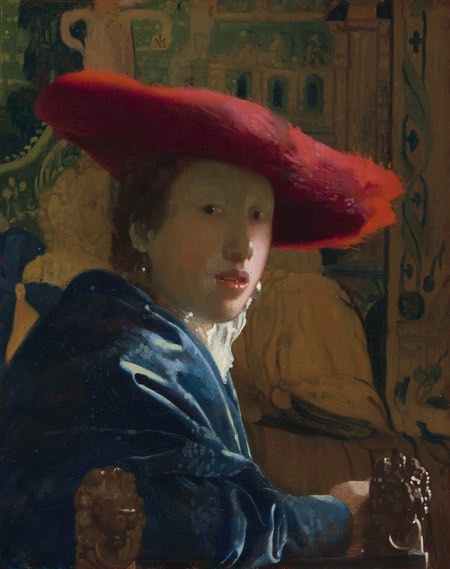

Girl with the Red Hat, Johannes Vermeer, oil on panel roughly 9 x 7 inches (23 x 18 cm), in the collection of the National Gallery of Art, DC.
Not as iconic as Girl with a Pearl Earring, so perhaps easier to see freshly, Vermeer’s Girl with the Red Hat is likewise a “tronie”, a painting of an interesting face, often in costume, as opposed to a formal portrait.
This is a very small painting, but striking nonetheless.
It’s common for painters to carry an important color through to other parts of a composition. Here, the dramatic red of the hat, part of which is in shadow, is balanced only by the red of the girl’s lips, also partly in shadow.
In fact, the majority of the face is in shadow, seemingly an odd shoice. The entire image is somewhat dark, except for the highlight on the lower left side of the face, streaks of light on the creases in the robe and the starkly white cravat.
For a painting that is intended to be a captivating face, there are a lot of interesting choices here.
The girl’s right hand is hidden behind the lion’s head finial of the chair, in much the way an artist’s drawing hand is often hidden in a self-portrait. The gaze directly at the viewer is characteristic of self portraits as well, leading me to the sometimes offered suggestion that some of Vermeer’s paintings may have been painted by one of his daughters. But forensic examination reveals the painting started with the head of a man in a wide brimmed hat, obviating that bit of fanciful speculation.
Shining out of the darkness of her hair, there is a highlight on the earring in her right ear, perhaps of pearl of silver, and I think the topmost white highlight at the upper right section of the cravat is the balancing earring.
There is an interesting light area to the left of her mouth (our left) that seems a bit odd to my eye, given the shadowed tones around it. Both that and the highlight on her left cheek are quite low in chroma.
Below that, the separation of the chin and cravat is quite dark and rough edged, looking almost like a charcoal line.
In many areas we see the soft edged brush marks that are often characteristic of Vermeer, and are perhaps due to the use of “Venice Turpentine”, which is not a solvent but technically a balsam, a resin that has not been distilled to produce a solvent like the more familiar gum spirits of turpentine.
The eyes, usually the focus of a portrait or other painted face, are in deep shadow, except… the small, perfectly circular highlight in her right eye is bright turquoise blue.
Categories:
-
Wenjun Lin
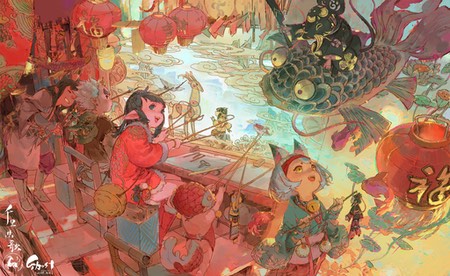

Wenjun Lin is a game development artist, illustrator and comics artist based in Shanghai.
There is a portfolio on Character Design Reference, and another on Art Station
I don’t know specifically which projects the images are from, but most have a delightful, innocent childrens book illustration vibe and a playful anime spirit.
They’re lush with high-chroma palettes — often of analogous colors — fun details, and fanciful, imaginative world building.
There is a Wenjun Lin art book titled Ghost, available from the French bookseller, Liberdistri, and a brief YouTube thumb-through of it here.
Categories:
-
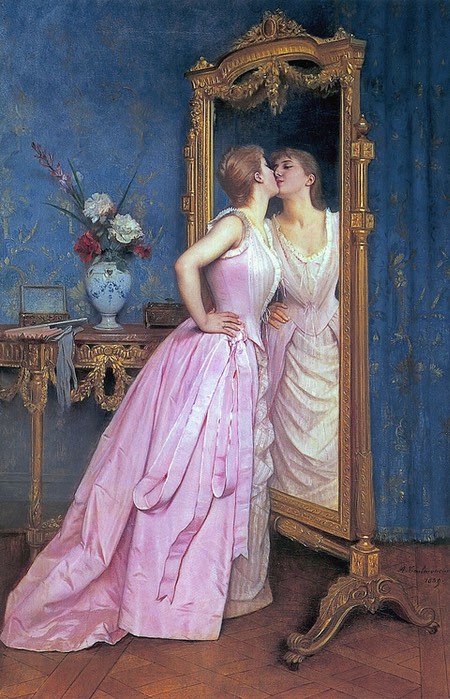
A few paintings from 1889

Wikimedia Commons, an offshoot of Wikipedia, is an extensive repository of media files: images, audio, video and even 3D models, to which anyone with a free account can contribute. The material must be either freely licensed or in the public domain.
You may have noticed I refer to it often when providing links to works by historic artists.
One of the many delights I find in Wikimedia Commons is the multiple categorizations in which the media are often listed, for instance paintings by artist, paintings by country, paintings by genre, style, subject, technique and, of course, paintings by year.
These categories lead to wonderfully random bedfellows, with juxtapositions of paintings by artists I might not ordinarily group together.
I have previously posted a few paintings from 1879, 1880, and 1888.
I find the end of the 19th century and the early part of the 20th to be particularly rich in the work of artists I admire, and I’ve indulged again in this selection of paintings from 1889.
They have no particular relation other than having been created in that year and I like them.
(Images above: Auguste Toulmouche, Dennis Miller Bunker, Anton Josef Pepino, William Merritt Chase, Theodore Robinson, Pascal Dagnan-Bouveret, Théo van Rysselberghe, Edgar Degas, John Singer Sargent, Anders Zorn, Peder Mork Monsted, William-Adolphe Bouguereau, H. A. Brendekilde, Vincent Van Gogh)
Categories:
-
Alar Iko


Alar Iko (AKA Alariko) is an illustrator and background artist from Spain. He works with digital painting and drawing tools, primarily in Procreate, in a style that has the character of traditional ink and watercolor.
His approach is at once loose and solidly grounded in good draftsmanship. In many of his architectural subjects, he will deliberately leave verticals askew, adding to the casual visual charm of the drawing.
You can see the influence of anime, particularly Studio Ghibli, in many of his images, including an occasional witch on a broomstick in a manner reminiscent of Miyazaki’s Kiki’s Delivery Service.
Much of the time, however, his work has the feeling of “urban sketching” style line and watercolor, which I particularly enjoy. I also like the way he plays with light and shcdow, often drawing late day shadows across the foreground, and giving his figures a bit of theatrical highlighting.
I came across his work through his portfolio on Character Design References. He also has a portfolio on ArtStation, and offers a selection of prints on InPrint.
Categories:
-
Eye Candy for Today: Emil Carlsen’s Still life with Brass Urn


Still life with Brass Urn, by Soren Emil Carlsen, oil on canvas, roughly 30 x 34 in. (76 x 86 cm). The image was sourced from a Christie’s auction in 2010, so I assume the original is now in a private collection.
Another mind-bogglingly beautiful still life from the brilliant Danish painter Emil Carlsen, who was active in the late 19th and early 20th centuries.
High end auction sites, like Christie’s and Sotheby’s, are some of the few places where I normally trust the fidelity of images of artwork.
But, in this case, my instincts got the better of me and I tried lightening it slightly in an image editor, and the wealth of additional detail and visual appeal that is revealed makes me think the original may look more like the color adjusted photos in the images above (bottom three).
The reason I look to auction sites for as true as possible images of art, is they often deal with patrons who will purchase directly over the internet, based on the image, so the image had better be right. I suppose, however, a client would be more pleased with a painting that arrived looking brighter and clearer then the photograph, rather then the other way around.
A simple but irresistibly compelling composition, sensual texture, almost mystically unified values, and… that bowl!
Categories:
-
Carlo Stanga


Carlo Stanga is an Italian born illustrator currently living and working in Berlin. He works primarily in a loose but often precise and detailed style of line and color, using a variety of media.
He plays with the conventions of line and color, sometimes using color for the lines themselves, sometimes losing the line altogether, often within the same illustration.
His detailed illustrations are often filled with fun details, even cut-aways of trains or buildings within a larger scene.
You can find a gallery of his illustrations on his website, as well as additional image in his shop, where prints are available.
There is an article about Stenga on Moleskein.com, an interview on Molteni design magazine, a brief video on YouTube, as well as a video review of Sranga’s his book I am New York by Teoh Yi Chie.
There are English versions of his books, I am New York and I am Milan (Amazon affiliate links).
Stenga has also created a Domestika video course: Architectural Illustration Tutorial: How to Refine Drawings of Urban Objects and People, for which you can find a video preview here.
Categories:




Charley’s Picks
Bookshop.org
(Bookshop.org affilliate links; sales benefit independent bookshop owners; I get a small percentage to help support my work on Lines and Colors)
Carlson’s Guide to Landscape Painting
Drawing and Sketching in Pencil

Bridgman’s Complete Guide to Drawing from Life
Charley’s Picks
Amazon
(Amazon.com affiliate links; sales go to a larger yacht for Jeff Bezos; but I get a small percentage to help support my work on Lines and Colors)
Carlson’s Guide to Landscape Painting
Drawing and Sketching in Pencil
Bridgman’s Complete Guide to Drawing from Life